



https://en.eeworld.com.cn/bbs/thread-1272311-1-1.html
https://en.eeworld.com.cn/bbs/thread-1272311-1-1.html
This post is a forum entry regarding DigiKey Follow Me 4th Batch Basic Assignment 1, covering the initialization process of the W5500 Ethernet chip on the main control board. The key points are as follows:
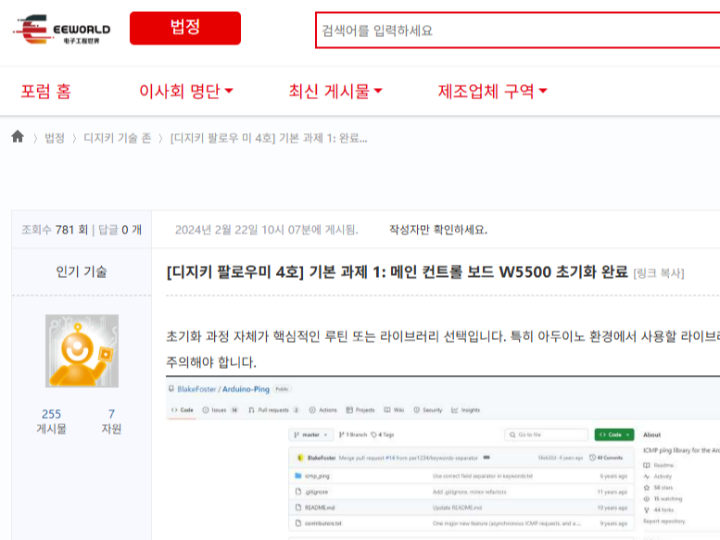
The initialization itself hinges on writing the main routine and selecting the library; choosing which library to use in an Arduino environment is crucial. The issue lies with the Ping function. The default Ethernet library lacks a Ping feature, making it cumbersome to manually modify the initial Ping library. Fortunately, a community user shared a ready-to-use ICMP Ping library (login required for the link), and while the official Ethernet library has been updated to version 2.02, it still does not include a Ping library. Someone has officially inquired about this, but there has been no response yet.
For testing, you can refer to the examples in the ICMP_PING library; when pinging a website, the method involves first obtaining the domain's IP address and then pinging that IP. The author verified that ICMP communication is functioning correctly by capturing ping packets to the host using Wireshark. The Role of the W5500
The W5500 is a hardware TCP/IP Ethernet controller chip from WIZnet that adds wired network capabilities to microcontrollers (MCUs). Its key features include:
Built-in hardware TCP/IP stack — Protocols such as TCP, UDP, ICMP (Ping), IPv4, ARP, IGMP, and PPPoE are processed directly within the chip's internal hardware. This eliminates the need for the MCU to handle complex network protocol calculations in software, significantly reducing its burden.
SPI interface communication — Since it connects to the MCU via a simple SPI bus, Ethernet can be easily implemented even on small MCUs with a limited number of pins.
Simultaneous socket support — It supports eight independent sockets, allowing it to handle multiple network connections simultaneously.
In the context of this article, the W5500 is a core component that enables the IoT development board to connect to the internet via a wired connection. The goal of this task is to verify the network connection's status using a Ping test after completing initialization (IP settings, MAC address, etc.). Although the W5500 supports ICMP in hardware, the official Arduino library does not provide a Ping API that allows for easy use, so the author had to find and use a separate library.
=============
이 게시물은 DigiKey Follow Me 4기 기초 과제 1에 관한 포럼 글로, 메인 컨트롤 보드의 W5500 이더넷 칩 초기화 과정을 다루고 있습니다. 핵심 내용은 다음과 같습니다.
초기화 자체는 메인 루틴 작성과 라이브러리 선택이 관건인데, Arduino 환경에서 어떤 라이브러리를 쓸지가 중요합니다. 문제는 Ping 기능입니다. 기본 Ethernet 라이브러리에는 Ping 기능이 없어서, 초기 Ping 라이브러리는 직접 수정해야 해서 번거롭습니다. 다행히 한 커뮤니티 유저가 바로 사용 가능한 ICMP Ping 라이브러리를 공유했고(링크는 로그인 필요), 공식 Ethernet 라이브러리는 2.02 버전까지 업데이트됐지만 여전히 Ping 라이브러리가 포함되어 있지 않습니다. 누군가 이에 대해 공식적으로 문의했으나 아직 답변이 없는 상태입니다.
테스트 방법으로는 ICMP_PING 라이브러리의 예제를 참고하면 되고, 웹사이트를 ping할 때는 먼저 도메인의 IP 주소를 얻은 후 그 IP로 ping을 수행하는 방식입니다. 작성자는 Wireshark로 호스트에 대한 ping 패킷을 캡처해 ICMP 통신이 정상 동작함을 확인했습니다.
W5500의 역할
W5500은 WIZnet사의 하드웨어 TCP/IP 이더넷 컨트롤러 칩으로, 마이크로컨트롤러(MCU)에 유선 네트워크 기능을 추가해주는 역할을 합니다. 주요 특징은:
하드웨어 TCP/IP 스택 내장 — TCP, UDP, ICMP(Ping), IPv4, ARP, IGMP, PPPoE 같은 프로토콜을 칩 내부 하드웨어에서 직접 처리합니다. 덕분에 MCU가 복잡한 네트워크 프로토콜 연산을 소프트웨어로 처리할 필요가 없어 부담이 크게 줄어듭니다.
SPI 인터페이스 통신 — MCU와는 간단한 SPI 버스로 연결되므로 핀 수가 적은 소형 MCU에서도 쉽게 이더넷을 구현할 수 있습니다.
동시 소켓 지원 — 독립적인 8개의 소켓을 지원해 여러 네트워크 연결을 동시에 처리할 수 있습니다.
이 글의 맥락에서 W5500은 IoT 개발 보드가 인터넷에 유선으로 연결되도록 하는 핵심 부품이며, 초기화(IP 설정, MAC 주소 등)를 완료한 뒤 Ping 테스트로 네트워크 연결이 정상인지 검증하는 것이 과제의 목표입니다. W5500은 ICMP를 하드웨어로 지원하지만, Arduino 공식 라이브러리 차원에서 이를 쉽게 쓸 수 있는 Ping API가 제공되지 않아 글쓴이가 별도 라이브러리를 찾아 사용한 것입니다.