


Building a commercial game show venue — need the most reliable microcontroller setup for buzzers + L
Building a commercial game show venue — need the most reliable microcontroller setup for buzzers + LEDs +Ethernet

WIZnet - W5500
x 1

1. Summary of Key Conversations
Since this is a commercial facility operating multiple times a day, the author wants a system that is reliable, easy to maintain, and free from breakdowns. Key requirements include button input detection, LED control, and Ethernet communication with a central server.
Author's Dilemma: The author is debating whether to use the ESP32, Arduino Mega, or Teensy 4.1. They are particularly concerned about "glitches" (blinking) caused by conflicts between Ethernet communication and LED timing.
Expert Recommendations:
Recommendation to use PLCs (Industrial PLCs): This was the most recommended opinion, suggesting that using an industrial PLC like the Siemens Logo instead of a hobbyist board like the Arduino guarantees 24/7 stability.
Dedicated Show Control Systems: Professional exhibition/event hardware such as Alcorn McBride or Medialon is also recommended.
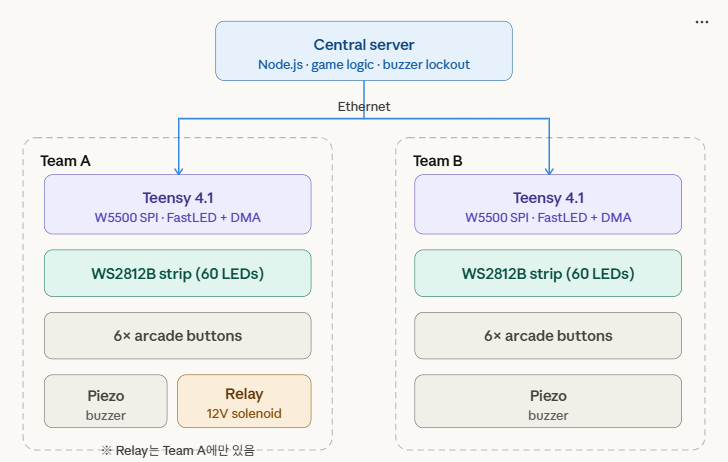
Hardware Alternatives: A method to separate communication and LED control using the Teensy 4.1 (high performance) or ESP32-S3 (utilizing dual cores) has been proposed.
2. The Role of the W5500 in This Article
The W5500 acts as the 'wired Ethernet communication-only controller' in this system.
The specific definitions and points are as follows:
Communication Gateway with the Central Server: To avoid the instability of wireless (Wi-Fi), this is a hardware interface that enables the MCU (such as the ESP32) to exchange JSON data with the central Node.js server via wired LAN.
SPI Communication Medium: It connects to the main processor via SPI (Serial Peripheral Interface) to process data.
Center of Technical Issues: * The main point of discussion in this article is the interrupts that occur when the W5500 processes data.
It is pointed out that if the W5500 occupies the CPU while processing Ethernet packets, data transmission for the addressable LED (WS2812B), which requires precise timing, may be interrupted, potentially causing the LED to blink irregularly (Glitch).
To resolve this, the author discusses a method of assigning W5500 communication to one core and LED control to the other.
In summary, the W5500 is used as a "core communication component for securely transmitting real-time game data (button presses, LED commands) over a wired network," but it is also mentioned as a variable that can cause resource conflicts with other precision control tasks in the system.
===
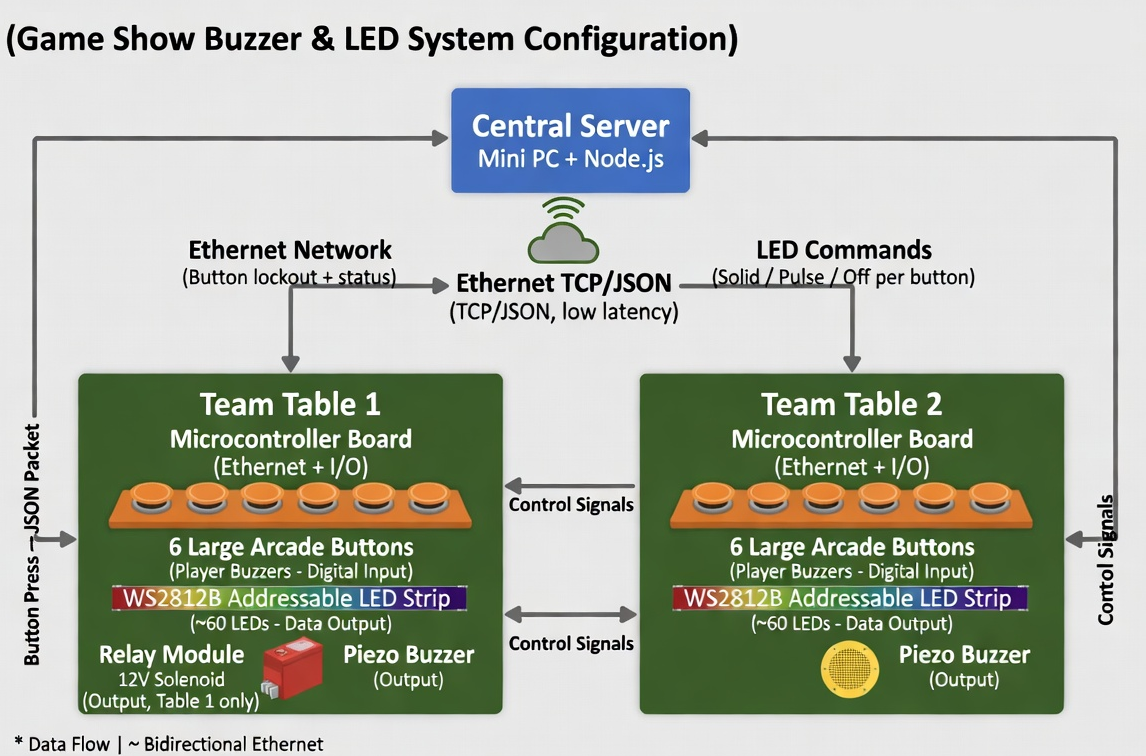
이 Reddit 게시글은 상업용 게임 쇼(예: 패밀리 퓨드 스타일) 행사장을 구축하려는 개발자가 '가장 신뢰할 수 있는 하드웨어 구성'에 대해 조언을 구하고 전문가들이 답변하는 내용을 담고 있습니다.
1. 주요 대화 내용 요약
작성자는 매일 여러 번 운영되는 상업용 시설인 만큼, 잔고장이 없고 유지보수가 쉬운 시스템을 원하고 있습니다. 주요 요구 사항은 버튼 입력 감지, LED 제어, 그리고 중앙 서버와의 이더넷 통신입니다.
작성자의 고민: ESP32, Arduino Mega, Teensy 4.1 중 무엇을 쓸지 고민 중입니다.
특히 이더넷 통신과 LED 타이밍이 충돌하여 발생하는 '글리치(깜빡임)' 현상을 걱정하고 있습니다.
전문가들의 추천:
PLC(산업용 제어기) 사용 권장: 가장 많은 추천을 받은 의견으로, 아두이노 같은 취미용 보드 대신 지멘스 로고(Siemens Logo) 같은 산업용 PLC를 써야 24시간 안정성이 보장된다는 의견입니다.
전용 쇼 컨트롤 시스템: Alcorn McBride나 Medialon 같은 전문 전시/이벤트용 하드웨어를 추천하기도 합니다.
하드웨어 대안: Teensy 4.1(고성능)이나 ESP32-S3(듀얼 코어 활용)를 사용하여 통신과 LED 제어를 분리하는 방법이 제시되었습니다.
2. 이 글에서 W5500의 역할
W5500은 이 시스템에서 '유선 이더넷 통신 전용 컨트롤러' 역할을 합니다.
구체적인 정의와 논점은 다음과 같습니다.
중앙 서버와의 통신 창구: 무선(Wi-Fi)의 불안정성을 피하기 위해, MCU(ESP32 등)가 유선 랜을 통해 중앙 Node.js 서버와 JSON 데이터를 주고받을 수 있게 해주는 하드웨어 인터페이스입니다.
SPI 통신 매개체: 메인 프로세서와 SPI(Serial Peripheral Interface) 방식으로 연결되어 데이터를 처리합니다.
기술적 이슈의 중심: * 이 글에서는 W5500이 데이터를 처리할 때 발생하는 인터럽트(Interrupt)가 주된 논점입니다.
W5500이 이더넷 패킷을 처리하는 동안 CPU를 점유하게 되면, 정밀한 타이밍이 필요한 주소 지정형 LED(WS2812B)의 데이터 전송이 끊겨 LED가 불규칙하게 깜빡이는(Glitch) 문제가 발생할 수 있음을 지적하고 있습니다.
작성자는 이를 해결하기 위해 W5500 통신은 한쪽 코어에, LED 제어는 다른 쪽 코어에 할당하는 방식을 논의합니다.
요약하자면, W5500은 "실시간 게임 데이터(버튼 누름, LED 명령)를 유선 네트워크로 안전하게 전달하기 위한 핵심 통신 부품"으로 사용되지만, 동시에 시스템의 다른 정밀 제어 작업과 자원 충돌을 일으킬 수 있는 변수로 언급되고 있습니다.
[Q&A]
Q: WS2812B LED와 W5500의 충돌 원인은?
A: WS2812B의 타이밍 요구사항
WS2812B는 SPI 같은 표준 프로토콜을 쓰지 않고, 매우 엄격한 타이밍의 비트뱅잉(bit-banging) 방식으로 데이터를 전달합니다.
| 신호 | 시간 |
|---|---|
| "1" 비트 HIGH | ~800ns |
| "1" 비트 LOW | ~450ns |
| "0" 비트 HIGH | ~400ns |
| "0" 비트 LOW | ~850ns |
| 허용 오차 | ±150ns 이하 |
이 타이밍이 조금이라도 어긋나면 LED가 오작동합니다.
ESP32에서 왜 충돌하나?
W5500은 SPI 통신을 사용합니다. ESP32에서 SPI 전송이 발생하면 인터럽트(interrupt) 가 걸리는데, 이 순간 CPU가 WS2812B 비트뱅잉을 잠깐 멈추게 됩니다. 그러면 타이밍이 깨져서 LED 색상이 틀어지거나 깜빡이는 현상이 발생합니다.
WS2812B 전송 중: ▬▬▬▬ [SPI 인터럽트 발생!] → 타이밍 깨짐 → LED 오작동Teensy 4.1이 해결책인 이유
- 멀티코어 + DMA: W5500(SPI)과 WS2812B를 서로 다른 코어/DMA 채널에서 독립적으로 실행 가능
- FastLED + DMA: CPU를 점유하지 않고 DMA가 WS2812B 타이밍을 하드웨어 수준에서 처리
WIZnet 관점에서 보면
이 글은 사실 W5500의 전형적인 ESP32 통합 pain point를 잘 보여주는 사례예요. W5500+ESP32 조합에서 이런 SPI 충돌 이슈가 커뮤니티에서 꽤 자주 제기되는데, W55RP20(W5500+RP2040 통합 SiP)이 이 문제를 근본적으로 해결할 수 있는 포지셔닝 포인트가 될 수 있어 보입니다. RP2040의 PIO(Programmable I/O)가 WS2812B 타이밍을 하드웨어로 완벽하게 처리하거든요.