A Dual-Path IoT Sensing and Communication Framework for Smart Building and Construction-Site Structu
A Dual-Path IoT Sensing and Communication Framework for Smart Building and Construction-Site Structural Monitoring
WIZnet - W5500
x 1

> Paper Overview
This paper was published in MDPI Electronics on September 11, 2026, by a joint research team including National Central University (Taiwan).
It proposes an IoT system that splits communication paths based on data characteristics to monitor the structural condition of smart buildings and construction sites.
- Smart Building Path: Handles high-speed, high-volume signals such as building vibrations. It collects vibration data at 200 Hz by integrating the ADXL355 accelerometer, ESP32-S3, PoE, and MQTT.
- Construction Site Path: Handles slowly changing status values such as tilt. It combines the SCL3300-D01 inclinometer with LoRaWAN and employs a hysteresis state machine with distinct thresholds for alarm triggering and recovery.
> Significance of the Paper
1. Peer-Reviewed Empirical Validation
The paper goes beyond merely proposing an architecture by presenting actual measurement data.
- In a 24-hour test, four vibration nodes successfully transmitted all 69,120,000 expected data records.
- Across four forced disconnection tests, the system maintained real-time transmission and recovered all records generated during the downtime.
- For the inclinometer, all 150 checkpoints across 25 tests matched the expected states, and no frame counter omissions occurred across 165 LoRaWAN packets.
2. Clear Design Principles
The system avoids forcing a single communication method onto all data types. Each path is tailored to the data's temporal resolution, connectivity requirements, and installation conditions, while maintaining shared principles for traceability and backend data interpretation. 3. Honest Disclosure of Limitations
It explicitly states that the results reflect the prototype's functionality under test conditions and do not imply immediate readiness for deployment at a construction site. It also notes that factors such as power consumption, resilience against prolonged disconnection, and temperature effects fall outside the scope of verification. This lack of exaggeration makes the information highly credible for citation or reference.
> Role of the W5500
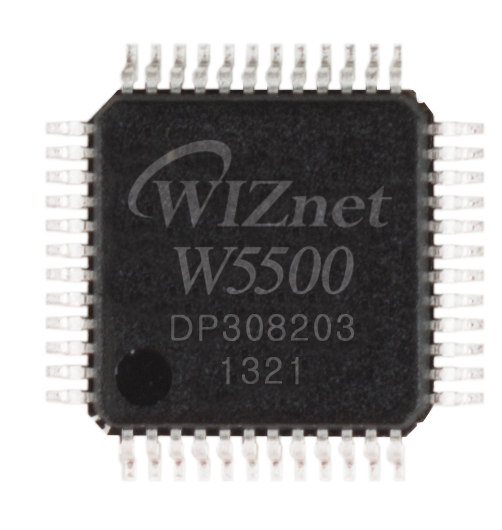
The W5500 is a dedicated wired communication chip for the "high-speed data" path that requires uninterrupted connectivity.
- A key component of the node configuration: The smart building node consists of an ADXL355 accelerometer, an ESP32-S3 controller, a W5500 Ethernet controller, and a PoE power module.
- Hardware TCP/IP offload: The paper explains that the W5500 integrates the TCP/IP stack, Ethernet MAC, and PHY required for wired connection to the backend network. The W5500 datasheet is included in the references.
- Reason for choosing PoE: PoE was selected not to demonstrate low-power operation, but to simultaneously handle power supply and wired data connectivity for continuous 200Hz data acquisition.
- Data transmission: Forty samples are bundled and transmitted at once via MQTT. At a 200Hz sampling rate, one bundle represents approximately 0.2 seconds of data; this approach reduces the number of publish operations and the processing load on the backend compared to sending each record individually.
- Integration with fault recovery: If the Ethernet connection, broker, or MQTT publishing fails, unsent records are first buffered in RAM; once the RAM is full, they are appended to a LittleFS file in Flash memory. Once the connection is restored, the system transmits a mix of stored data and real-time data. In the recovery test, out of 52,200 records received, 50,840 were retransmitted from Flash memory, while 1,360 were real-time data.
Summary: In this paper, wireless (LoRaWAN) handles low-speed status reporting, while W5500-based wired Ethernet serves as the "reliability backbone" for high-speed, continuous data transmission without loss. For WIZnet, the most significant takeaway is that the key achievements—100% data collection over 24 hours and 100% data recovery following a disconnection—were realized through the path utilizing the W5500.
However, it should be noted that this paper does not compare the performance of the W5500 itself against other chips. Additionally, the paper acknowledges a limitation: if a PoE failure cuts power to the node, sampling cannot continue during the outage unless a separate power source is available. It would be wise to keep these points in mind when crafting promotional materials.
> Value from WIZnet's Perspective
1. Evidence supporting the message that "reliability comes from wired connections"
The paper categorizes communication methods based on the nature of the data. Critical 200Hz vibration data—which requires uninterrupted transmission—was assigned to the wired path utilizing the ESP32-S3, PoE, and MQTT, whereas slow-changing tilt status data was assigned to LoRaWAN. Rather than framing this as a competition between wireless and wired technologies, the researchers themselves designed a division of roles where "critical data is transmitted via W5500 wired Ethernet." This aligns perfectly with the positioning of wired Ethernet that WIZnet has consistently emphasized. 2. Quantitative figures ready for marketing use
- Successfully transmitted 100% of the 69,120,000 records generated by four nodes over a 24-hour period.
- Achieved 100% recovery of offline records following four instances of forced disconnection.
- The W5500 datasheet is directly cited in the references.
3. Reference for new industrial sectors
Structural Health Monitoring (SHM), smart buildings, and construction sites are B2B sectors where safety is paramount. By linking this to the existing W5500-based cable-stayed bridge protection case study found on the Maker site, we can craft a narrative that equates "infrastructure safety monitoring" with the "W5500."
4. Confirmation of the ESP32 + W5500 combination as a de facto standard
This paper utilizes the ESP32-S3 and W5500 combination. Previously registered projects like WaterFlowKit (ESP32-C6 + W5500) and CeilSense (ESP32-S3 + W5500) follow the same pattern. Since the ESP32-S3 and C6 lack an integrated Ethernet MAC, the W5500—connected via SPI—becomes the natural choice for wired connectivity. This serves as evidence of a prevailing trend across academia, commercial products, and open-source projects (such as ESPHome) that the W5500 is the go-to wired Ethernet partner for the ESP32 series.
5. Confirmation of PoE demand
The research team selected PoE to handle both power and wired data transmission through a single cable. This provides a basis for demonstrating market demand when proposing PoE-integrated modules or reference boards in the future. 6. Business and Collaboration Opportunities
This research was conducted jointly by several Taiwanese universities (including National Central University, Minghsin University of Science and Technology, and National Sun Yat-sen University). It serves as a gateway to the Taiwanese academic community and the construction IoT market, offering opportunities to propose technical support or collaborative projects for subsequent phases, such as on-site deployment and digital twin integration.
Q&A
Q. Why was the W5500 used in the structural monitoring paper, and what role did it play?
A. The system described in the paper splits communication paths based on the nature of the data. Slowly changing tilt data from the construction site is transmitted via LoRaWAN (wireless), while continuous building vibration data—streaming at 200Hz—is transmitted via a W5500-based wired Ethernet connection. Since the loss of even a small amount of vibration data diminishes its analytical value, the research team assigned the W5500 to the path requiring the highest transmission stability.
The vibration node consists of an ADXL355 accelerometer, an ESP32-S3, a W5500, and a PoE module. The W5500 integrates the TCP/IP stack, MAC, and PHY in hardware, thereby reducing the network processing load on the MCU. Using PoE allows both power and data to be supplied via a single cable.
As a result, the W5500-based wired path achieved a 100% data collection rate—capturing 69.12 million records from four nodes over 24 hours—and successfully recovered 100% of the data lost during four instances of forced disconnection. This recovery performance was achieved through a combination of flash buffering and retransmission firmware. In summary, this is a case that validates the design principle of handling "critical high-speed data via the W5500 wired connection," built upon the foundation of stable wired communication.
Related Articles
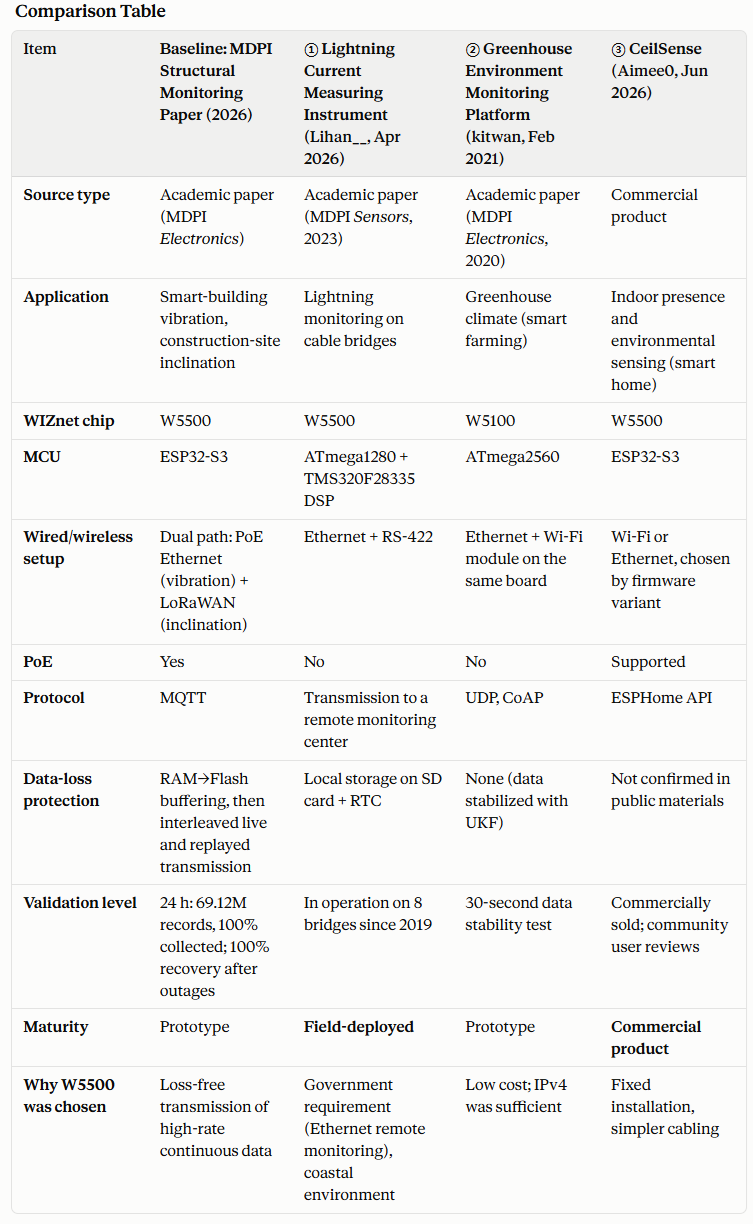
We identified and compared three related articles. These were selected based on the key characteristics of the paper in question: its nature as an academic paper, its focus on infrastructure and environmental monitoring, the reliability of wired Ethernet, and the use of the ESP32-S3, W5500, and PoE.
==========
> 논문 개요
대만 국립중앙대학교 등 여러 대학 공동 연구팀이 MDPI Electronics에 2026년 9월 11일 발표한 논문입니다.
스마트 빌딩과 공사 현장의 구조물 상태를 감시하기 위해 데이터 특성에 따라 통신 경로를 두 갈래로 나눈 IoT 시스템을 제안합니다.
- 스마트 빌딩 경로: 건물 진동처럼 데이터가 빠르고 많은 신호를 다룹니다. ADXL355 가속도계, ESP32-S3, PoE, MQTT를 결합해 200Hz로 진동을 수집합니다.
- 공사 현장 경로: 기울기처럼 느리게 변하는 상태 값을 다룹니다. SCL3300-D01 경사계와 LoRaWAN을 결합하고, 경보와 복귀 기준을 다르게 둔 히스테리시스 상태 머신을 사용합니다.
> 논문의 가치
1. 동료 심사를 거친 실측 검증
구조만 제안하고 끝나지 않고, 실제로 측정한 수치를 제시합니다.
- 24시간 시험에서 진동 노드 4개가 예상한 69,120,000개 레코드를 모두 전송했습니다.
- 강제 단선 시험 4회에서도 실시간 전송을 유지하면서 끊긴 동안의 레코드를 전부 복구했습니다.
- 경사계 쪽은 25회 시험의 체크포인트 150개가 모두 기대한 상태와 일치했고, LoRaWAN 패킷 165개에서 프레임 카운터 누락이 없었습니다.
2. 설계 원칙이 명확함
한 가지 통신 방식을 모든 데이터에 억지로 적용하지 않습니다. 각 경로를 데이터의 시간 해상도, 연결성, 설치 조건에 맞추고, 추적성과 백엔드 해석에 대한 원칙은 공통으로 유지합니다.
3. 한계를 정직하게 밝힘
결과가 보여주는 것은 시험 조건에서의 프로토타입 기능이며, 곧바로 공사 현장에 배치할 수 있다는 뜻은 아니라고 명시합니다. 전력 소비, 장시간 단선 내성, 온도 영향 등도 검증 범위 밖이라고 스스로 적어 두었습니다. 과장이 없어서 인용하거나 소개하기에 신뢰도가 높습니다.
> W5500의 역할
W5500은 "끊기면 안 되는 고속 데이터" 경로의 유선 통신 전담 칩입니다.
- 노드 구성의 한 축: 스마트 빌딩 노드는 ADXL355 가속도계, ESP32-S3 컨트롤러, W5500 이더넷 컨트롤러, PoE 전원 모듈로 이루어집니다.
- 하드웨어 TCP/IP 오프로드: 논문은 W5500이 백엔드 네트워크와의 유선 연결에 필요한 TCP/IP 스택, 이더넷 MAC, PHY를 통합하고 있다고 설명합니다. 참고문헌에도 W5500 데이터시트가 들어 있습니다.
- PoE를 고른 이유: PoE는 저전력 운용을 보여주기 위해서가 아니라, 200Hz 연속 수집을 위해 전원 공급과 유선 데이터 연결을 한 번에 해결하려고 선택했다고 밝힙니다.
- 데이터 전송: 샘플 40개를 묶어 MQTT로 한 번에 보냅니다. 200Hz 기준으로 한 묶음은 약 0.2초 분량이며, 레코드마다 따로 보내는 것보다 발행 횟수와 백엔드 처리 부담이 줄어듭니다.
- 장애 복구와의 연계: 이더넷, 브로커, MQTT 발행 중 하나라도 불가능해지면 보내지 못한 레코드를 먼저 RAM에 쌓고, RAM이 차면 Flash의 LittleFS 파일에 추가합니다. 연결이 돌아오면 저장해 둔 데이터와 실시간 데이터를 번갈아 전송합니다. 복구 시험에서 받은 52,200개 레코드 중 50,840개는 Flash에서 재전송된 것이고 1,360개는 실시간 데이터였습니다.
정리: 이 논문에서 무선(LoRaWAN)은 저속 상태 보고를 맡고, W5500 기반 유선 이더넷은 누락 없는 고속 연속 데이터를 맡는 "신뢰성 백본"입니다. 24시간 100% 수집과 단선 후 100% 복구라는 핵심 성과가 모두 W5500이 들어간 경로에서 나왔다는 점이 WIZnet 입장에서 가장 큰 의미입니다.
다만 이 논문이 W5500 자체의 성능을 다른 칩과 비교한 것은 아닙니다. 또 PoE 장애로 노드 전원까지 끊기면, 별도 전원이 없는 한 그 동안은 샘플링을 계속할 수 없다는 한계도 명시돼 있으니, 홍보 문구를 쓸 때 이 두 점은 감안하시는 게 좋겠습니다.
> 위즈네트 관점의 가치
1. "신뢰성은 유선"이라는 메시지를 뒷받침하는 근거
논문은 통신 방식을 데이터 성격에 따라 나눴습니다. 끊기면 안 되는 200Hz 진동 데이터는 ESP32-S3, PoE, MQTT로 묶인 유선 경로에 맡겼고, 느린 기울기 상태는 LoRaWAN에 맡겼습니다. 무선과 경쟁하는 구도가 아니라, > "중요한 데이터는 W5500 유선으로 보낸다"는 역할 분담> 을 연구자가 스스로 설계한 것입니다. 위즈네트가 강조해 온 유선 이더넷의 포지션과 정확히 맞아떨어집니다.
2. 마케팅에 바로 쓸 수 있는 정량 수치
- 24시간 동안 노드 4개가 예상한 레코드 69,120,000개를 > 100%> 전송
- 강제 단선 4회 후 오프라인 레코드 > 100%> 복구
- 참고문헌에 W5500 데이터시트가 직접 인용됨
3. 새로운 산업 분야의 레퍼런스
구조물 상태 모니터링(SHM), 스마트 빌딩, 건설 현장은 안전과 직결되는 B2B 분야입니다. 메이커 사이트에 이미 있는 W5500 기반 케이블 교량 보호 사례와 묶으면 > "인프라 안전 모니터링 = W5500"> 이라는 스토리를 만들 수 있습니다.
4. ESP32 + W5500 조합이 사실상 표준임을 확인
이 논문은 ESP32-S3와 W5500 조합을 씁니다. 이미 등록된 WaterFlowKit(ESP32-C6 + W5500)과 CeilSense(ESP32-S3 + W5500)도 같은 패턴입니다. ESP32-S3와 C6에는 이더넷 MAC이 내장돼 있지 않아서, 유선이 필요할 때 SPI로 붙이는 W5500이 자연스러운 선택이 됩니다. 학계, 상용 제품, 오픈소스(ESPHome) 모두에서 > "ESP32 계열의 유선 이더넷 짝 = W5500"> 이라는 흐름이 이어지고 있다는 증거입니다.
5. PoE 수요 확인
연구진은 PoE를 전원과 유선 데이터를 케이블 하나로 해결하려고 선택했습니다. 앞으로 PoE 통합 모듈이나 레퍼런스 보드를 제안할 때 수요 근거로 쓸 수 있습니다.
6. 영업과 협력 기회
대만의 여러 대학(국립중앙대, 밍신과기대, 중산대 등)이 공동으로 진행한 연구입니다. 대만 학계와 건설 IoT 시장에 접근할 연결고리가 될 수 있고, 후속 연구(현장 배치, 디지털 트윈 연동) 단계에서 기술 지원이나 공동 사례를 제안해 볼 수 있습니다.
Q&A
Q. 구조물 모니터링 논문에서 W5500은 왜, 어떤 역할로 쓰였나요?
A. 이 논문의 시스템은 데이터 성격에 따라 통신 경로를 둘로 나눕니다. 느리게 변하는 공사 현장의 기울기 데이터는 LoRaWAN 무선으로 보내고, 200Hz로 쉬지 않고 쏟아지는 건물 진동 데이터는 W5500 기반 유선 이더넷으로 보냅니다. 진동 데이터는 조금이라도 누락되면 분석 가치가 떨어지기 때문에, 연구진은 가장 안정적인 전송이 필요한 경로에 W5500을 배치했습니다.
진동 노드는 ADXL355 가속도계, ESP32-S3, W5500, PoE 모듈로 구성됩니다. W5500은 TCP/IP 스택, MAC, PHY를 하드웨어로 통합하고 있어 MCU의 네트워크 처리 부담을 덜어 줍니다. PoE를 함께 쓰면 케이블 하나로 전원과 데이터를 모두 공급할 수 있습니다.
그 결과 W5500 기반 유선 경로는 24시간 동안 노드 4개에서 6,912만 개 레코드를 100% 수집했고, 네 차례 강제 단선 후에도 끊긴 동안의 데이터를 100% 복구했습니다. 이 복구 성능은 Flash 버퍼링과 재전송 펌웨어가 함께 만들어낸 결과입니다. 정리하면, 안정적인 유선 통신이라는 기반 위에서 "중요한 고속 데이터는 W5500 유선으로"라는 설계가 실제로 입증된 사례입니다.
유사글
유사 글 3개를 찾아 비교했습니다. 이 논문의 특징(학술 논문, 인프라·환경 모니터링, 유선 이더넷 신뢰성, ESP32-S3 + W5500 + PoE)을 기준으로 가장 가까운 글들을 골랐습니다.