



W55MH32L Single-Chip Ethernet Solution: Expanding storage via SDIO interface to achieve local log
W55MH32L Single-Chip Ethernet Solution: Expanding storage via SDIO interface to achieve local log storage.
In fields such as Industrial Internet of Things (IIoT) , intelligent monitoring, and embedded control, log data carries critical information such as equipment operating status, fault information, and operation trajectories. Its storage capacity and accessibility directly impact equipment maintenance efficiency and the accuracy of troubleshooting. With the intelligent upgrading of equipment and the continuous growth of data volume, the shortcomings of traditional storage solutions in terms of capacity expansion flexibility , read/write transmission efficiency, and ease of remote access are becoming increasingly apparent. The W55MH32L, with its large memory configuration of 1024 KB Flash and 96 KB SRAM, a high clock speed of up to 216 MHz, and a native SDIO interface and all-hardware Ethernet core configuration, can create a log storage solution that is "easy to read locally and flexible to access remotely," specifically addressing industry pain points.
1. Three Core Pain Points in Industry Log Storage
1.1 Low flexibility in storage expansion and difficulty in long-term retention.
Most embedded devices have relatively fixed built-in storage resources, making it difficult to flexibly adjust capacity based on differences in log generation volume. In high-frequency data recording scenarios, limited storage space can easily lead to the overwriting of some critical logs, making it impossible to completely preserve the device's entire lifecycle operation trajectory. This can hinder subsequent fault tracing and performance optimization. For example, on industrial production lines, equipment running 24/7 generates massive amounts of logs. Fixed-capacity storage media often cannot meet long-term storage needs, potentially leading to the loss of logs from critical production nodes.
1.2 Insufficient read/write speed compatibility poses a risk to data integrity.
Some traditional solutions use interfaces with low transmission rates and have limited storage media performance. This can lead to delays and data loss during log writing, making it difficult to accurately capture the device's instantaneous operating status. Furthermore, local log reading is cumbersome and time-consuming, affecting the timeliness of troubleshooting. For example, in intelligent monitoring equipment, if instantaneous data from a sudden failure is not fully recorded due to write delays, it may be difficult to accurately reconstruct the failure scenario.
1.3 Remote access configuration is complex, and maintenance costs are relatively high.
Traditional log storage solutions primarily rely on local reading. Remote retrieval typically requires additional network transmission modules and adaptation to proprietary protocols, increasing hardware deployment and software development costs. Furthermore, issues such as module compatibility and network stability can arise, hindering efficient remote operation and maintenance management. For embedded devices distributed across a wide area, frequent on-site log reading operations consume significant manpower and resources, substantially increasing maintenance costs.
2. Limitations of traditional local storage solutions
To meet log storage needs, various traditional solutions have emerged in the industry, but all have significant shortcomings:
Built-in Flash storage : Relying on the chip's integrated Flash resources, the storage capacity cannot be flexibly expanded, and frequent log write operations may accelerate Flash wear and shorten the device's lifespan, making it difficult to adapt to long-term, high-volume log storage needs. Especially in scenarios with high log generation frequency, the Flash lifespan will be further shortened, potentially increasing the frequency of device maintenance and replacement.
External storage via SPI interface : This method expands capacity by connecting to external storage media via the SPI interface. However, the SPI interface has a relatively limited transmission rate, which can easily lead to performance bottlenecks in high-frequency log writing scenarios. Furthermore, it requires additional driver circuitry, increasing hardware design complexity. This can not only affect the real-time storage of log data but also potentially reduce system stability due to the complexity of the hardware design.
Separate modular solutions require separate configuration of storage and Ethernet modules, which not only occupies more circuit board space but may also lead to compatibility issues between modules, increasing system integration difficulty, overall power consumption, and deployment costs. The collaborative operation of multiple modules may also increase potential points of failure, causing inconvenience for later maintenance.
3. W55MH32L Log Storage Solution: Combining the Advantages of Local and Remote Storage
Leveraging its large memory and high clock speed, the W55MH32L utilizes SDIO interface for expanded storage and incorporates full hardware Ethernet functionality to build a collaborative and efficient log management system, making local reading more convenient and remote access more flexible.

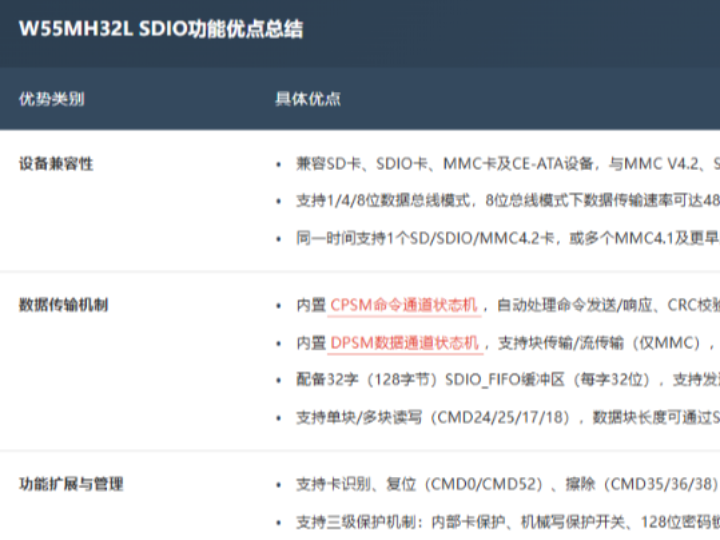
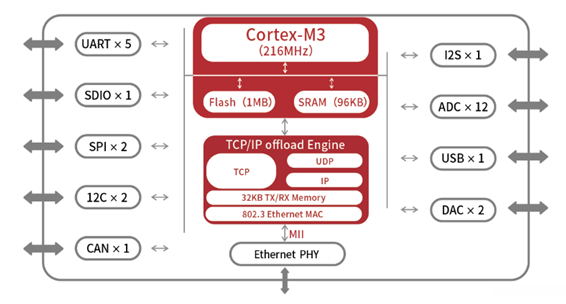
3.1 Core Implementation Path The W55MH32L natively integrates an SDIO interface, allowing direct connection to common storage media such as SD cards and MMC cards without the need for additional expansion chips or complex drivers, simplifying the hardware connection process. During device operation, leveraging its high clock speed of up to 216 MHz, log data can be processed quickly and written to external storage media in real time via the SDIO interface. Users can directly read log files from the storage media through local interfaces (such as SD card direct read, UART export, etc.) to quickly obtain device operating information. Simultaneously, the chip integrates a 10/100M Ethernet MAC and PHY, and features a full hardware TCP/IP protocol stack, supporting multiple network protocols such as TCP, UDP, and ICMP. With 8 independent hardware sockets, 32KB independent transmit/receive buffers, and ample memory support of 1024 KB Flash and 96 KB SRAM, stable remote access to the device can be achieved via the network, supporting secure retrieval and management of log data, meeting log access needs in various scenarios.
3.2 Core Advantages of the Solution
Highly efficient and stable read/write transmission : The SDIO interface boasts excellent transmission performance, coupled with the W55MH32L's high clock frequency of up to 216 MHz, matching the log write frequency in most scenarios and reducing data latency and packet loss risks. The full hardware TCP/IP protocol stack does not consume excessive MCU resources, and combined with ample memory buffering, it helps ensure the transmission efficiency and stability of remote log reading, providing users with a smoother experience when remotely retrieving logs.
Convenient and worry-free operation and management : Local reading does not require complicated supporting equipment, and users can quickly obtain logs through conventional reading devices; remote access relies on the mature Ethernet protocol, which does not require the deployment of additional dedicated transmission modules, helping to reduce the threshold and management cost of operation and maintenance, and improve the overall efficiency of operation and maintenance work.
Data processing is stress-free : 1024 KB Flash can fully store program and critical log data, and 96 KB SRAM provides ample space for temporary storage and fast processing of log data. Combined with a 32-bit Arm® Cortex®-M3 core with a high clock speed of 216 MHz, it significantly improves the efficiency of log data encoding, transmission and storage, and effectively reduces log backlog.
3.3 Core Application Scenarios: Ethernet Remote Access and Local Reading
3.3.1 Application Scenarios for Remote Access to Ethernet Logs
Industrial IoT Distributed Equipment Operation and Maintenance: In scenarios such as production lines in large factories, sensor networks in smart warehouses, and remote power monitoring terminals, equipment is often deployed across a wide area (e.g., across workshops, factories, or even cities). Maintenance personnel do not need to be on-site; they can remotely access the log systems of each device via Ethernet to retrieve real-time logs of equipment operating parameters, fault alarms, and energy consumption statistics. For example, multiple automated processing machines on an automotive parts production line are equipped with the W55MH32L solution. The maintenance center can remotely access logs to simultaneously monitor the spindle speed, tool wear data, and processing cycle time of each machine. If abnormal parameters are detected in the logs, timely remote troubleshooting can be performed, helping to reduce the risk of production line downtime and significantly lowering the manpower and time costs of on-site maintenance.
Management of Outdoor Intelligent Monitoring Equipment: Outdoor road monitoring, scenic area security cameras, forest fire monitoring equipment, etc., are typically deployed in remote, inaccessible areas. Through the W55MH32L's Ethernet remote log access function, the monitoring center can remotely obtain the equipment's operational status logs (such as power supply voltage, network connection status, lens cleanliness detection data) and abnormal event logs (such as screen obstruction alarms, equipment vibration alarms, and nighttime infrared activation anomaly logs). For example, in mountainous forest fire monitoring equipment operating in harsh environments such as low temperatures and strong winds, if a sensor malfunctions, the log will record the time of the failure and specific abnormal data. The monitoring center can remotely retrieve this data to accurately determine the type of fault, facilitating the dispatch of maintenance personnel with the appropriate spare parts and reducing unnecessary inspections.
Intelligent building security system operation and maintenance: Access control systems, elevator operation monitoring terminals, fire alarm equipment, etc., in intelligent buildings require stable operation 24 hours a day. Through remote access to logs via Ethernet, the property maintenance team can centrally manage equipment logs from multiple buildings, such as personnel entry and exit records for access control systems, elevator start/stop counts and fault code logs, and fire sensor inspection logs. When an elevator in a building experiences operational malfunction, maintenance personnel can remotely retrieve logs to view data such as elevator load, motor current, and control system commands at the time of the malfunction without going to the elevator machine room. This helps to quickly locate the cause of the fault and improve maintenance response speed.
3.3.2 Application Scenarios for Local Log Reading
Troubleshooting Equipment in Network-Free Environments: In scenarios without Ethernet coverage, such as underground mines, enclosed workshops, and remote mountainous areas, the ability to locally read equipment logs is crucial. For example, if ventilation equipment or gas monitoring terminals in underground coal mines malfunction, maintenance personnel can use a portable card reader to directly read log files from the external SD card of the equipment. This allows for quick access to data such as gas concentration before and after the fault, fan speed logs, and power supply stability logs, helping to accurately reconstruct the fault scenario, complete repairs promptly, and ensure production safety.
On-site equipment commissioning and log evidence collection: During the commissioning phase before equipment leaves the factory, engineers can verify the normal functioning of the equipment by reading local logs. For example, during the production of smart meters, commissioning personnel read the equipment's calibration logs and data acquisition logs to confirm whether parameters such as the meter's measurement accuracy and data recording frequency meet the standards. After a serious equipment failure or safety incident, the locally stored logs can be used as raw data for evidence collection. By reading the complete logs on the SD card, the entire process of the failure can be traced, providing a basis for clarifying responsibility and subsequent system optimization.
Local maintenance of small embedded devices: For small devices such as home security cameras, small smart home controllers, and portable industrial testing instruments, users or maintenance personnel do not need to build a complex remote management system. They can directly read logs through the local interface. For example, if a home security camera interrupts recording, the user can remove the SD card from the device, read the logs to check the cause of the interruption (such as network disconnection, insufficient storage space, or abnormal power supply), quickly complete the troubleshooting, and improve the ease of use of the device.
4. W55MH32L Hardware Features: Providing Robust Support for Log Storage Solutions
The W55MH32L is equipped with 1024 KB of Flash program memory and 96 KB of SRAM. This ample memory not only meets the device's own program execution needs but also provides strong support for temporary caching and batch processing of log data. The large-capacity SRAM enables high-speed temporary storage and preprocessing of log data, further improving data flow efficiency and effectively reducing the risk of log loss or processing delays due to insufficient memory. This makes it better suited for high-capacity, high-frequency log storage scenarios.
4.1 Large memory configuration for more efficient storage and processing.
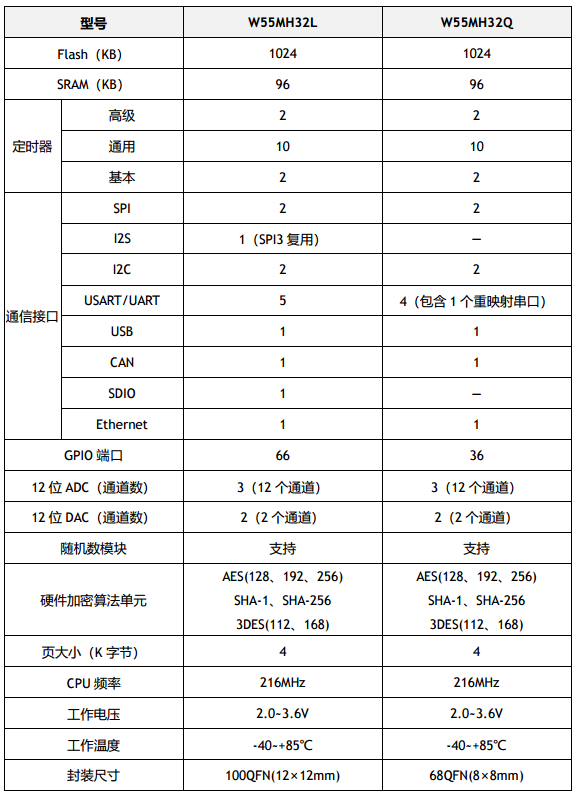
The W55MH32L is equipped with 1024 KB of Flash program memory and 96 KB of SRAM. This ample memory not only meets the device's own program execution needs but also provides strong support for temporary caching and batch processing of log data. It effectively reduces the risk of log loss or processing delays due to insufficient memory, making it better suited for high-capacity, high-frequency log storage scenarios.
4.2 High-frequency core for stronger computing performance
Equipped with a 32-bit Arm® Cortex®-M3 core, it operates at a maximum frequency of 216 MHz and boasts a computing performance of 2.54 DMips/MHz. This powerful core performance enables it to quickly process tasks related to the encoding, storage, and transmission of log data. Even in scenarios with multiple tasks running in parallel, it ensures the timeliness and accuracy of log data processing, reducing log backlog issues caused by delayed data processing.
4.3 Native SDIO interface for easier storage expansion
The W55MH32L natively integrates an SDIO interface, enabling connection to external storage media without the need for additional expansion chips, significantly simplifying the hardware design process and reducing hardware development difficulty. This interface offers stable transmission performance, efficiently handling log data writing and reading tasks, and adapting to different log generation frequencies. It can effectively handle both low-frequency status recording and high-frequency detailed log collection in most scenarios.
4.4 Full hardware Ethernet configuration for more reliable remote access
The chip integrates a full hardware TCP/IP protocol stack, supporting multiple mainstream network protocols and providing diverse adaptation methods for remote log transmission. An independent 32KB transmit/receive buffer provides ample buffer space for log data transmission, reducing packet loss caused by data transmission congestion. Eight independent hardware sockets can handle multiple network connection requests simultaneously, helping to ensure the stability of remote log reading connections, reducing transmission interruptions, and making remote operation and maintenance more reliable.
4.5 Multiple security protection designs ensure safer data storage.
Built-in hardware encryption algorithm units such as DES, AES, and SHA can encrypt log data, effectively reducing the risk of data tampering or leakage. The TRNG true random number generator supports generating 128-bit random numbers at a time, providing a secure foundation for the encryption process and ensuring log data security throughout the entire process from local storage to remote transmission, so users don't need to worry excessively about data security issues.
4.6 Wide temperature and pressure compatibility, enabling more flexible deployment in various scenarios.
The W55MH32L operates within a voltage range of 2.0~3.6V and a temperature range of -40~+85℃, enabling stable operation in various complex environments such as industrial sites and outdoor equipment. This feature reduces the impact of extreme environmental factors on log storage functionality, ensuring the stability of core functions and allowing it to function normally in devices under different geographical locations and environmental conditions, adapting to deployment needs in multiple scenarios.
5. Project schedule and delivery guarantee
5.1 Comprehensive technical support
It provides high-quality examples of TCP protocol and its MQTT protocol , SDIO, and various peripherals;
A professional technical team provides full support throughout the process;
Comprehensive technical documentation and design guidelines;
Timely technical updates and iteration support.
5.2 Stable supply chain guarantee
Complete documentation, stable and controllable supply;
A rigorous quality control system ensures product consistency.
Summarize
The W55MH32L, with its core "SDIO interface for expanded storage + all-hardware Ethernet transmission," organically combines the flexibility of local log storage with the convenience of remote access. This alleviates the pain points of traditional solutions in terms of capacity and efficiency, while also reducing system integration and maintenance costs. Its robust hardware performance and abundant interface resources provide a more reliable and efficient solution for log storage, enabling smarter operation and maintenance management of the device.