



How to Learn W5500 Network Stack and Protocol Handling on STM32?
This educational project explains how to integrate the WIZnet W5500 with an STM32L4 platform and use it as a hardware network engine beneath the application
How to Learn W5500 Network Stack and Protocol Handling on STM32?
Summary
This educational project explains how to integrate the WIZnet W5500 with an STM32L4 platform and use it as a hardware network engine beneath the application. The source focuses on driver structure, register mapping, socket control, and the boundary between the STM32 HAL layer and higher-level protocol software, making it useful for learning how W5500 handles Ethernet transport while the MCU remains responsible for control flow and application logic.
What the Project Does
The source article presents a W5500 integration guide for the STM32 NUCLEO-L476RG rather than a full end-user product. Its stated goal is to provide a stable, portable low-level Ethernet path on STM32L4 by wrapping register access, SPI timing control, interrupt handling, and memory access into a standardized C driver layer. The article explicitly says this is not a standalone protocol-stack implementation, but a hardware-facing integration layer for upper software such as LwIP, uIP, or custom lightweight protocols.
For education, that makes the material more useful than a simple demo. It shows where the network stack boundary actually sits in an embedded design: the STM32 provides SPI transactions, GPIO control, and system orchestration, while the W5500 provides the Ethernet MAC/PHY and hardwired TCP/IP socket engine. The learner can therefore study register-level network bring-up, socket state transitions, and buffer movement without first having to port a full software TCP/IP stack to the MCU.
Where WIZnet Fits
The exact WIZnet product here is the W5500. In this STM32 design, it acts as a dedicated Ethernet controller connected to the MCU over SPI, with an embedded 10/100 Ethernet MAC/PHY, hardwired TCP/IP support, 8 independent sockets, and 32 KB of internal Tx/Rx buffer memory. WIZnet’s official documentation also states that the chip supports SPI up to 80 MHz and works with SPI mode 0 or 3.
That role is central to the article’s architecture. The source frames the combination as an “MCU + dedicated network coprocessor” model: the STM32 does not run the full network protocol machinery in software, but instead writes configuration registers, manages send and receive buffers, and checks socket and interrupt state while W5500 executes the transport-side work. The article further claims this structure keeps CPU load very low on the STM32L4 and improves portability across STM32 families because the driver depends mainly on a small set of HAL SPI and GPIO calls.
For protocol handling, the educational value comes from the way the chip exposes socket-based networking. WIZnet’s own materials describe the ioLibrary as an MCU-independent stack support library with socket-style APIs and higher-level services such as DHCP, DNS, MQTT, SNTP, TFTP, and HTTP server components. That makes W5500 a good teaching platform for showing how raw hardware control, socket abstractions, and optional upper-layer services fit together in an embedded Ethernet design.
Implementation Notes
A full verified repository is not provided in the source article, so exact file paths cannot be confirmed independently. The article does, however, describe the driver as being split into register, socket, and buffer-oriented layers such as w5500.h, w5500_socket.h, and w5500_buffer.h, and it gives concrete API examples that reflect a typical W5500 driver structure.
One important part of the article is the socket register model. It identifies Sn_MR for protocol selection, Sn_CR for command execution, Sn_SR for runtime status, Sn_PORT for local port configuration, Sn_DIPR and Sn_DPORT for remote addressing, Sn_TX_FSR for available transmit buffer space, and Sn_RX_RSR for unread receive data. For learning protocol handling, this matters because it makes the transport state machine visible: protocol mode is chosen explicitly, commands are issued explicitly, and the driver must not proceed until the socket status reflects the expected state.
The article’s API layer also shows how the protocol path is intended to be used on STM32. It lists functions such as w5500_socket(), w5500_connect(), w5500_listen(), w5500_send(), w5500_recv(), and w5500_getsockopt(). Just as importantly, it explains the constraints around them: after w5500_socket(), a TCP socket is only in INIT, and the application must still call w5500_listen() or w5500_connect() before data transfer is valid. The write-up also notes that w5500_send() depends on sufficient free space in Sn_TX_FSR, while incoming data is detected by polling Sn_RX_RSR. That is a clear and useful teaching example of socket-state-driven embedded networking.
The SPI layer is also treated as part of the protocol architecture, not merely board bring-up. The article specifies low-level routines such as w5500_read_reg(), w5500_write_reg(), w5500_read_buf(), and w5500_write_buf(), and says the tested STM32L476RG setup runs SPI1 at 40 MHz even though W5500 officially supports up to 80 MHz. In educational terms, that is a helpful reminder that protocol capability and board-level implementation margin are not the same thing: the chip specification sets the ceiling, but the actual MCU clock tree, board routing, and validation effort determine what is safe in practice.
Practical Tips / Pitfalls
- Treat W5500 as the transport engine, not as a full application framework. The article is clear that this driver layer is for lower-level integration and may sit under LwIP, uIP, or custom logic rather than replacing all upper-layer software.
- Do not issue socket commands and immediately assume success. The source notes that
Sn_CRis write-triggered and self-clearing, so the driver must wait forSn_SRto reach the expected state before continuing. - Check
Sn_TX_FSRbefore transmit andSn_RX_RSRbefore receive. Those two registers are the core visibility points for buffer flow and are central to understanding how W5500 moves data between the socket engine and the MCU. - Separate hardware integration issues from protocol issues. SPI timing, chip-select handling, and register-readback validation belong to board bring-up, while socket state transitions and packet flow belong to protocol handling. Students often mix the two when debugging.
- Use SPI mode and clock settings conservatively during bring-up. W5500 supports SPI mode 0 and 3 and up to 80 MHz, but the article’s STM32L476RG example validates 40 MHz operation, which is a more realistic starting point for education and lab work.
- Remember that W5500 socket support does not eliminate application design work. WIZnet’s library ecosystem adds services such as DHCP, DNS, MQTT, SNTP, TFTP, and HTTP server support, but the developer still has to structure application logic and service integration correctly.
FAQ
Q: Why use W5500 for an STM32 education project?
A: Because it exposes embedded Ethernet in a way that is easier to reason about than a full software stack running entirely on the MCU. Students can see register configuration, socket state control, buffer management, and SPI transport separately, while the W5500 handles the hardwired TCP/IP side.
Q: How does W5500 connect to STM32 in this project?
A: It connects over SPI and is controlled through a small STM32 HAL-dependent layer using functions such as HAL_SPI_TransmitReceive(), HAL_GPIO_WritePin(), and HAL_GPIO_ReadPin(). The source also describes the design as portable across multiple STM32 families because the dependency surface is intentionally small.
Q: What role does W5500 play in this specific STM32 project?
A: It is the Ethernet controller and socket-processing engine underneath the STM32 application. The MCU configures registers, manages data movement, and drives control flow, while W5500 provides the hardwired transport-side networking and socket resources.
Q: Can beginners follow this material?
A: Yes, but it is better for learners who already understand basic SPI, register access, and TCP versus UDP socket behavior. This is more of a driver-integration and protocol-architecture guide than a beginner wiring tutorial.
Q: How does this compare with putting everything in LwIP on STM32?
A: The article positions this driver as a lower layer that can sit beneath LwIP or a custom lightweight protocol path, while W5500’s official positioning is that the chip provides hardwired TCP/IP socket capability with minimal MCU dependency. In practice, that means W5500 can reduce protocol-processing burden on the STM32, while a pure LwIP design teaches more about a software stack but generally shifts more networking work onto the MCU.
Source
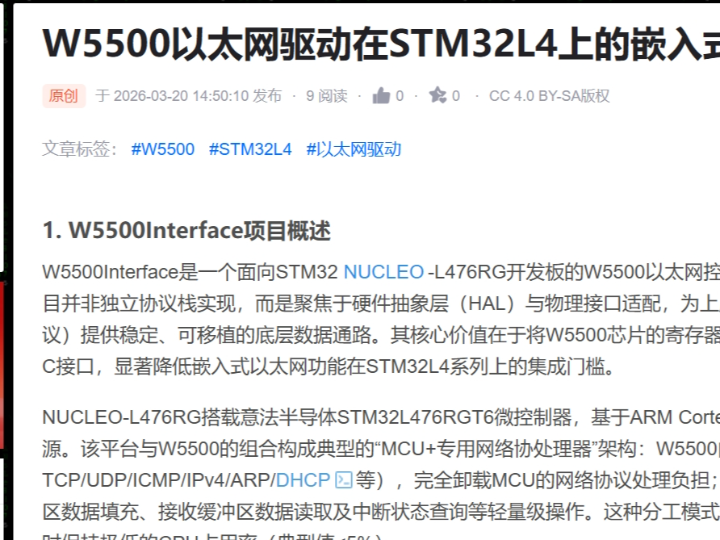
Original source: CSDN article “W5500以太网驱动在STM32L4上的嵌入式集成指南,” published March 20, 2026, under CC BY-SA 4.0.
Supporting references: WIZnet W5500 official documentation and the official ioLibrary_Driver repository.
Tags
#W5500 #STM32 #STM32L4 #WIZnet #EmbeddedEthernet #NetworkStack #ProtocolHandling #SPI #SocketProgramming #Education
STM32에서 W5500 네트워크 스택과 프로토콜 처리를 어떻게 학습할 수 있을까?
Summary
이 교육용 프로젝트는 STM32L4 플랫폼에 WIZnet W5500을 통합하고, 이를 애플리케이션 하부의 하드웨어 네트워크 엔진으로 사용하는 방법을 설명합니다. 원문은 드라이버 구조, 레지스터 매핑, 소켓 제어, 그리고 STM32 HAL 계층과 상위 프로토콜 소프트웨어 사이의 경계에 초점을 맞추고 있어, W5500이 Ethernet 전송을 처리하고 MCU는 제어 흐름과 애플리케이션 로직을 담당하는 구조를 학습하기에 적합합니다.
What the Project Does
이 소스 글은 완성형 제품이 아니라, STM32 NUCLEO-L476RG에서 W5500을 통합하는 가이드를 제공합니다. 목적은 SPI 타이밍 제어, GPIO 처리, 인터럽트 대응, 메모리 접근을 표준화된 C 드라이버 계층으로 묶어 STM32L4에서 안정적이고 이식 가능한 저수준 Ethernet 경로를 만드는 것입니다. 글에서도 분명히 밝히듯, 이것은 독립적인 전체 프로토콜 스택 구현이 아니라 LwIP, uIP, 또는 자체 경량 프로토콜 같은 상위 소프트웨어를 위한 하드웨어 접속 계층입니다.
교육 관점에서 이 점이 오히려 유용합니다. 이 자료는 임베디드 설계에서 네트워크 스택의 경계가 실제로 어디에 있는지를 보여줍니다. STM32는 SPI 트랜잭션, GPIO 제어, 시스템 오케스트레이션을 담당하고, W5500은 Ethernet MAC/PHY와 hardwired TCP/IP socket engine을 담당합니다. 따라서 학습자는 MCU에 전체 소프트웨어 TCP/IP 스택을 먼저 포팅하지 않아도, 레지스터 수준의 네트워크 초기화, 소켓 상태 전이, 버퍼 이동 구조를 이해할 수 있습니다.
Where WIZnet Fits
이 설계에서 사용된 정확한 WIZnet 제품은 W5500입니다. STM32 기반 구조에서 W5500은 SPI로 연결되는 전용 Ethernet controller 역할을 하며, 내장 10/100 Ethernet MAC/PHY, hardwired TCP/IP 지원, 8개의 독립 소켓, 32 KB 내부 Tx/Rx 버퍼 메모리를 제공합니다. WIZnet 공식 문서에 따르면 SPI는 최대 80 MHz까지 지원하며, SPI mode 0 또는 3에서 동작할 수 있습니다.
이 역할은 글의 아키텍처 중심에 있습니다. 원문은 이 조합을 “MCU + dedicated network coprocessor” 모델로 설명합니다. 즉 STM32가 전체 네트워크 프로토콜을 소프트웨어로 실행하는 것이 아니라, 설정 레지스터를 쓰고, 송수신 버퍼를 관리하고, 소켓 및 인터럽트 상태를 점검하는 동안, W5500이 전송 계층 쪽 작업을 수행하는 구조입니다. 글은 이 방식이 STM32L4의 CPU 부하를 매우 낮게 유지하고, HAL SPI 및 GPIO 호출 몇 개에만 의존하므로 STM32 계열 간 이식성도 좋다고 주장합니다.
프로토콜 처리 측면에서 교육적 가치는 W5500이 socket-based networking을 노출한다는 점에 있습니다. WIZnet 자료에서도 ioLibrary를 MCU-독립형 지원 라이브러리로 설명하며, socket 스타일 API와 DHCP, DNS, MQTT, SNTP, TFTP, HTTP server 같은 상위 서비스를 제공합니다. 그래서 W5500은 저수준 하드웨어 제어, socket 추상화, 그리고 선택적 상위 서비스가 임베디드 Ethernet 설계 안에서 어떻게 결합되는지를 보여주기에 좋은 학습 플랫폼입니다.
Implementation Notes
완전한 검증 가능한 저장소가 제공된 것은 아니므로, 정확한 파일 경로를 독립적으로 확인할 수는 없습니다. 다만 글에서는 드라이버가 w5500.h, w5500_socket.h, w5500_buffer.h 같은 레지스터, 소켓, 버퍼 계층으로 나뉜다고 설명하며, 전형적인 W5500 드라이버 구조와 일치하는 구체적 API 예시를 제시합니다.
글에서 중요한 부분 중 하나는 소켓 레지스터 모델입니다. 원문은 Sn_MR을 프로토콜 선택, Sn_CR을 명령 실행, Sn_SR을 런타임 상태, Sn_PORT를 로컬 포트 설정, Sn_DIPR와 Sn_DPORT를 원격 주소, Sn_TX_FSR을 사용 가능한 송신 버퍼 공간, Sn_RX_RSR을 미처리 수신 데이터로 설명합니다. 프로토콜 처리를 학습할 때 이 점이 중요한 이유는 전송 상태 머신이 눈에 보이기 때문입니다. 프로토콜 모드는 명시적으로 선택되고, 명령도 명시적으로 내려지며, 드라이버는 소켓 상태가 기대한 값으로 바뀔 때까지 진행해서는 안 됩니다.
API 계층 역시 STM32에서 프로토콜 경로가 어떻게 사용되는지 보여줍니다. 글에는 w5500_socket(), w5500_connect(), w5500_listen(), w5500_send(), w5500_recv(), w5500_getsockopt() 같은 함수가 나옵니다. 더 중요한 것은 그 제약 조건을 함께 설명한다는 점입니다. w5500_socket() 호출 후 TCP 소켓은 INIT 상태일 뿐이며, 실제 데이터 전송을 하려면 반드시 w5500_listen() 또는 w5500_connect()를 추가로 호출해야 합니다. 또한 w5500_send()는 Sn_TX_FSR에 충분한 여유 공간이 있을 때만 동작하고, 수신 데이터는 Sn_RX_RSR을 polling하여 감지한다고 설명합니다. 이는 소켓 상태 기반 임베디드 네트워킹을 가르치기에 매우 좋은 예입니다.
SPI 계층도 단순한 보드 bring-up이 아니라 프로토콜 아키텍처의 일부로 다뤄집니다. 글에서는 w5500_read_reg(), w5500_write_reg(), w5500_read_buf(), w5500_write_buf() 같은 저수준 루틴을 제시하며, 테스트된 STM32L476RG 환경에서는 SPI1을 40 MHz로 운용했다고 설명합니다. 공식적으로 W5500은 최대 80 MHz를 지원하지만, 교육 관점에서는 이 부분이 중요합니다. 칩 사양이 이론적 상한을 제시하더라도, 실제로 안전한 동작은 MCU 클록 구조, 보드 라우팅, 검증 수준에 따라 달라진다는 점을 보여주기 때문입니다.
Practical Tips / Pitfalls
- W5500을 전체 애플리케이션 프레임워크가 아니라 전송 엔진으로 봐야 합니다. 원문도 이 드라이버 계층이 LwIP, uIP, 또는 커스텀 로직 아래에 놓이는 저수준 통합층이라고 분명히 설명합니다.
- 소켓 명령을 내린 직후 바로 성공했다고 가정하면 안 됩니다. 글에서는
Sn_CR이 write-trigger 후 self-clearing 되므로, 드라이버는Sn_SR이 기대 상태에 도달할 때까지 기다려야 한다고 설명합니다. - 송신 전에는
Sn_TX_FSR, 수신 전에는Sn_RX_RSR을 확인해야 합니다. 이 두 레지스터는 버퍼 흐름을 파악하는 핵심 지점이며, W5500이 socket engine과 MCU 사이에서 데이터를 어떻게 이동시키는지 이해하는 중심입니다. - 하드웨어 통합 문제와 프로토콜 문제를 분리해서 봐야 합니다. SPI 타이밍, chip-select 처리, 레지스터 readback 검증은 보드 bring-up 문제이고, 소켓 상태 전이와 패킷 흐름은 프로토콜 처리 문제입니다. 학습자들은 디버깅 과정에서 이 둘을 자주 혼동합니다.
- 초기 bring-up 단계에서는 SPI mode와 클록을 보수적으로 잡는 편이 좋습니다. W5500은 SPI mode 0과 3, 최대 80 MHz를 지원하지만, 글의 STM32L476RG 예제는 40 MHz 동작을 검증한 수준이며, 교육 및 실험용 시작점으로 더 현실적입니다.
- W5500의 socket 지원이 애플리케이션 설계까지 대신해 주는 것은 아닙니다. WIZnet 생태계는 DHCP, DNS, MQTT, SNTP, TFTP, HTTP server 같은 서비스를 제공하지만, 개발자는 여전히 애플리케이션 로직과 서비스 통합을 올바르게 설계해야 합니다.
FAQ
Q: STM32 교육 프로젝트에서 왜 W5500을 사용하나요?
A: MCU에서 모든 네트워크 처리를 소프트웨어 스택으로 돌리는 방식보다, 임베디드 Ethernet을 더 명확하게 이해할 수 있기 때문입니다. 학생들은 레지스터 설정, 소켓 상태 제어, 버퍼 관리, SPI 전송을 분리해서 볼 수 있고, hardwired TCP/IP 처리는 W5500이 맡습니다.
Q: 이 프로젝트에서 W5500은 STM32에 어떻게 연결되나요?
A: SPI로 연결되며, HAL_SPI_TransmitReceive(), HAL_GPIO_WritePin(), HAL_GPIO_ReadPin() 같은 STM32 HAL 의존 계층을 통해 제어됩니다. 원문도 의존 범위를 작게 유지했기 때문에 여러 STM32 계열로 이식하기 쉽다고 설명합니다.
Q: 이 STM32 프로젝트에서 W5500은 구체적으로 어떤 역할을 하나요?
A: W5500은 STM32 애플리케이션 아래에서 동작하는 Ethernet controller이자 socket-processing engine입니다. MCU는 레지스터 설정, 데이터 이동, 제어 흐름을 담당하고, W5500은 hardwired transport-side networking과 socket 자원을 제공합니다.
Q: 초보자도 따라갈 수 있나요?
A: 가능합니다. 다만 기본적인 SPI, 레지스터 접근, TCP와 UDP 소켓 동작 차이를 알고 있으면 훨씬 이해하기 쉽습니다. 이 자료는 초보용 배선 튜토리얼이라기보다 드라이버 통합과 프로토콜 아키텍처를 설명하는 가이드에 가깝습니다.
Q: STM32에서 LwIP만으로 구현하는 방식과 비교하면 어떤 차이가 있나요?
A: 원문은 이 드라이버를 LwIP 또는 커스텀 경량 프로토콜 아래에 놓을 수 있는 하위 계층으로 설명하고, W5500 공식 포지셔닝은 hardwired TCP/IP socket capability를 제공하는 칩입니다. 실무적으로 보면 W5500은 STM32의 프로토콜 처리 부담을 줄일 수 있고, 반대로 순수 LwIP 설계는 소프트웨어 스택 내부를 더 깊게 학습할 수 있지만 MCU가 감당해야 할 네트워킹 작업은 더 많아집니다.
Source
Original source: CSDN article “W5500以太网驱动在STM32L4上的嵌入式集成指南,” published March 20, 2026.
License: CC BY-SA 4.0
Supporting references: WIZnet W5500 official documentation and the official ioLibrary_Driver repository.
Tags
#W5500 #STM32 #STM32L4 #WIZnet #EmbeddedEthernet #NetworkStack #ProtocolHandling #SPI #SocketProgramming #Education