



How to Build Secure Local Data Storage with W5500 on an MCU Edge Device?
This project describes a maker-oriented edge-device architecture that combines the W5500 with local encryption and integrity checks so an MCU-class system can k
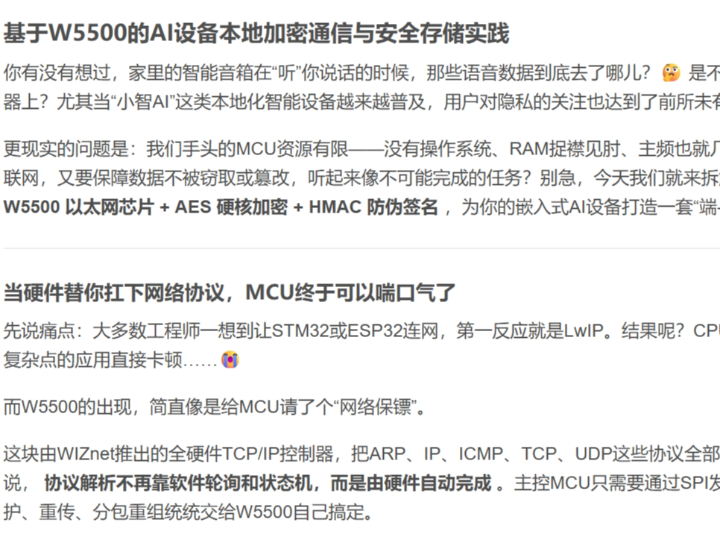
How to Build Secure Local Data Storage with W5500 on an MCU Edge Device?
Summary
This project describes a maker-oriented edge-device architecture that combines the W5500 with local encryption and integrity checks so an MCU-class system can keep network communication lightweight while protecting sensitive data at rest. In this design, the W5500 handles wired TCP/IP connectivity and socket transport, while the MCU uses AES-based encryption, HMAC verification, and external storage control to keep local AI or voice data protected.
What the Project Does
The source presents a local security architecture for an AI edge device that needs to store sensitive data such as voice-related features or user behavior records without relying entirely on cloud services. The stated design goal is to let a small MCU maintain stable Ethernet connectivity through the W5500 while encrypting local data before it is written to flash and verifying integrity through HMAC during later reads or boot-time checks.
Architecturally, the system is divided into three layers: an application layer that produces AI or voice data, a security middleware layer that performs AES encryption, HMAC-SHA256 signing, and key management, and a hardware layer built from the MCU, the W5500 Ethernet interface, and SPI flash. The article’s data flow is explicit: plaintext is generated locally, encrypted, signed, stored with IV and HMAC, and optionally transmitted later over a TCP connection established through the W5500.
For maker use, the important point is that this is not just a networking example and not just a crypto example. It is a practical split between communication offload and local data protection on resource-constrained hardware. The article explicitly frames the target as MCU-class devices with limited RAM and clock speed, where a simpler Ethernet path helps leave more CPU time for AI or application logic.
Where WIZnet Fits
The exact WIZnet product here is the W5500. In this architecture, it is the wired transport engine rather than the security engine. It handles Ethernet connectivity, TCP socket setup, and ongoing link management so the MCU does not need to run a full software TCP/IP stack while also managing encryption and storage. The article’s own initialization example uses W5500 register calls such as setSHAR, setSIPR, setSUBR, setGAR, setPHYCFGR, socket, and connect, which makes its role in the system concrete.
That separation matters on small boards. The article claims that W5500 reduces CPU overhead compared with software-stack approaches and positions it as a way to preserve MCU resources for application-side tasks. The source also claims support for eight sockets, 8 KB per socket cache, sub-10% CPU usage, and throughput near 80 Mbps at a 70 MHz SPI clock, but those numbers are presented in the article without linked measurement methodology, so they should be treated as article claims rather than independently verified benchmarks.
For a maker edge device, W5500 is a good fit when the design priority is predictable wired networking and a clean software boundary. The MCU remains responsible for key handling, encryption workflow, HMAC validation, and flash writes, while W5500 keeps the network side close to a socket-driven control model instead of a full software networking stack. That division is the main architectural value in this project.
Implementation Notes
This project does use WIZnet products, and the article includes visible code snippets, but it does not provide a public repository with file paths or line-addressable source files. I therefore cannot verify a repository-backed codebase. The implementation details below are limited to what is explicitly visible in the article itself.
The first visible implementation element is a W5500 initialization routine shown inline in the article:
void W5500_Init(void) { ... setSHAR(mac); setSIPR(ip); setSUBR(sn); setGAR(gw); setPHYCFGR(PHYCFGR_DEFAULT); socket(0, Sn_MR_TCP, 5000, 0); connect(0, remote_ip, 5001); }
Why it matters: this shows the intended transport boundary very clearly. The MCU initializes SPI, resets the W5500, programs MAC and IPv4 settings, enables PHY auto-negotiation, then opens a TCP socket through the W5500. That is the network side of the system, and it exists to support the secure edge workflow rather than to dominate firmware complexity.
The second visible implementation element is the local encryption wrapper shown in the article:
int encrypt_data(const uint8_t *plain, int len, uint8_t *cipher) { aes_set_key(&aes_ctx, key, 256); return aes_crypt_cbc(&aes_ctx, AES_ENCRYPT, len, iv, plain, cipher); }
Why it matters: this confirms that the project’s security model is application-layer encryption plus integrity checking on top of W5500-based transport, not transport-layer security implemented inside the Ethernet chip. The W5500 moves data; the MCU-side security layer protects what is stored and what may later be sent.
The article also gives the higher-level storage path: data is generated by the application, encrypted, signed with HMAC, then written to external flash together with IV and integrity metadata. On boot, stored data is checked again through HMAC validation, and the device enters a lock state if verification fails. That is the core system behavior here, and it explains why W5500 is paired with encryption rather than presented as a standalone networking feature.
Practical Tips / Pitfalls
Do not treat W5500 as a security feature by itself. In this design, it provides Ethernet transport only; AES, HMAC, and key handling are implemented outside the W5500.
Be careful with the article’s performance numbers. The source makes strong claims about low CPU load and high throughput, but it does not publish benchmark conditions or measurement data.
Never hardcode encryption keys in normal firmware flash. The article explicitly warns against that and recommends injected per-device keys or derivation from MCU identity.
Do not reuse IVs in CBC mode. The source explicitly says IVs must be different and unpredictable for each encryption operation.
Keep flash writes atomic when storing encrypted records. The article recommends temporary-page writing and pointer switching to avoid partial ciphertext writes after power loss.
Validate integrity before trusting stored data. The article’s boot-time HMAC verification and lock-on-failure behavior are important because encryption alone does not stop tampering.
FAQ
Why use the W5500 in this project?
Because the project needs wired TCP/IP connectivity on a small MCU that is already busy handling encryption, integrity checks, and local storage logic. The W5500 keeps network handling simple and hardware-assisted so the MCU can spend more time on application and security functions.
How does it connect to the platform?
The article shows the W5500 being brought up through SPI initialization and reset, followed by register-level configuration for MAC address, IP address, subnet mask, gateway, PHY configuration, and socket setup. That means the platform interface is an external MCU plus SPI-controlled W5500 network controller.
What role does it play in this specific project?
It is the communication layer for secure local AI data handling. The device uses W5500 to maintain TCP connectivity, while the MCU encrypts local records, computes HMAC signatures, stores ciphertext in flash, and optionally transmits protected data later.
Can beginners follow this project?
Yes, but it is better suited to makers who already understand SPI peripherals, TCP socket basics, and elementary cryptography concepts. The networking side is relatively approachable because W5500 keeps it socket-oriented, but the full project also requires careful handling of keys, IVs, and storage integrity.
How does this compare with LwIP?
The article explicitly positions W5500 as a lower-overhead alternative to a software-stack approach on small MCUs. That can simplify integration, but the article does not provide side-by-side measurements. The defensible comparison is architectural: LwIP gives more software flexibility, while W5500 reduces stack burden and keeps the firmware model closer to register setup plus socket operations.
Source
Original link: CSDN article “W5500以太网接入实现小智AI本地数据加密存储安全架构.” The page states CC 4.0 BY-SA and presents a W5500-based local encryption and storage architecture for an MCU-class AI edge device.
Tags
W5500, WIZnet, Embedded Ethernet, Secure Storage, AES, HMAC, Edge AI, Maker, TCP Socket, SPI Flash, Local Data Protection, MCU Security