



How to Build Commercial Alibaba Cloud MQTT Connectivity with WIZnet W5500 on STM32F103?
This project combines an STM32F103C8T6, WIZnet W5500, and an MQTT client to publish and subscribe to messages through Alibaba Cloud IoT.
How to Build Commercial Alibaba Cloud MQTT Connectivity with WIZnet W5500 on STM32F103?
Summary
This project combines an STM32F103C8T6, WIZnet W5500, and an MQTT client to publish and subscribe to messages through Alibaba Cloud IoT. STM32 runs the application, MQTT packet handling, cloud authentication, telemetry formatting, command validation, and recovery logic. W5500 provides the 10/100 Ethernet MAC/PHY, hardwired TCP/IP processing, eight hardware sockets, and 32 KB of network buffer memory. The GitCode repository identifies an MQTT client, W5500 driver integration, Alibaba Cloud connectivity, and a downloadable project archive, but the archive contents are not directly inspectable through the accessible repository view.
What the Project Does
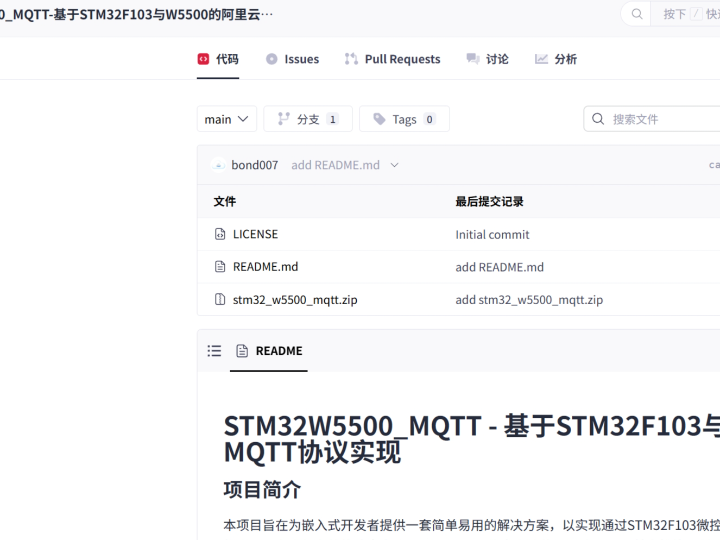
The project provides an STM32F103-based MQTT client that communicates with Alibaba Cloud through W5500 Ethernet. Its README describes publish and subscribe support, an integrated W5500 driver, simplified application interfaces, and configuration through Keil MDK or another compatible STM32 environment. The repository contains README.md, LICENSE, and stm32_w5500_mqtt.zip, with an MIT license marker and three recorded commits.
The commercial data path is:
Sensor or machine state → STM32 application → telemetry encoding → MQTT packet layer → W5500 TCP socket → SPI → W5500 → RJ45 Ethernet → router or industrial gateway → Alibaba Cloud MQTT broker
The command path operates in reverse:
Alibaba Cloud topic → MQTT broker connection → W5500 TCP socket → STM32 MQTT parser → topic and payload validation → controlled application action
An indexed listing of the associated archive shows files such as main.c, spi.c, w5500.c, w5500api.c, socket.c, mqtt_api.c, MQTTPacket.c, MQTTConnectClient.c, MQTTSerializePublish.c, MQTTSubscribeClient.c, dhcp.c, dns.c, cJSON.c, and the STM32F10x Standard Peripheral Library. The listing exposes filenames rather than inspectable project source, so exact pin assignments, broker parameters, buffer sizes, and reconnect logic cannot be verified from the archive itself.
For a commercial product, the software should be divided into clear layers:
Board support for SPI, reset, interrupt, timing, watchdog, and nonvolatile storage
W5500 register and socket driver
DHCP or static-IP configuration and DNS resolution
MQTT transport, packet encoding, keepalive, publish, and subscribe logic
Alibaba Cloud authentication and topic mapping
Product telemetry, command validation, diagnostics, and recovery
This separation prevents cloud-specific strings, product logic, and hardware access from becoming tightly coupled to the W5500 driver.
Where WIZnet Fits
The exact WIZnet product is W5500. It connects to STM32F103 through SPI and sits between the application firmware and the wired Ethernet network.
W5500 integrates a 10/100 Ethernet MAC and PHY, hardwired TCP, UDP, ICMP, IPv4, ARP, IGMP, and PPPoE processing, eight independent sockets, and 32 KB of internal Tx/Rx memory. Its SPI interface supports modes 0 and 3 at up to 80 MHz. WIZnet also publishes an MCU-independent driver with DHCP, DNS, MQTT, SNTP, TFTP, and HTTP server components.
The division of responsibility is:
STM32F103
Initializes SPI, GPIO, timers, interrupts, and watchdogs
Builds MQTT CONNECT, PUBLISH, SUBSCRIBE, PING, and DISCONNECT flows
Generates Alibaba Cloud authentication parameters
Validates topics, payload lengths, JSON fields, commands, and device state
Stores credentials and configuration
Controls reconnect timing and operational fallback
W5500
Maintains the physical Ethernet link
Processes ARP, IPv4, and TCP
Maintains socket connection states and retransmissions
Buffers network data independently of STM32 SRAM
Reports link, socket, interrupt, and buffer conditions through registers
This boundary is useful on STM32F103C8T6 because the MCU has a 72 MHz Cortex-M3 core, 64 KB of Flash, and up to 20 KB of SRAM. Moving TCP/IP state and packet buffering into W5500 preserves more MCU memory for MQTT packets, application data, diagnostics, and product control.
A commercial security limitation remains: W5500 offloads TCP/IP but not TLS. Current Alibaba Cloud guidance strongly recommends TLS 1.2 or 1.3 and warns that direct unencrypted TCP access is insecure and being withdrawn. A direct TLS implementation on a 64 KB Flash, 20 KB SRAM STM32F103C8 is therefore a constrained engineering choice; memory usage, handshake time, certificate validation, and reconnect behavior must be measured before deployment.
Implementation Notes
The repository confirms that W5500 and MQTT are used, but its ZIP archive is not inspectable through the accessible GitCode page. The following short snippet is therefore taken from WIZnet’s official ioLibrary_Driver, not presented as project-specific code.
File: Internet/MQTT/mqtt_interface.c
What it configures: binding an MQTT network object to a selected W5500 socket and its read, write, and disconnect functions.
Why it matters: this is the boundary between the MQTT packet library and W5500’s hardware TCP socket.
void NewNetwork(Network* n, int sn) {
    n->my_socket = sn;
    n->mqttread = w5x00_read;
    n->mqttwrite = w5x00_write;
    n->disconnect = w5x00_disconnect;
}
The same official source checks Sn_SR for SOCK_ESTABLISHED, checks Sn_RX_RSR before reading, and maps MQTT transport operations to WIZnet send(), recv(), connect(), and disconnect() calls. This code exists so the MQTT library can remain transport-independent while W5500 owns the TCP connection.
Hardware interface
Connect STM32 SPI signals to W5500 SCLK, MOSI, MISO, and SCSn. Connect RSTn to a controllable GPIO so firmware can reset the network subsystem without rebooting the entire product. Connecting INTn is recommended when receive, disconnect, timeout, or send-complete events should be handled without constant polling. The Ethernet side must follow WIZnet’s transformer or integrated-magnetics RJ45 reference circuit.
Commercial bring-up should proceed in this order:
Confirm power, reset timing, and stable SPI communication.
Read W5500 VERSIONR.
Inspect PHYCFGR for link, speed, and duplex.
Configure MAC address, gateway, subnet mask, and local IP.
Resolve the MQTT endpoint or load a configured broker address.
Open a TCP socket and verify Sn_SR.
Perform MQTT authentication and subscription.
Start telemetry publication and command processing.
Register strategy
Useful diagnostic registers include:
VERSIONR for digital-interface verification
PHYCFGR for PHY link, speed, and duplex
SIPR, SUBR, GAR, and SHAR for network identity
Sn_MR for socket mode
Sn_CR for OPEN, CONNECT, SEND, RECV, and CLOSE
Sn_SR for current socket state
Sn_IR for connect, receive, disconnect, timeout, and send-complete events
Sn_TX_FSR and Sn_RX_RSR for buffer availability
These values should be included in field diagnostics. A generic “MQTT disconnected” message is insufficient because the underlying failure may be SPI communication, PHY link, DHCP, DNS, TCP connection, authentication, keepalive, or broker policy.
Firmware architecture
Use a nonblocking state machine rather than a single function that waits indefinitely for the cloud connection. A practical sequence is:
LINK_WAIT → IP_CONFIG → DNS_RESOLVE → TCP_CONNECT → MQTT_CONNECT → SUBSCRIBE → ONLINE → BACKOFF
The ONLINE state should service MQTT keepalive, receive subscribed messages, publish queued telemetry, and monitor socket status. Any failure should record a reason before moving to bounded exponential backoff. The product’s local control function should continue safely while cloud communication is unavailable.
Alibaba Cloud’s MQTT interface supports publish, subscribe, ping, connect, disconnect, and unsubscribe operations, with platform-specific differences in MQTT features and QoS behavior. Product firmware should be tested against the current platform rules rather than assuming that every standard MQTT feature is available.
Performance validation
The repository describes the project as efficient and low-latency, but it provides no packet size, SPI frequency, publication interval, broker region, reconnect time, CPU load, or sustained-throughput measurements. Those statements should not be treated as verified performance results.
Measure at least:
SPI transfer rate and CPU time per W5500 transaction
MQTT CONNECT and subscription time
Publish latency at QoS 0 and QoS 1
Maximum sustainable message rate
Maximum payload size
W5500 Tx/Rx buffer occupancy
Reconnect time after cable, router, DNS, or broker failure
SRAM and Flash consumption with and without TLS
Watchdog margin during authentication and reconnect
Long-run packet loss, duplicate delivery, and command latency
The W5500’s 80 MHz SPI rating is a controller limit, not the guaranteed rate of this STM32F103 design. Actual throughput is constrained by the STM32 SPI peripheral clock, driver implementation, transaction overhead, MQTT packet size, TCP acknowledgements, cloud latency, and any TLS processing.
Practical Tips / Pitfalls
Validate VERSIONR, PHYCFGR, IP configuration, and TCP socket state before debugging MQTT authentication.
Store device credentials in protected nonvolatile storage and never include production secrets in public firmware images or logs.
Use bounded reconnect backoff with jitter so a fleet does not reconnect simultaneously after an outage.
Reserve W5500 sockets explicitly for MQTT, DNS, DHCP, diagnostics, provisioning, and future maintenance functions.
Validate subscribed topic names, payload lengths, JSON fields, numeric ranges, and device operating state before executing commands.
Test cable removal, DHCP failure, DNS failure, bad credentials, expired certificates, broker rejection, duplicate IP, router restart, and long broker outages.
Record link state, IP address, socket state, MQTT return code, reconnect count, last successful publish, and watchdog reset reason.
FAQ
Q: Why use WIZnet W5500 for this commercial MQTT product?
A: W5500 gives STM32F103 a 10/100 Ethernet interface, hardwired TCP/IP processing, eight sockets, and 32 KB of packet memory. This reduces the MCU’s responsibility for TCP state, retransmission, ARP, and packet buffering, which is useful on an STM32F103C8 with limited Flash and SRAM. It also makes the lower network boundary observable through explicit registers and socket states.
Q: How does W5500 connect to STM32F103?
A: It connects through SPI using SCLK, MOSI, MISO, and SCSn, plus RSTn and optionally INTn. The physical Ethernet path uses W5500’s embedded PHY with approved magnetics and RJ45 circuitry. Firmware should control reset and verify the version and PHY registers before opening a socket.
Q: What role does W5500 play in this project?
A: W5500 carries the MQTT TCP connection between STM32 and Alibaba Cloud. It handles Ethernet, ARP, IPv4, TCP state, retransmission, sockets, and network buffers. STM32 remains responsible for MQTT packets, cloud authentication, topic mapping, telemetry, command validation, TLS when required, and product recovery behavior.
Q: Can beginners follow this project?
A: The basic MQTT demonstration is approachable for developers familiar with STM32, SPI, C, and TCP sockets. A commercial implementation additionally requires experience with watchdogs, credential storage, TLS, certificate validation, nonblocking state machines, fault injection, production logging, and long-duration reliability testing.
Q: How does W5500 compare with ENC28J60 and LwIP?
A: ENC28J60 is a 10Base-T Ethernet controller with an SPI interface up to 20 MHz and 8 KB of packet RAM. It includes the MAC and PHY but not a hardwired TCP/IP socket engine, so TCP/IP must run on the host. W5500 provides 10/100 Ethernet, eight hardware sockets, hardwired TCP/IP, 32 KB of packet memory, and a faster host-interface ceiling, making it a more direct fit for an STM32F103 MQTT endpoint.
LwIP is a software TCP/IP stack rather than an Ethernet chip. It provides IPv4/IPv6, TCP, UDP, DHCP, DNS, MQTT, optional TLS integration, and configurable memory pools, but those functions consume MCU Flash, RAM, and processing time. It also requires a compatible network interface such as an MCU Ethernet MAC plus PHY or a lower-level external controller. LwIP offers greater protocol and buffer control; W5500 provides a smaller and more explicit offload boundary. On STM32F103C8, memory requirements for LwIP, MQTT, application logic, and TLS must be evaluated carefully.
Source
Original project: GitCode, “STM32W5500_MQTT — 基于STM32F103与W5500的阿里云MQTT协议实现.” The repository identifies STM32F103C8T6, W5500 driver integration, MQTT publishing and subscription, Alibaba Cloud connectivity, a downloadable ZIP archive, and an MIT license marker.
Archive index: CSDN download listing for stm32_w5500_mqtt.zip. It exposes the package file inventory, including STM32F10x library files, W5500 drivers, socket code, MQTT packet code, DHCP, DNS, JSON, and application files, but not enough source content for project-specific quotation.
WIZnet references: Official W5500 product documentation and ioLibrary_Driver, including the hardware TCP/IP architecture, eight sockets, 32 KB buffer memory, SPI interface, reference hardware, socket APIs, and MQTT adapter. The official driver is MIT-licensed.
Cloud reference: Alibaba Cloud IoT MQTT protocol documentation, including supported operations, protocol differences, authentication flow, and current TLS guidance.
Comparison references: Microchip ENC28J60 datasheet and official lwIP documentation.
Tags
#W5500 #WIZnet #STM32F103 #MQTT #AlibabaCloud #CommercialIoT #Ethernet #ENC28J60 #LwIP #Firmware #NetworkStack #TLS
STM32F103에서 WIZnet W5500으로 상용 Alibaba Cloud MQTT 연결을 구축하는 방법은?
요약
이 프로젝트는 STM32F103C8T6, WIZnet W5500, MQTT client를 결합해 Alibaba Cloud IoT에서 message를 publish하고 subscribe합니다. STM32는 application, MQTT packet handling, cloud authentication, telemetry formatting, command validation, recovery logic을 실행합니다. W5500은 10/100 Ethernet MAC/PHY, hardwired TCP/IP processing, 8개 hardware socket, 32KB network buffer memory를 제공합니다. GitCode repository에서는 MQTT client, W5500 driver integration, Alibaba Cloud connectivity, downloadable project archive를 확인할 수 있지만, accessible repository view에서는 archive 내부 source를 직접 inspect할 수 없습니다.
프로젝트가 하는 일
이 프로젝트는 W5500 Ethernet을 통해 Alibaba Cloud와 통신하는 STM32F103 기반 MQTT client를 제공합니다. README는 publish 및 subscribe 지원, integrated W5500 driver, simplified application interface, Keil MDK 또는 compatible STM32 environment를 통한 configuration을 설명합니다.
Repository에는 다음 file이 포함되어 있습니다.
README.md
LICENSE
stm32_w5500_mqtt.zip
Visible page에서는 MIT license marker와 3개의 recorded commit도 확인할 수 있습니다.
상용 환경의 data path는 다음과 같습니다.
Sensor 또는 machine state → STM32 application → telemetry encoding → MQTT packet layer → W5500 TCP socket → SPI → W5500 → RJ45 Ethernet → router 또는 industrial gateway → Alibaba Cloud MQTT broker
Command path는 반대 방향으로 동작합니다.
Alibaba Cloud topic → MQTT broker connection → W5500 TCP socket → STM32 MQTT parser → topic 및 payload validation → controlled application action
연결된 archive index에서는 다음과 같은 file name을 확인할 수 있습니다.
main.c
spi.c
w5500.c
w5500api.c
socket.c
mqtt_api.c
MQTTPacket.c
MQTTConnectClient.c
MQTTSerializePublish.c
MQTTSubscribeClient.c
dhcp.c
dns.c
cJSON.c
STM32F10x Standard Peripheral Library
하지만 해당 listing은 filename만 제공하며, inspect 가능한 project source를 제공하지 않습니다. 따라서 정확한 pin assignment, broker parameter, buffer size, reconnect logic은 archive 자체에서 검증할 수 없습니다.
상용 제품에서는 software를 다음 layer로 분리하는 것이 적절합니다.
SPI, reset, interrupt, timing, watchdog, nonvolatile storage를 위한 board support
W5500 register 및 socket driver
DHCP 또는 static IP configuration과 DNS resolution
MQTT transport, packet encoding, keepalive, publish, subscribe logic
Alibaba Cloud authentication 및 topic mapping
Product telemetry, command validation, diagnostics, recovery
이러한 분리는 cloud-specific string, product logic, hardware access가 W5500 driver와 지나치게 결합되는 것을 방지합니다.
WIZnet이 들어가는 위치
이 프로젝트에서 사용하는 정확한 WIZnet 제품은 W5500입니다. W5500은 SPI를 통해 STM32F103에 연결되며 application firmware와 wired Ethernet network 사이에 위치합니다.
W5500은 다음 기능을 통합합니다.
10/100 Ethernet MAC 및 PHY
Hardwired TCP, UDP, ICMP, IPv4, ARP, IGMP, PPPoE processing
8개 independent socket
32KB internal Tx/Rx memory
SPI mode 0 및 mode 3
최대 80MHz SPI operation
WIZnet은 W5500과 함께 사용할 수 있는 MCU-independent driver도 제공합니다. 해당 driver에는 DHCP, DNS, MQTT, SNTP, TFTP, HTTP server component가 포함됩니다.
역할은 다음과 같이 나뉩니다.
STM32F103
SPI, GPIO, timer, interrupt, watchdog 초기화
MQTT CONNECT, PUBLISH, SUBSCRIBE, PING, DISCONNECT flow 생성
Alibaba Cloud authentication parameter 생성
Topic, payload length, JSON field, command, device state 검증
Credential 및 configuration 저장
Reconnect timing 및 operational fallback 제어
W5500
Physical Ethernet link 유지
ARP, IPv4, TCP 처리
Socket connection state 및 retransmission 유지
STM32 SRAM과 독립적으로 network data buffering
Register를 통해 link, socket, interrupt, buffer condition 보고
이 경계는 STM32F103C8T6에서 특히 유용합니다. 이 MCU는 72MHz Cortex-M3 core, 64KB Flash, 최대 20KB SRAM을 제공합니다. TCP/IP state와 packet buffering을 W5500에서 처리하면 MQTT packet, application data, diagnostics, product control에 더 많은 MCU memory를 사용할 수 있습니다.
다만 상용 보안 측면에서 제한이 있습니다. W5500은 TCP/IP를 offload하지만 TLS를 자체 처리하지는 않습니다. 현재 Alibaba Cloud guidance는 TLS 1.2 또는 1.3 사용을 강하게 권장하며, 암호화되지 않은 direct TCP connection은 안전하지 않다고 설명합니다.
따라서 64KB Flash와 20KB SRAM을 가진 STM32F103C8에서 direct TLS를 구현하려면 다음 항목을 반드시 측정해야 합니다.
Memory usage
TLS handshake time
Certificate validation cost
Reconnect behavior
Application task와의 resource competition
구현 참고 사항
Repository에서 W5500과 MQTT 사용은 확인할 수 있지만, ZIP archive는 accessible GitCode page에서 inspect할 수 없습니다. 따라서 아래 snippet은 project-specific code가 아니라 WIZnet 공식 ioLibrary_Driver에서 가져온 reference입니다.
파일: Internet/MQTT/mqtt_interface.c
설정 내용: MQTT network object를 선택된 W5500 socket과 read, write, disconnect function에 연결
중요한 이유: MQTT packet library와 W5500 hardware TCP socket 사이의 경계를 구성합니다.
void NewNetwork(Network* n, int sn) {
    n->my_socket = sn;
    n->mqttread = w5x00_read;
    n->mqttwrite = w5x00_write;
    n->disconnect = w5x00_disconnect;
}
같은 공식 source는 Sn_SR이 SOCK_ESTABLISHED인지 확인하고, read 전에 Sn_RX_RSR을 검사하며, MQTT transport operation을 WIZnet의 send(), recv(), connect(), disconnect()에 연결합니다.
이 코드가 존재하는 이유는 MQTT library를 transport-independent하게 유지하면서 W5500이 TCP connection을 담당하게 하기 위해서입니다.
Hardware interface
STM32 SPI signal은 다음 W5500 signal에 연결합니다.
SCLK
MOSI
MISO
SCSn
RSTn은 controllable GPIO에 연결해 전체 product를 reboot하지 않고 network subsystem만 reset할 수 있게 해야 합니다.
Receive, disconnect, timeout, send-complete event를 constant polling 없이 처리해야 한다면 INTn 연결도 권장됩니다.
Ethernet 측은 WIZnet의 transformer 또는 integrated-magnetics RJ45 reference circuit을 따라야 합니다.
상용 bring-up은 다음 순서로 진행하는 것이 좋습니다.
Power, reset timing, stable SPI communication을 확인합니다.
W5500 VERSIONR을 읽습니다.
PHYCFGR에서 link, speed, duplex를 확인합니다.
MAC address, gateway, subnet mask, local IP를 설정합니다.
MQTT endpoint를 resolve하거나 configured broker address를 불러옵니다.
TCP socket을 열고 Sn_SR을 확인합니다.
MQTT authentication 및 subscription을 수행합니다.
Telemetry publication과 command processing을 시작합니다.
Register strategy
현장 진단에 유용한 register는 다음과 같습니다.
VERSIONR: digital interface verification
PHYCFGR: PHY link, speed, duplex
SIPR, SUBR, GAR, SHAR: network identity
Sn_MR: socket mode
Sn_CR: OPEN, CONNECT, SEND, RECV, CLOSE
Sn_SR: current socket state
Sn_IR: connect, receive, disconnect, timeout, send-complete event
Sn_TX_FSR, Sn_RX_RSR: buffer availability
이 값들은 field diagnostics에 포함해야 합니다.
단순한 “MQTT disconnected” message만으로는 충분하지 않습니다. 실제 failure 원인은 다음 중 하나일 수 있습니다.
SPI communication
PHY link
DHCP
DNS
TCP connection
Authentication
Keepalive
Broker policy
Firmware architecture
Cloud connection을 기다리며 무한정 block하는 단일 function 대신 nonblocking state machine을 사용해야 합니다.
권장 state sequence는 다음과 같습니다.
LINK_WAIT → IP_CONFIG → DNS_RESOLVE → TCP_CONNECT → MQTT_CONNECT → SUBSCRIBE → ONLINE → BACKOFF
ONLINE state에서는 다음 작업을 수행해야 합니다.
MQTT keepalive 처리
Subscribed message 수신
Queued telemetry publish
Socket status monitoring
Failure가 발생하면 reason을 기록한 뒤 bounded exponential backoff로 전환해야 합니다. Cloud communication이 중단되더라도 product의 local control function은 안전하게 계속 동작해야 합니다.
Alibaba Cloud MQTT interface는 publish, subscribe, ping, connect, disconnect, unsubscribe operation을 지원하지만, platform-specific MQTT feature와 QoS behavior 차이가 존재합니다. Product firmware는 모든 standard MQTT feature가 지원된다고 가정하지 말고 현재 platform rule을 기준으로 테스트해야 합니다.
Performance validation
Repository는 project가 efficient하고 low-latency라고 설명하지만 다음 측정 조건을 제공하지 않습니다.
Packet size
SPI frequency
Publication interval
Broker region
Reconnect time
CPU load
Sustained throughput
따라서 이러한 표현을 검증된 performance result로 취급하면 안 됩니다.
최소한 다음 항목을 측정해야 합니다.
SPI transfer rate 및 W5500 transaction당 CPU time
MQTT CONNECT 및 subscription time
QoS 0 및 QoS 1 publish latency
Maximum sustainable message rate
Maximum payload size
W5500 Tx/Rx buffer occupancy
Cable, router, DNS, broker failure 후 reconnect time
TLS 사용 여부에 따른 SRAM 및 Flash consumption
Authentication 및 reconnect 중 watchdog margin
Long-run packet loss, duplicate delivery, command latency
W5500의 80MHz SPI rating은 controller limit이지 STM32F103 design의 guaranteed throughput이 아닙니다. 실제 성능은 다음 요소에 의해 제한됩니다.
STM32 SPI peripheral clock
Driver implementation
SPI transaction overhead
MQTT packet size
TCP acknowledgement
Cloud latency
TLS processing
실무 팁 / 주의점
MQTT authentication을 debug하기 전에 VERSIONR, PHYCFGR, IP configuration, TCP socket state를 검증해야 합니다.
Device credential은 protected nonvolatile storage에 저장하고, production secret을 public firmware image나 log에 포함하면 안 됩니다.
Fleet 전체가 outage 이후 동시에 reconnect하지 않도록 jitter를 포함한 bounded reconnect backoff를 사용해야 합니다.
MQTT, DNS, DHCP, diagnostics, provisioning, future maintenance function용 W5500 socket을 명시적으로 예약해야 합니다.
Subscribed topic name, payload length, JSON field, numeric range, device operating state를 검증한 후 command를 실행해야 합니다.
Cable removal, DHCP failure, DNS failure, bad credential, expired certificate, broker rejection, duplicate IP, router restart, long broker outage를 테스트해야 합니다.
Link state, IP address, socket state, MQTT return code, reconnect count, last successful publish, watchdog reset reason을 기록해야 합니다.
FAQ
Q: 이 상용 MQTT 제품에 왜 WIZnet W5500을 사용하나요?
A: W5500은 STM32F103에 10/100 Ethernet, hardwired TCP/IP processing, 8개 socket, 32KB packet memory를 제공합니다. 따라서 MCU가 TCP state, retransmission, ARP, packet buffering을 직접 처리할 필요가 줄어듭니다. Flash와 SRAM이 제한된 STM32F103C8에서 특히 유용하며, register와 socket state를 통해 lower network boundary를 명확하게 관찰할 수 있습니다.
Q: W5500은 STM32F103에 어떻게 연결되나요?
A: SCLK, MOSI, MISO, SCSn을 사용하는 SPI로 연결하며, RSTn과 선택적인 INTn도 사용합니다. Physical Ethernet path는 W5500 embedded PHY와 approved magnetics 및 RJ45 circuit을 사용합니다. Firmware는 socket을 열기 전에 reset을 제어하고 version register와 PHY register를 확인해야 합니다.
Q: 이 프로젝트에서 W5500은 어떤 역할을 하나요?
A: W5500은 STM32와 Alibaba Cloud 사이의 MQTT TCP connection을 전달합니다. Ethernet, ARP, IPv4, TCP state, retransmission, socket, network buffer를 처리합니다. STM32는 MQTT packet, cloud authentication, topic mapping, telemetry, command validation, 필요한 경우 TLS, product recovery behavior를 담당합니다.
Q: 초보자도 이 프로젝트를 따라갈 수 있나요?
A: STM32, SPI, C, TCP socket에 익숙한 개발자는 기본 MQTT demonstration을 따라갈 수 있습니다. 상용 구현에는 watchdog, credential storage, TLS, certificate validation, nonblocking state machine, fault injection, production logging, 장시간 reliability testing 경험이 추가로 필요합니다.
Q: W5500은 ENC28J60 및 LwIP와 어떻게 다른가요?
A: ENC28J60은 최대 20MHz SPI interface와 8KB packet RAM을 제공하는 10Base-T Ethernet controller입니다. MAC과 PHY는 포함하지만 hardwired TCP/IP socket engine은 제공하지 않으므로 TCP/IP stack은 host에서 실행해야 합니다.
W5500은 다음과 같은 차이가 있습니다.
10/100 Ethernet
8개 hardware socket
Hardwired TCP/IP
32KB packet memory
더 높은 SPI host-interface ceiling
따라서 STM32F103 MQTT endpoint에는 W5500이 더 직접적인 구조를 제공합니다.
LwIP는 Ethernet chip이 아니라 software TCP/IP stack입니다. IPv4/IPv6, TCP, UDP, DHCP, DNS, MQTT, optional TLS integration, configurable memory pool을 제공하지만 MCU Flash, RAM, processing time을 사용합니다.
또한 LwIP는 MCU Ethernet MAC과 PHY 또는 lower-level external Ethernet controller 같은 network interface가 필요합니다.
LwIP는 protocol과 buffer에 대한 더 깊은 제어를 제공하고, W5500은 더 작고 명확한 offload boundary를 제공합니다. STM32F103C8에서는 LwIP, MQTT, application logic, TLS를 함께 사용할 때 필요한 memory를 신중하게 계산해야 합니다.
출처
Original project: GitCode, “STM32W5500_MQTT — 基于STM32F103与W5500的阿里云MQTT协议实现.” Repository는 STM32F103C8T6, W5500 driver integration, MQTT publishing 및 subscription, Alibaba Cloud connectivity, downloadable ZIP archive, MIT license marker를 설명합니다.
https://gitcode.com/open-source-toolkit/2ce14
Archive index: CSDN의 stm32_w5500_mqtt.zip download listing. STM32F10x library, W5500 driver, socket code, MQTT packet code, DHCP, DNS, JSON, application file 목록을 보여주지만 project-specific quotation이 가능한 source content는 제공하지 않습니다.
https://download.csdn.net/download/wicevi/12719521
WIZnet references: W5500 공식 product documentation 및 ioLibrary_Driver. Hardwired TCP/IP architecture, 8개 socket, 32KB buffer memory, SPI interface, reference hardware, socket API, MQTT adapter를 포함합니다. 공식 driver는 MIT license로 제공됩니다.
https://docs.wiznet.io/Product/Chip/Ethernet/W5500
https://github.com/Wiznet/ioLibrary_Driver
Cloud reference: Alibaba Cloud IoT MQTT protocol documentation. Supported operation, protocol difference, authentication flow, current TLS guidance를 설명합니다.
https://help.aliyun.com/zh/iot/user-guide/connect-a-device-to-iot-platform-over-mqtt/
Comparison references: Microchip ENC28J60 datasheet 및 official LwIP documentation.
https://www.microchip.com/en-us/product/ENC28J60
https://lwip.nongnu.org/
태그
#W5500 #WIZnet #STM32F103 #MQTT #AlibabaCloud #CommercialIoT #Ethernet #ENC28J60 #LwIP #Firmware #NetworkStack #TLS