



How to Build an Ethernet-Based STM32 Motor Control and Oscilloscope System with W5500?
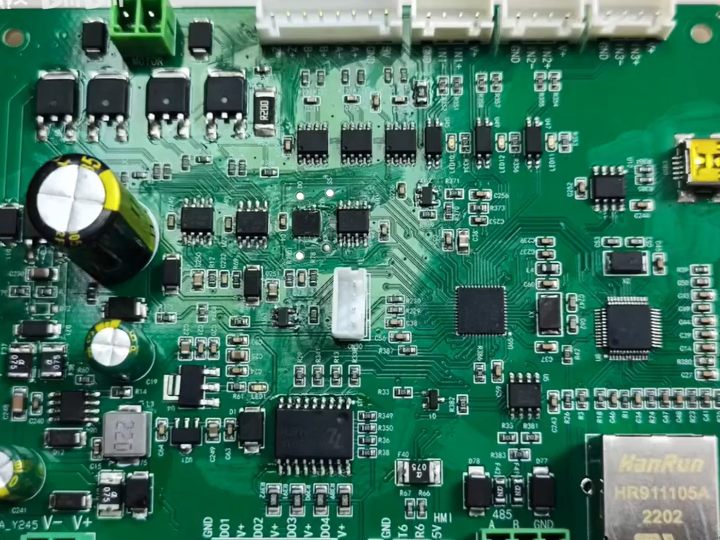
This project combines STM32, the WIZnet W5500 Ethernet controller, and a brushed DC motor driver to create an Ethernet-enabled motor control and waveform monito
How to Build an Ethernet-Based STM32 Motor Control and Oscilloscope System with W5500?
(W5500과 STM32로 이더넷 기반 모터 제어 및 오실로스코프 시스템 구축하기)
Project Summary (58 words)
This project combines STM32, the WIZnet W5500 Ethernet controller, and a brushed DC motor driver to create an Ethernet-enabled motor control and waveform monitoring system. By using hardware TCP/IP offloading instead of Wi-Fi, the design ensures reliable communication in EMI-heavy motor environments, making it suitable for Industrial IoT applications.
System Architecture Overview
Core Blocks
STM32
PWM motor control
ADC waveform sampling
Control algorithms
W5500
Hardware TCP/IP stack
Ethernet interface
SPI connection to STM32
Motor Driver
H-bridge or MOSFET stage
Current sensing
Power isolation
Network Architecture & Protocol Flow
Communication Flow
Data Types
Configuration commands (speed, direction)
Real-time waveform data (voltage/current)
Status telemetry (temperature, fault)
Protocol Selection
| Protocol | Use Case |
|---|---|
| TCP | Reliable control & waveform transfer |
| UDP | Low-latency streaming |
| HTTP | Web-based configuration |
| MQTT | Cloud telemetry |
W5500 isolates network stack complexity from the control firmware.
Ethernet vs Wi-Fi in Motor Control Systems
Motor environments generate:
EMI noise
Voltage spikes
High current switching
Wi-Fi systems may suffer packet loss or jitter. Ethernet with W5500:
Provides stable wired connectivity
Eliminates RF sensitivity
Ensures deterministic latency
Improves industrial robustness
Industrial IoT Design Perspective
This architecture mirrors professional industrial systems:
Control loop runs locally on MCU
Network layer is hardware-isolated
Remote monitoring does not disturb control timing
Suitable for continuous 24/7 operation
It bridges motor control engineering with networked instrumentation.
FAQ (WIZnet-Focused)
Q1: Why use W5500 for motor control systems?
A: W5500 ensures stable Ethernet communication even in EMI-heavy motor environments.
Q2: How does STM32 communicate with W5500?
A: Via SPI, allowing deterministic separation between control and networking.
Q3: Is this suitable for Industrial IoT?
A: Yes. Wired Ethernet is preferred in industrial motor control applications.
Q4: Can waveform data be streamed?
A: Yes, using TCP or UDP sockets handled by W5500.
Q5: Is Wi-Fi a good alternative here?
A: Generally no. Wi-Fi is more susceptible to EMI and latency variation in motor systems.
Tags
#W5500 #STM32 #MotorControl #Ethernet #IndustrialIoT #EmbeddedOscilloscope
🇰🇷 KOREAN VERSION
W5500과 STM32로 이더넷 기반 모터 제어 및 오실로스코프 시스템을 구축하는 방법은?
(How to Build an Ethernet-Based STM32 Motor Control and Oscilloscope System with W5500?)
프로젝트 개요 (58단어)
이 프로젝트는 STM32, WIZnet W5500 이더넷 컨트롤러, 브러시 DC 모터 드라이버를 결합하여 이더넷 기반 모터 제어 및 파형 모니터링 시스템을 구현합니다. Wi-Fi 대신 하드웨어 TCP/IP 오프로딩을 사용하여 EMI가 많은 모터 환경에서도 안정적인 산업용 IoT 통신을 제공합니다.
시스템 구성
STM32: PWM 제어, ADC 샘플링
W5500: 하드웨어 TCP/IP 이더넷 통신
모터 드라이버: H-브리지, 전류 센싱
네트워크 아키텍처
Remote Client → Ethernet → W5500 → STM32 → Motor Driver
네트워크 처리는 W5500이 담당하여 제어 루프에 영향을 주지 않습니다.
산업용 IoT 관점
유선 이더넷 사용
EMI 환경에서도 안정적
제어 루프와 네트워크 분리
실제 산업용 모터 제어 시스템과 동일한 구조입니다.
FAQ
Q1: 왜 W5500을 사용하나요?
A: 모터 환경의 EMI에서도 안정적인 이더넷 통신을 제공하기 때문입니다.
Q2: STM32와의 연결 방식은?
A: SPI 인터페이스입니다.
Q3: 산업용으로 적합한가요?
A: 네, 유선 이더넷 기반 설계는 산업 환경에 적합합니다.
Q4: 파형 데이터를 전송할 수 있나요?
A: TCP/UDP를 통해 가능합니다.
Q5: Wi-Fi로 대체 가능합니까?
A: 모터 환경에서는 권장되지 않습니다.