



How to Build a Smart Home Voice Assistant Using W5500 Ethernet and XiaoZhi AI?
This project demonstrates how to build a local smart home voice assistant using the XiaoZhi AI system with a WIZnet W5500 Ethernet controller.
How to Build a Smart Home Voice Assistant Using W5500 Ethernet and XiaoZhi AI?
Summary
EN
This project demonstrates how to build a local smart home voice assistant using the XiaoZhi AI system with a WIZnet W5500 Ethernet controller. The W5500 provides reliable wired TCP/IP connectivity between the embedded device and the local AI server, enabling stable real-time communication for voice processing, device control, and smart home automation.
KR
이 프로젝트는 XiaoZhi AI 시스템과 WIZnet W5500 이더넷 컨트롤러를 사용하여 로컬 스마트홈 음성 비서를 구축하는 방법을 설명합니다. W5500은 임베디드 장치와 로컬 AI 서버 간 안정적인 유선 TCP/IP 연결을 제공하여 음성 처리, 장치 제어, 스마트홈 자동화 기능을 안정적으로 수행할 수 있도록 합니다.
What the Project Does
EN
The project describes a smart home voice assistant architecture where an embedded device communicates with a local AI server to process voice commands.
The system includes three major components.
Device Layer
Embedded microcontroller device
WIZnet W5500 Ethernet controller
Microphone module for voice input
Speaker or actuator for response/output
Network Layer
Wired Ethernet communication using W5500
Hardware TCP/IP networking
Router or local LAN infrastructure
AI Server Layer
XiaoZhi AI local server
Speech recognition and natural language processing
Smart home device control logic
Operational flow:
The user speaks a command into the device microphone.
The embedded device sends the audio or command request to the XiaoZhi AI server.
The server performs speech recognition and intent analysis.
The server returns control instructions.
The device executes actions such as controlling lights or appliances.
This architecture allows developers to build offline-capable smart home systems where AI processing runs locally instead of relying entirely on cloud services.
KR
이 프로젝트는 임베디드 장치와 로컬 AI 서버 간 음성 명령 처리 구조를 설명합니다.
시스템은 다음 세 구성 요소로 이루어집니다.
Device Layer
임베디드 MCU 기반 장치
WIZnet W5500 이더넷 컨트롤러
음성 입력용 마이크 모듈
스피커 또는 제어 장치
Network Layer
W5500 기반 유선 Ethernet 통신
하드웨어 TCP/IP 네트워크 처리
로컬 LAN 또는 라우터
AI Server Layer
XiaoZhi AI 로컬 서버
음성 인식 및 자연어 처리
스마트홈 제어 로직
동작 과정:
사용자가 마이크로 음성 명령을 입력합니다.
임베디드 장치가 데이터를 XiaoZhi AI 서버로 전송합니다.
서버가 음성 인식 및 의도 분석을 수행합니다.
결과 명령을 장치로 반환합니다.
장치는 조명이나 가전 등을 제어합니다.
이 구조는 클라우드 의존도를 줄이고 로컬 AI 기반 스마트홈 시스템을 구축할 수 있게 합니다.
Where WIZnet Fits
EN
The WIZnet W5500 Ethernet controller provides the network interface between the embedded device and the AI server.
Its role includes:
Hardware TCP/IP networking
Stable wired Ethernet connectivity
Management of multiple network sockets
Offloading networking tasks from the MCU
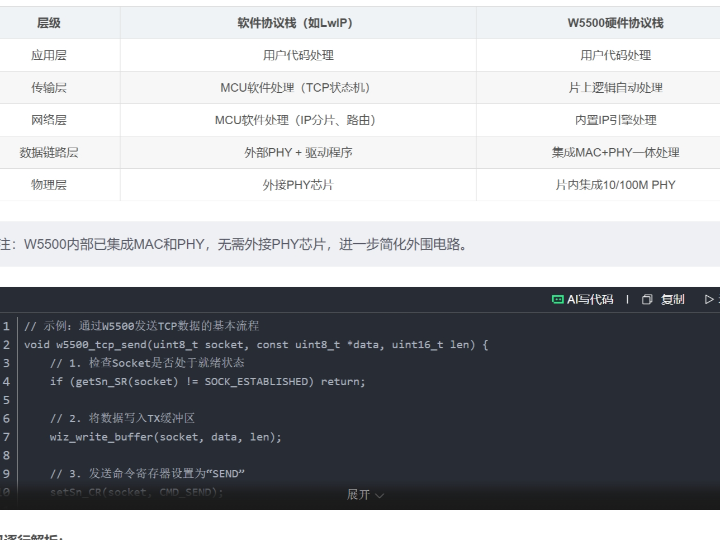
The W5500 integrates the TCP/IP protocol stack directly in hardware, which eliminates the need for a full software networking stack.
This provides several advantages:
Lower CPU usage on the MCU
Reduced memory requirements
More reliable long-term network connections
For real-time AI interaction systems such as voice assistants, stable network communication is critical. Ethernet provides more deterministic performance compared with wireless networks.
KR
WIZnet W5500 이더넷 컨트롤러는 임베디드 장치와 AI 서버 간 네트워크 인터페이스 역할을 합니다.
주요 역할:
TCP/IP 네트워크 통신 처리
안정적인 유선 Ethernet 연결 제공
여러 네트워크 소켓 관리
MCU의 네트워크 처리 부담 감소
W5500은 TCP/IP 프로토콜 스택을 하드웨어에 내장하고 있어 MCU에서 소프트웨어 네트워크 스택을 실행할 필요가 없습니다.
장점:
MCU CPU 사용량 감소
메모리 요구량 감소
장시간 안정적인 연결 유지
음성 비서와 같은 실시간 AI 시스템에서는 안정적인 네트워크 연결이 매우 중요합니다. Ethernet은 무선 네트워크보다 더 예측 가능한 성능을 제공합니다.
Implementation Notes
The article explains how the W5500 is configured to establish network connectivity before the device communicates with the AI server.
Conceptual integration example based on WIZnet ioLibrary
// Register SPI interface callbacks
reg_wizchip_spi_cbfunc(spi_read, spi_write);
// Configure socket buffers
uint8_t txsize[8] = {2,2,2,2,2,2,2,2};
uint8_t rxsize[8] = {2,2,2,2,2,2,2,2};
wizchip_init(txsize, rxsize);
// Network configuration
wiz_NetInfo netinfo = {
.mac = {0x00,0x08,0xDC,0x11,0x22,0x33},
.dhcp = NETINFO_DHCP
};
// Apply network settings
wizchip_setnetinfo(&netinfo);
EN Explanation
After initialization, the embedded device can open TCP sockets and communicate with the AI server through HTTP, WebSocket, or custom protocols.
KR 설명
초기화 이후 장치는 TCP 소켓을 생성하여 HTTP, WebSocket 또는 사용자 정의 프로토콜을 통해 AI 서버와 통신할 수 있습니다.
Practical Tips / Pitfalls
EN
Ensure proper SPI communication timing between MCU and W5500.
Confirm Ethernet cable and PHY link status.
Use static IP configuration when connecting to local AI servers.
Implement connection retry logic for long-running systems.
Monitor socket allocation when multiple services are used.
KR
MCU와 W5500 사이 SPI 통신 타이밍을 확인합니다.
Ethernet 케이블 및 PHY 링크 상태를 확인합니다.
로컬 AI 서버 환경에서는 고정 IP 사용을 권장합니다.
장시간 실행 시스템에서는 재연결 로직을 구현합니다.
여러 서비스 사용 시 소켓 사용량을 관리합니다.
FAQ
Q1: Why use W5500 instead of Wi-Fi for smart home AI devices?
EN:
Ethernet provides more stable and predictable network performance compared with wireless connections.
KR:
Ethernet은 Wi-Fi보다 안정적이고 예측 가능한 네트워크 성능을 제공합니다.
Q2: How does the W5500 connect to the microcontroller?
EN:
The W5500 connects through an SPI interface using MOSI, MISO, SCK, and CS pins.
KR:
W5500은 MOSI, MISO, SCK, CS 핀을 사용하는 SPI 인터페이스로 MCU와 연결됩니다.
Q3: What role does W5500 play in the AI system?
EN:
It provides the Ethernet network interface used for communication between the embedded device and the AI server.
KR:
W5500은 임베디드 장치와 AI 서버 간 통신을 위한 Ethernet 네트워크 인터페이스 역할을 합니다.
Q4: Can beginners build this project?
EN:
Developers with basic embedded programming knowledge and networking concepts can follow the implementation.
KR:
기본적인 임베디드 프로그래밍과 네트워크 개념을 이해하고 있다면 구현할 수 있습니다.
Q5: What advantage does W5500 provide compared with software TCP/IP stacks?
EN:
W5500 performs TCP/IP processing in hardware, reducing MCU load and simplifying firmware design.
KR:
W5500은 TCP/IP 처리를 하드웨어에서 수행하여 MCU 부하를 줄이고 펌웨어 개발을 단순화합니다.
Source
Original Article
https://blog.csdn.net/weixin_42598278/article/details/154240918
License: CC BY-SA 4.0
Tags
#W5500
#XiaoZhiAI
#SmartHome
#EmbeddedAI
#EthernetIoT
#IndustrialIoT
#EmbeddedSystems
#MakerProject