



How to Build a Low-Latency Local TCP Server with W5500 for a Maker Edge Gateway?
This article describes a maker-oriented edge gateway design that uses the W5500 to run a local TCP server with an emphasis on low latency,
How to Build a Low-Latency Local TCP Server with W5500 for a Maker Edge Gateway?
Summary
This article describes a maker-oriented edge gateway design that uses the W5500 to run a local TCP server with an emphasis on low latency, stable wired communication, and offline operation. In this architecture, the W5500 is the Ethernet transport engine: it provides the hardwired TCP/IP stack, socket handling, and packet buffering, while the MCU side focuses on SPI access, service logic, and gateway behavior.
What the Project Does
The source presents a local server design for a “Xiaozhi AI edge gateway” built around the W5500. Its stated goal is to create a local TCP server on embedded hardware so the gateway can continue to exchange data with nearby devices even when cloud access is unavailable. The article frames this as a low-latency, high-reliability wired path suitable for embedded platforms such as STM32-class systems.
From an architectural point of view, this is a classic split between application control and network transport. The MCU or gateway CPU runs the device logic, local service flow, and edge application behavior, while the W5500 handles Ethernet connectivity through its embedded TCP/IP engine and hardware sockets. That division is what makes the design maker-friendly: it avoids the complexity of integrating a full software network stack just to expose a local TCP endpoint.
Where WIZnet Fits
The exact WIZnet part here is the W5500. Its role is not just physical Ethernet connectivity but full socket-oriented transport offload. WIZnet documents describe the W5500 as a hardwired TCP/IP controller with integrated 10/100 Ethernet MAC and PHY, support for up to eight independent sockets, 32 KB internal packet buffer memory, and an SPI interface that can run up to 80 MHz. Those properties are the main reason this kind of local gateway can stay small and responsive on modest MCU hardware.
For a maker gateway, the W5500 is a good fit when the priority is predictable local Ethernet behavior rather than protocol flexibility. A pure software stack can offer more customization, but the W5500 reduces RAM pressure, shortens bring-up time, and keeps the firmware model close to a simple socket state machine. In a local-server design, that usually matters more than raw stack flexibility. This last point is an engineering inference based on the article’s focus and W5500’s documented hardware-offload model.
Implementation Notes
The source clearly states that the gateway is built around the W5500 and covers hardware connection, SPI initialization, TCP service deployment, and state-machine design, but it does not expose a public repository or line-addressable source files. Because of that, there is no verified project code snippet available to quote directly.
What can be verified is the implementation pattern. The visible design path is: wire the W5500 to the host platform, bring up SPI, initialize the local Ethernet service, and then run the TCP server using a socket-driven state machine. That matches WIZnet’s documented application model for W5500 TCP services, where the chip opens sockets, transitions through TCP states, and transmits or receives payloads through its internal TX/RX memory.
From a performance perspective, the article’s “low latency” claim is plausible for a local wired server, but it should be read in architectural terms rather than as a benchmark result. The source does not publish measured throughput, round-trip latency, or CPU load numbers. So the defensible claim is narrower: W5500 can reduce firmware-side protocol work and provide a stable local Ethernet path, but real latency still depends on SPI clock rate, polling or interrupt design, buffer handling, and the rest of the gateway software.
Practical Tips / Pitfalls
Start with the local TCP server only. The article’s value is in its narrow focus on a local wired server path; adding cloud logic too early will hide basic SPI and socket faults.
Treat SPI speed as a performance lever, not a guaranteed outcome. The W5500 supports SPI up to 80 MHz, but actual server responsiveness will depend on board design and firmware efficiency.
Keep the socket state machine simple. W5500’s TCP flow is easiest to debug when open, listen, established, receive, send, and close transitions are visible in firmware.
Plan socket and buffer usage early. W5500 supports eight sockets, but the 32 KB internal packet memory is shared across those channels.
Use wired local mode as the first milestone. The article specifically emphasizes stable communication in disconnected environments, which is exactly where W5500’s deterministic local Ethernet path is most useful.
FAQ
Why use the W5500 for this project?
Because the project needs a compact local Ethernet server with low software overhead. The W5500 gives the system a hardwired TCP/IP stack, eight hardware sockets, integrated MAC/PHY, and internal packet memory, so the gateway firmware can stay focused on application logic instead of running a full software network stack.
How does it connect to the platform?
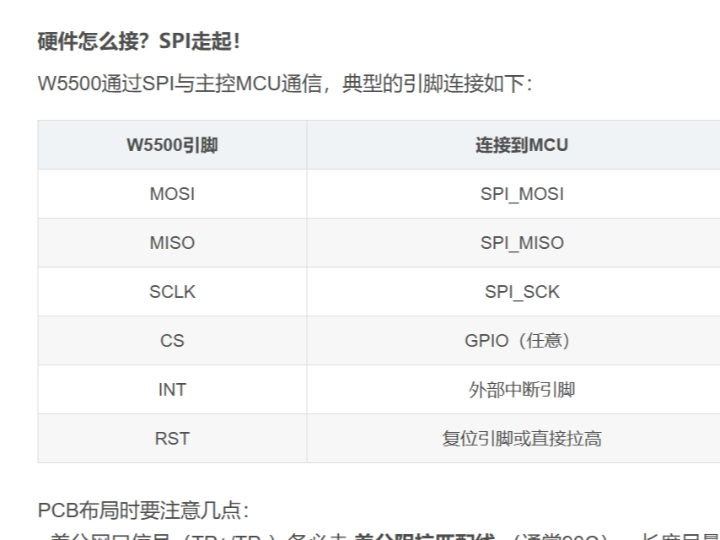
Through SPI plus the usual board-control signals needed for Ethernet-controller bring-up. WIZnet’s documentation defines the W5500 as an external-MCU Ethernet controller accessed over SPI, and the article explicitly highlights SPI initialization as part of the implementation flow.
What role does it play in this project?
It is the local TCP transport endpoint inside the edge gateway. The host platform runs the edge application, while the W5500 provides the wired socket service that keeps nearby device communication running even in offline conditions.
Can beginners follow this project?
Yes, if they already understand MCU SPI bring-up and basic socket concepts. The source is more architecture-focused than code-heavy, so it is suitable for makers who want to understand the transport boundary and local-server design without first learning a full embedded IP stack.
How does this compare with LwIP?
LwIP offers more flexibility because the stack runs in software on the MCU, but that also increases integration effort, RAM use, and debugging complexity. The W5500 approach trades some flexibility for a simpler bring-up path by moving TCP/IP handling into hardware and exposing a socket-oriented interface over SPI.
Source
Original link: CSDN article, “小智AI边缘网关中W5500本地服务器搭建全流程.” The page is indexed as a recent article describing W5500-based local TCP server construction for an edge gateway. Product facts were verified against WIZnet’s official W5500 overview, datasheet, and TCP application documentation.
Tags
W5500, WIZnet, Edge Gateway, Local TCP Server, Embedded Ethernet, SPI, Socket Offload, Maker, Low Latency, Hardwired TCP/IP, Offline Networking, Ethernet Architecture