



How Does Async UDP over W6100 Improve Industrial IPv4/IPv6 Networking on ESP32?
How Does Async UDP over W6100 Improve Industrial IPv4/IPv6 Networking on ESP32?
COMPONENTS
PROJECT DESCRIPTION
# How Does Async UDP over W6100 Improve Industrial IPv4/IPv6 Networking on ESP32?
*(W6100 기반 Async UDP는 ESP32에서 산업용 IPv4/IPv6 네트워크를 어떻게 개선할까?)*
------
## Summary (40–60 words)
This article explains how asynchronous UDP communication using the WIZnet W6100 and ESP32 enables reliable IPv4 and IPv6 networking for Industrial IoT. By combining event-driven UDP, hardware TCP/IP offloading, and SPI-based Ethernet abstraction, developers achieve deterministic behavior, multicast support, and long-term network stability without complex firmware stacks.
------
## 1. Why Async UDP Matters in Industrial IoT
In Industrial IoT systems, networking requirements differ from consumer devices.
Key priorities include:
- Deterministic timing
- Low and predictable latency
- Broadcast or multicast discovery
- Long-term stability (years, not hours)
UDP is often preferred over TCP because it avoids connection overhead and allows **one-to-many communication**. However, traditional **blocking UDP implementations** can still introduce firmware complexity and timing issues.
This is where **Async (event-driven) UDP** becomes important.
------
## 2. Project Context: AsyncUDP_ESP32_SC_Ethernet
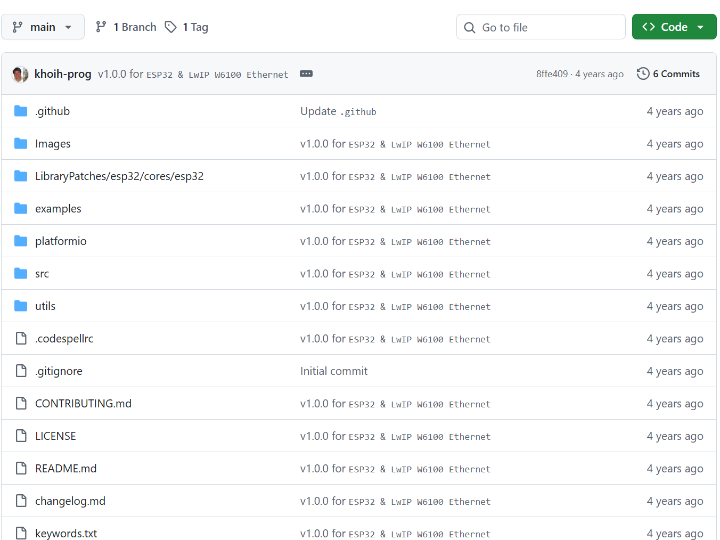
The **AsyncUDP_ESP32_SC_Ethernet** project provides an abstraction layer that allows ESP32 firmware to use **non-blocking, callback-driven UDP** over SPI-based Ethernet controllers.
When paired with the **WIZnet W6100**, this architecture gains additional advantages:
- Hardware IPv4/IPv6 dual-stack
- UDP parsing and checksum offloading
- Deterministic Ethernet behavior
The result is a networking model well-suited for industrial systems.
------
## 3. System Architecture Overview
The overall architecture can be summarized as follows:
```
Application Logic (ESP32)
↓
Async UDP Layer (Event-driven)
↓
Ethernet Abstraction Layer
↓
SPI Interface
↓
W6100 Hardware TCP/IP (IPv4 + IPv6)
↓
Ethernet PHY + RJ45
↓
Industrial Network
```
The most important design principle is **separation of responsibilities**:
- ESP32 handles application logic
- Async UDP handles event dispatch
- W6100 handles all IP/UDP protocol processing
------
## 4. Async (Event-Driven) UDP Behavior
### Blocking vs Async UDP
Traditional UDP implementations often rely on:
- Polling loops
- Blocking `receive()` calls
- Tight coupling between networking and application logic
Async UDP changes this model:
- Incoming packets trigger **callbacks**
- No busy-waiting loops
- Network I/O does not block the main application
This makes firmware more responsive and easier to maintain.
------
### Why This Is Important for Industrial Firmware
In industrial systems:
- Tasks often run concurrently (sensing, control, communication)
- Blocking network calls can cause missed deadlines
- Timing predictability is critical
Async UDP allows UDP traffic to be handled **only when data arrives**, preserving deterministic behavior.
------
## 5. Broadcast and Multicast over UDP
One of UDP’s strongest features is **one-to-many communication**.
### Typical Industrial Use Cases
- Device discovery
- Status broadcasting
- Group commands
- Diagnostics
With Async UDP:
- Broadcast packets are received via callbacks
- Multicast groups can be joined without blocking
- Multiple devices can be addressed simultaneously
This is difficult to achieve cleanly with TCP.
------
## 6. IPv4 and IPv6 with W6100
### Dual-Stack Hardware Support
The W6100 is a **hardware dual-stack Ethernet controller**, supporting:
- IPv4
- IPv6
- UDP over both protocols
- ICMPv4 / ICMPv6
All of this is implemented **inside the chip**, not in ESP32 firmware.
------
### IPv6 Offloading Advantage
IPv6 introduces:
- Larger headers
- Neighbor Discovery
- More complex addressing
In software, this increases:
- RAM usage
- CPU load
- Firmware complexity
With W6100:
- IPv6 headers are parsed in hardware
- Checksums are calculated internally
- ESP32 firmware remains unchanged
For Industrial IoT devices expected to operate for **10–20 years**, IPv6 offloading is a major reliability advantage.
------
## 7. ESP32 ↔ W6100 SPI Abstraction
Communication between ESP32 and W6100 uses **SPI**, with:
- Register-based control
- Dedicated TX/RX buffers
- Deterministic transaction timing
The Ethernet abstraction layer hides chip-specific details, allowing:
- Cleaner application code
- Easier migration between Ethernet controllers
- Consistent Async UDP behavior
This abstraction is essential for scalable firmware design.
------
## 8. How UDP Packets Flow (Conceptual)
> 🧩 **Conceptual packet flow**
```
UDP packet arrives (IPv4 or IPv6)
↓
W6100 hardware parses IP + UDP headers
↓
Payload stored in RX buffer
↓
Interrupt / event generated
↓
Async UDP callback invoked on ESP32
↓
Application processes data
```
The ESP32 never parses IP or UDP headers directly.
This dramatically reduces the chance of protocol-level bugs.
------
## 9. Industrial IoT Reliability Perspective
### Deterministic Networking
Because W6100 handles:
- UDP checksum verification
- Packet framing
- Dual-stack IP logic
the system behavior is:
- Predictable
- Repeatable
- Resistant to timing bugs
### Wired Ethernet Advantage
Compared to Wi-Fi:
- No RF interference
- No roaming or re-association
- Stable latency
- Better EMC characteristics
For industrial deployments, **wired Ethernet with W6100 is far more reliable**.
------
## 10. Why Async UDP + W6100 Is a Strong Combination
| Aspect | Benefit |
| ----------------- | --------------------------------- |
| Async UDP | Non-blocking, responsive firmware |
| W6100 | Hardware IPv4/IPv6 offloading |
| UDP | Low latency, multicast support |
| SPI Ethernet | Deterministic timing |
| Abstraction Layer | Maintainable codebase |
This combination allows systems to scale from **demo → pilot → production** without redesigning the network stack.
------
## Key Takeaway
> **With W6100, Async UDP over IPv4/IPv6 becomes a hardware-accelerated, event-driven service—not a firmware burden.**
This is exactly what Industrial IoT systems require.
------
## Source
- GitHub: **AsyncUDP_ESP32_SC_Ethernet**
- WIZnet W6100 datasheet and architecture
------
## Tags
W6100, WIZnet, Async UDP, IPv6 Offloading, Broadcast UDP, Multicast, ESP32 Ethernet, Industrial IoT, Hardware TCP/IP
------
------
# 🇰🇷 한국어 번역 (1:1 Full Translation)
------
# W6100 기반 Async UDP는 ESP32에서 산업용 IPv4/IPv6 네트워크를 어떻게 개선할까?
------
## 요약
본 문서는 AsyncUDP_ESP32_SC_Ethernet 프로젝트를 기반으로 ESP32와 WIZnet W6100을 결합해 비동기 UDP 통신을 구현하는 방식을 설명한다. 하드웨어 IPv4/IPv6 오프로딩과 이벤트 기반 UDP 모델을 통해 산업용 IoT 환경에 적합한 결정성과 안정성을 제공한다.
------
## 1. 산업 IoT에서 Async UDP가 중요한 이유
산업용 시스템에서는 다음이 중요하다.
- 예측 가능한 타이밍
- 낮은 지연 시간
- 브로드캐스트 / 멀티캐스트
- 장기간 안정적 동작
UDP는 이러한 요구에 적합하며, Async UDP는 이를 더욱 안전하게 만든다.
------
## 2. 프로젝트 개요
AsyncUDP_ESP32_SC_Ethernet은 ESP32에서 **논블로킹 UDP 통신**을 가능하게 하는 추상화 계층을 제공한다.
W6100과 결합하면 IPv4/IPv6를 하드웨어에서 처리할 수 있다.
------
## 3. 시스템 아키텍처
```
ESP32 애플리케이션
↓
Async UDP 계층
↓
Ethernet 추상화
↓
SPI
↓
W6100 하드웨어 TCP/IP
```
------
## 4. 비동기 UDP 통신 모델
Async UDP는:
- 블로킹 없음
- 이벤트 기반
- 높은 응답성
을 제공하며 산업용 펌웨어에 적합하다.
------
## 5. 브로드캐스트 / 멀티캐스트
UDP는:
- 장치 검색
- 그룹 제어
- 상태 전송
에 매우 효과적이다.
------
## 6. W6100의 IPv4 / IPv6 오프로딩
W6100은 IPv4와 IPv6를 **하드웨어로 동시에 지원**한다.
ESP32는 네트워크 스택을 알 필요가 없다.
------
## 7. ESP32 ↔ W6100 SPI 추상화
SPI 기반 이더넷은:
- 타이밍이 예측 가능하고
- 실시간 제어에 유리하며
- 장기 안정성이 높다
------
## 8. UDP 패킷 흐름 (개념)
```
패킷 수신
↓
W6100 하드웨어 처리
↓
RX 버퍼 저장
↓
Async 콜백
```
------
## 9. 산업용 신뢰성 관점
- RF 간섭 없음
- 낮은 지터
- 재현 가능한 동작
이는 산업 환경에서 매우 중요하다.
------
## 10. 핵심 메시지
> **W6100을 사용하면 Async UDP와 IPv6는 펌웨어 부담이 아닌 하드웨어 기능이 된다.**
------
## 태그
W6100, WIZnet, 비동기 UDP, IPv6 오프로딩, 산업용 IoT, ESP32 이더넷
Documents
Comments
Write