



How to Implement MQTT Messaging with WIZnet W5500 on AI8051U?
This AI8051U education project explains how to build MQTT communication over wired Ethernet with the WIZnet W5500.
How to Implement MQTT Messaging with WIZnet W5500 on AI8051U?
Summary
This AI8051U education project explains how to build MQTT communication over wired Ethernet with the WIZnet W5500. The AI8051U firmware uses W5500 as the TCP/IP transport device, while MQTT runs above that TCP connection to exchange publish/subscribe messages with a broker. The source focuses on MQTT concepts, MQTT frame format, writing an MQTT program, and debugging the MQTT workflow.
What the Project Does
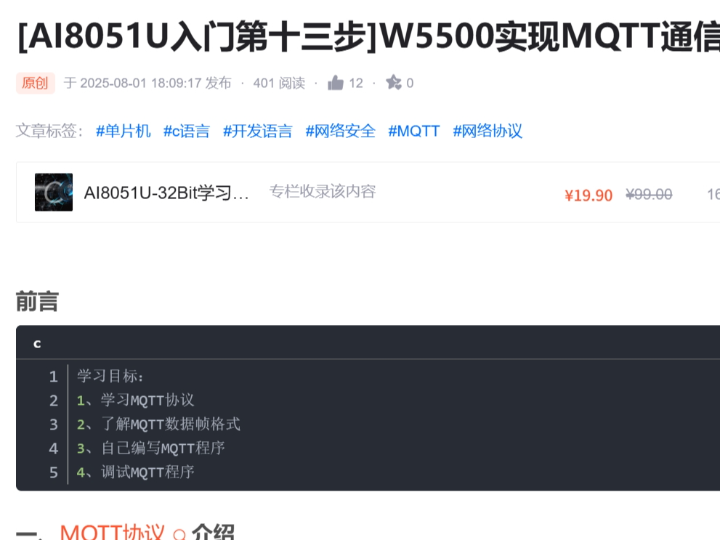
The project is an MQTT communication lesson for an AI8051U microcontroller paired with a WIZnet W5500 Ethernet controller. The source article lists four learning goals: learning MQTT, understanding MQTT data-frame format, writing an MQTT program, and debugging that program. It introduces MQTT as a lightweight publish/subscribe messaging protocol used in IoT, mobile applications, and industrial automation, and it highlights core MQTT features such as small headers, publisher/subscriber decoupling, QoS levels, persistent sessions, and Last Will and Testament behavior.
At the architecture level, the AI8051U board is the embedded MQTT client, W5500 is the wired Ethernet and TCP/IP transport controller, and the MQTT broker routes messages between publishers and subscribers. The article’s public summary also states that it analyzes MQTT CONNECT frame structure through Wireshark, including fixed header fields, remaining length, protocol level, connection flags, keep-alive time, and hexadecimal-to-ASCII decoding.
For education, the project is useful because it links three layers that beginners often mix together: W5500 handles Ethernet and TCP sockets, MQTT defines the application message format, and the broker handles publish/subscribe routing. Students can therefore separate socket connection problems from MQTT packet-format problems and broker-side topic problems.
Where WIZnet Fits
The exact WIZnet product is W5500. In this project, W5500 provides the wired Ethernet interface and hardwired TCP/IP socket path between AI8051U firmware and the MQTT broker. MQTT itself is not handled by W5500; the MCU firmware still constructs MQTT CONNECT, PUBLISH, SUBSCRIBE, PINGREQ, and DISCONNECT packets. W5500 carries those packets over a TCP socket.
W5500 is a hardwired TCP/IP stack internet controller with SPI access up to 80 MHz, embedded 10/100 Ethernet MAC and PHY, support for TCP, UDP, ICMP, IPv4, ARP, IGMP, and PPPoE, 8 independent sockets, and 32 KB internal Tx/Rx memory. WIZnet also documents ioLibrary as an MCU-independent driver library for WIZnet chips, with supported services including MQTT.
For performance education, the important point is not only raw link speed. MQTT responsiveness depends on TCP connection stability, broker reachability, keep-alive processing, socket buffer availability, and how often the firmware services the MQTT client loop. W5500 reduces the network-stack work inside the AI8051U by keeping TCP/IP handling and packet buffering inside the Ethernet controller, leaving the MCU to focus on MQTT state, topic payloads, and application logic.
Implementation Notes
The public CSDN page confirms the W5500 MQTT communication topic and learning objectives, but the full code section is not publicly visible without unlocking the article. A related CSDN download listing reports that a resource package exists with C and header files, but the code is not directly inspectable from the public article page.
Conceptual integration example based on WIZnet ioLibrary
#include "wizchip_conf.h"
#include "socket.h"
#include "MQTTClient.h"

#define MQTT_SOCKET  0
#define MQTT_PORT    1883

static uint8_t tx_size[8] = {2,2,2,2,2,2,2,2};
static uint8_t rx_size[8] = {2,2,2,2,2,2,2,2};

void w5500_network_init(void)
{
    reg_wizchip_cs_cbfunc(w5500_select, w5500_deselect);
    reg_wizchip_spi_cbfunc(w5500_spi_read, w5500_spi_write);

    wizchip_init(tx_size, rx_size);
    wizchip_setnetinfo(&net_info);
}
This layer exists because ioLibrary is platform-independent. The AI8051U firmware must provide W5500 chip-select and SPI read/write functions before socket or MQTT routines can use the controller. WIZnet’s ioLibrary repository describes the driver as an Internet Offload Library for WIZnet TCP/IP chips and provides Berkeley-style socket APIs.
Network net;
MQTTClient client;
uint8_t mqtt_tx[256];
uint8_t mqtt_rx[512];

void mqtt_client_start(uint8_t broker_ip[4])
{
    NewNetwork(&net, MQTT_SOCKET);
    ConnectNetwork(&net, broker_ip, MQTT_PORT);

    MQTTClientInit(&client, &net, 1000,
                   mqtt_tx, sizeof(mqtt_tx),
                   mqtt_rx, sizeof(mqtt_rx));

    MQTTPacket_connectData opt = MQTTPacket_connectData_initializer;
    opt.MQTTVersion = 4;
    opt.clientID.cstring = "ai8051u-w5500";
    opt.keepAliveInterval = 60;
    opt.cleansession = 1;

    MQTTConnect(&client, &opt);
}
This conceptual flow matches the WIZnet MQTT interface model: connect the W5500-backed network object first, initialize the MQTT client with bounded send and receive buffers, then send MQTT CONNECT. The ioLibrary MQTT client header exposes functions such as MQTTClientInit(), MQTTConnect(), MQTTPublish(), MQTTSubscribe(), MQTTDisconnect(), and MQTTYield().
Practical Tips / Pitfalls
- Verify W5500 SPI register access before debugging MQTT. If W5500 cannot be read reliably, MQTT packet debugging is premature.
- Keep the broker IP or hostname stable during classroom testing. Changing broker addresses creates confusion between network-layer and MQTT-layer failures.
- Reserve one W5500 socket for MQTT. MQTT normally uses one long-lived TCP connection to the broker.
- Size MQTT buffers around the largest topic plus payload. A short demo message may work while a real topic tree overflows the MCU-side MQTT buffer.
- Call the MQTT service loop regularly. Keep-alive depends on periodic processing such as
MQTTYield()or equivalent handling. - Test broker restart, cable removal, and reconnect behavior. These cases reveal whether the firmware handles TCP disconnects cleanly.
- Use packet capture as a teaching tool. The source article’s focus on Wireshark CONNECT-frame analysis is a good way to connect bytes on the wire with MQTT fields.
FAQ
Q: Why use WIZnet W5500 for MQTT on AI8051U?
A: W5500 provides the wired Ethernet MAC/PHY, hardwired TCP/IP engine, TCP socket path, and internal packet buffers. That lets the AI8051U focus on MQTT packet construction, topic handling, keep-alive behavior, and device logic instead of running a full software TCP/IP stack.
Q: How does W5500 connect to the AI8051U platform?
A: W5500 connects through SPI plus chip select, reset, interrupt, power, ground, and the RJ45/Ethernet front end. In firmware, AI8051U must register SPI and chip-select callbacks before using W5500 socket APIs.
Q: What role does W5500 play in this MQTT project?
A: W5500 is the TCP transport engine. MQTT messages are created and parsed by the AI8051U firmware, but W5500 opens the TCP connection to the broker and carries MQTT frames such as CONNECT, PUBLISH, SUBSCRIBE, and PINGREQ.
Q: Can beginners follow this education project?
A: Yes, if they already understand basic C, SPI, IPv4 addressing, TCP client behavior, and the publish/subscribe model. The project is educational because it separates W5500 socket transport from MQTT frame format and broker routing.
Q: How does W5500 compare with Wi-Fi for MQTT performance lessons?
A: W5500 is better for teaching deterministic wired MQTT behavior because students can observe a fixed Ethernet link, TCP socket states, and broker traffic without RF association, roaming, or interference variables. Wi-Fi is useful when cable-free installation is required, but latency-sensitive Wi-Fi deployments often need QoS mechanisms to prioritize traffic flows and improve consistency.
Source
Original article: CSDN, “[AI8051U入门第十三步]W5500实现MQTT通信.” The accessible page confirms the W5500 MQTT communication topic and the learning goals, but the full implementation is behind CSDN subscription access.
CSDN search summary: confirms MQTT frame-format analysis, Wireshark CONNECT-frame decoding, and MQTT communication context.
WIZnet product reference: W5500 documentation.
WIZnet driver reference: Wiznet/ioLibrary_Driver, MIT license.
MQTT protocol reference: OASIS MQTT Version 3.1.1.
Tags
#W5500 #WIZnet #AI8051U #MQTT #Ethernet #SPI #ioLibrary #TCPIP #NetworkStack #Performance #Education #WiFi #EmbeddedC
AI8051U에서 WIZnet W5500으로 MQTT 메시징을 구현하는 방법은?
요약
이 AI8051U 교육용 프로젝트는 WIZnet W5500을 사용해 유선 이더넷 기반 MQTT 통신을 구현하는 방법을 설명합니다. AI8051U 펌웨어는 W5500을 TCP/IP 전송 장치로 사용하고, MQTT는 그 TCP 연결 위에서 브로커와 publish/subscribe 메시지를 교환합니다. 원문은 MQTT 개념, MQTT 프레임 형식, MQTT 프로그램 작성, MQTT 통신 디버깅에 초점을 둡니다.
프로젝트가 하는 일
이 프로젝트는 AI8051U 마이크로컨트롤러와 WIZnet W5500 이더넷 컨트롤러를 결합한 MQTT 통신 학습 예제입니다. 원문은 네 가지 학습 목표를 제시합니다. MQTT 학습, MQTT 데이터 프레임 형식 이해, MQTT 프로그램 작성, 작성한 프로그램 디버깅입니다.
MQTT는 IoT, 모바일 애플리케이션, 산업 자동화에서 사용되는 경량 publish/subscribe 메시징 프로토콜입니다. 원문은 MQTT의 작은 헤더, publisher와 subscriber의 분리, QoS level, persistent session, Last Will and Testament 동작 같은 핵심 특징을 설명합니다.
아키텍처 관점에서 AI8051U 보드는 임베디드 MQTT client이고, W5500은 유선 이더넷 및 TCP/IP 전송 컨트롤러이며, MQTT broker는 publisher와 subscriber 사이의 메시지를 라우팅합니다. 공개 검색 요약에서는 Wireshark를 사용해 MQTT CONNECT frame 구조를 분석한다고 설명합니다. 분석 대상에는 fixed header field, remaining length, protocol level, connection flag, keep-alive time, hexadecimal-to-ASCII decoding이 포함됩니다.
교육용으로 이 프로젝트가 유용한 이유는 초보자가 자주 혼동하는 세 계층을 분리해서 보여주기 때문입니다. W5500은 Ethernet과 TCP socket을 처리하고, MQTT는 application message format을 정의하며, broker는 publish/subscribe routing을 담당합니다. 따라서 학생들은 socket connection 문제, MQTT packet format 문제, broker topic 문제를 구분해서 디버깅할 수 있습니다.
WIZnet이 들어가는 위치
이 프로젝트에서 사용되는 WIZnet 제품은 W5500입니다. W5500은 AI8051U 펌웨어와 MQTT broker 사이의 유선 이더넷 인터페이스 및 하드웨어 TCP/IP socket 경로를 제공합니다. MQTT 자체를 W5500이 처리하는 것은 아닙니다. MCU 펌웨어가 MQTT CONNECT, PUBLISH, SUBSCRIBE, PINGREQ, DISCONNECT packet을 구성하고, W5500은 그 packet을 TCP socket 위로 운반합니다.
W5500은 하드웨어 TCP/IP 스택 기반 인터넷 컨트롤러이며, 최대 80 MHz SPI 접근, 내장 10/100 Ethernet MAC 및 PHY, TCP, UDP, ICMP, IPv4, ARP, IGMP, PPPoE 지원, 8개 독립 socket, 32 KB 내부 Tx/Rx memory를 제공합니다. WIZnet ioLibrary는 WIZnet chip용 MCU 독립형 driver library이며, MQTT를 포함한 여러 네트워크 서비스를 지원합니다.
성능 교육 관점에서 중요한 점은 단순한 link speed만이 아닙니다. MQTT 응답성은 TCP connection 안정성, broker reachability, keep-alive 처리, socket buffer availability, firmware가 MQTT client loop를 얼마나 자주 service하는지에 의해 결정됩니다. W5500은 TCP/IP 처리와 packet buffering을 Ethernet controller 내부에서 수행하므로, AI8051U 내부의 network-stack 부담을 줄이고 MCU가 MQTT state, topic payload, application logic에 집중할 수 있게 합니다.
구현 참고 사항
공개 CSDN 페이지에서는 W5500 MQTT 통신 주제와 학습 목표를 확인할 수 있지만, 전체 코드 섹션은 article unlock 없이는 공개적으로 확인할 수 없습니다. 관련 CSDN download listing에서는 C file과 header file이 포함된 resource package가 있다고 설명하지만, 공개 article page에서 코드를 직접 검증할 수는 없습니다.
WIZnet ioLibrary 기반 개념적 통합 예제
#include "wizchip_conf.h"
#include "socket.h"
#include "MQTTClient.h"

#define MQTT_SOCKET  0
#define MQTT_PORT    1883

static uint8_t tx_size[8] = {2,2,2,2,2,2,2,2};
static uint8_t rx_size[8] = {2,2,2,2,2,2,2,2};

void w5500_network_init(void)
{
    reg_wizchip_cs_cbfunc(w5500_select, w5500_deselect);
    reg_wizchip_spi_cbfunc(w5500_spi_read, w5500_spi_write);

    wizchip_init(tx_size, rx_size);
    wizchip_setnetinfo(&net_info);
}
이 계층은 ioLibrary가 platform-independent 구조이기 때문에 필요합니다. AI8051U 펌웨어는 socket 또는 MQTT routine이 W5500 controller를 사용할 수 있도록 W5500 chip-select와 SPI read/write 함수를 먼저 제공해야 합니다. WIZnet ioLibrary는 WIZnet TCP/IP chip을 위한 Internet Offload Library이며 Berkeley-style socket API를 제공합니다.
Network net;
MQTTClient client;
uint8_t mqtt_tx[256];
uint8_t mqtt_rx[512];

void mqtt_client_start(uint8_t broker_ip[4])
{
    NewNetwork(&net, MQTT_SOCKET);
    ConnectNetwork(&net, broker_ip, MQTT_PORT);

    MQTTClientInit(&client, &net, 1000,
                   mqtt_tx, sizeof(mqtt_tx),
                   mqtt_rx, sizeof(mqtt_rx));

    MQTTPacket_connectData opt = MQTTPacket_connectData_initializer;
    opt.MQTTVersion = 4;
    opt.clientID.cstring = "ai8051u-w5500";
    opt.keepAliveInterval = 60;
    opt.cleansession = 1;

    MQTTConnect(&client, &opt);
}
이 개념적 흐름은 WIZnet MQTT interface model과 일치합니다. 먼저 W5500 기반 network object를 연결하고, 제한된 send/receive buffer로 MQTT client를 초기화한 뒤, MQTT CONNECT를 전송합니다. ioLibrary MQTT client header는 MQTTClientInit(), MQTTConnect(), MQTTPublish(), MQTTSubscribe(), MQTTDisconnect(), MQTTYield() 같은 함수를 제공합니다.
실무 팁 / 주의점
- MQTT를 디버깅하기 전에 W5500 SPI register access를 먼저 검증해야 합니다.
- 수업 테스트에서는 broker IP 또는 hostname을 안정적으로 유지해야 합니다.
- MQTT용 W5500 socket 하나를 예약해야 합니다.
- MQTT buffer는 가장 긴 topic과 payload 크기를 기준으로 잡아야 합니다.
- MQTT service loop를 주기적으로 호출해야 합니다.
- Broker restart, cable removal, reconnect behavior를 테스트해야 합니다.
- Packet capture를 교육 도구로 활용하면 좋습니다. Wireshark로 CONNECT frame을 분석하면 wire-level byte와 MQTT field를 직접 연결해서 볼 수 있습니다.
FAQ
Q: AI8051U에서 MQTT를 구현할 때 왜 WIZnet W5500을 사용하나요?
A: W5500은 유선 Ethernet MAC/PHY, 하드웨어 TCP/IP engine, TCP socket path, 내부 packet buffer를 제공합니다. AI8051U는 전체 software TCP/IP stack을 실행하지 않고 MQTT packet construction, topic handling, keep-alive behavior, device logic에 집중할 수 있습니다.
Q: W5500은 AI8051U 플랫폼에 어떻게 연결하나요?
A: W5500은 SPI와 chip select, reset, interrupt, power, ground, RJ45/Ethernet front end를 통해 연결됩니다. Firmware에서는 W5500 socket API를 사용하기 전에 AI8051U의 SPI 및 chip-select callback을 등록해야 합니다.
Q: 이 MQTT 프로젝트에서 W5500은 어떤 역할을 하나요?
A: W5500은 TCP transport engine입니다. MQTT message는 AI8051U 펌웨어가 생성하고 해석하지만, W5500은 broker로 TCP connection을 열고 CONNECT, PUBLISH, SUBSCRIBE, PINGREQ 같은 MQTT frame을 운반합니다.
Q: 초보자도 이 교육용 프로젝트를 따라갈 수 있나요?
A: basic C, SPI, IPv4 addressing, TCP client behavior, publish/subscribe model을 이해하고 있다면 따라갈 수 있습니다. 이 프로젝트는 W5500 socket transport, MQTT frame format, broker routing을 분리해서 학습할 수 있다는 점에서 교육용으로 적합합니다.
Q: MQTT 성능 수업에서 W5500은 Wi-Fi와 어떻게 다른가요?
A: W5500은 deterministic wired MQTT behavior를 가르치기에 더 적합합니다. 학생들은 RF association, roaming, interference 변수 없이 고정된 Ethernet link, TCP socket state, broker traffic을 관찰할 수 있습니다. Wi-Fi는 cable-free 설치가 필요할 때 유용하지만, latency-sensitive Wi-Fi 환경에서는 traffic flow 우선순위와 일관성을 높이기 위해 QoS 같은 추가 메커니즘을 고려해야 합니다.
출처
Original article: CSDN, “[AI8051U入门第十三步]W5500实现MQTT通信.” 공개 페이지에서는 W5500 MQTT 통신 주제와 학습 목표를 확인할 수 있지만, 전체 구현은 CSDN subscription access 뒤에 있습니다.
https://blog.csdn.net/sinat_58149788/article/details/149837935
CSDN search summary: MQTT frame-format analysis, Wireshark CONNECT-frame decoding, MQTT communication context를 확인할 수 있습니다.
https://blog.csdn.net/sinat_58149788/article/details/149837935
WIZnet product reference: W5500 documentation.
https://docs.wiznet.io/Product/Chip/Ethernet/W5500
WIZnet driver reference: Wiznet/ioLibrary_Driver, MIT license.
https://github.com/Wiznet/ioLibrary_Driver
MQTT protocol reference: OASIS MQTT Version 3.1.1.
https://docs.oasis-open.org/mqtt/mqtt/v3.1.1/mqtt-v3.1.1.html
태그
#W5500 #WIZnet #AI8051U #MQTT #Ethernet #SPI #ioLibrary #TCPIP #NetworkStack #Performance #Education #WiFi #EmbeddedC