



How to Add Wired Ethernet with WIZnet W5500 to MicroPython Robot Nodes?
This robotics design uses WIZnet W5500 to add wired Ethernet to a MicroPython-based robot node
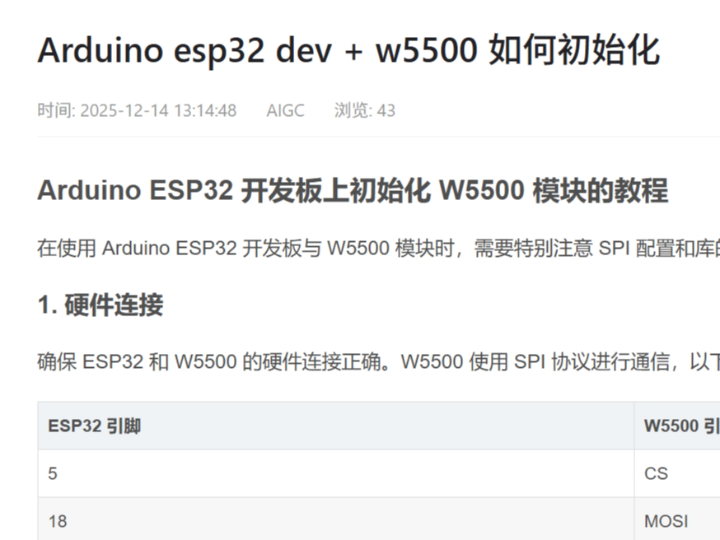
How to Add Wired Ethernet with WIZnet W5500 to MicroPython Robot Nodes?
Summary
This robotics design uses WIZnet W5500 to add wired Ethernet to a MicroPython-based robot node. The robot controller runs MicroPython application logic, sensor handling, command parsing, and diagnostic behavior, while W5500 provides the Ethernet MAC/PHY, hardwired TCP/IP stack, hardware sockets, and packet buffering. The original CSDN Wenku answer page could not be directly fetched during verification, so the implementation notes below use accessible related CSDN W5500 MicroPython sources rather than claiming code from the exact Wenku page.
What the Project Does
The project target is a MicroPython robot node that communicates over wired Ethernet instead of relying only on wireless links. Typical robot traffic includes heartbeat packets, motor status, encoder values, sensor summaries, fault codes, calibration commands, and service-console messages. The robot MCU or ESP32-class controller owns the robot behavior, while W5500 owns the Ethernet transport path.
The data flow is direct: MicroPython application → W5500 driver/socket layer → SPI → W5500 → RJ45 Ethernet → robot supervisor, PC tool, gateway, or field-service laptop. A related CSDN MicroPython example uses an ESP32-C3 development board, a W5500 wired Ethernet UDP/TCP module, jumper wires, and a Windows PC, with the W5500 module connected to the board over SPI and the W5500 LAN port connected to a router so the PC and W5500 are on the same network segment.
For robotics, the value is not only raw throughput. Wired Ethernet gives a repeatable maintenance path for bench testing, fixed robot cells, calibration rigs, and debugging stations. It also gives firmware a clearer failure model: link down, IP conflict, socket closed, peer restart, timeout, or packet loss can be handled explicitly instead of being hidden behind a wireless connection state.
Where WIZnet Fits
The exact WIZnet product is W5500. W5500 sits between the MicroPython-capable MCU and the Ethernet connector. The MCU controls W5500 through SPI, chip select, reset, and optionally interrupt. W5500 provides the hardwired TCP/IP engine, socket state machine, packet buffers, and embedded 10/100 Ethernet MAC/PHY.
WIZnet documents W5500 as a hardwired TCP/IP Internet controller that connects to an external MCU through SPI up to 80 MHz. It provides an embedded 10/100 Ethernet MAC and PHY, supports TCP, UDP, ICMP, IPv4, ARP, IGMP, and PPPoE, provides 8 independent sockets, and includes 32 KB internal memory for Tx/Rx buffers.
This division is useful in a robot node because MicroPython can stay focused on robot application logic rather than low-level TCP/IP processing. MicroPython’s WIZNET5K documentation describes WIZnet5x00 modules as controlled through an SPI object, chip-select pin, and reset pin; after initialization, sockets can be used normally. The same documentation notes that register dumping is available for debugging.
Implementation Notes
The exact Wenku page did not expose verified source files or a public repository. The following snippets are from an accessible related CSDN MicroPython W5500 source and should be treated as a verified reference pattern, not as code proven to come from the exact Wenku page.
File: wiznet5k.py
What it configures: common W5500 network registers, PHY register access, socket registers, socket status values, and socket commands.
Why it matters: robotics firmware needs visibility into chip identity, IP configuration, link behavior, socket state, RX size, TX free space, and close/reconnect conditions.
REG_MR = const(0x0000)  # Mode
REG_GAR = const(0x0001)  # Gateway IP Address
REG_SUBR = const(0x0005)  # Subnet Mask Address
REG_VERSIONR_W5500 = const(0x0039)  # W5500 Silicon Version
REG_SHAR = const(0x0009)  # Source Hardware Address
REG_SIPR = const(0x000F)  # Source IP Address
REG_PHYCFGR = const(0x002E)  # W5500 PHY Configuration

REG_SNMR = const(0x0000)  # Socket n Mode
REG_SNCR = const(0x0001)  # Socket n Command
REG_SNSR = const(0x0003)  # Socket n Status
REG_SNRX_RSR = const(0x0026)  # RX Free Size
REG_SNTX_FSR = const(0x0020)  # Socket n TX Free Size
The same related source defines socket states such as closed, initialized, listening, established, UDP, IPRAW, MACRAW, and PPPoE, plus socket commands such as open, listen, connect, disconnect, close, send, and receive. Those constants are the practical boundary between MicroPython robot logic and W5500’s socket engine.
File: example.py
What it configures: MicroPython SPI pins, W5500 chip-select/reset pins, UDP socket, TCP socket, and basic chip/MAC/IP reporting.
Why it matters: this is the bring-up pattern a robot node needs before adding motor telemetry, sensor packets, or supervisor commands.
from machine import Pin,SPI
from wiznet5k import WIZNET5K
import wiznet5k_socket as socket
import time

spi = SPI(1,baudrate = 8_000_000,sck = Pin(2),mosi = Pin(3),miso = Pin(10,Pin.IN))
net = WIZNET5K(spi,cs = Pin(7,Pin.OUT),reset = Pin(6))

addr = ("192.168.1.10",8080)

udp_socket = socket.socket(socket.AF_INET,socket.SOCK_DGRAM)
udp_socket.bind(("192.168.1.55",8080))

tcp_socket = socket.socket(socket.AF_INET,socket.SOCK_STREAM)
tcp_socket.bind(("192.168.1.12",8080))
tcp_socket.connect(("192.168.1.10",8080))
This example shows the core structure: configure SPI, instantiate W5500, open UDP for lightweight datagrams, and open TCP for connection-oriented communication. In a robot system, UDP is suitable for periodic telemetry or discovery, while TCP is better for service commands, configuration, or logs that need ordered delivery.
Practical Tips / Pitfalls
- Bring up Ethernet before robot motion. Confirm chip version, MAC address, IP address, link state, UDP send, and TCP connect before enabling actuators.
- Keep SPI wiring short and deterministic. SCLK, MOSI, MISO, chip select, reset, 3.3 V, and ground are the minimum practical signals.
- Route reset to a GPIO. A robot should be able to reset the Ethernet controller without rebooting the whole motion system.
- Use interrupt when the firmware needs event-driven receive, disconnect, timeout, or send-complete handling.
- Reserve W5500 sockets by function: telemetry, command channel, service console, discovery, diagnostics, and future expansion.
- Keep robot payloads compact. Use node ID, sequence number, timestamp, message type, status flags, and checksum where needed.
- Do not let socket servicing block the motor-control loop. Network handling should run as a separate task, timer-driven loop, or bounded polling section.
FAQ
Q: Why use WIZnet W5500 for a MicroPython robot node?
A: W5500 gives the robot a wired Ethernet path with hardwired TCP/IP, 8 sockets, and 32 KB internal Tx/Rx memory. That lets MicroPython handle robot messages and diagnostics while W5500 handles Ethernet MAC/PHY operation, TCP/UDP behavior, socket state, and buffering.
Q: How does W5500 connect to the robot platform?
A: W5500 connects through SPI using MOSI, MISO, SCLK, chip select, reset, power, and ground. A related ESP32 hardware design maps SCLK to GPIO18, MOSI to GPIO23, MISO to GPIO19, chip select to GPIO5, interrupt to GPIO4, and reset to GPIO16, while MicroPython’s WIZNET5K model uses an SPI object, chip-select pin, and reset pin.
Q: What role does W5500 play in this robotics project?
A: W5500 is the wired Ethernet transport engine. The robot MCU creates telemetry and command payloads, while W5500 manages the physical Ethernet link, hardwired TCP/IP processing, socket status, RX/TX buffer movement, and connection state.
Q: Can beginners follow this project?
A: Yes, if the bring-up is staged. The recommended order is power check, SPI wiring check, W5500 reset check, chip/version read, IP configuration, UDP packet test, TCP connection test, then robot-specific telemetry and command framing.
Q: Is wired W5500 Ethernet always better than Wi-Fi for robots?
A: No. Wi-Fi is better when the robot must move freely without a cable. W5500 is better for fixed robot cells, bench diagnostics, calibration fixtures, service ports, and factory test setups where stable wired behavior, clear link state, and repeatable latency are more important than untethered movement.
Source
Original source: CSDN Wenku answer page provided by the user. The page could not be directly fetched during verification, so its license and project-specific implementation details could not be confirmed.
Related CSDN source: “Micropython ESP32 C3连接W5500有线以太网UDP&TCP协议通讯模块,” which includes ESP32-C3 + W5500 environment details, SPI connection context, MicroPython W5500 driver files, register constants, and UDP/TCP example code. The page states that the content follows the CC 4.0 BY-SA license.
Related CSDN hardware source: “ESP32+W5500以太网硬件设计与MicroPython驱动实现,” which documents an ESP32-to-W5500 SPI pin map, reset, interrupt, RJ45 transformer, and hardware design constraints.
WIZnet product reference: W5500 documentation and feature list.
MicroPython reference: WIZNET5K documentation for WIZnet5x00 Ethernet modules.
Tags
#W5500 #WIZnet #MicroPython #Robotics #ESP32 #ESP32C3 #Ethernet #SPI #HardwareWiring #NetworkStack #Firmware #Socket #UDP #TCP #RobotDiagnostics
MicroPython 로봇 노드에 WIZnet W5500으로 유선 Ethernet을 추가하는 방법은?
요약
이 로보틱스 설계는 WIZnet W5500을 사용해 MicroPython 기반 로봇 노드에 유선 Ethernet을 추가합니다. 로봇 컨트롤러는 MicroPython 애플리케이션 로직, 센서 처리, 명령 파싱, 진단 동작을 실행하고, W5500은 Ethernet MAC/PHY, hardwired TCP/IP stack, hardware socket, packet buffering을 제공합니다. 원본 CSDN Wenku answer page는 검증 중 직접 가져올 수 없었기 때문에, 아래 구현 참고 사항은 정확한 Wenku 페이지의 코드라고 주장하지 않고 접근 가능한 관련 CSDN W5500 MicroPython 자료를 기반으로 작성했습니다.
프로젝트가 하는 일
대상 프로젝트는 무선 링크에만 의존하지 않고 유선 Ethernet으로 통신하는 MicroPython 로봇 노드입니다. 일반적인 로봇 트래픽에는 heartbeat packet, motor status, encoder value, sensor summary, fault code, calibration command, service-console message가 포함됩니다. 로봇 MCU 또는 ESP32급 컨트롤러는 로봇 동작을 담당하고, W5500은 Ethernet transport path를 담당합니다.
데이터 흐름은 다음과 같습니다.
MicroPython application → W5500 driver/socket layer → SPI → W5500 → RJ45 Ethernet → robot supervisor, PC tool, gateway 또는 field-service laptop
관련 CSDN MicroPython 예제는 ESP32-C3 개발 보드, W5500 유선 Ethernet UDP/TCP 모듈, jumper wire, Windows PC를 사용합니다. W5500 모듈은 SPI로 보드에 연결되고, W5500 LAN 포트는 router에 연결되어 PC와 W5500이 같은 network segment에 있도록 구성됩니다.
로보틱스에서 중요한 것은 단순한 throughput만이 아닙니다. 유선 Ethernet은 bench test, fixed robot cell, calibration rig, debugging station에서 반복 가능한 maintenance path를 제공합니다. 또한 firmware가 link down, IP conflict, socket closed, peer restart, timeout, packet loss 같은 실패 모델을 명확하게 처리할 수 있게 해줍니다.
WIZnet이 들어가는 위치
이 프로젝트에서 사용되는 정확한 WIZnet 제품은 W5500입니다. W5500은 MicroPython을 실행할 수 있는 MCU와 Ethernet connector 사이에 위치합니다. MCU는 SPI, chip select, reset, 선택적으로 interrupt를 통해 W5500을 제어합니다. W5500은 hardwired TCP/IP engine, socket state machine, packet buffer, embedded 10/100 Ethernet MAC/PHY를 제공합니다.
WIZnet 문서 기준으로 W5500은 외부 MCU와 최대 80 MHz SPI로 연결되는 hardwired TCP/IP Internet controller입니다. Embedded 10/100 Ethernet MAC and PHY를 제공하고, TCP, UDP, ICMP, IPv4, ARP, IGMP, PPPoE를 지원하며, 8개의 independent socket과 Tx/Rx buffer용 32 KB internal memory를 포함합니다.
이 분업은 로봇 노드에서 유용합니다. MicroPython은 low-level TCP/IP 처리 대신 로봇 애플리케이션 로직에 집중할 수 있습니다. MicroPython WIZNET5K 문서는 WIZnet5x00 module이 SPI object, chip-select pin, reset pin으로 제어된다고 설명합니다. 초기화 후에는 socket을 일반적으로 사용할 수 있으며, debugging을 위한 register dump도 제공됩니다.
구현 참고 사항
정확한 Wenku 페이지는 검증 가능한 source file이나 public repository를 노출하지 않았습니다. 아래 snippet은 접근 가능한 관련 CSDN MicroPython W5500 자료에서 가져온 검증된 reference pattern이며, 정확한 Wenku 페이지에서 나온 코드로 확정할 수는 없습니다.
파일: wiznet5k.py
설정 내용: common W5500 network register, PHY register access, socket register, socket status value, socket command
중요한 이유: 로보틱스 firmware는 chip identity, IP configuration, link behavior, socket state, RX size, TX free space, close/reconnect condition을 관찰할 수 있어야 합니다.
REG_MR = const(0x0000)  # Mode
REG_GAR = const(0x0001)  # Gateway IP Address
REG_SUBR = const(0x0005)  # Subnet Mask Address
REG_VERSIONR_W5500 = const(0x0039)  # W5500 Silicon Version
REG_SHAR = const(0x0009)  # Source Hardware Address
REG_SIPR = const(0x000F)  # Source IP Address
REG_PHYCFGR = const(0x002E)  # W5500 PHY Configuration

REG_SNMR = const(0x0000)  # Socket n Mode
REG_SNCR = const(0x0001)  # Socket n Command
REG_SNSR = const(0x0003)  # Socket n Status
REG_SNRX_RSR = const(0x0026)  # RX Free Size
REG_SNTX_FSR = const(0x0020)  # Socket n TX Free Size
같은 관련 자료는 closed, initialized, listening, established, UDP, IPRAW, MACRAW, PPPoE 같은 socket state와 open, listen, connect, disconnect, close, send, receive 같은 socket command도 정의합니다. 이 constant들은 MicroPython 로봇 로직과 W5500 socket engine 사이의 실질적인 경계입니다.
파일: example.py
설정 내용: MicroPython SPI pin, W5500 chip-select/reset pin, UDP socket, TCP socket, 기본 chip/MAC/IP reporting
중요한 이유: motor telemetry, sensor packet, supervisor command를 추가하기 전에 로봇 노드가 먼저 검증해야 하는 bring-up pattern입니다.
from machine import Pin,SPI
from wiznet5k import WIZNET5K
import wiznet5k_socket as socket
import time

spi = SPI(1,baudrate = 8_000_000,sck = Pin(2),mosi = Pin(3),miso = Pin(10,Pin.IN))
net = WIZNET5K(spi,cs = Pin(7,Pin.OUT),reset = Pin(6))

addr = ("192.168.1.10",8080)

udp_socket = socket.socket(socket.AF_INET,socket.SOCK_DGRAM)
udp_socket.bind(("192.168.1.55",8080))

tcp_socket = socket.socket(socket.AF_INET,socket.SOCK_STREAM)
tcp_socket.bind(("192.168.1.12",8080))
tcp_socket.connect(("192.168.1.10",8080))
이 예제는 핵심 구조를 보여줍니다. SPI를 설정하고, W5500을 인스턴스화하고, lightweight datagram을 위한 UDP를 열고, connection-oriented communication을 위한 TCP를 엽니다. 로봇 시스템에서는 UDP가 periodic telemetry 또는 discovery에 적합하고, TCP는 ordered delivery가 필요한 service command, configuration, log에 더 적합합니다.
실무 팁 / 주의점
- 로봇 motion을 활성화하기 전에 Ethernet을 먼저 bring-up해야 합니다. Chip version, MAC address, IP address, link state, UDP send, TCP connect를 확인해야 합니다.
- SPI 배선은 짧고 결정적으로 유지해야 합니다. SCLK, MOSI, MISO, chip select, reset, 3.3 V, ground가 최소 실용 신호입니다.
- Reset을 GPIO에 연결해야 합니다. 로봇은 전체 motion system을 reboot하지 않고 Ethernet controller를 reset할 수 있어야 합니다.
- Firmware가 event-driven receive, disconnect, timeout, send-complete 처리를 필요로 한다면 interrupt를 사용하는 것이 좋습니다.
- W5500 socket을 기능별로 예약해야 합니다. Telemetry, command channel, service console, discovery, diagnostics, future expansion을 구분하는 것이 좋습니다.
- Robot payload는 compact하게 유지해야 합니다. 필요에 따라 node ID, sequence number, timestamp, message type, status flag, checksum을 포함합니다.
- Socket servicing이 motor-control loop를 막으면 안 됩니다. Network handling은 별도 task, timer-driven loop, 또는 bounded polling section으로 처리하는 것이 좋습니다.
FAQ
Q: MicroPython 로봇 노드에 왜 WIZnet W5500을 사용하나요?
A: W5500은 hardwired TCP/IP, 8개 socket, 32 KB internal Tx/Rx memory를 갖춘 유선 Ethernet 경로를 로봇에 제공합니다. 따라서 MicroPython은 robot message와 diagnostics를 처리하고, W5500은 Ethernet MAC/PHY operation, TCP/UDP behavior, socket state, buffering을 담당할 수 있습니다.
Q: W5500은 로봇 플랫폼에 어떻게 연결되나요?
A: W5500은 MOSI, MISO, SCLK, chip select, reset, power, ground를 사용하는 SPI로 연결됩니다. 관련 ESP32 hardware design은 SCLK를 GPIO18, MOSI를 GPIO23, MISO를 GPIO19, chip select를 GPIO5, interrupt를 GPIO4, reset을 GPIO16에 매핑합니다. MicroPython WIZNET5K model은 SPI object, chip-select pin, reset pin을 사용합니다.
Q: 이 로보틱스 프로젝트에서 W5500은 어떤 역할을 하나요?
A: W5500은 유선 Ethernet transport engine입니다. 로봇 MCU는 telemetry 및 command payload를 만들고, W5500은 physical Ethernet link, hardwired TCP/IP processing, socket status, RX/TX buffer movement, connection state를 관리합니다.
Q: 초보자도 이 프로젝트를 따라갈 수 있나요?
A: 가능합니다. 다만 staged bring-up이 필요합니다. 권장 순서는 power check, SPI wiring check, W5500 reset check, chip/version read, IP configuration, UDP packet test, TCP connection test, 그다음 robot-specific telemetry 및 command framing입니다.
Q: 유선 W5500 Ethernet이 로봇에서 항상 Wi-Fi보다 낫나요?
A: 아닙니다. 로봇이 케이블 없이 자유롭게 움직여야 한다면 Wi-Fi가 더 적합합니다. W5500은 fixed robot cell, bench diagnostics, calibration fixture, service port, factory test setup처럼 안정적인 유선 동작, 명확한 link state, 반복 가능한 latency가 untethered movement보다 중요한 경우에 더 적합합니다.
출처
Original source: 사용자가 제공한 CSDN Wenku answer page. 검증 중 해당 페이지를 직접 가져올 수 없었으므로, 라이선스와 프로젝트별 구현 세부 정보는 확인할 수 없었습니다.
https://wenku.csdn.net/answer/3mdbg307d2
Related CSDN source: “Micropython ESP32 C3连接W5500有线以太网UDP&TCP协议通讯模块,” ESP32-C3 + W5500 environment detail, SPI connection context, MicroPython W5500 driver file, register constant, UDP/TCP example code를 포함합니다. 해당 페이지는 CC 4.0 BY-SA license를 따른다고 명시합니다.
https://blog.csdn.net/zhusongziye/article/details/130996429
Related CSDN hardware source: “ESP32+W5500以太网硬件设计与MicroPython驱动实现,” ESP32-to-W5500 SPI pin map, reset, interrupt, RJ45 transformer, hardware design constraint를 문서화합니다.
https://blog.csdn.net/weixin_42355400/article/details/158409678
WIZnet product reference: W5500 documentation and feature list.
https://docs.wiznet.io/Product/Chip/Ethernet/W5500
MicroPython reference: WIZNET5K documentation for WIZnet5x00 Ethernet modules.
https://docs.micropython.org/en/latest/library/network.WIZNET5K.html
태그
#W5500 #WIZnet #MicroPython #Robotics #ESP32 #ESP32C3 #Ethernet #SPI #HardwareWiring #NetworkStack #Firmware #Socket #UDP #TCP #RobotDiagnostics