



How Does the W5500 Handle TCP Socket Lifecycle in Embedded Systems?
This article explains how the WIZnet W5500 manages TCP socket lifecycle in embedded systems.
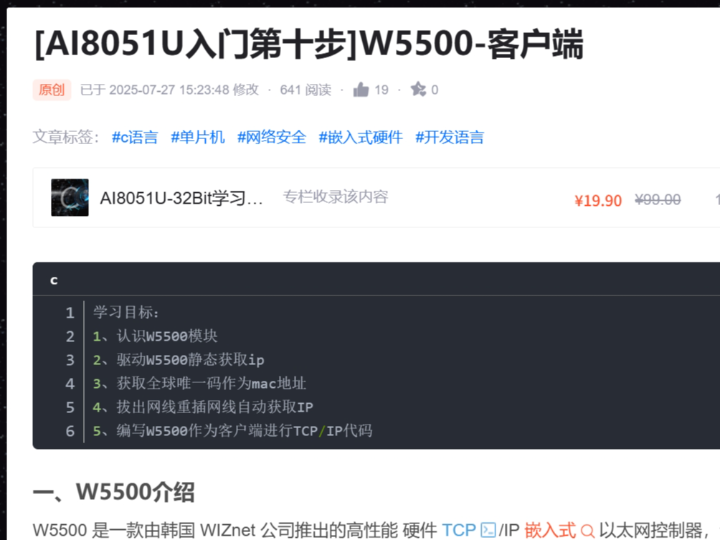
How Does the W5500 Handle TCP Socket Lifecycle in Embedded Systems?
Understanding OPEN → CONNECT → ESTABLISHED Workflow at the Protocol Level
(W5500에서 TCP 소켓 라이프사이클은 어떻게 동작하는가?)
Summary (40–60 words)
This article explains how the WIZnet W5500 manages TCP socket lifecycle in embedded systems. By analyzing the complete workflow from socket OPEN to CONNECT and ESTABLISHED states, developers can understand how hardware TCP/IP offloading simplifies TCP communication and enables reliable Ethernet-based applications.
1. Why TCP Socket Lifecycle Matters
After completing:
- Network bring-up (IP configuration)
- DNS resolution (optional)
- SPI/register initialization
the next critical step is TCP communication.
Most application protocols—such as:
- HTTP
- MQTT
- Modbus TCP
are built on top of TCP.
If the socket lifecycle is not handled correctly, you will see issues like:
- “Connect fails”
- “Socket stuck in INIT”
- “No data transmission”
2. W5500 TCP Socket Architecture
The W5500 provides:
- 8 independent hardware sockets
- Hardware TCP/IP stack
- Internal state machine
Each socket operates independently and is controlled through registers.
Key Socket Registers
| Register | Function |
|---|---|
| Sn_MR | Mode (TCP/UDP) |
| Sn_CR | Command register |
| Sn_SR | Status register |
| Sn_PORT | Local port |
| Sn_DIPR | Destination IP |
| Sn_DPORT | Destination port |
👉 Key insight:
TCP behavior is not implemented in firmware—it is handled by W5500 hardware state machine.
3. TCP Socket Lifecycle Overview
The TCP lifecycle in W5500 follows a deterministic sequence:
CLOSED
   │
   ▼
OPEN (INIT)
   │
   ▼
CONNECT (SYN)
   │
   ▼
ESTABLISHED
   │
   ▼
DATA EXCHANGE
Each transition is triggered by writing to Sn_CR (Command Register).
4. Step-by-Step TCP Client Workflow
Step 1 — Socket OPEN
Set Sn_MR = TCP
Set Sn_PORT
Issue OPEN command
Result:
- Socket enters INIT state
Step 2 — Configure Destination
Set Sn_DIPR (destination IP)
Set Sn_DPORT (destination port)
Step 3 — CONNECT Command
Write CONNECT to Sn_CRW5500 automatically performs:
- SYN packet transmission
- TCP handshake
Step 4 — ESTABLISHED State
Check Sn_SR == ESTABLISHEDOnce established:
- data can be transmitted
- RX/TX buffers become active
5. End-to-End Protocol Workflow
The complete TCP communication process:
Application request
      │
      ▼
MCU configures socket registers
      │
      ▼
W5500 sends SYN packet
      │
      ▼
Server responds (SYN-ACK)
      │
      ▼
W5500 completes handshake
      │
      ▼
Socket = ESTABLISHED
      │
      ▼
Data exchange begins
6. Data Transmission After Connection
Sending Data
Write data to TX buffer
 → Update pointer
 → SEND command
Receiving Data
Check RX size
 → Read data
 → Issue RECV command
👉 Critical rule:
Without RECV command, new packets will not be processed.
7. Common TCP Failure Cases
❌ Case 1 — Stuck in INIT
Cause:
- OPEN command failed
- SPI write error
❌ Case 2 — CONNECT Fails
Cause:
- wrong IP or port
- server not reachable
- network configuration error
❌ Case 3 — Never Reaches ESTABLISHED
Cause:
- SYN packet not sent
- firewall blocking
- incorrect gateway
❌ Case 4 — Connected but No Data
Cause:
- TX/RX buffer mismanagement
- RECV not issued
👉 Key insight:
TCP problems are often configuration or register issues—not protocol bugs.
8. Debugging Workflow
Follow this strict order:
1. Verify network (Ping OK)
2. Check Sn_SR status
3. Confirm destination IP/port
4. Monitor CONNECT command
5. Check ESTABLISHED state
6. Validate TX/RX buffer operations
9. W5500 vs Software TCP/IP Stack
| Feature | W5500 | Software Stack (LwIP) |
|---|---|---|
| TCP handling | Hardware | Software |
| CPU usage | Low | High |
| RAM usage | Internal 32KB | ~30KB MCU RAM |
| Timing | Deterministic | OS-dependent |
👉 Result:
- simpler firmware
- more stable communication
- easier debugging
10. Educational Value
Understanding TCP lifecycle on W5500 helps developers:
- build reliable Ethernet clients
- implement higher-level protocols
- debug networking issues efficiently
This is a core skill for:
- IoT gateway development
- industrial controllers
- embedded networking systems
Key Takeaway
The W5500 TCP socket lifecycle is a hardware-driven state machine controlled via registers.
By correctly managing OPEN, CONNECT, and ESTABLISHED states, developers can build stable and reliable Ethernet communication systems without implementing a full TCP/IP stack in firmware.
FAQ (WIZnet-Focused)
Q1. Why use W5500 for TCP instead of software stack?
W5500 offloads TCP/IP processing to hardware, reducing CPU usage and saving ~30KB RAM compared to software stacks like LwIP.
Q2. How does CONNECT work internally?
When CONNECT is issued, W5500 automatically performs TCP handshake (SYN → SYN-ACK → ACK) without MCU intervention.
Q3. What is the most important register for TCP?
Sn_SR (Socket Status Register) is critical, as it indicates the current socket state (INIT, ESTABLISHED, etc.).
Q4. Why does CONNECT fail even with correct code?
Most failures are due to incorrect network configuration (IP, gateway) or unreachable server—not code logic.
Q5. Can beginners implement TCP using W5500?
Yes. The hardware TCP/IP stack simplifies implementation significantly, making it easier than software-based networking.
Source
CSDN Blog
sinat_58149788 — W5500 TCP Socket Lifecycle Article
Tags
W5500
TCP Socket
Embedded Ethernet
Socket Lifecycle
IoT Networking
🇰🇷 한국어 번역 (1:1)
W5500에서 TCP 소켓 라이프사이클은 어떻게 동작하는가?
요약
본 문서는 WIZnet W5500 이더넷 컨트롤러에서 TCP 소켓이 OPEN → CONNECT → ESTABLISHED 상태로 전이되는 과정을 설명한다. 전체 프로토콜 흐름을 분석하여 임베디드 시스템에서 안정적인 TCP 통신을 구현하는 방법을 제시한다.
1. 핵심 개념
TCP는 모든 상위 프로토콜의 기반이다.
2. 흐름
OPEN → CONNECT → ESTABLISHED3. 핵심 메시지
W5500의 TCP 동작은 하드웨어 상태 머신으로 구현되며, 레지스터 제어가 핵심이다.
원하시면 다음 단계로:
- 📡 HTTP client on top of TCP
- 🔌 MQTT over TCP workflow
- 🐞 실제 실패 로그 기반 분석
까지 이어서 시리즈로 구성해 드릴 수 있습니다.