



Zealacare Smart Sensor
Zealacare's Smart Incontinence System combines disposable briefs with integrated sensing strips, a reusable wireless Smart Sensor, inductive charging, and APP
How Does Zealacare Detect a Wet Brief and Alert Caregivers, and Where Does WizFi360 Fit?
Zealacare's Smart Incontinence System combines disposable briefs with integrated sensing strips, a reusable wireless Smart Sensor, inductive charging, and a mobile application. FCC records for the SmartSensor, model SENS247, show that a pre-certified WIZnet WizFi360 module provides its Wi-Fi connection, while a separate BLE radio is certified as part of the finished sensor.
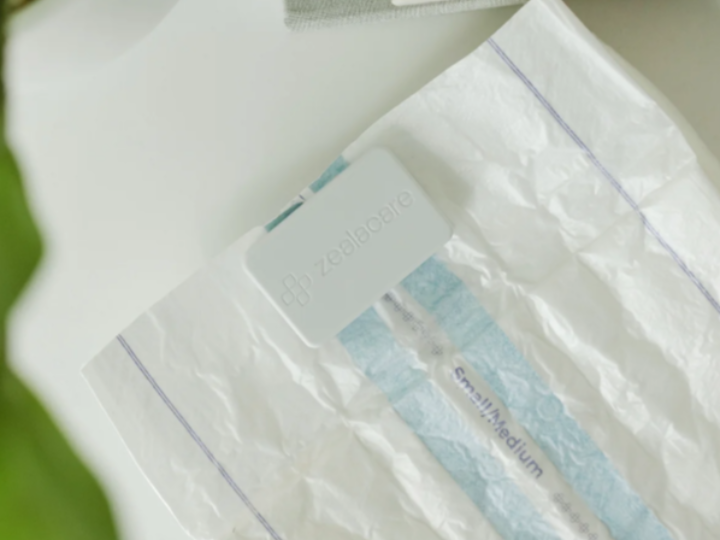
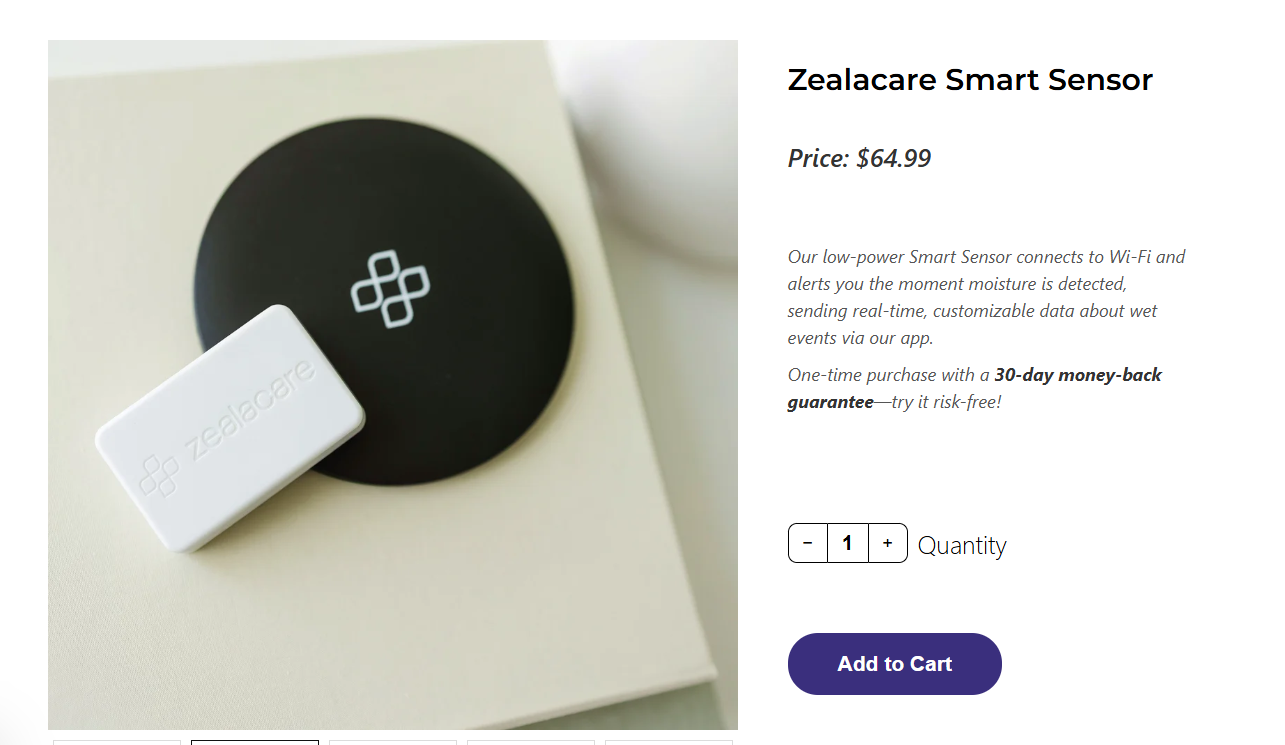
Photos: Zealacare.
Components
WIZnet WizFi360 × 1 — 2.4 GHz Wi-Fi connectivity. The FCC test report states that the SmartSensor contains a pre-certified wireless module with FCC ID 2ATUB-WIZFI360PA for Wi-Fi transmissions. WIZnet's own FCC authorization identifies that FCC ID as WizFi360, operating from 2412 to 2462 MHz under a single modular approval.
The Zealacare filing does not identify the exact WizFi360 sub-model in searchable text. WIZnet's FCC authorization has historically covered the WizFi360 family under the same FCC ID, so this article does not infer a PA/CON variant from appearance alone.
BLE radio — provisioning and short-range wireless function. The SmartSensor itself is certified over 2402–2480 MHz for BLE. Zealacare's setup instructions require Bluetooth to be enabled on the phone while the sensor is provisioned onto the local Wi-Fi network.
Rechargeable battery and inductive charger. The FCC test report describes a 3.7 V, 1.18 Wh rechargeable lithium-ion battery and standard Qi charging. The user manual gives approximately 120 hours of use and specifies an inductive charging pad.
Turning an Adult Brief into a Connected Sensor System
Zealacare describes its product not as a standalone electronic sensor but as a three-part Smart Incontinence System:
- Zealacare Comfort Briefs
- Zealacare Smart Sensor and Inductive Charger
- Zealacare Mobile Application.
The briefs contain two sensing strips running along their length. When the reusable Smart Sensor is snapped onto the brief, those strips form part of the wetness-detection system. Zealacare says the Smart Sensor can identify a wet event and estimate the saturation level after that event.
The company's current product material describes the sensor simply as “a low power device” providing real-time information around wet events. The application can generate wet-brief notifications, estimated-saturation notifications, low-battery warnings, sensor-connection warnings, and notifications when no brief is detected.
This division is important for understanding the electronics.
The brief contains the sensing strips.
The SmartSensor performs the connected sensing function.
The mobile application presents status and notifications.
And the FCC documentation shows that WizFi360 supplies the Wi-Fi radio used by that SmartSensor.
One Piece of Context: Why Monitor Wetness Electronically?
Traditional incontinence care can require caregivers to check briefs manually or according to a schedule rather than knowing precisely when a change is required.
Zealacare's system is designed around event-based monitoring instead. Its current website describes the system as using a reusable sensor attached to disposable smart briefs, with alerts delivered through the app when a change is needed. It also publishes brief history and approximate saturation information through the application's dashboard.
The FCC authorization describes the hardware more neutrally as a “Wireless wetness sensor for senior care.”
For embedded engineers, that makes the product a fairly conventional IoT architecture attached to an unconventional sensor:
wetness sensing strips → reusable SmartSensor → Wi-Fi network → application
The precise internal processing chain between the sensing contacts, local processor, BLE circuitry and WizFi360 is not publicly documented, so it should not be reconstructed from the photographs alone.
Bluetooth Gets the Sensor Onto Wi-Fi
The setup procedure provides a useful clue about how the two radios divide their work.
After charging the SmartSensor, the user opens the Zealacare app and selects “link sensor.” The app then directs the user to provision the sensor onto the local Wi-Fi network. During that step, Zealacare specifically instructs:
“Make sure your device’s bluetooth is enabled for this step.”
The user then selects the corresponding sensor, enters the Wi-Fi password, and is redirected to the dashboard after the connection succeeds.
If setup fails, Zealacare tells the user to verify that Wi-Fi reaches the room, that the phone is on the same Wi-Fi network, and that Bluetooth remains enabled.
The public documentation therefore establishes a setup sequence involving Bluetooth-assisted provisioning followed by local Wi-Fi connectivity, without publishing the actual provisioning protocol.
This is where the WizFi360's function becomes concrete: FCC testing identifies the WIZnet module specifically as the component used “for WiFi transmissions.”
The FCC Internal Photo Leaves Little Ambiguity
This adoption case is stronger than one based only on a contained FCC ID.
The FCC internal-photograph exhibit shows the SmartSensor PCBA with two explicit annotations: “Chip Antenna” and “WiFi Module.” The arrow for the Wi-Fi module points directly to a module carrying the WIZnet logo and WizFi360 marking.
The same PCBA photograph shows the rechargeable battery mounted immediately above the board. A separate close-up identifies the RF circuitry used for the other radio portion of the product.
This gives three independent pieces of evidence for WIZnet adoption:
FCC test report: contains FCC ID 2ATUB-WIZFI360PA for Wi-Fi.
WIZnet FCC record: that ID belongs to WIZnet's WizFi360.
FCC internal photograph: WIZnet module visibly installed on the SmartSensor PCB.
For a commercial-product adoption story, that is unusually solid documentation.
A Small Sensor Built for Days Rather Than Hours
The FCC test unit was compact.
VPI Technology records the engineering sample as 5.5 × 3.5 × 1.5 cm, powered internally by a 3.7 V, 1.18 Wh lithium-ion battery and charged using Qi-compatible wireless charging.
Zealacare's user manual gives the production-oriented dimensions as approximately:
- 53.4 mm long
- 31.75 mm wide
- 12.7 mm high
- 25 g
and specifies about 120 hours of use time.
The current Zealacare site advertises a 5–7 day battery life and inductive recharging. The FCC-era manual's ~120-hour figure corresponds to roughly five days, so the two documents describe broadly compatible but not identical specifications.
The manual instructs the user to place the sensor on the charging mat for approximately 60 minutes, or until the indicator LED stops flashing or turns green.
That battery and charging design fits the product's intended workflow: the electronic sensor is reusable, while the brief to which it attaches is disposable.
A Worked Example From the FCC Radio Measurements
The product contains both Wi-Fi and BLE, and their certification treatment needs to remain separate.
The WizFi360 Wi-Fi radio enters the product as a pre-certified module, under WIZnet's FCC ID 2ATUB-WIZFI360PA. The SENS247 filing itself evaluates the SmartSensor's BLE transmitter.
For that BLE transmitter, VPI measured three channels:
| BLE frequency | Conducted output |
|---|---|
| 2402 MHz | -9.28 dBm / 0.12 mW |
| 2440 MHz | -10.50 dBm / 0.09 mW |
| 2480 MHz | -8.98 dBm / 0.13 mW |
The maximum measured value was therefore -8.98 dBm, or 0.13 mW, with a declared antenna gain of 2.0 dBi.
Those values are BLE certification measurements. They are not WizFi360 output-power figures, Wi-Fi range measurements, battery-consumption results, or application performance numbers.
The distinction matters because simply reading the SENS247 FCC grant could otherwise lead someone to incorrectly assign the 0.13 mW figure to the WizFi360.
The Wi-Fi Radio Uses Its Own Certification
This is an instructive example of FCC modular certification.
The SENS247 test report explicitly describes the Wi-Fi component as a pre-certified wireless module, and identifies its FCC ID as 2ATUB-WIZFI360PA.
That FCC ID belongs separately to WIZnet H.K. LTD. WIZnet received the original authorization in August 2019, and the FCC record categorizes WizFi360 as a Single Modular device operating from 2412–2462 MHz.
The Zealacare SmartSensor nevertheless has its own FCC ID, 2BF5N-SENS247, and its own finished-product test record. Its grant covers the 2402–2480 MHz BLE radio and requires the certified installation to meet the applicable RF-exposure conditions.
So the regulatory structure can be read as:
WIZnet WizFi360
FCC ID 2ATUB-WIZFI360PA
↓ incorporated as pre-certified Wi-Fi module
Zealacare SmartSensor
FCC ID 2BF5N-SENS247
↓
Zealacare Smart Incontinence System
This does not mean using a pre-certified Wi-Fi module eliminates finished-product compliance work. Zealacare still has a separate end-product filing, test report, RF-exposure assessment, internal and external photographs, labels and user documentation.
Wi-Fi Is More Than a Setup Convenience
The current Zealacare system is built around remote status and notifications rather than requiring the caregiver to stay physically beside the SmartSensor.
Zealacare says its app provides real-time wetness notifications, approximate saturation information, sensor status, usage history and customizable notifications. The current company website describes the experience as remaining connected whether the caregiver is nearby or farther away.
This makes Wi-Fi different from the Bluetooth role visible during initial setup.
Bluetooth participates in linking and provisioning the device. The WIZnet module provides the SmartSensor's documented Wi-Fi radio. What happens above that connection — server architecture, cloud service, security protocol, application transport and data format — is not disclosed by the FCC material or user documentation used here.
It would therefore be incorrect to claim MQTT, HTTP, TLS, AWS, Azure or another cloud architecture without another source.
Water Resistant Does Not Mean Submersible
The current Zealacare site describes the Smart Sensor as water resistant. The technical section of its user manual is more specific: it lists an IPX4 rating and also states “Not to be used in water.”
That limitation is worth retaining in a product introduction because the sensor attaches to an incontinence brief and could otherwise be assumed to be washable or immersible.
The manual instructs users to clean it with a barely damp, lint-free cloth, permits disinfecting wipes, and specifically warns against products including acids, hydrogen peroxide, acetone, paint thinner and other solvents.
The reusable element is therefore the removable SmartSensor, not a sensor intended to pass through a washing process while attached to clothing.
FDA Registration Should Not Be Overstated
Zealacare's user documentation describes the Smart Incontinence System as FDA registered, and its current website uses the same terminology.
The cited sources say registered. They do not say in the material examined here that SENS247 has FDA clearance or approval.
For an engineering article, retaining that wording exactly is preferable to turning a registration statement into a stronger regulatory claim.
The user manual additionally lists compliance references including ES60601-1, CSA C22.2 No. 60601-1, EN 60601-1 and IEC 60601-1-2.
Where the WizFi360 Fits
The documented role is unusually straightforward:
WizFi360 provides Wi-Fi connectivity for the reusable Zealacare SmartSensor.
The FCC test laboratory states it directly:
“EUT contains pre-certified wireless module … FCCID 2ATUB-WIZFI360PA for WiFi transmissions.”
The user experience provides the other half of the story. During setup, the Zealacare application provisions the SmartSensor onto the user's local Wi-Fi network. After successful Wi-Fi configuration, the user is returned to the sensor dashboard.
A reasonable source-supported architecture is therefore:
Smart Brief sensing strips
→ Zealacare SmartSensor
→ WizFi360 Wi-Fi
→ network-connected Zealacare service/application
The public sources do not show the interface between the SmartSensor's processor and WizFi360, so this article does not claim UART, SPI or another bus.
They also do not disclose WizFi360 AT commands, TCP/UDP settings, TLS configuration, cloud endpoint, Wi-Fi firmware, packet formats or OTA mechanism.
What Is Published and What Is Not
The Zealacare FCC filing is quite useful for hardware verification. Public exhibits include the 20-page user manual, internal and external photographs, antenna information, RF-exposure documentation, test-setup photographs and a 41-page radio test report.
The FCC internal photographs visibly identify the WIZnet Wi-Fi module on the board.
The test report publishes the engineering sample's size, rechargeable-battery specification, Qi charging method, Wi-Fi-module certification ID, BLE frequency range and measured BLE RF performance.
The detailed schematic, block diagram and operational description, however, are listed only as metadata and are not publicly accessible through the FCC index used here.
That means the evidence is strong enough to establish which WIZnet module family is present and what radio function it provides, but not strong enough to reverse-engineer Zealacare's firmware or complete hardware architecture.
For a WIZnet reader, the useful thread is the move from a generic Wi-Fi module demonstration to a rechargeable, wearable-adjacent commercial sensing product. The WizFi360 is being used as the network link inside a compact healthcare-oriented sensor whose primary job is unrelated to networking: detecting wetness and getting that information to caregivers.
Related Reading
Regular WIZnet Maker readers may find Wireless Data Acquisition – Wireless, Low-Cost, and Portable EMG System useful as another body-sensor example. That project explicitly uses WizFi360 to transport physiological EMG measurements over Wi-Fi, although it is a research/data-acquisition platform rather than a commercial incontinence-care product.
WiFi Connected Environmental Sensor with WizFi360 shows the same broad sensor-to-network pattern with a BME680 environmental sensor. Zealacare applies the networking idea to a very different sensing domain and a finished reusable device.
WizSocket – Cloud-Connected IoT AC Socket is useful from the cloud-architecture side: it explicitly combines sensing, WizFi360 connectivity and cloud reporting, whereas Zealacare's public documentation does not disclose its application protocol or cloud implementation.
FAQ
Is a WIZnet module really inside Zealacare SENS247?
Yes. The FCC test report says the SmartSensor contains a pre-certified Wi-Fi module with FCC ID 2ATUB-WIZFI360PA, and that ID belongs to WIZnet H.K. LTD.'s WizFi360. The FCC internal photograph also shows the WIZnet module mounted on the SmartSensor PCB.
Is the exact module WizFi360-PA or WizFi360-CON?
The Zealacare test report identifies the FCC ID but does not explicitly state a sub-model in the searchable product documentation. This article therefore refers to it simply as WizFi360 rather than inferring the precise variant.
What does WizFi360 do in the SmartSensor?
The FCC report explicitly assigns it to Wi-Fi transmissions. Zealacare's user manual shows the sensor being provisioned onto a local Wi-Fi network through the mobile application.
What is Bluetooth used for?
The setup process requires Bluetooth to be enabled while the sensor is linked and provisioned to Wi-Fi. The SENS247's own FCC radio testing covers its BLE transmitter over 2402–2480 MHz.
Does WizFi360 detect the wetness?
The sources do not say that. Zealacare's briefs contain sensing strips, while the FCC report identifies WizFi360 as the Wi-Fi module. The detailed processor-to-sensor architecture is not publicly documented.
How long does the SmartSensor operate per charge?
The FCC-submitted user manual specifies approximately 120 hours. Zealacare's current website advertises 5–7 days.
Is it waterproof?
The current website calls it water resistant, while the technical manual specifies IPX4 and states that it is not to be used in water.
Documents
Zealacare SENS247 — FCC ID 2BF5N-SENS247 — Finished-product FCC record identifying the product as a wireless wetness sensor for senior care and providing its public regulatory exhibits. FCC ID 2BF5N-SENS247
VPI Technology FCC Test Report — The key WIZnet adoption source. It identifies the SmartSensor as Wi-Fi/BLE enabled and explicitly states that it contains pre-certified FCC ID 2ATUB-WIZFI360PA for Wi-Fi transmissions. SENS247 FCC Test Report
FCC Internal Photographs — Shows the production-style PCBA with the WIZnet Wi-Fi module explicitly indicated by an annotation. SENS247 Internal Photos
Zealacare Instructions for Use — Describes the three-part system, app, wetness/saturation functionality, Bluetooth/Wi-Fi setup, charging procedure and technical specifications. SENS247 User Manual
WIZnet WizFi360 FCC record — 2ATUB-WIZFI360PA — Establishes that the contained certification belongs to WIZnet H.K. LTD.'s WizFi360 and documents its modular approval. WizFi360 FCC Record
Zealacare Smart Incontinence System — Current product information covering Smart Briefs, Smart Sensor, app functions, current battery-life claim and care workflow. Zealacare official site