NORVI GSM-AE08-I-G
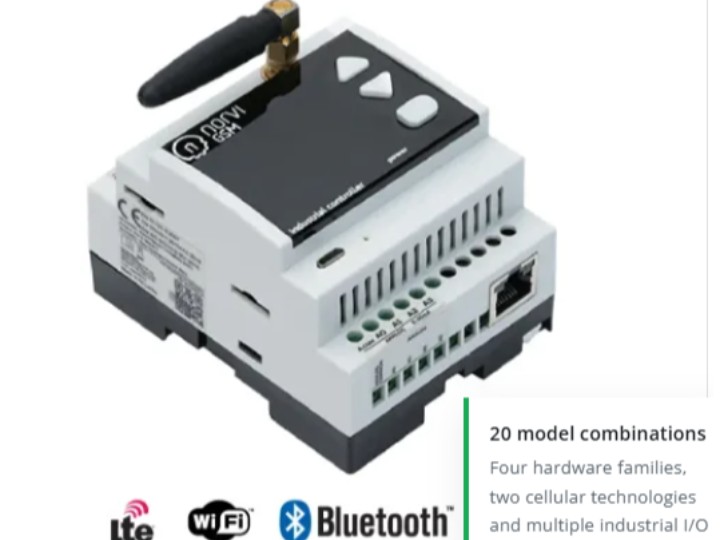
The NORVI ESP32 cellular IoT controller is designed for remote industrial monitoring, control, telemetry and data acquisition over 2G GSM or 4G LTE.
0
Project description
https://www.youtube.com/shorts/EAUiRhkJjYg
NORVI GSM-AE08-I-G: W5500 Industrial Connectivity Meets NORVI Edge AI
Industrial automation is rapidly moving beyond simple remote monitoring and control. Today, industrial devices are expected not only to collect sensor data and connect machines, but increasingly to support edge computing, machine vision, and AI-driven decision making.
NORVI provides an interesting example of this transition.
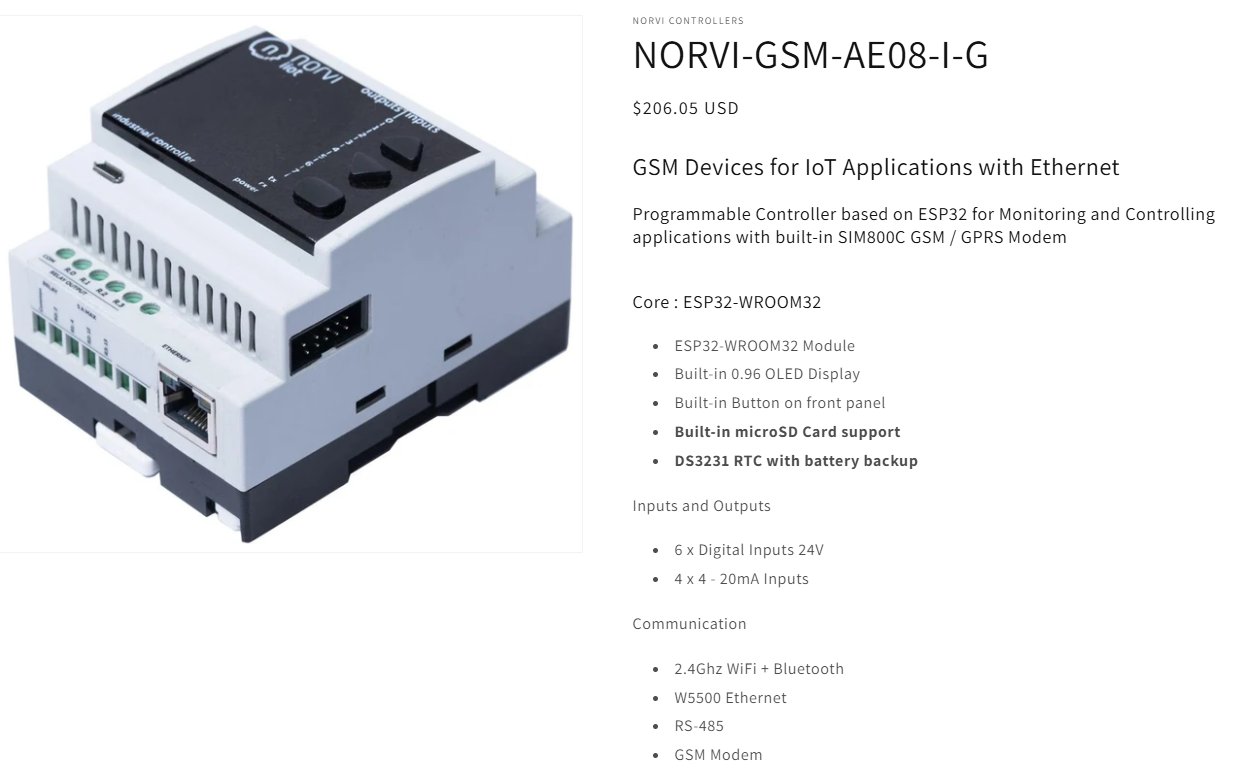
Its NORVI GSM-AE08-I-G is an industrial programmable controller built around the ESP32 and WIZnet W5500 Ethernet controller, combining wired Ethernet, cellular connectivity, RS-485, and industrial analog inputs in a DIN-rail form factor. At the same time, NORVI is expanding its portfolio toward embedded vision and Edge AI through the NORVI AI Optic, an ESP32-S3-based industrial camera platform.
Together, these products illustrate how traditional industrial connectivity and emerging Edge AI can coexist within the same automation ecosystem.
NORVI GSM-AE08-I-G: An Industrial Controller with Multiple Connectivity Options
The NORVI GSM-AE08-I-G is designed for industrial monitoring and remote-control applications where several communication methods may be required simultaneously.
At its core is an ESP32-WROOM32 MCU combined with a WIZnet W5500 for 10/100 Mbps Ethernet connectivity. The controller also includes GSM/GPRS, Wi-Fi, Bluetooth, and RS-485 interfaces.
Key specifications include:
ESP32-WROOM32
WIZnet W5500 Ethernet
10Base-T / 100Base-TX
GSM/GPRS using SIM800C
Wi-Fi and Bluetooth
RS-485
5 digital inputs
4 × 4–20 mA analog inputs
ADS1115 ADC
DS3231 RTC with battery backup
microSD card
0.96-inch OLED display
24 V DC power input
DIN-rail mounting
NORVI documents the W5500 as the Ethernet transceiver and exposes its SPI interface directly to the ESP32. The W5500 provides eight independent hardware sockets and supports TCP, UDP, ICMP, IPv4, ARP, IGMP, and PPPoE.
Why W5500 Matters in This Architecture
The GSM-AE08-I-G is particularly interesting because Ethernet is not its only network interface.
The controller already has:
Wi-Fi
Bluetooth
GSM/GPRS
RS-485
Yet NORVI still includes dedicated W5500 wired Ethernet.
This gives system integrators several possible communication paths depending on the installation.
For example:
4–20 mA Sensor
→ NORVI GSM-AE08-I-G
→ W5500 Ethernet
→ Local SCADA / Server
For a remote site:
Industrial Sensor
→ NORVI GSM-AE08-I-G
→ GSM/GPRS
→ Remote Server
And for legacy industrial equipment:
Modbus / RS-485 Device
→ NORVI Controller
→ W5500 Ethernet
→ Ethernet Network
The result is a controller that can bridge traditional field instrumentation with both local Ethernet infrastructure and wide-area cellular networks.
This is particularly useful for applications such as:
remote equipment monitoring
water and wastewater systems
environmental monitoring
energy monitoring
factory equipment
distributed sensor systems
unattended industrial installations
The industrial nature of the device is also reflected in NORVI's documented compliance with standards including EN 61131-2 and EN 61010 series requirements.
From Industrial Connectivity to Edge AI
NORVI's more recent product portfolio shows another direction: embedded vision and Edge AI.
The NORVI AI Optic is an ESP32-S3-based camera platform designed for embedded vision, machine monitoring, and TinyML development. NORVI describes it as an edge camera that can capture images, process them locally, display results, store data, and react to external trigger events.
Its hardware includes:
ESP32-S3-WROOM-1U-N16R8
16 MB flash
8 MB PSRAM
OV5640 5 MP autofocus camera
local TFT display option
microSD storage
external dry-contact trigger
dual LED illumination
USB-C programming and charging
rechargeable backup battery
This makes AI Optic very different from a conventional IP camera.
Instead of simply streaming images to a remote server, the ESP32-S3 can perform lightweight image processing or compact machine-learning inference close to the machine.
NORVI's Edge AI Workflow
NORVI documents a practical TinyML workflow using Edge Impulse.
The process is:
Capture training images using the deployed AI Optic hardware.
Build a dataset from real application images.
Train a compact vision model in Edge Impulse.
Export the trained model as an Arduino library.
Deploy the model back to the ESP32-S3.
Run classification locally on the device.
This allows AI inference to take place close to the equipment without requiring every image to be sent to a cloud AI service.
NORVI proposes applications including:
visual inspection
object detection
barcode and label workflows
meter reading
people counting
equipment monitoring
time-lapse process monitoring
For example:
External Machine Trigger
→ AI Optic Camera Capture
→ ESP32-S3 Local AI Inference
→ Classification Result
The result can then become part of a larger industrial automation system.
Connecting Industrial I/O and AI
The interesting opportunity appears when NORVI's two product directions are viewed together.
The GSM-AE08-I-G represents the conventional industrial automation layer:
Sensors / Equipment
→ 4–20 mA / Digital Input / RS-485
→ ESP32
→ WIZnet W5500
→ Industrial Ethernet
The AI Optic represents a newer machine-vision layer:
Camera / Trigger
→ ESP32-S3
→ Edge AI
→ Visual Decision
Together, they illustrate an architecture such as:
Industrial Sensors + Machine Vision
↓
NORVI Industrial Controllers / AI Optic
↓
Local Processing and Control
↓
Ethernet / Cellular Network
↓
SCADA / Server / Industrial Application
This is an important direction for industrial IoT.
AI does not eliminate traditional industrial connectivity. Instead, AI creates even greater demand for reliable field data and dependable communication between sensors, controllers, machines, and higher-level systems.
In that architecture, WIZnet W5500 provides a reliable wired Ethernet path for NORVI's industrial controller, while NORVI AI Optic introduces local vision intelligence at the edge.
From Connected Machines to Intelligent Machines
NORVI's portfolio shows how industrial automation is evolving.
The first step is connectivity:
Sensor → Controller → Ethernet
The next step adds intelligence:
Sensor / Camera → Edge Processing → Decision → Industrial Network
For WIZnet, this evolution is particularly relevant.
W5500 does not need to perform the AI inference itself. Its role is equally fundamental: providing the network path that connects field devices, controllers, SCADA systems, gateways, and AI-enabled equipment.
A useful way to describe this relationship is:
Industrial AI starts with reliable field data, and reliable field data needs dependable connectivity.
The NORVI GSM-AE08-I-G demonstrates the connectivity side of this architecture with ESP32, 4–20 mA inputs, RS-485, cellular communications, and WIZnet W5500 Ethernet.
NORVI AI Optic shows where the same industrial ecosystem is heading next: toward embedded vision, TinyML, and local machine intelligence.
Together, they provide a useful example of the transition from connected industrial devices to intelligent edge automation.
Product Status Note
NORVI currently lists the AI Optic technical documentation and Edge AI workflow publicly, but states that new orders for AI Optic are temporarily paused. Its documentation, object-detection workflow, and technical information remain available for engineering evaluation.
References
NORVI GSM-AE08-I-G official datasheet
NORVI AI Optic official product page and Edge AI workflow
NORVI AI Optic official datasheet
NORVI industrial product portfolio
