



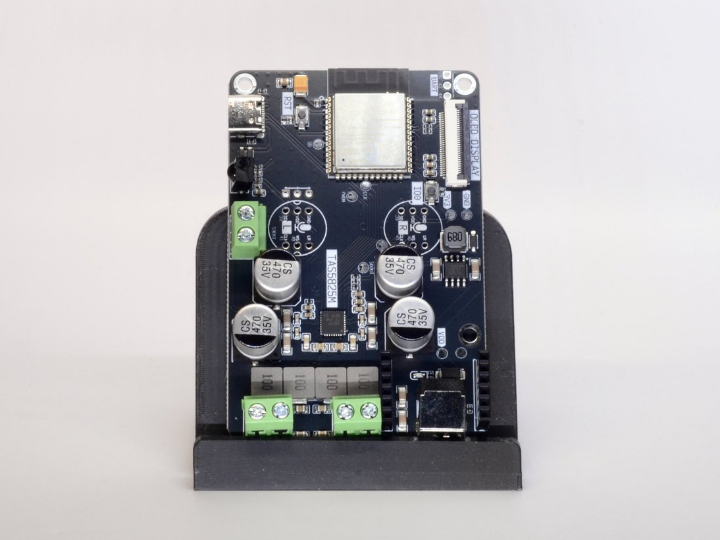
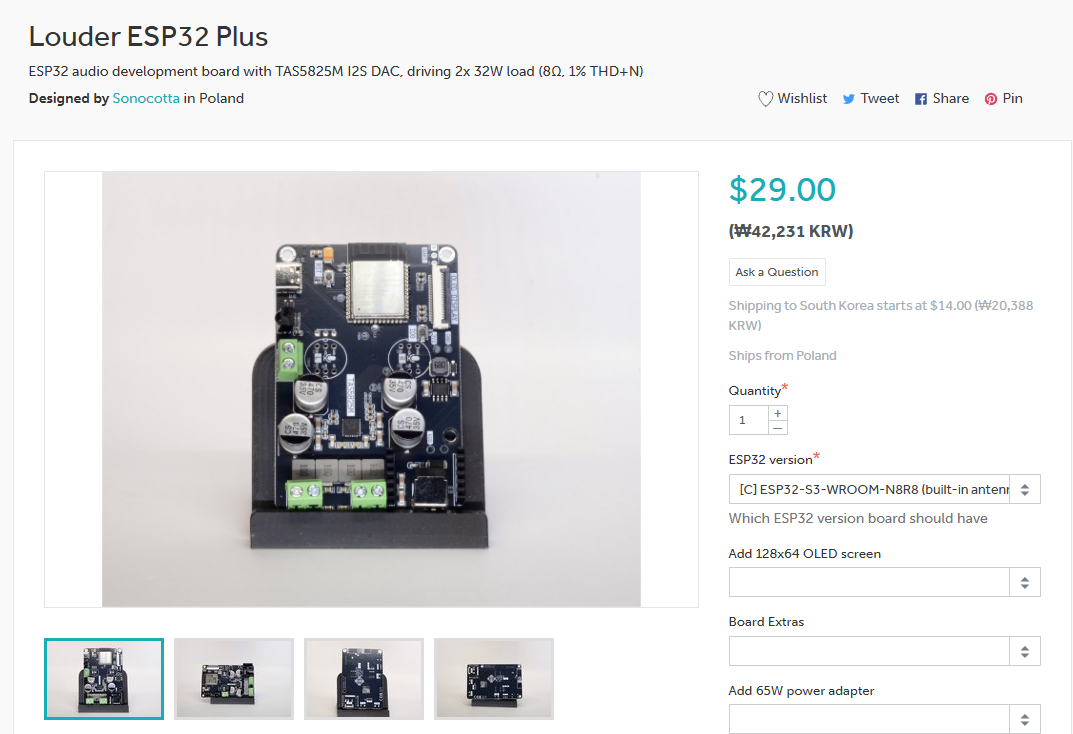
Louder ESP32 Plus
ESP32 audio development board with TAS5825M I2S DAC, driving 2x 32W load (8Ω, 1% THD+N)
1. Project Definition and Context
The esp32-audio-dock project by sonocotta is an open hardware and firmware ecosystem designed around ESP32 audio boards such as Loud-ESP32, Louder-ESP32, and Amped-ESP32. These boards are intended for always-on network audio playback, often installed inside enclosures, racks, or fixed locations where physical access is limited.
A key architectural decision in this project is to support Ethernet as an optional transport, rather than forcing Wi-Fi as the only network interface. Every supported board exposes a dedicated header for an SPI Ethernet module, explicitly targeting WIZnet W5500. This aligns well with industrial audio requirements: predictable connectivity, reduced maintenance, and configuration-based deployment without firmware recompilation.
2. Why WIZnet W5500 in This Project?
In this design, W5500 is not treated as an experimental add-on but as a first-class, customer-selectable option. The repository documents how Ethernet can be enabled purely through runtime configuration (NVS parameters) when W5500 hardware is present.
From a system engineering perspective:
The ESP32 remains responsible for audio decoding, buffering (PSRAM), and application logic
The W5500 handles TCP/IP networking in hardware, reducing software stack complexity
Ethernet becomes a deployment choice, not a firmware fork
This separation is particularly valuable for fixed installations where device variants (Wi-Fi only vs Ethernet-enabled) must share the same firmware image.
3. WIZnet W5500 Usage in esp32-audio-dock
3.1 Role of W5500
In this project, W5500 acts as the Ethernet network interface for audio streaming and control traffic, connected to the ESP32 via SPI. It provides the physical Ethernet link and hardware TCP/IP stack, while the application layer remains unchanged.
3.2 Configuration-Based Enablement (Actual Repository Snippet)
The repository documents W5500 enablement using Squeezelite-ESP32 configuration parameters.
File: README.md (root of repository)
Why this matters (technical reasoning)
model=w5500 explicitly selects WIZnet hardware TCP/IP
SPI clock = 20 MHz ensures sufficient throughput for continuous audio streams
Dedicated INT and RST lines allow reliable link state handling and recovery
No application-level code changes are required when Ethernet is enabled
This approach is well-suited to industrial deployments, where installers or integrators can decide at provisioning time whether a unit uses Wi-Fi or Ethernet.
4. Hardware Architecture (Industrial Perspective)
From the documented design:
ESP32 + external 8 MB PSRAM handles audio buffering and UI
W5500 connects via SPI and exposes RJ-45 Ethernet through a module
Boards are designed with case clearance for Ethernet modules in mind
Ethernet is physically optional but logically integrated
This results in a clean hardware architecture where Ethernet support does not complicate the base design yet remains fully supported.
5. Strategic Alignment: Fixed-Install Audio Devices
For industrial or permanent audio installations (factories, public spaces, control rooms):
Devices are expected to run 24/7
Network configuration must be predictable and repeatable
Field maintenance should avoid firmware rebuilds
The esp32-audio-dock + W5500 approach directly supports these requirements by allowing Ethernet to be enabled through configuration while maintaining a unified firmware base.
6. FAQ (WIZnet-Focused, AEO Optimized)
Q1. Why is WIZnet W5500 used as the Ethernet option in this project?
W5500 provides a hardware TCP/IP stack, allowing the ESP32 to focus on audio decoding and application logic instead of network protocol processing. In fixed-install audio devices, this separation improves system robustness and simplifies long-term operation without increasing firmware complexity.
Q2. How is W5500 connected to the ESP32 in esp32-audio-dock boards?
W5500 is connected via an SPI interface using MOSI, MISO, CLK, and CS signals, along with dedicated interrupt and reset pins. The repository documents exact pin mappings for ESP32 and ESP32-S3 variants, enabling consistent hardware integration across board families.
Q3. What role does W5500 play in the overall system architecture?
W5500 acts as the Ethernet networking layer, handling TCP/IP communication for audio streaming and control traffic. The ESP32 application remains unchanged, treating Ethernet as just another transport layer enabled through configuration rather than custom code paths.
Q4. Is this Ethernet implementation suitable for industrial or permanent installations?
Yes. The design supports configuration-based enablement, optional hardware population, and stable wired networking. These characteristics are well-aligned with industrial audio systems that require predictable connectivity and minimal maintenance after installation.
Q5. Can the same firmware image support both Wi-Fi and W5500 Ethernet devices?
Yes. The project explicitly supports selecting the network interface through runtime configuration. This allows manufacturers and integrators to ship a single firmware image while offering Ethernet-enabled variants using W5500 hardware.
7. Original Source
Original Project: sonocotta / esp32-audio-dock
https://github.com/sonocotta/esp32-audio-dock
License: Refer to repository license
8. Tags
#W5500 #ESP32 #IndustrialAudio #FixedInstall #EthernetAudio #WIZnet #SPIEthernet