



Lithium-ion Rechargeable Battery System BOS-B
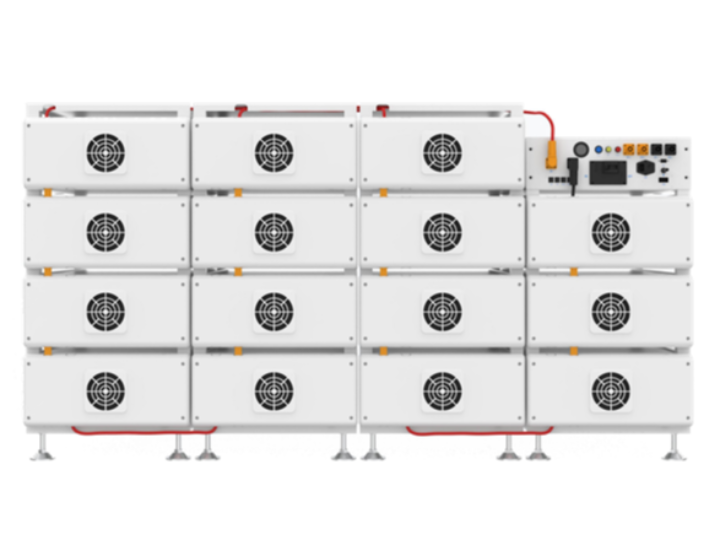
The installation and operation manual applies to the modular battery energy storage system.
Summary
The BOS-B modular lithium-ion battery energy storage system is designed for commercial and industrial backup power applications. In this architecture, Ethernet networking—implemented with a WIZnet W5500 controller—enables remote monitoring, fault detection, and system communication between the battery management system (BMS), controllers, and external monitoring infrastructure. The Ethernet interface allows reliable TCP-based diagnostics and monitoring for large-scale energy storage deployments.
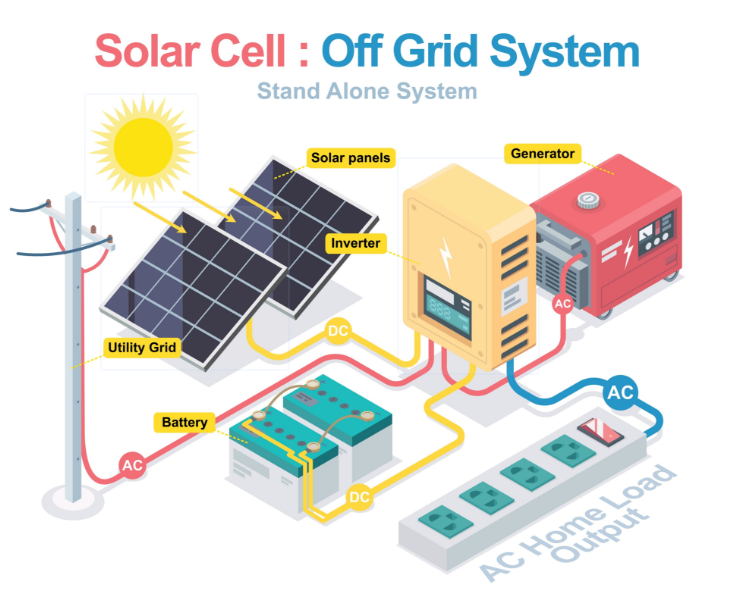
This image was created by Gemini.
Solar Panels: Installed on the roof, they absorb sunlight and produce direct current (DC) electricity.
Solar Inverter: Converts the DC electricity produced by the panels into alternating current (AC) electricity for household use.
Lithium-ion Battery System: Stores surplus power generated during the day for use at night or on cloudy days.
Battery Management System (BMS): Monitors and safely manages the charge and discharge status of the batteries.
Grid: Receives power when solar power generation is insufficient or transmits surplus power.
What the Project Does
The BOS-B system is a modular lithium-ion battery energy storage system (ESS) used for applications such as:
commercial backup power
renewable energy integration
load shifting and peak shaving
industrial facility energy stabilization
Each battery module provides 14.3 kWh capacity, and up to 15 modules can be connected in series, allowing systems to scale up to 214.5 kWh total energy capacity.
The system architecture includes:
Battery Modules
Each module contains:
lithium-ion battery cells
integrated cooling fan
BMS monitoring electronics
communication interface
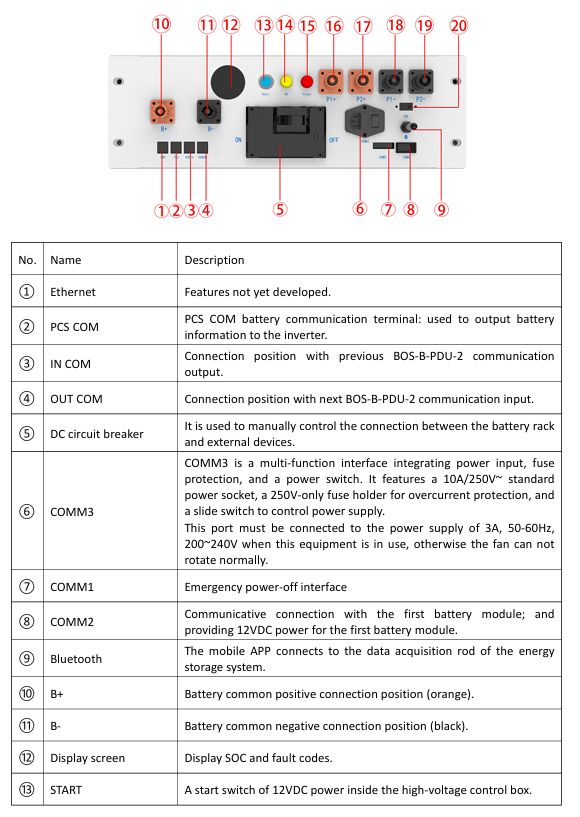
High-Voltage Control Box
The control unit aggregates battery clusters and provides:
system monitoring
high-voltage switching
communication with external devices
display and fault reporting
External System Integration
The ESS communicates with inverters and monitoring systems using multiple interfaces:
CAN for battery management communication
RS485 for industrial device integration
TCP Ethernet networking for remote monitoring and diagnostics
Where WIZnet Fits
The system includes Ethernet networking capability implemented using the WIZnet W5500 Ethernet controller.
Evidence appears in the system fault-handling logic where the firmware explicitly detects Ethernet chip communication errors:
Fault code example
This indicates that the controller communicates with a W5500 Ethernet chip over SPI and monitors its operational state.
Role of the W5500
In this ESS architecture, the W5500 provides:
hardware TCP/IP stack
Ethernet connectivity for monitoring systems
reliable network communication independent of the main MCU load
Because the TCP/IP stack runs inside the W5500 hardware, the system controller can focus on:
BMS data processing
battery safety monitoring
fault detection
inverter communication
This architecture is particularly useful in industrial environments where deterministic and stable communication is required.
Practical Tips / Pitfalls
Ensure stable SPI wiring between the MCU and W5500 to prevent communication faults.
Industrial ESS environments often contain EMI; proper grounding and shielding are critical.
Monitor W5500 link status to detect Ethernet cable disconnection.
Use static IP configuration when integrating with industrial SCADA systems.
Validate socket buffer configuration to support multiple simultaneous monitoring connections.
Implement watchdog supervision for network tasks to maintain reliability.
FAQ
Why is W5500 used in this system?
The W5500 provides a hardware TCP/IP stack that offloads networking tasks from the system MCU. This reduces CPU usage and improves communication reliability in industrial energy storage controllers.
How does the controller connect to the W5500?
The W5500 communicates with the controller through an SPI interface. The MCU exchanges network packets and configuration commands via SPI registers.
What role does the W5500 play in this ESS project?
It enables Ethernet-based monitoring and remote diagnostics for the battery system, allowing operators to view system status, fault codes, and performance metrics over a network.
Can beginners reproduce this architecture?
The basic Ethernet interface using W5500 is accessible to intermediate embedded developers. However, a full ESS system involves high-voltage battery management and industrial safety requirements.
How does W5500 compare to Wi-Fi solutions?
Industrial battery systems typically prefer wired Ethernet because it provides deterministic latency, higher reliability, and immunity to wireless interference in electrically noisy environments.