



Praesidium RemWave BioFi Device
BioFi is a software-led hardware-enabled solution to personal healthcare.
How Does RemWave Sleep Track Vital Signs Without a Wearable, and Where Does WizFi360 Fit?
Praesidium's RemWave Sleep is an under-bed, contactless sleep sensor that tracks heart rate, breathing, presence, and motion without requiring the user to wear a device. Its FCC certification records identify a WIZnet WizFi360CON as the pre-certified 2.4 GHz WLAN module inside the certified product.
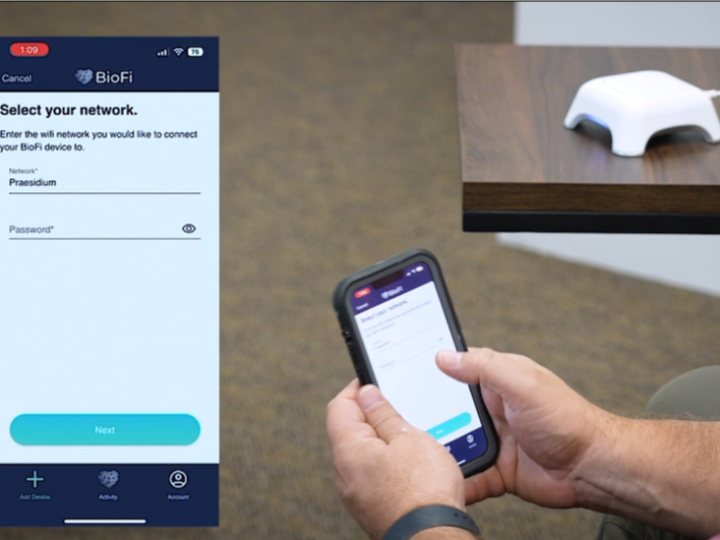
Photo: BioFi.
Components
WIZnet WizFi360CON × 1 — Wi-Fi connectivity. The FCC test report identifies the integrated WLAN as a pre-certified module from WIZnet H.K. LTD., model WizFi360CON, with contained FCC ID 2ATUB-WIZFI360PA and ISED identifier 20560-WIZFI360CON. The same report lists a Laird Connectivity flexible planar 2.4 GHz antenna, MPN EMF2471A3S-10MHF1, with a declared gain of 2.4 dBi.
The available sources identify WizFi360 as the WLAN component, but they do not publish the electrical interface between the Wi-Fi module and RemWave's main processor, the commands used between them, or the application protocol carried over the Wi-Fi connection.
A Sleep Sensor Designed to Stay Out of the Bed
Praesidium develops the technology under the BioFi name. The company describes BioFi in its own words as “a software-led hardware-enabled solution to personal healthcare.” Its technology pages describe contactless sensing of presence, motion, and physiological information, while the consumer-facing RemWave Sleep product places that sensing hardware underneath the bed.
RemWave's product page reduces the usage model to an even shorter phrase: “Track Sleep. Wear Nothing.” The sensor is positioned under the bed and is documented as tracking heart rate, breathing, presence, and subtle movement. The associated mobile application presents sleep balance, sleep stages, sleep timing, historical information, and real-time sensor data.
For a WIZnet reader, the interesting part comes one layer below that user experience. FCC ID 2A7ZX2001BIO1 identifies model 2001BIO1 as a contactless vital-sign detection sensor from Praesidium, and the certification report identifies its product name as RemWave Sleep. Inside the certified configuration, the report documents two different radio functions: a 60–64 GHz radar and a 2.4 GHz WIZnet WLAN module.
Two Radios, Two Different Jobs
Readers who have not worked with contactless sensing need one piece of context: the certification documents describe the radar and Wi-Fi as separate radio systems.
The FCC report lists a TI IWR6843 for the 60–64 GHz radar function. Separately, under “Other Radios included in the device,” it lists the pre-certified WIZnet WLAN module. The current RemWave product page describes its wireless interface as 802.11 b/g/n 2.4 GHz Wi-Fi.
This distinction prevents an easy but incorrect conclusion. WizFi360 is not documented as the component that senses breathing or heart rate. The FCC record places it on the WLAN side of the device, while the 60–64 GHz radar is separately identified as the sensing radio.
The product page also lists a 550 MHz STM32 microcontroller, but neither the product page nor the public portions of the FCC filing provide enough information to reconstruct a complete signal path such as radar → STM32 → WizFi360. That topology may be plausible, but it is not documented by the sources used here and therefore should not be presented as fact.
The Wi-Fi Link Is Part of the Product Experience
BioFi's support documentation makes network connectivity a requirement rather than an optional accessory.
RemWave Sleep requires a 2.4 GHz Wi-Fi network during setup. BioFi instructs users to install the RemWave Sleep mobile app and use it to connect the sensor to Wi-Fi. If the network needs to be changed, a multifunction button on the sensor puts the device back into Wi-Fi setup mode.
The user guide similarly states that RemWave requires Wi-Fi, a working broadband Internet connection, a compatible mobile device, the RemWave Sleep application, and a RemWave account. It also warns that live biometric data, phone alerts, and history may be interrupted by Wi-Fi or service-provider outages.
The current product FAQ goes one step further: RemWave data can be viewed while the phone is away from the sensor's local Wi-Fi network, provided the user has an Internet connection.
That gives WizFi360 a concrete but appropriately scoped role. The certification evidence identifies it as the RemWave sensor's 2.4 GHz WLAN module; BioFi's own documentation establishes that Wi-Fi is required for sensor setup and remote access. What the sources do not document is which cloud protocol RemWave uses, whether the STM32 communicates with WizFi360 through UART or another interface, or how much processing is performed locally versus remotely.
The FCC Filing Makes the WIZnet Connection Explicit
The strongest evidence does not come from marketing material. It comes from the regulatory paperwork.
The August 24, 2023 CETECOM test report for FCC ID 2A7ZX2001BIO1 states on its cover:
“Contains FCC ID: 2ATUB-WIZFI360PA.”
Inside the Equipment Under Test table, the WLAN entry is more specific:
WIZnet H.K. LTD. — Model: WizFi360CON — FCC ID: 2ATUB-WIZFI360PA.
The RemWave user guide independently repeats the contained FCC ID 2ATUB-WIZFI360PA next to model 2001BIO1 and FCC ID 2A7ZX2001BIO1.
There is a naming detail worth preserving rather than smoothing over. The test report calls the installed module WizFi360CON, while the contained FCC identifier is 2ATUB-WIZFI360PA. The source documents themselves use those exact names, so an article should retain both rather than silently changing the module name to WizFi360-PA.
For this article, the safest description is therefore WizFi360CON, operating under the contained FCC certification identified as 2ATUB-WIZFI360PA.
A Certification Change Gives Us a Rare Measured Example
The August 2023 FCC report is particularly interesting because it was produced after a change involving the integrated Wi-Fi module.
CETECOM states that “The integrated Wi-Fi module in this product underwent a C2PC.” The purpose of the report was to verify that the radar transmitter's performance was not adversely affected by that change.
This gives us a worked example with actual test numbers instead of product specifications.
At 62 GHz, with the radar configured for continuous-wave operation at 100% duty cycle and the unit powered at 5 VDC, the report records an EIRP of 4.4 dBm before and 2.6 dBm after the change. CETECOM classified the result as within expectation given the measurement uncertainty and different test setup.
That measurement should not be misread as WizFi360 throughput, output power, or Wi-Fi performance. It is a radar verification measurement performed after a change involving the Wi-Fi module. The value of the record for a WIZnet reader is different: it shows WizFi360 appearing not only in a component list, but inside the compliance process of a finished commercial sensing product.
The same report lists the Wi-Fi band as 2400–2483.5 MHz, with channels centered from 2412 MHz to 2462 MHz, while the sensing radar operates at 60–64 GHz.
Pre-Certified Wi-Fi Inside a Certified End Product
The phrase used by the FCC report is noteworthy: “WLAN (WiFi Pre-certified).”
That is the documented reason the WIZnet device appears separately in the equipment description with its own FCC identifier. The RemWave sensor has its own FCC ID, 2A7ZX2001BIO1, while its incorporated WIZnet Wi-Fi module carries 2ATUB-WIZFI360PA.
The record should not be stretched into a general claim that using a pre-certified module eliminates end-product certification. RemWave itself has its own FCC filing, including test reports, external and internal photographs, RF-exposure material, labels, and user documentation.
In fact, the certification history demonstrates the opposite lesson: module certification and end-product compliance exist at different levels. A change associated with the WLAN module triggered a Class II permissive-change process in the RemWave filing, including verification that the device's 60 GHz radar behavior remained acceptable.
The Published Specifications Do Not All Describe the Same Revision
Another useful engineering detail appears when the current BioFi product page is compared with the FCC test sample.
Both sources give essentially the same enclosure dimensions: 4.25 × 4.25 × 1.64 inches. The current RemWave page, however, gives a product weight of 5.6 oz (158 g), whereas the August 2023 FCC test report records 450 g and explicitly identifies the tested unit as a pre-production sample.
The sources do not explain the difference, so it would be inappropriate to invent an explanation involving housing revisions, internal hardware changes, or manufacturing updates.
The only safe conclusion is that the current product page and the certification test report should not be treated as identical hardware snapshots for every physical specification.
The current product page also specifies USB-C power at 5 V, 1 A, while the FCC report's tested configuration gives a nominal operating voltage of 5 V, with a declared 4.75–5.25 V range.
This Is a Consumer Sleep Product, Not a Diagnostic Medical Device
The BioFi website operates broadly in healthcare and remote patient monitoring, but the regulatory language for this specific RemWave Sleep product needs to remain visible.
Its user guide explicitly states that the device “is not a medical device” and says it is not intended for diagnosis, cure, mitigation, treatment, or prevention of disease or other conditions. The documentation directs users to consult a healthcare provider before making health-related decisions.
That limitation matters in an engineering article because features such as heart-rate and breathing monitoring can otherwise be mistaken for medical-device claims.
The current product page should likewise be read in that context: it documents sleep tracking, heart rate, breathing, presence, motion, sleep stages, and sleep history, while the user guide defines the regulatory boundary of the product.
Where the WizFi360 Fits
The public evidence supports a narrow and clear statement:
WizFi360CON provides the certified RemWave Sleep unit's 2.4 GHz WLAN function.
The FCC test report identifies WIZnet as the WLAN supplier. BioFi's current specifications state 802.11 b/g/n at 2.4 GHz, and BioFi's setup documentation requires the sensor to join a 2.4 GHz Wi-Fi network.
That is enough to establish a meaningful commercial use case for WizFi360 without assigning it work the sources never document.
What the sources do not show is the MCU-to-WizFi360 schematic connection, AT-command sequence, firmware source, socket configuration, TLS implementation, cloud endpoint, data format, or measured Wi-Fi throughput. The FCC index lists schematics, block diagrams, and operational descriptions only as metadata, while publicly accessible exhibits include items such as the manual, internal and external photographs, test reports, labels, and RF-exposure information.
This makes RemWave a useful example of the distinction between knowing that a networking module is inside a commercial product and knowing exactly how the product firmware uses it.
What Is Published and What Is Not
The current BioFi site publishes the user-facing RemWave Sleep specification: a 550 MHz STM32 processor, 2.4 GHz 802.11 b/g/n Wi-Fi, USB-C 5 V/1 A power, dimensions of 107.95 × 107.95 × 41.61 mm, an operating distance of 203.2 mm to 1.02 m, and sensing functions for presence, heart rate, respiration, and motion.
The FCC filing separately publishes the regulatory identity of model 2001BIO1, its 60–64 GHz radar band, test records, product photographs, labels and user manual. Most importantly for this article, the filing explicitly identifies WIZnet's WizFi360CON as the pre-certified WLAN module incorporated into the product.
Not publicly established by these sources are the complete hardware schematic, WizFi360 firmware configuration, interface with the STM32, cloud architecture, or networking performance measurements.
For a WIZnet reader, the useful thread is the appearance of a pre-certified WizFi360 module inside a finished, FCC-certified consumer sensing product rather than another development-board demonstration. RemWave Sleep shows a specialized 60 GHz sensing system and a separate 2.4 GHz WLAN subsystem coexisting inside a product intended to remain installed under a bed and connected continuously to an Internet service.
Related Reading
Regular Maker readers looking at the module side can start with Getting Started with WizFi360-EVB-Pico, which explicitly distinguishes WizFi360-PA's PCB antenna from WizFi360-CON's external antenna connector and provides broader development context for the same module family.
The WizFi360-EVB-Mini Pulse Oximeter Blynk BPM project provides a useful maker-scale contrast: it also transports physiological sensor information over WizFi360, but from a prototype pulse-oximeter platform rather than a finished contactless sleep product.
WizSocket — Cloud-Connected IoT AC Socket shows the same module family in a more conventional cloud-connected IoT role, helping separate what is common WizFi360 networking from what is specific to BioFi's sensing application.
FAQ
Is WizFi360 really inside RemWave Sleep?
The regulatory evidence says yes for the certified model covered by FCC ID 2A7ZX2001BIO1. CETECOM's report identifies the WLAN module as WIZnet H.K. LTD., model WizFi360CON, and the RemWave user guide states that the product contains FCC ID 2ATUB-WIZFI360PA.
Is it WizFi360-PA or WizFi360-CON?
The FCC end-product test report explicitly names WizFi360CON, while giving the contained FCC ID as 2ATUB-WIZFI360PA. The user manual also prints 2ATUB-WIZFI360PA. Because the documents use both identifiers, this article preserves both instead of assuming they are interchangeable product names.
Does WizFi360 measure heart rate or respiration?
The available documents do not assign that function to WizFi360. The FCC report identifies WizFi360 as the WLAN module and separately identifies the 60–64 GHz IWR6843 radar.
Does RemWave require Wi-Fi?
Yes. BioFi's setup instructions specify a 2.4 GHz Wi-Fi connection, and the user guide lists Wi-Fi and broadband Internet among the operating requirements.
Is RemWave Sleep a medical device?
The RemWave user guide explicitly says no. It states that the product is not intended to diagnose, treat, cure, mitigate, or prevent disease or other conditions.
Do the FCC documents reveal how the STM32 communicates with WizFi360?
Not in the public material used here. The documents establish that WizFi360 is the WLAN module but do not publish the processor interface, AT commands, network stack architecture, or cloud protocol.
Documents
- BioFi — Remote Patient Monitoring — Current overview of BioFi's remote-patient-monitoring platform and its use of connected devices.
- BioFi Technology — BioFi's own description of its contactless sensing technology and software-led/hardware-enabled approach.
- RemWave Sleep product page — Current product features and specifications, including Wi-Fi, processor, dimensions, power, operating distance and sleep functions.
- BioFi — How to connect RemWave Sleep to Wi-Fi — 2.4 GHz Wi-Fi setup procedure.
- FCC ID 2A7ZX2001BIO1 — FCC filing index for Praesidium model 2001BIO1, including reports, photographs, manual and certification history.
- CETECOM FCC/ISED Test Report — The key regulatory source identifying WIZnet H.K. LTD., WizFi360CON and contained FCC ID 2ATUB-WIZFI360PA, along with the radar/WLAN specifications and C2PC verification results.
- RemWave Sleep User Guide — Setup and regulatory guide identifying model 2001BIO1 and contained FCC ID 2ATUB-WIZFI360PA, as well as the product's non-medical-device limitation.