



Sound Event Localization and Classification Using Wireless Acoustic Sensor Networks in Outdoor
Sound Event Localization and Classification Using Wireless Acoustic Sensor Networks in Outdoor Environments

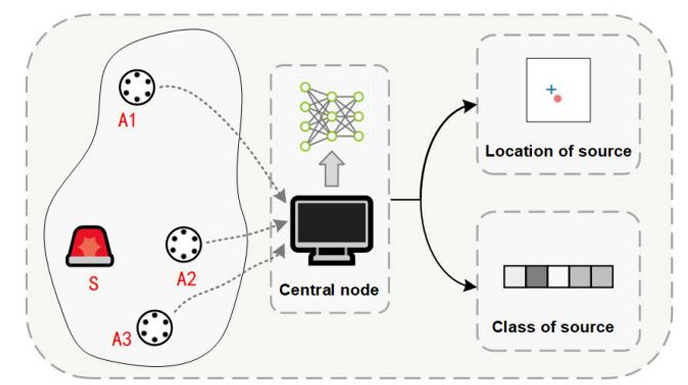
Technical Overview: What This System Actually Does
The curated project is based on an IEEE Sensors Journal paper describing a Wireless Acoustic Sensor Network (WASN) deployed in a large outdoor area measuring approximately 100 × 80 meters. The system’s objective is not only to detect acoustic events but also to classify the event type (SEC) and estimate the absolute spatial coordinates of the sound source (SSL) in real-world outdoor conditions.
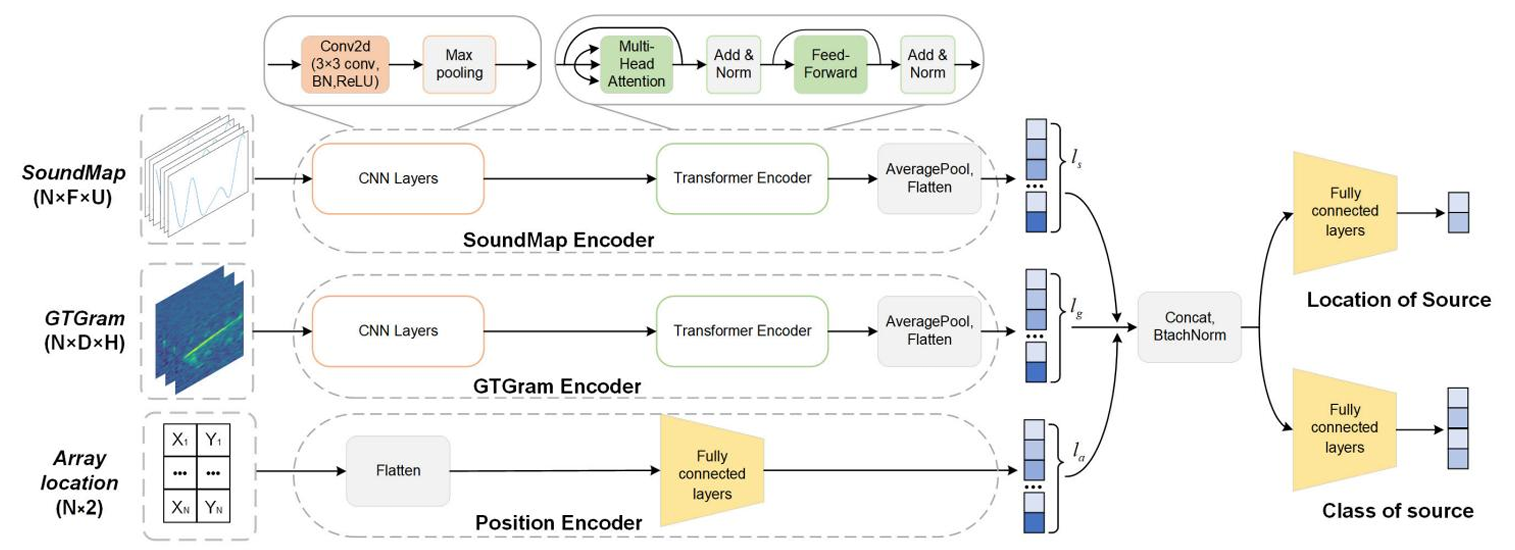
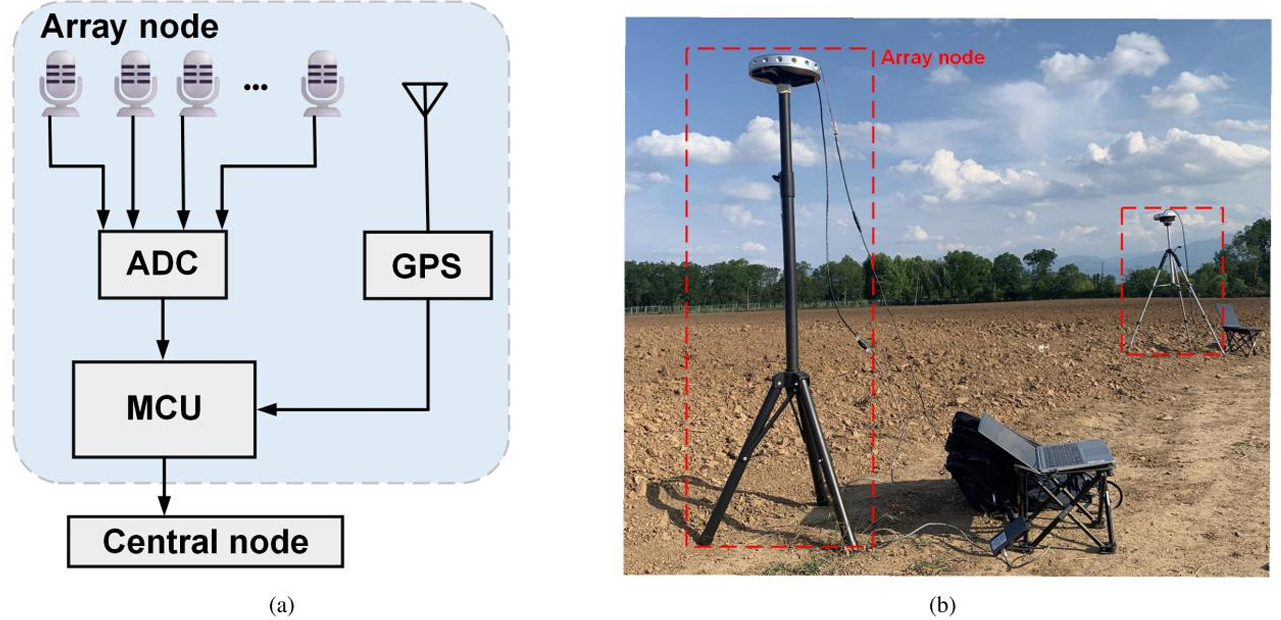
Each sensing unit, referred to as an array node, is equipped with an eight-channel circular microphone array. Instead of streaming raw audio, which would be bandwidth-intensive and sensitive to packet loss, each node performs local signal processing. This includes broadband beamforming to generate SoundMap features and perceptually motivated GTGram (Gammatone-based spectrogram) features. These features capture spatial, temporal, and frequency-domain information required for downstream inference.
A central node aggregates feature data from multiple array nodes and feeds them into a CNN + Transformer-based multitask neural network. The network jointly predicts the sound class (e.g., siren, scream, gunshot, or background noise) and the 2D coordinates of the sound source. Experimental results show state-of-the-art performance in both simulated and real outdoor environments, with localization RMSE as low as a few meters in complex noise scenarios .
Where WIZnet W5500 Fits into the Architecture
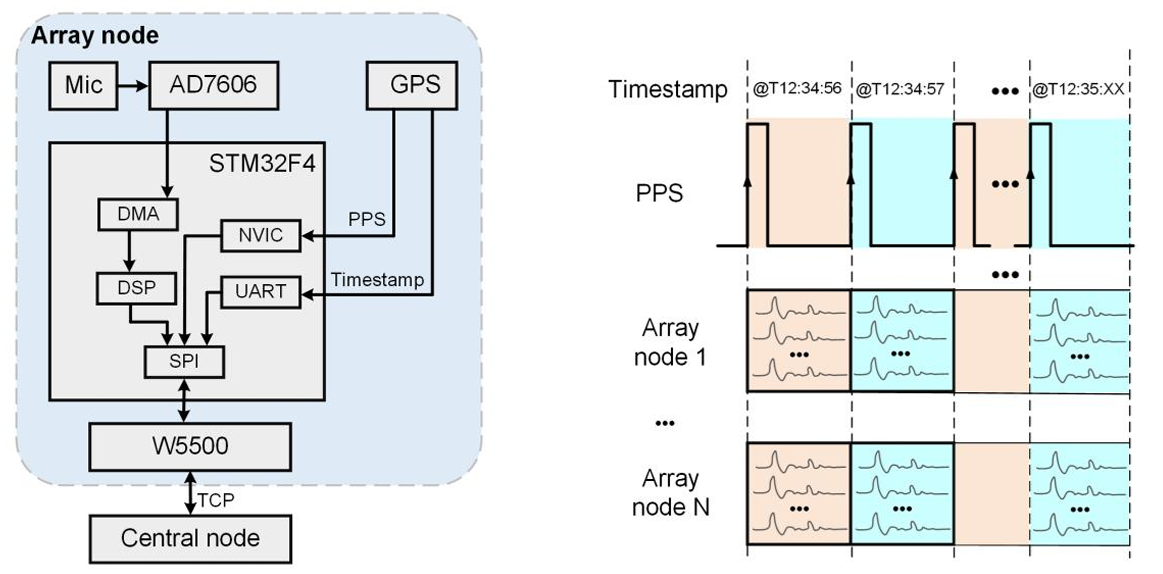
The paper explicitly documents the hardware architecture of each array node. At its core is an STM32F4 microcontroller (ARM Cortex-M4, up to 168 MHz, FPU enabled). Audio signals are digitized using an external AD7606 multi-channel ADC, and precise time alignment across nodes is achieved using GPS modules providing PPS (Pulse-Per-Second) signals.
After local feature extraction, each array node transmits timestamped acoustic feature packets to the central node. This transmission is handled by a WIZnet W5500 Ethernet controller, connected to the STM32F4 via SPI. The paper states that feature data are sent over TCP connections using the W5500, making the Ethernet controller the dedicated network transport layer for the system .
Importantly, the system relies on wired Ethernet, not wireless links, for inter-node communication. This design choice aligns with Industrial IoT requirements, where predictability, synchronization, and long-term stability outweigh deployment convenience.
Why W5500 Is Technically Essential (Not Optional)
In this WASN, network behavior directly affects algorithmic accuracy. Sound source localization depends on tight time alignment between features arriving from different nodes. Any jitter, packet loss, or unpredictable latency introduces spatial estimation errors that propagate through the neural network.
The W5500 addresses this by providing a hardware TCP/IP stack, offloading all protocol handling from the STM32F4. As a result:
The MCU can dedicate its CPU cycles to DSP tasks, such as beamforming and GTGram extraction.
TCP retransmissions, window management, and checksum handling occur inside the Ethernet chip, not in firmware.
Deterministic, low-jitter data delivery is maintained even when multiple nodes transmit concurrently.
The paper reports that generating SoundMap and GTGram features from one second of multi-channel audio takes approximately 380 ms on the STM32F4, while network transmission is not identified as a performance bottleneck. This strongly indicates that hardware-based TCP/IP offloading via W5500 is a key enabler of real-time operation .
Conceptual Architecture Explanation
Array Node (Edge Layer)
Microphone array captures multi-channel audio.
ADC digitizes signals and DMA transfers data to MCU memory.
STM32F4 performs feature extraction (SoundMap + GTGram).
GPS PPS signal aligns feature timestamps across nodes.
W5500 sends timestamped feature packets to the central node via TCP.
Central Node (Aggregation Layer)
Receives feature streams from all array nodes.
Aligns data temporally using embedded timestamps.
Runs CNN + Transformer inference to estimate event class and location.
Outputs monitoring results for Industrial IoT applications such as public safety or environmental surveillance.
This division of responsibilities illustrates a classic edge-compute + deterministic Ethernet backbone architecture, common in modern Industrial IoT systems.
Industrial IoT Relevance and Strategic Value
From an Industrial IoT perspective, this project demonstrates how wired Ethernet with hardware TCP/IP enables scalable outdoor sensor networks. Unlike consumer IoT scenarios, the monitored area is large, environmental conditions are unpredictable, and accuracy requirements are strict. The choice of W5500 supports:
Long-term deployment stability
Predictable latency under multi-node load
Reduced firmware complexity on edge devices
Easier system validation and maintenance
These characteristics align with use cases such as urban safety monitoring, critical infrastructure surveillance, and industrial perimeter monitoring, where acoustic events act as early indicators of abnormal situations.
FAQ
Q1. Why is W5500 suitable for outdoor Industrial IoT sensor networks?
W5500 integrates a full hardware TCP/IP stack, which removes protocol processing from the MCU. In outdoor Industrial IoT systems, sensor nodes often operate continuously and handle both signal processing and communication. By offloading TCP/IP, W5500 allows the MCU to focus on time-critical DSP tasks while ensuring stable, deterministic Ethernet communication. This is particularly important when multiple nodes transmit synchronized data streams to a central server.
Q2. What role does W5500 play in time synchronization across nodes?
In this system, time synchronization is achieved using GPS PPS signals at each node. However, synchronization is only useful if timestamped data arrive at the central node with minimal jitter. W5500 ensures consistent TCP delivery behavior, preventing variable software stack delays on the MCU. This helps preserve the temporal alignment of features extracted at different nodes, which directly impacts localization accuracy.
Q3. Why are acoustic features transmitted instead of raw audio?
Transmitting raw multi-channel audio would require significantly higher bandwidth and would increase sensitivity to packet loss. By extracting SoundMap and GTGram features locally, each node reduces data volume and sends only semantically meaningful information. W5500 then reliably transports these compact feature packets over Ethernet, enabling scalable multi-node deployment without overwhelming the network.
Q4. Is this architecture scalable to larger monitoring areas?
Yes. The architecture naturally scales by adding more array nodes, as each node independently extracts features and transmits them over TCP. Because W5500 handles TCP/IP in hardware, adding nodes does not linearly increase MCU firmware complexity. The central node aggregates data based on timestamps, making it feasible to extend coverage to larger outdoor areas while maintaining synchronization and reliability.
Q5. Can this design be adapted to other Industrial IoT sensing domains?
Absolutely. While this project focuses on acoustic monitoring, the same architectural pattern applies to vibration sensing, structural health monitoring, or distributed environmental sensing. Any application requiring synchronized edge processing and reliable data aggregation can benefit from using W5500 as a deterministic Ethernet transport layer within an Industrial IoT framework.
Original Source
Paper: Sound Event Localization and Classification Using Wireless Acoustic Sensor Networks in Outdoor Environments, IEEE Sensors Journal, 2025.
Tags
#W5500 #IndustrialIoT #Ethernet #WASN #AcousticMonitoring #EdgeComputing #OutdoorSensors