
Wiznet makers

bruno

Published July 01, 2026 ©

181 UCC

15 WCC

46 VAR

0 Contests

0 Followers

0 Following

Original Link

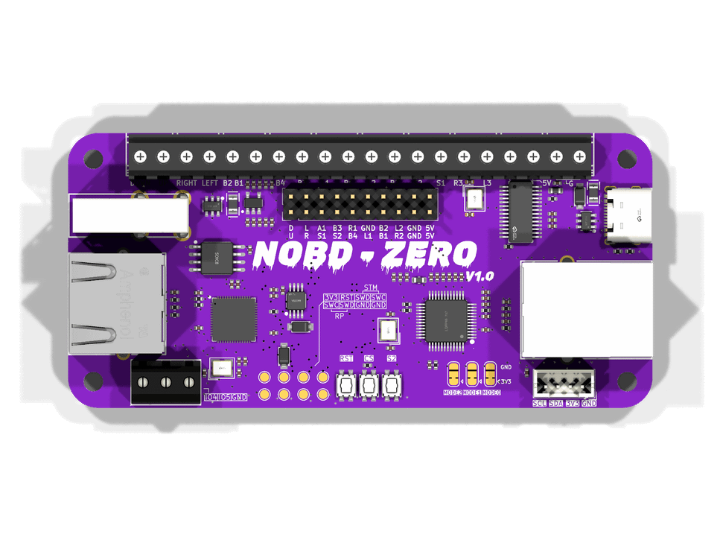
NOBD Zero

dual-MCU flagship fightstick PCB. 8 kHz USB target, native Dreamcast, hardware Ethernet for LAN. First prototypes in fab.
COMPONENTS
PROJECT DESCRIPTION

https://packaged-media.redd.it/sbtsj5gz5gah1/pb/m2-res_1080p.mp4?m=DASHPlaylist.mpd&var=sgpssan&v=1&e=1782910800&s=ed6bc72a1f4667d98a2d501813865ed56bac4c2a

r/fightsticks - NOBD Zero — dual-MCU flagship fightstick PCB. 8 kHz USB target, native Dreamcast, hardware Ethernet for LAN. First prototypes in fab.

NOBD Zero — the board

Dual-MCU · RP2040 + STM32F723. RP2040 handles deterministic input scanning + Maple Bus PIO + retro. STM32F723 (USB High-Speed) does nothing but talk to the host. 1000 Hz is the silicon ceiling of RP2040-only boards — we broke it by adding a chip that can.

8000 Hz USB High-Speed (target) — 0.125 ms reports, 8× standard.

Native Dreamcast over Maple Bus — bit-banged on RP2040 PIO, no adapter. Retro jack uses the standard Brook retro-cable pinout, so your existing Brook DC/NES/SNES cables drop straight in. Dreamcast ships native; more retro arrives in firmware.

Hardware Ethernet (W5500) — first fightstick PCB built around a real network stack, not an RJ45 reused as a console cable. Enables LAN Mode (planned): companion app, virtual controller fed over Ethernet, target ~25 µs press-to-game — equivalent of ~40 kHz polling. Deterministic, not faster on average; faster in the trades that matter.

Brook 20-pin + screw terminals — existing stick harnesses drop in.

Two firmware modes — Sync & Raw. Sync groups your presses on a tunable window (default 5 ms); Raw runs full speed. Fast when you want it, synced when you need it.

~50 more parts than the GP2040-CE Advanced Breakout. 4-layer, controlled impedance, 96.3 × 45.31 mm.

Full spec deep-dive -> https://zero.nobd.net

Hey all, first time posting. Cloud engineer, came back to MvC2 after 15 years, kept dropping two-button inputs. Spent the last year figuring out why and building the most over-engineered fightstick PCB I could design around the answer.

NOBD Zero — the board

  • Dual-MCU · RP2040 + STM32F723. RP2040 handles deterministic input scanning + Maple Bus PIO + retro. STM32F723 (USB High-Speed) does nothing but talk to the host. 1000 Hz is the silicon ceiling of RP2040-only boards — we broke it by adding a chip that can.

  • 8000 Hz USB High-Speed (target) — 0.125 ms reports, 8× standard.

  • Native Dreamcast over Maple Bus — bit-banged on RP2040 PIO, no adapter. Retro jack uses the standard Brook retro-cable pinout, so your existing Brook DC/NES/SNES cables drop straight in. Dreamcast ships native; more retro arrives in firmware.

  • Hardware Ethernet (W5500) — first fightstick PCB built around a real network stack, not an RJ45 reused as a console cable. Enables LAN Mode (planned): companion app, virtual controller fed over Ethernet, target ~25 µs press-to-game — equivalent of ~40 kHz polling. Deterministic, not faster on average; faster in the trades that matter.

  • Brook 20-pin + screw terminals — existing stick harnesses drop in.

  • Two firmware modes — Sync & Raw. Sync groups your presses on a tunable window (default 5 ms); Raw runs full speed. Fast when you want it, synced when you need it.

~50 more parts than the GP2040-CE Advanced Breakout. 4-layer, controlled impedance, 96.3 × 45.31 mm.

Documents
Comments Write