



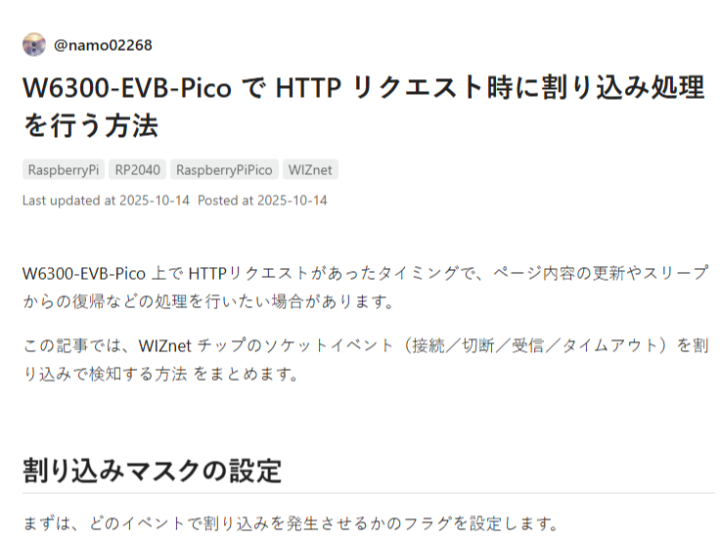
How to handle interrupts on HTTP requests on the W6300-EVB-Pico
Implementing Interrupt-Driven Handling on HTTP Requests with W6300-EVB-Pico
How to Build a Deterministic Interrupt-Driven HTTP Server with W6300 on RP2040?
Summary
This project demonstrates how to implement event-driven Ethernet networking on the W6300-EVB-Pico by wiring the W6300 INTn hardware signal to the RP2040 GPIO interrupt system. Instead of polling socket registers, the firmware reacts only when the W6300 TCP/IP Offload Engine (TOE) asserts a hardware interrupt. This architecture provides bounded response latency, protects RTOS scheduling predictability, and enables clean dual-stack (IPv4/IPv6) HTTP server design on resource-constrained MCUs.
What the Project Does
The reference implementation builds a lightweight HTTP server running on:
RP2040 (MCU)
W6300 (Hardware TCP/IP Controller)
Traditional embedded Ethernet examples often use a polling model:
check_socket_status();
if(data_available) {
process_packet();
}
}
This approach introduces two architectural issues:
Unbounded latency
Response delay can be as large as the main loop period.
CPU inefficiency
The MCU continuously reads socket registers even when no packet exists.
This project replaces polling with hardware-triggered interrupts, where:
The W6300 hardware state machine detects TCP events.
Interrupt flags are set internally.
INTn is asserted immediately.
The RP2040 ISR processes only real events.
The main loop remains free for control logic.
Where WIZnet Fits
The W6300 provides three essential architectural capabilities:
1️⃣ Hardware TCP/IP State Machine
Full TCP/UDP stack in silicon
IPv4 / IPv6 dual stack
32 KB internal packet buffer
No LwIP required
TCP handshake, retransmission, checksum, and header parsing occur entirely inside hardware.
2️⃣ Interrupt Logic Block (Register-Level Mechanism)
The interrupt path works as follows:
A socket event occurs (e.g., RECV).
The corresponding Sn_IR RECV bit is set.
If enabled in Sn_IMR, the socket bit propagates to:
SIR (Socket Interrupt Register).
If allowed by Global IMR, INTn is driven LOW.
In other words:
Sn_IR → Sn_IMR → SIR → IMR → INTn
This hardware chain ensures the MCU is interrupted only for enabled events.
When a packet is received:
Data is already stored in the internal W6300 buffer.
The MCU does not poll.
The MCU does not parse TCP headers.
The MCU reacts only when necessary.
3️⃣ Dual-Stack Interrupt Transparency
The interrupt mechanism is protocol-agnostic.
Whether:
IPv4 packet
IPv6 packet
TCP handshake
HTTP payload
The same INTn hardware signal is triggered.
No additional firmware branching is required for IPv6 support.
Deterministic Latency Analysis
Polling Model
If the main loop period is:
Worst-case response delay:
Under load, latency becomes dependent on:
Loop complexity
Other blocking tasks
RTOS scheduling
Latency is variable and unbounded under burst conditions.
Interrupt Model
Latency becomes:
Both are bounded:
GPIO interrupt latency (few µs)
SPI register access (deterministic)
Thus:
Response time is bounded and independent of main loop timing.
This is critical in:
Industrial control
Robotics
Motor control loops
Real-time sensing systems
RTOS Scheduling Impact
In RTOS systems:
Polling introduces periodic high CPU usage inside a network task.
Under burst traffic:
ISR → stack processing → context switching
High-priority tasks may experience jitter
With W6300 interrupt-driven TOE:
No protocol stack execution on MCU
ISR duration remains short
Network task consumes time only on actual events
This improves:
Worst-case latency bounds
Task scheduling predictability
Control-loop timing integrity
Implementation Notes
1️⃣ GPIO Interrupt Registration
W6300_INT_PIN,
GPIO_IRQ_EDGE_FALL,
true,
&w6300_callback
);
INTn is active-low.
2️⃣ ISR with Register-Level Awareness
{
// Read Global Interrupt Register
uint8_t ir = getIR();
if(ir & _IK_SOCK_ALL)
{
// At this point:
// - Sn_IR.RECV is already set
// - Data is already stored in internal buffer
process_http_socket_events();
}
// Important:
// Interrupt flags must be cleared before exit
// otherwise INTn will remain asserted
}
Key engineering detail:
Interrupt flags must be cleared in Sn_IR before exiting ISR to re-arm detection.
3️⃣ Main Loop Remains Clean
{
do_critical_control_loop();
}
No polling.
No socket scanning.
No unnecessary SPI traffic.
Interrupt Storm Handling
If traffic becomes excessive:
Use Sn_IMR to enable only critical events (e.g., RECV).
Disable SEND_OK or DISCON interrupts if unnecessary.
Apply socket-level filtering.
This prevents CPU overload during heavy traffic bursts.
Practical Tips / Pitfalls
Always clear Sn_IR bits after servicing.
Keep ISR minimal; defer heavy HTTP parsing to task context.
Validate PHY link before enabling interrupts.
Avoid long SPI transactions inside ISR.
Mask unused socket interrupts.
Test both IPv4 and IPv6 flows.
FAQ
Q: Does interrupt-driven networking increase throughput?
A: No. Throughput depends on bus speed and buffer size. Interrupt-driven design improves CPU efficiency and response determinism.
Q: How does this differ from using LwIP on RP2040?
A: LwIP executes TCP/IP in software on the MCU. W6300 executes the TCP state machine in hardware, reducing interrupt frequency and eliminating protocol parsing overhead.
Q: What is the advantage over W5500?
A: W6300 supports native IPv4/IPv6 dual stack and architectural refinements while maintaining hardware TOE operation.
Q: What happens if interrupts occur too frequently?
A: Use Sn_IMR and global IMR to mask non-critical events. Only enable RECV or connection-related interrupts as required.
Q: Is this suitable for RTOS-based systems?
A: Yes. Hardware offloading combined with interrupt-driven notification preserves scheduler predictability and reduces task jitter.
Source
Original Project:
https://maker.wiznet.io/bruno/projects/how-to-handle-interrupts-on-http-requests-on-the-w6300-evb-pico/
Tags
#W6300
#RP2040
#InterruptDriven
#EventDrivenEthernet
#TCP_Offloading
#IPv6_Embedded
#Deterministic_Latency
#IndustrialIoT
#EmbeddedEthernet