


Sheath-Current-Acquisition
AI-powered sheath current monitoring using STM32F407 and W5500 for real-time analysis, fault detection, and predictive maintenance.
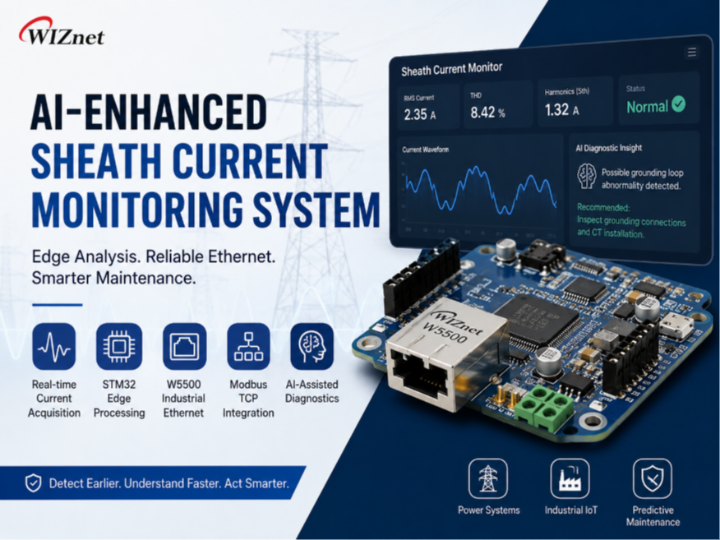
WIZnet - W5500
x 1

What the Project Does
In many electrical facilities, sheath current measurements are collected during scheduled inspections. While this approach has been used for years, it has several limitations:
- Abnormal events may occur between inspections.
- Historical trends are difficult to capture.
- Diagnosis often depends on engineer experience.
- Scaling monitoring across multiple assets increases operational workload.
This project takes a different approach.
Instead of simply collecting current measurements, it continuously analyzes electrical behavior at the edge and delivers meaningful information to operators through an Ethernet-connected monitoring platform.
The system combines:
- Real-time current acquisition
- Electrical signal analysis
- Industrial Ethernet communication
- Modbus TCP/RTU integration
- Web-based visualization
- AI-assisted diagnostic reporting
The result is a monitoring architecture that helps engineers identify potential problems before they become failures.
From Raw Data to Maintenance Decisions
Traditional monitoring systems typically stop at data collection.
This project extends the workflow further.
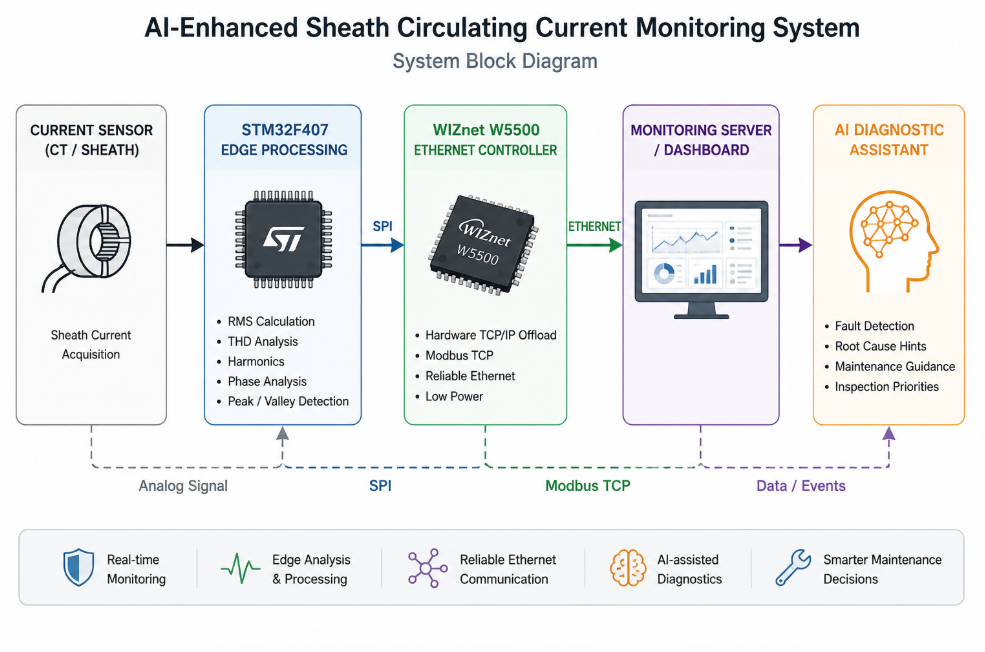
The key idea is simple:
Engineers do not need more numbers. They need faster understanding of what those numbers mean.
For example, an increase in RMS current combined with rising harmonic distortion may indicate grounding issues, installation problems, or abnormal load conditions. Rather than presenting only alarms, the system can generate structured diagnostic suggestions that guide investigation and maintenance activities.
Where WIZnet Fits
The WIZnet W5500 serves as the networking backbone of the system.
After electrical data is processed by the STM32F407, the W5500 provides Ethernet connectivity for:
- Modbus TCP communication
- Device-to-dashboard data exchange
- Waveform transmission
- Remote monitoring access
This role is particularly important in industrial environments where reliability and deterministic communication are often preferred over wireless alternatives.
By using the W5500's hardware TCP/IP offload engine, the STM32 can focus on signal acquisition and electrical analysis instead of spending processing resources on a software networking stack. This architecture simplifies firmware design while maintaining stable Ethernet communication for monitoring applications.
Why Edge Analysis Matters
Many monitoring systems forward raw sensor data directly to a server.
This project processes information locally before transmission.
The STM32 performs calculations such as:
- RMS current measurement
- Peak and valley detection
- Harmonic analysis
- THD-related indicators
- Phase-related calculations
This edge-processing approach offers two practical advantages.
First, less bandwidth is required because meaningful indicators are transmitted instead of large amounts of raw data.
Second, abnormal conditions can be detected immediately without waiting for cloud-side processing.
The monitoring device behaves as an intelligent measurement node rather than a simple data logger.
AI-Assisted Diagnostics
One of the most interesting aspects of the project is the AI-assisted diagnostic layer.
The goal is not to replace engineers.
The goal is to reduce the time required to interpret abnormal conditions.
When unusual electrical behavior is detected, the system can generate guidance such as:
- Possible grounding loop abnormalities
- Potential CT installation issues
- Phase imbalance indicators
- Excessive harmonic content warnings
- Recommended inspection priorities
This shifts the operator experience from observing measurements to understanding potential causes.
In practical deployments, this type of assistance can help maintenance teams respond more quickly and consistently, especially when managing large numbers of monitored assets.
Similar Projects on WIZnet Maker
| Project | Main Focus | Difference from This Project | Link |
|---|---|---|---|
| Industrial Modbus TCP Communication with STM32 and W5500 | Industrial Ethernet communication, Modbus TCP implementation | Demonstrates reliable Modbus TCP networking using STM32 and W5500. The Sheath Current Monitoring System builds on a similar communication architecture but adds real-time electrical analysis, harmonic monitoring, and AI-assisted diagnostics. | https://maker.wiznet.io/sophia/projects/industrial-modbus-tcp-communication-with-stm32-and-w5500/ |
| Unified IIoT Monitoring Platform | Multi-protocol industrial monitoring platform (LoRaWAN, BACnet/IP, Modbus TCP) | Focuses on integrating multiple industrial protocols into a centralized monitoring system. In contrast, this project targets high-voltage cable condition monitoring with dedicated edge analytics and predictive maintenance workflows. | https://maker.wiznet.io/sophia/projects/unified-iiot-monitoring-platform/ |
| Smart Factory Monitoring System using IoT | Factory monitoring, dashboard visualization, industrial data collection | Provides real-time monitoring and visualization of factory data using W5500-based connectivity. This project goes further by performing RMS, harmonic, and THD calculations on the STM32 before transmitting processed data to the monitoring platform. | https://maker.wiznet.io/Sunny_/projects/smart-factory-monitoring-system-using-iot/ |
Why This Project Stands Out
While many industrial IoT projects focus on collecting and transporting data, the AI-Enhanced Sheath Circulating Current Monitoring System combines three key layers in a single architecture: edge-side electrical analysis, industrial Ethernet communication through WIZnet W5500, and AI-assisted diagnostic guidance. Rather than displaying measurements alone, the system helps engineers interpret abnormal current behavior and identify potential maintenance actions, making it a practical example of an Industrial AIoT monitoring solution.
Practical Tips and Pitfalls
- Verify CT polarity and installation direction before collecting diagnostic data.
- Use shielded wiring and proper grounding to reduce measurement noise.
- Separate analog acquisition circuits from Ethernet communication paths where possible.
- Validate Modbus register mapping early to simplify dashboard integration.
- Configure watchdog recovery for long-term unattended operation.
- Consider static IP addressing in industrial environments where deterministic network access is required.
FAQ
Why use the W5500 instead of a software TCP/IP stack?
The W5500 integrates a hardware TCP/IP offload engine, allowing the STM32 to focus on signal processing and monitoring tasks. This reduces firmware complexity and helps maintain predictable performance during continuous acquisition and analysis.
How does the W5500 connect to the STM32F407?
The W5500 communicates through SPI. In this project, the STM32 controls the Ethernet interface through SPI signals along with dedicated reset and chip-select lines.
What role does the W5500 play in this project?
It acts as the Ethernet communication layer, enabling Modbus TCP connectivity, waveform transmission, dashboard integration, and remote access to monitoring data.
Can beginners build this project?
The project targets intermediate to advanced embedded developers. Familiarity with STM32 development, ADC/DMA concepts, industrial communication protocols, and Ethernet networking will be helpful.
Why use Ethernet instead of Wi-Fi?
For industrial monitoring applications, wired Ethernet often provides more predictable communication behavior and reduced susceptibility to environmental interference. This makes it well suited for continuous monitoring systems that require reliable data delivery.
Source
Original Project: AI-Enhanced Sheath Circulating Current Monitoring System
License: Educational and prototype-oriented usage as described by the project documentation.
Tags
#W5500 #STM32F407 #IndustrialIoT #ModbusTCP #Ethernet #PowerMonitoring #AIoT #EdgeComputing #ConditionMonitoring #SmartGrid