


NaoDec: A Dodecahedron That Had to Go Wired — W5500 Inside a 1,740-Pixel Art Installation
Build an interactive art installation using ESP32-S3 and WIZnet W5500 Ethernet, replacing unreliable Wi-Fi with stable wired OSC communication for 1,740-pixel s
WIZnet - W5500
x 1

Intuitive explanation
Interactive installations often combine lighting, audio, sensors, and control systems that must work together without interruption. In NaoDec, replacing Wi-Fi with WIZnet W5500 Ethernet provides a stable communication link between the operator interface and the media playback system, even across long cable runs and in electrically challenging environments. This approach is well suited for immersive art installations, museum exhibits, stage productions, and other permanent multimedia systems where reliable real-time control is more important than wireless convenience.
Why a 6 m Cable Broke the Artwork
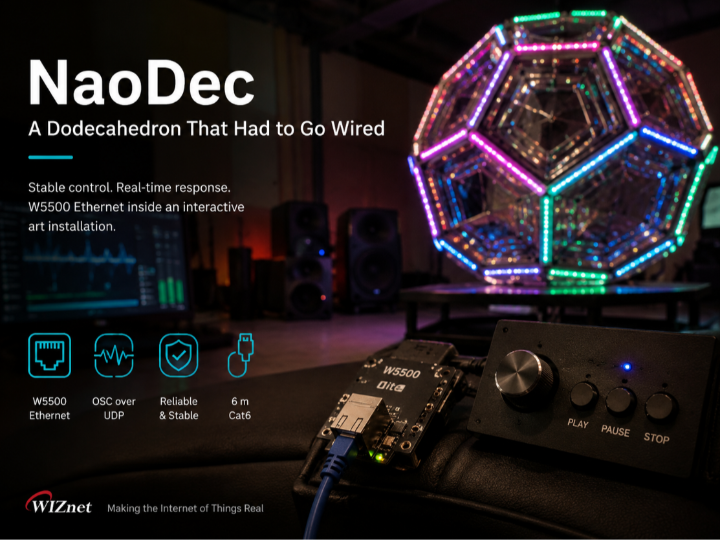
The playback controller is not a computer peripheral. It is a rotary encoder (KY-040), three buttons (Play / Pause / Stop), and a status LED mounted on the side of a chair, sending OSC over UDP to Max/MSP.
Running those raw panel signals over a 6 m cable—twelve times their intended distance—causes predictable electrical problems. The quadrature encoder is affected first: unshielded wiring picks up capacitance, crosstalk, and EMI, resulting in phantom detents, missed steps, and unstable volume control. The high-impedance button lines behave like antennas, causing false or missed button presses, especially near switching power supplies and the Wi-Fi router. The LED output survives the distance with only minor voltage drop, but ground reference shifts over the cable length, while the rotary encoder—the most frequently touched and most ESD-exposed part of the installation—connects directly to an unprotected GPIO. The existing 100 Ω series resistors were designed for short-range ESD protection, not for maintaining signal integrity across several metres.
The project's design notes evaluate three possible solutions. Option 1, moving the ESP32 into the ATX enclosure, places all vulnerable GPIO signals on the long cable and was therefore rejected. Option 2, keeping the ESP32 at the chair and relying on Wi-Fi, solves the signal integrity issue but requires 2.4 GHz communication to escape a metal enclosure acting as a partial Faraday cage, making it practical only if the router's antennas are extended outside the case. Option 3, placing the ESP32 at the chair while connecting it to the router over wired Ethernet, keeps every panel signal within its recommended 0.5 m length and lets a Cat6 cable handle the 6 m connection it was designed for. This became the Rev 3.0 architecture.
One Structure, Four Sensory Layers
The lighting system forms the visual core of the installation. Two ESP32-S3-WROOM-1 N16R8 modules run WLED in a master/slave DDP configuration. The master controls the 60-pixel vertex channel and three edge channels, while the slave drives the remaining three edge channels. Each edge contains 280 WS2815 LEDs. A SN74AHCT245N octal transceiver shifts the ESP32's 3.3 V logic to the 5 V level required by the WS2815 data input, providing a proper electrical solution instead of relying on marginal signal levels.
The audio system places six speakers around the structure using a Wondom GAB8 amplifier, with a dedicated subwoofer and chair-mounted transducers added during installation. A separate controller manages the scent subsystem.
The electromagnetic subsystem consists of sixty hand-wound coils connected in series around crystal cores. The repository explicitly labels this section as Rev 0 (pre-release) because the current design still has known limitations. At a steady 12 V DC supply, the entire coil string behaves as approximately a 3 Ω resistive load. Since the crystal cores are non-magnetic, they provide no magnetic field amplification, meaning current is limited almost entirely by wire resistance and the power supply. The adopted solution uses an XL4015 CC/CV buck converter configured for approximately 3 A constant-current operation with an input fuse. The documentation also notes that current limiting regulates normal operation but should not be considered fault protection.
Power distribution is divided into three isolated rails: 5 V / 3 A for logic, 12 V / 5 A for the vertex LEDs, and 12 V / 50 A (600 W) dedicated exclusively to the edge lighting.
                    Operator

         Rotary Encoder / Play / Pause / Stop
                          │
                          ▼
                     ESP32-S3 Controller
                          │
                     SPI Interface
                          │
                          ▼
                  WIZnet W5500 Ethernet
                          │
                     Cat6 Ethernet
                          │
                          ▼
                    Router / Switch
                          │
                          ▼
                  Mac Mini (Max/MSP)
                          │
          ┌───────────────┼───────────────┐
          │               │               │
          ▼               ▼               ▼
     WLED Master      Audio System    Scent Controller
          │
     WLED Slave
          │
          ▼
      1,740 WS2815 LEDs
⚙️ What the W5500 Actually Does
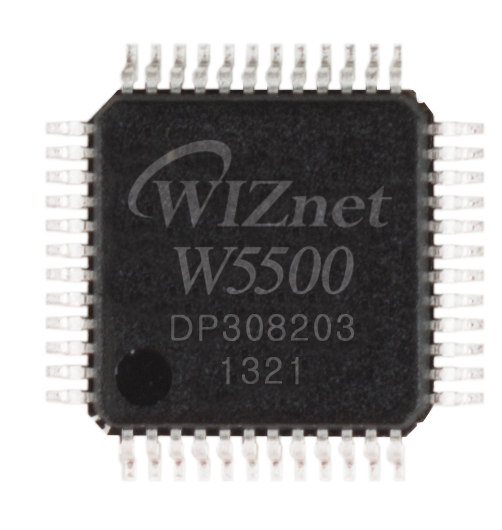
The ESP32-S3 does not include a built-in Ethernet MAC. The W5500 provides the Ethernet MAC, PHY, and its own hardwired TCP/IP engine through an SPI interface, allowing Rev 3.0 to switch from Wi-Fi to wired Ethernet without changing the artwork's control protocol.
Rev 3.0 introduces only three hardware additions:
- A W5500 Lite module (U2)
- A 100 nF X7R decoupling capacitor placed across the module's 3.3 V and GND pins
- Approximately 6 m of Cat6 cable connecting the controller to a LAN port on the router
The W5500 operates exclusively at 3.3 V and typically consumes around 150 mA. Because the interface is limited to 10/100 Mbps Ethernet, Cat5e already exceeds the required specification, making higher-grade cabling such as Cat8 unnecessary.
| W5500 | ESP32-S3 | Function |
|---|---|---|
| SCLK | GPIO13 | SPI_SCLK |
| MOSI | GPIO14 | SPI_MOSI |
| MISO | GPIO15 | SPI_MISO |
| SCS | GPIO16 | SPI_SCS |
| INT | GPIO17 | SPI_INT (optional) |
| RST | GPIO18 | SPI_RST (optional) |
The Cat6 cable carries data only. Since the router does not support PoE, the controller continues to use a local 5 V power supply at the chair, while the onboard regulator generates the 3.3 V required by the W5500.
Firmware version 3.0.0 completed the migration by replacing the Wi-Fi stack with the ESP32 Ethernet driver (ETH.h) operating over SPI on GPIO13–18. The OSC-over-UDP protocol and IP addressing scheme remained unchanged. WiFiManager and its captive portal were removed entirely because a wired installation no longer requires wireless provisioning. DHCP reservation is now based on the Ethernet MAC address reported through the controller's STATUS command. All encoder handling, button processing, LED control logic, and the Max/MSP patch remain exactly the same.
The result demonstrates the primary benefit of a hardwired Ethernet controller in embedded systems: the transport layer changed completely, while the application layer remained entirely unaffected.
What the Audience Touches
Nobody inside NaoDec configures a network. The visitor experiences light, sound, scent, and vibration inside a walk-in dodecahedron. The operator interacts with only a rotary encoder, three buttons, and a status LED mounted on the chair. Behind this simple interface are seven LED channels, a WLED DDP master/slave architecture, a 600 W lighting system, level-shifted WS2815 data lines, an audio amplifier, a scent controller, a current-limited electromagnetic subsystem, and—since Rev 3.0—a W5500 Ethernet link carrying OSC packets to a Mac Mini.
Although the internal architecture became significantly more sophisticated, the user experience remained unchanged. Replacing Wi-Fi with wired Ethernet improved communication reliability without altering how the installation is operated.
What Builders Need to Configure
NaoDec provides unusually comprehensive documentation for an interactive art installation, including detailed assembly instructions, subsystem schematics, power distribution documentation, controller hardware, interactive 3D visualizations, and LED mapping references.
Builders should still carefully configure:
- Separate power rails for logic and LED systems
- The 12 V / 50 A LED power distribution
- Proper level-shifter wiring
- DHCP reservation using the W5500 Ethernet MAC address
- Electromagnet current limiting and safety protection
Previous hardware revisions are archived, making it easy to compare design decisions across project versions.
Similar WIZnet Maker Projects
| Project | Focus | Difference |
|---|---|---|
| TheBreeze | W5500 Ethernet DDP Receiver | Dedicated wired DDP receiver for WLED installations. |
| 2040-ArtNode | RP2040 + W5500 Art-Net Controller | Ethernet-first controller for professional lighting networks. |
| DMXion | Multi-port DMX over Ethernet | Designed for large-scale stage lighting applications. |
| openHASP | MQTT Touchscreen Controller | Wired Ethernet user interface for home and industrial automation. |
FAQ
Why replace Wi-Fi with W5500 Ethernet?
The installation requires reliable OSC communication between the operator panel and a Mac Mini located approximately 6 meters away inside a metal enclosure. W5500 provides stable wired Ethernet, eliminating wireless signal issues while preserving the existing OSC-over-UDP workflow.
How does the W5500 connect to the ESP32-S3?
The W5500 interfaces with the ESP32-S3 over SPI, providing the Ethernet MAC, PHY, and hardware TCP/IP engine. This enables Ethernet communication without changing the application logic.
What role does W5500 play in this project?
The W5500 handles wired Ethernet communication for OSC messages between the media playback controller and Max/MSP, allowing the operator interface to remain responsive and reliable during continuous operation.
Can beginners build this project?
The project is best suited for advanced makers familiar with ESP32 development, Ethernet networking, LED installations, and high-current power distribution. The comprehensive documentation makes it approachable for experienced builders.
Why use W5500 instead of Wi-Fi?
While Wi-Fi is convenient, wired Ethernet provides deterministic communication, immunity to RF interference, and greater reliability in permanent installations where metal enclosures or long operating hours can affect wireless performance.
Source
Repository: https://github.com/SurasakNie/naodec
Documentation: https://surasaknie.github.io/naodec/
License: MIT License
Tags
#W5500 #ESP32S3 #Ethernet #InteractiveArt #WLED #OSC #MaxMSP #WS2815 #EmbeddedSystems #MediaInstallation #MakerProject #WIZnet