


esp32_mmdvm_hotspot
How to Build an ESP32 Digital Radio Hotspot with Reliable Networking using W5500
WIZnet - W5500
x 1

What the Project Does
This system can be understood as a self-contained digital radio gateway.
It connects RF communication (via an external modem) to modern IP-based services:
- Radio Layer (MMDVM Modem)
Handles digital voice/data protocols such as DMR and POCSAG - ESP32 Core System
Acts as the control plane:- Runs FreeRTOS tasks for each service
- Manages networking (Wi-Fi / Ethernet)
- Handles logging, storage, and OTA updates
- Network Services Layer
Provides connectivity to:- MQTT brokers (telemetry)
- Telegram bots (alerts)
- WireGuard VPN (secure remote access)
- Web UI (configuration and monitoring)
- User Interface Layer
- Web dashboard (status, config, control)
- OLED display for local status
System Analogy
Think of this system as a networked radio base station in a box:
- The modem speaks “radio protocol”
- The ESP32 translates it into IP traffic
- The network stack delivers it to cloud services and users
Where WIZnet Fits
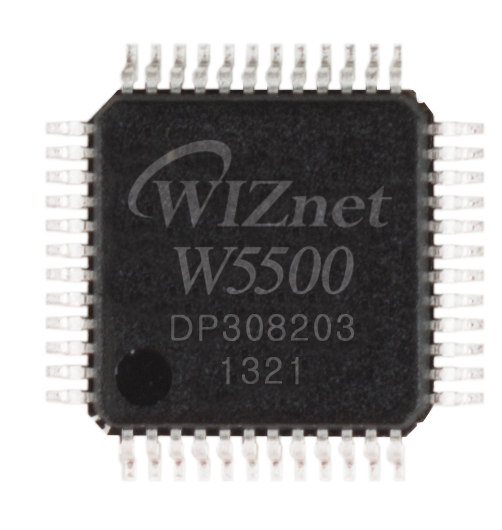
The project uses the WIZnet W5500 as the Ethernet interface, connected to the ESP32 over SPI and integrated into the system’s networking stack.
In this architecture, the W5500 operates as:
- A wired Ethernet interface (MAC/PHY over SPI)
- A stable transport layer for IP communication
- A dedicated network path for services such as MQTT, Web UI, and remote access
Role of W5500 in This System
Within the system, W5500 is responsible for:
- Providing reliable wired connectivity alongside the ESP32 networking stack
- Enabling continuous IP communication for:
- MQTT telemetry
- Web-based configuration interface
- Remote access services (e.g., VPN)
- Acting as the physical network bridge between the embedded system and external infrastructure
Unlike Wi-Fi, this wired path offers:
- Consistent latency
- Reduced packet loss
- Immunity to RF interference
Why It Matters Here
From the codebase analysis :
The system is characterized by:
- High task concurrency (multiple FreeRTOS services running in parallel)
- Frequent network operations (MQTT, HTTP, OTA, messaging)
- Blocking I/O paths (SD card access, web streaming)
These conditions make network stability a critical factor.
Using W5500 as the Ethernet interface provides:
- Stable, interference-free communication compared to Wi-Fi
- Predictable network behavior under continuous load
- Separation of concerns between RF (radio modem) and IP networking
- Improved reliability for long-running deployments
Architectural Impact
By introducing a dedicated wired Ethernet interface, the system evolves from:
- A wireless-dependent embedded node
to:
- A hybrid communication gateway with a stable wired backbone
This is particularly important for MMDVM-based systems, where:
- Continuous connectivity is required for protocol synchronization
- Network instability directly affects communication quality
In this design, the W5500 strengthens the system by ensuring that:
- Network transport remains consistent
- Higher-level services (MQTT, Web UI, VPN) operate reliably
- The ESP32 can maintain predictable behavior under load
Implementation Notes
1) Existing Network Architecture
From the project structure :
system_wifi.cpp→ Wi-Fi manager with fallback logicsystem_eth.cpp→ LAN8720 Ethernet (RMII)service_mqtt.cpp→ MQTT clientsystem_webserver.cpp→ HTTP server
All networking depends on ESP32’s internal TCP/IP stack (LwIP).
2) Key Architectural Limitation
Example (MQTT payload generation):
json += "{\"id\":\"wifi\",\"label\":\"WiFi\",\"enabled\":true,\"connected\":" +
        String(wifiConn ? "true" : "false") + "},";
Issue:
- Dynamic memory allocation
- CPU-heavy string concatenation
- No hardware offload
Combined with:
- 15+ concurrent tasks
- Continuous network activity
→ Leads to fragmentation and unpredictable latency
3) Conceptual W5500 Integration
Conceptual integration example based on WIZnet ioLibrary
#include "wizchip_conf.h"

// SPI interface binding
reg_wizchip_spi_cbfunc(spi_read, spi_write);

// Allocate socket buffers (8 sockets)
uint8_t txsize[8] = {2,2,2,2,2,2,2,2};
uint8_t rxsize[8] = {2,2,2,2,2,2,2,2};
wizchip_init(txsize, rxsize);

// Network configuration
wiz_NetInfo netinfo = {
    .mac = {0x00,0x08,0xDC,0xAA,0xBB,0xCC},
    .ip  = {192,168,1,50},
    .sn  = {255,255,255,0},
    .gw  = {192,168,1,1}
};

wizchip_setnetinfo(&netinfo);
Where It Connects in This Project
- Replace
WiFiClientinservice_mqtt.cpp - Replace socket layer in
system_webserver.cpp - Integrate into
system_eth.cppas alternative backend
4) Critical Code Insight (Why Networking Stability Matters)
From the analysis :
reading = random(20, 30);
cpuUsage = (float)random(0, 100) / 100.0;
This shows:
- System observability is unreliable
- Debugging performance issues becomes difficult
With W5500:
- Network load becomes predictable
- Easier to correlate system behavior with actual workload
Practical Tips / Pitfalls
- SPI wiring must be stable; avoid long traces at high clock speeds
- Use static IP for initial bring-up before enabling DHCP
- Monitor socket usage (W5500 supports 8 sockets max)
- Avoid mixing Wi-Fi and W5500 without clear routing strategy
- Replace
Stringwith fixed buffers in hot paths - Ensure proper task prioritization (modem must not be preempted)
- Validate Ethernet link status before starting services
FAQ
Q: Why use W5500 instead of ESP32 Wi-Fi in this project?
A: This system runs many concurrent tasks and network services. W5500 offloads TCP/IP processing, reducing CPU load and eliminating Wi-Fi-induced latency jitter that can disrupt real-time radio communication.
Q: How would W5500 connect to the ESP32 here?
A: Via SPI (MISO, MOSI, SCK, CS). It can be integrated as an alternative to LAN8720 in system_eth.cpp, with minimal hardware changes.
Q: What role would W5500 play in this hotspot?
A: It would handle all TCP/IP communication (MQTT, web server, VPN transport), allowing the ESP32 to focus on modem handling and task scheduling.
Q: Can beginners build this system?
A: This is an advanced embedded system involving RF protocols, FreeRTOS, and networking. Prior experience with ESP32 and networking stacks is required.
Q: How does W5500 compare to LAN8720 or LwIP?
A: LAN8720 relies on ESP32’s LwIP stack, consuming CPU and memory. W5500 includes a hardware TCP/IP stack, reducing overhead and improving determinism in multi-tasking systems.
Source
- Original Project Analysis: ESP32 MMDVM Hotspot Review
- License: Not specified
Tags
#W5500 #ESP32 #MMDVM #DigitalRadio #MQTT #Ethernet #EmbeddedSystems #FreeRTOS #IoT #VPN