



Open Pedalboard Mainboard
pedalboard audio midi processor open hardware
Open Pedalboard: Exploring W5500 Ethernet for a Network-Connected Guitar Pedalboard
Introduction
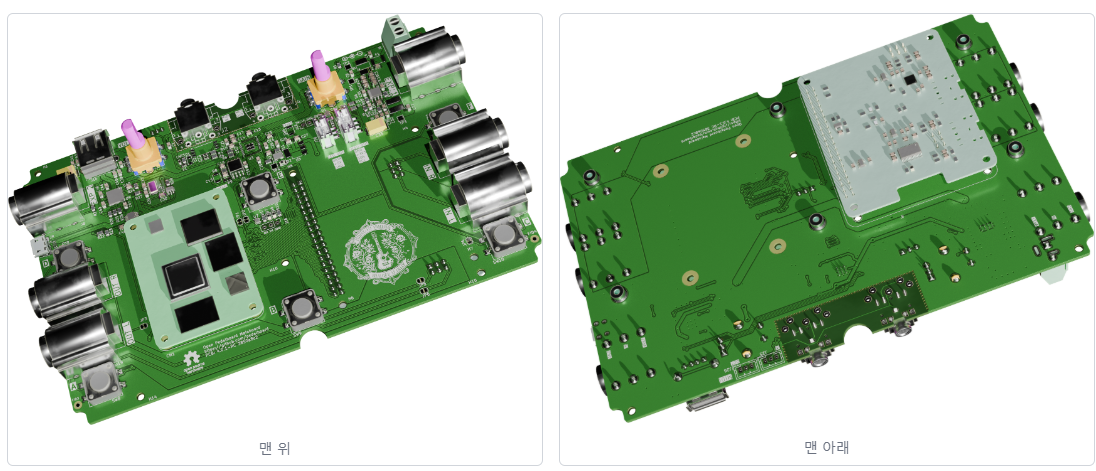
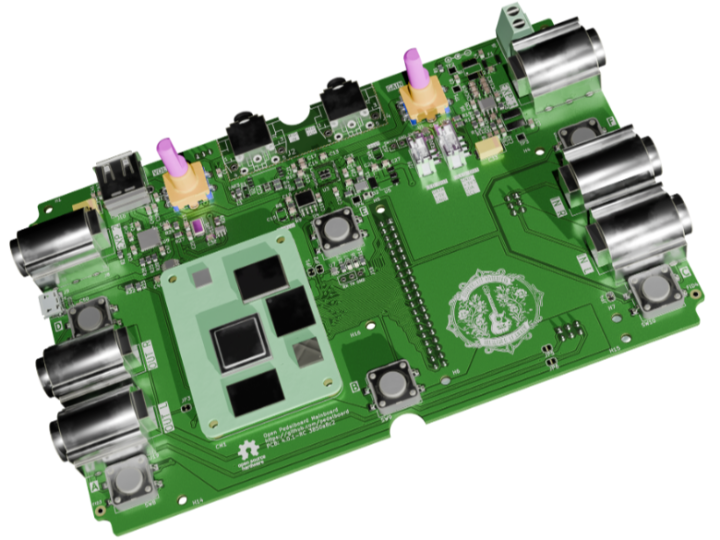
Open Pedalboard is an open-source hardware platform designed to combine guitar audio processing and MIDI control into a single customizable pedalboard.
The project uses a Raspberry Pi CM4/CM5 for low-latency audio processing and an RP2040-based controller for handling physical user inputs such as foot switches, encoders, and expression pedals.
The Raspberry Pi processes the actual guitar audio, including amp modeling, effects, and looping, while the RP2040 operates as a MIDI controller.
The basic architecture can be represented as:
Guitar / Audio Input
→ Raspberry Pi CM4 / CM5
→ Amp Modeling / Effects / Looper
→ Audio Output
At the same time, user controls are handled separately:
Foot Switch / Encoder / Expression Pedal
→ RP2040
→ MIDI Command
→ Raspberry Pi / MIDI Device
MIDI does not transmit the guitar audio itself. Instead, it carries control information such as effect ON/OFF commands, preset changes, parameter adjustments, and looper control.
For example, when a guitarist presses a foot switch, the RP2040 can generate a MIDI command that switches from a clean preset to a distortion preset or activates a delay effect.
By separating audio processing and control functions, Open Pedalboard can use the Raspberry Pi for computationally intensive audio processing while leaving real-time physical control to the RP2040.
Current Network Architecture
The currently released Open Pedalboard hardware does not include a WIZnet Ethernet controller.
In the current architecture, the RP2040 communicates with the Raspberry Pi CM5 through USB MIDI, while the Raspberry Pi can provide the network connection.
The communication path can therefore be simplified as:
Foot Switch / Encoder
→ RP2040
→ USB MIDI
→ Raspberry Pi CM5
→ Network
This architecture already allows network-related functions to be implemented through the Raspberry Pi.
However, the RP2040 MIDI controller itself does not have a dedicated network interface and therefore depends on the Raspberry Pi for network connectivity.
Why Is W5500 Being Considered?
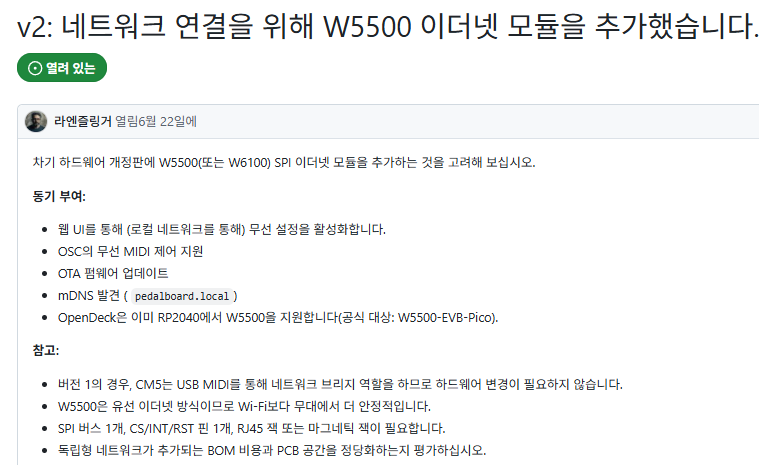
One of the main reasons is to provide standalone network connectivity to the RP2040 MIDI controller.
In the current design, network access is provided indirectly through the Raspberry Pi.
Adding W5500 would allow the controller to communicate directly with other devices over Ethernet.
Several possible applications are mentioned in the proposal.
Web-Based Configuration
The pedalboard could provide a local Web interface for configuring MIDI mappings, switches, presets, or other controller settings.
Instead of connecting the board to a PC through a dedicated configuration interface, the user could access it directly over the local network.
For example:
Laptop / Tablet
↔ Ethernet
↔ W5500
↔ RP2040
This could make configuration easier, especially when the pedalboard is already installed as part of a larger stage or studio setup.
OSC-Based MIDI Control
Another proposed application is OSC, or Open Sound Control.
OSC is commonly used to exchange real-time control messages between music, audio, and multimedia devices over IP networks.
With Ethernet connectivity, the RP2040 controller could send or receive OSC messages directly through the network.
For example:
Foot Switch
→ RP2040
→ OSC Message
→ W5500
→ Ethernet
→ Remote Audio System
This creates the possibility of controlling external audio equipment or software without routing every command through the Raspberry Pi.
OTA Firmware Updates
Ethernet connectivity could also enable firmware updates over the network.
Instead of physically connecting the controller to a computer whenever firmware needs to be updated, new firmware could potentially be delivered through the local network.
This becomes particularly useful when multiple pedalboards or controllers are deployed in fixed installations.
mDNS Device Discovery
The proposal also mentions mDNS support.
This could allow the pedalboard to be accessed using a local hostname such as:
pedalboard.local
rather than requiring the user to know its IP address.
This would simplify access to configuration pages or other network services.
Why Wired Ethernet?
A guitar pedalboard is often used in environments where communication reliability is important.
Live stages can contain many wireless devices, including Wi-Fi access points, smartphones, Bluetooth devices, wireless microphones, and other RF equipment.
For configuration purposes, Wi-Fi may be convenient.
However, for real-time control during a live performance, wired Ethernet can provide a more predictable and stable communication path.
In this case, Ethernet is not simply being added to provide Internet connectivity.
It could become part of the actual control infrastructure used by the musician.
For example:
Musician
→ Foot Switch
→ RP2040
→ W5500
→ Ethernet
→ Audio / MIDI Control System
This makes the application somewhat different from typical embedded Ethernet systems.
A conventional W5500 application might look like:
Sensor
→ MCU
→ W5500
→ Ethernet
→ Server
Open Pedalboard introduces another possible structure:
Human Input
→ MIDI Controller
→ W5500
→ Ethernet
→ Real-Time Audio Application
Instead of transferring sensor data, the Ethernet connection carries control commands generated directly by the musician.
Existing W5500 Support
The proposal also points out an important software advantage.
OpenDeck, the MIDI controller firmware related to this project, already supports W5500 with RP2040, including WIZnet's W5500-EVB-Pico as a supported target.
This means that the proposed Ethernet integration would not necessarily require building the entire network implementation from scratch.
The project could potentially build on an existing combination:
RP2040
MIDI Controller Firmware
W5500 Ethernet Support
This existing software support makes W5500 a practical option for adding Ethernet connectivity to the next hardware revision.
Expected Benefits
If W5500 or W6100 is integrated into a future version of Open Pedalboard, several improvements could be expected.
First, the RP2040 MIDI controller could become a standalone network device rather than relying entirely on the Raspberry Pi CM5.
Second, Ethernet could provide a reliable communication path for live-performance control.
Third, functions such as Web configuration, OSC control, OTA updates, and mDNS discovery could be implemented directly on the controller.
The architecture could therefore evolve from:
RP2040
→ USB MIDI
→ Raspberry Pi
→ Network
to:
RP2040
→ W5500 / W6100
→ Ethernet
while still maintaining communication with the Raspberry Pi for audio processing.
This separation could allow the audio processor and control network to operate more independently.
Conclusion
Open Pedalboard is primarily an open-source guitar audio and MIDI platform built around Raspberry Pi and RP2040.
Its current architecture already separates audio processing from physical MIDI control.
The proposed addition of W5500/W6100 would introduce another level of separation by allowing the RP2040 MIDI controller to connect directly to an Ethernet network.
If implemented, this could enable Web-based configuration, OSC control, OTA firmware updates, mDNS discovery, and more reliable wired communication for live-performance environments.
As of September 2026, Issue #33 remains open with no assignee or linked development work, so the Ethernet integration is still at the proposal stage.
Although the proposal is still at an early stage, it presents an interesting potential application for WIZnet Ethernet technology beyond traditional IoT and industrial systems.
It shows how W5500/W6100 could also be used in professional audio, musical instruments, and network-connected human interface devices.
References
Open Pedalboard Hardware
https://github.com/pedalboard/pedalboard-hw
GitHub Issue #33 – Ethernet Connectivity Proposal
https://github.com/pedalboard/pedalboard-hw/issues/33