



LuxDMX V2
Not just another Art-Net node — a network DMX node and a live diagnostic tool.
Watch all 512 channels update in real time in your browser, get warned the instan

LuxDMX V2 – W5500 기반 Art-Net / sACN to DMX512 Gateway
프로젝트 소개
LuxDMX V2는 네트워크를 통해 전달되는 Art-Net 및 sACN(E1.31) 조명 제어 데이터를 DMX512 신호로 변환하는 오픈소스 Ethernet/Wi-Fi DMX Gateway입니다.
일반적인 DMX 조명 시스템에서는 조명 콘솔이나 제어 소프트웨어에서 생성된 데이터를 실제 조명 장비까지 전달하기 위한 Gateway가 필요합니다.
LuxDMX V2는 ESP32 또는 ESP32-S3를 기반으로 이러한 역할을 수행하며, 네트워크에서 수신한 Art-Net/sACN 패킷을 실제 DMX512 신호로 변환해 조명 장비로 출력합니다. 현재 V2에서는 최대 4개의 독립적인 DMX Universe를 출력할 수 있으며, 일부 출력은 RDM(Remote Device Management)도 지원합니다.
전체 데이터 흐름은 다음과 같이 볼 수 있습니다.
Lighting Console / PC
→ Art-Net or sACN
→ Wi-Fi / W5500 Ethernet
→ ESP32-S3
→ DMX512 / RDM
→ Lighting Fixtures
즉, IP 기반 네트워크와 기존 산업용 조명 인터페이스인 DMX512 사이를 연결하는 Network-to-DMX Gateway입니다.
Art-Net 및 sACN 지원
LuxDMX V2는 네트워크 조명 제어에서 널리 사용되는 두 가지 프로토콜을 모두 지원합니다.
Art-Net은 UDP/IP 네트워크를 통해 DMX 데이터를 전송하기 위한 프로토콜이며, sACN(E1.31) 역시 Ethernet 네트워크를 이용해 여러 DMX Universe를 전송하기 위해 사용됩니다.
LuxDMX에서는 설정에 따라
Art-Net only / sACN only / Both
중 하나를 선택할 수 있으며, Art-Net은 Unicast 또는 Broadcast를 지원하고 sACN은 Multicast 방식으로 데이터를 수신할 수 있습니다.
수신된 네트워크 패킷은 ESP32에서 처리된 후 실제 DMX512 출력으로 변환됩니다.
WIZnet W5500을 이용한 Wired Ethernet
LuxDMX V2에서 특히 주목할 부분은 WIZnet W5500을 실제 유선 Ethernet 인터페이스로 지원한다는 점입니다.
프로젝트는 ESP32 및 ESP32-S3에서 외부 W5500 SPI Ethernet Controller를 사용할 수 있도록 설계되어 있으며, V2에는 esp32s3_n16r8_eth라는 전용 빌드 환경도 제공됩니다.
이 구성은
ESP32-S3-WROOM-2 N16R8 + W5500
조합으로 이루어진 LuxDMX 4-Universe 보드를 대상으로 하며, 최대 4개의 DMX Universe와 8 MB PSRAM을 지원합니다.
README에서도 Wired Ethernet 항목에 W5500 (SPI, all boards)를 명시하고 있으며, ESP32 기본 환경에서도 W5500 드라이버를 활성화해 외부 W5500 모듈을 추가할 수 있습니다.
따라서 네트워크 구조는 다음과 같습니다.
Ethernet Cable
→ WIZnet W5500
→ SPI
→ ESP32 / ESP32-S3
→ Art-Net / sACN Processing
→ DMX512 Output
Wi-Fi가 혼잡하거나 안정적인 유선 연결이 필요한 공연장 및 조명 제어 환경에서 W5500을 이용한 Ethernet 연결을 사용할 수 있습니다.
PoE를 이용한 단일 케이블 전원 공급
LuxDMX의 커스텀 하드웨어는 IEEE 802.3af PoE를 지원합니다.
PoE를 사용하면 하나의 Ethernet 케이블을 통해 Art-Net/sACN 네트워크 데이터와 장치 구동 전원을 동시에 공급할 수 있습니다. 따라서 조명 장비가 설치된 위치마다 별도의 전원 어댑터를 연결할 필요가 없어 배선을 단순화할 수 있으며, 여러 DMX Node를 분산 배치하는 공연장이나 무대 환경에서 설치 편의성을 높일 수 있습니다.
LuxDMX의 PoE 전원은 PoE MagJack을 통해 입력된 후 절연형 PoE PD/DC-DC 회로를 거쳐 보드에서 사용하는 5V 전원으로 변환됩니다.
또한 USB-C 전원도 함께 지원하며, 전원 MUX를 통해 PoE를 우선적으로 사용하고 PoE 전원이 없을 경우 USB-C 전원을 사용할 수 있도록 구성되어 있습니다.
즉, W5500을 이용한 안정적인 유선 Ethernet 연결뿐만 아니라 PoE를 함께 적용함으로써,
Ethernet Cable
→ Network Data + Power
→ W5500 / ESP32-S3
→ DMX512 / RDM
과 같은 단일 케이블 기반의 Network Lighting Node를 구성할 수 있습니다.
Wi-Fi와 Ethernet을 지원하는 Network Architecture
LuxDMX V2는 Wi-Fi와 Wired Ethernet을 모두 지원합니다.
웹 설정 화면에서 Wi-Fi 또는 유선 Ethernet을 선택할 수 있으며, Wi-Fi에서는 기존 AP에 연결하는 STA 모드뿐 아니라 LuxDMX 자체가 Access Point가 되는 Standalone AP 모드도 사용할 수 있습니다.
특히 Wired Ethernet을 사용할 때는 네트워크 연결이 끊어졌을 경우의 동작도 설정할 수 있습니다.
프로젝트에서는 Ethernet Link Loss 발생 시
계속 Ethernet 재연결 시도 / WPA2 AP 실행 / 재부팅 / 저장된 Wi-Fi로 전환
등의 동작을 선택할 수 있습니다.
ESP32용 빌드에는 Wi-Fi와 W5500 코드가 하나의 Firmware Image에 포함되어 있고, 실제 사용할 인터페이스를 설정 페이지에서 선택할 수 있도록 구현되어 있습니다.
따라서 LuxDMX V2는 하나의 장치에서 유선 및 무선 네트워크 환경에 모두 대응할 수 있는 구조를 가지고 있습니다.
최대 4개의 DMX Universe
V2에서는 기존 구조를 확장하여 최대 4개의 독립적인 DMX 출력을 지원합니다.
각 출력은 별도의 Universe를 담당할 수 있으며,
Output A / B → DMX + RDM 지원
Output C / D → DMX 출력
형태로 구성할 수 있습니다.
DMX 출력은 기존의 단순 UART 방식이 아니라 ESP32의 RMT Peripheral을 이용합니다.
프로젝트에서는 네트워크 트래픽이 많아졌을 때 Core 0의 Network DMA가 UART 기반 DMX 신호에 영향을 주던 문제를 해결하기 위해 RMT 기반 DMX 출력 구조로 변경했습니다.
이를 통해 Wi-Fi 또는 Ethernet 네트워크 부하가 증가하더라도 DMX Timing을 보다 안정적으로 유지하도록 개선했습니다.
RDM 지원
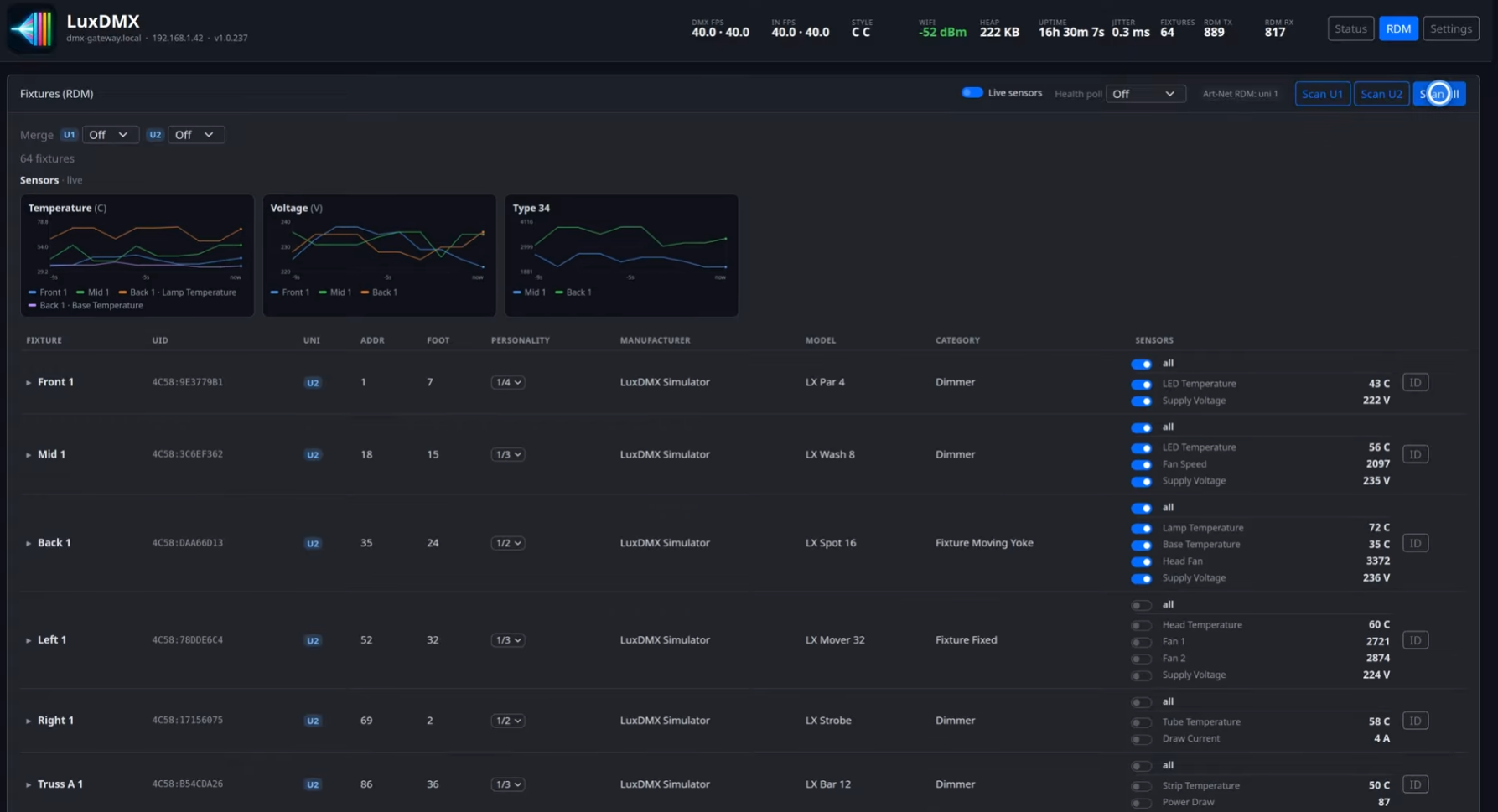
LuxDMX V2는 단순 DMX512 출력뿐 아니라 RDM(E1.20)도 지원합니다.
RDM은 기존 DMX512 통신에 양방향 통신 기능을 추가하여 조명 장비의 상태 확인이나 설정 변경을 가능하게 하는 프로토콜입니다.
LuxDMX에서는 RDM Discovery를 비롯해 Device Information, DMX Start Address, Identification, Sensor 정보 등의 다양한 RDM 기능을 지원합니다.
또한 RDM over Art-Net도 지원하므로 Ethernet Network에서 전달된 RDM 명령을 실제 DMX/RDM Bus로 전달할 수 있습니다.
구조적으로는 다음과 같이 볼 수 있습니다.
Art-Net Controller
↕ Ethernet / Wi-Fi
LuxDMX V2
↕ DMX512 / RDM
Lighting Fixture
따라서 단순한 Network-to-DMX 변환기뿐만 아니라 네트워크를 통한 조명 장비 관리 Gateway 역할도 수행할 수 있습니다.
실시간 Web Monitoring
LuxDMX V2의 또 다른 특징은 내장된 Web UI입니다.
사용자는 별도의 프로그램 없이 브라우저를 통해 장치에 접속하여 DMX 데이터를 실시간으로 확인할 수 있습니다.
Web UI에서는 512개의 DMX Channel 값을 확인할 수 있으며, 현재 데이터를 보내고 있는 Art-Net/sACN Sender와 각 Sender의 FPS도 확인할 수 있습니다.
특히 여러 조명 Console 또는 Controller가 동일한 Universe로 데이터를 전송할 경우 이를 감지하여 Source Conflict Warning을 표시하는 기능도 제공합니다.
즉, LuxDMX는 단순히 데이터를 전달하는 Gateway가 아니라 Network DMX Diagnostic Tool 역할도 함께 수행합니다.
HTP / LTP Source Merging
여러 Art-Net 또는 sACN Sender가 동시에 데이터를 전송할 경우 LuxDMX는 출력별로 데이터 Merge 방식을 설정할 수 있습니다.
지원되는 방식은
HTP – Highest Takes Precedence
LTP – Latest Takes Precedence
Merge Off
입니다.
HTP에서는 여러 Source 중 가장 높은 Channel 값을 사용하고, LTP에서는 가장 최근에 수신된 Source 데이터를 사용합니다.
이를 통해 여러 Lighting Controller가 연결된 환경에서도 실제 공연이나 설치 환경에 맞게 데이터를 처리할 수 있습니다.
Live Configuration 및 REST API
LuxDMX V2는 대부분의 설정을 Web UI에서 변경할 수 있도록 설계되어 있습니다.
Universe, Merge Mode, DMX 출력 속도, Signal Loss 동작, 밝기 등의 설정은 대부분 장치를 재부팅하지 않고 바로 적용됩니다.
또한 REST API도 제공하여 외부 시스템에서 LuxDMX의 상태와 정보를 조회할 수 있습니다.
예를 들어 DMX 상태, Sender 정보, 로그, 버전 정보, Channel Label, RDM 정보를 API를 통해 확인할 수 있습니다.
따라서 Web UI뿐만 아니라 외부 Monitoring 또는 Automation 시스템과 연동하는 것도 가능합니다.
V2의 Modular Architecture
LuxDMX V2는 기존 Firmware를 단순히 확장한 것이 아니라 전체 구조를 5-Layer Modular Architecture로 다시 설계했습니다.
구조는 다음과 같습니다.
Driver
→ Configuration
→ Core
→ Network
→ Application / System
각 기능을 계층별로 분리하여 Ethernet, DMX, Configuration, Application 기능이 서로 독립적으로 개발되고 테스트될 수 있도록 구성했습니다.
이를 통해 새로운 Ethernet Interface나 DMX 기능을 추가할 때 전체 시스템에 미치는 영향을 줄이고 유지보수성을 높였습니다.
WIZnet W5500의 역할
이 프로젝트에서 W5500의 역할은 명확합니다.
W5500은 ESP32-S3에 SPI 기반 Wired Ethernet Interface를 제공하여 Art-Net 및 sACN 데이터를 Ethernet Network에서 수신할 수 있도록 합니다.
특히 ESP32-S3 기반 LuxDMX-4uni 환경에서는 W5500이 유선 네트워크 인터페이스로 사용됩니다.
구조를 단순화하면 다음과 같습니다.
Lighting Controller
↓ Art-Net / sACN
W5500 Ethernet
↓ SPI
ESP32-S3
↓ DMX Processing
DMX512 / RDM
↓
Lighting Fixtures
따라서 W5500은 단순히 Web Server용 Ethernet을 추가하는 것이 아니라, 실시간 조명 제어 데이터를 전달하는 핵심 네트워크 인터페이스로 활용됩니다.
Conclusion
LuxDMX V2는 ESP32/ESP32-S3와 WIZnet W5500을 활용하여 Art-Net 및 sACN 네트워크 데이터를 DMX512/RDM으로 변환하는 오픈소스 Lighting Gateway입니다.
W5500 SPI Ethernet뿐 아니라 Wi-Fi도 지원하여 설치 환경에 따라 유선 또는 무선 네트워크를 선택할 수 있으며, Ethernet Link Loss 시 Wi-Fi로 전환하는 기능도 제공합니다.
또한 최대 4개의 DMX Universe, RDM, Web Monitoring, Source Conflict Detection, HTP/LTP Merge, REST API 및 OTA Update 등을 제공해 단순한 Art-Net Node를 넘어 Network Lighting Gateway + Diagnostic Platform으로 활용할 수 있습니다.
특히
Ethernet/Wi-Fi Network
→ W5500 / ESP32-S3
→ Art-Net / sACN Processing
→ DMX512 / RDM
이라는 구조를 통해 WIZnet Ethernet이 기존 산업용 조명 인터페이스와 연결되는 실제 Application 사례라는 점에서 의미가 있습니다.
LuxDMX V2 – W5500-Based Art-Net / sACN to DMX512 Gateway
Project Introduction
LuxDMX V2 is an open-source Ethernet/Wi-Fi to DMX gateway that converts network-based lighting protocols such as Art-Net and sACN (E1.31) into physical DMX512 signals.
In a typical lighting system, a gateway is required to deliver lighting control data generated by a console or PC software to physical lighting fixtures.
LuxDMX V2 performs this role using an ESP32 or ESP32-S3. It receives Art-Net or sACN packets over a network and converts them into DMX512 output signals.
The current V2 architecture supports up to four independent DMX universes, while selected outputs can also support RDM (Remote Device Management).
The overall data flow can be represented as:
Lighting Console / PC
→ Art-Net or sACN
→ Wi-Fi / W5500 Ethernet
→ ESP32-S3
→ DMX512 / RDM
→ Lighting Fixtures
This makes LuxDMX V2 a network-to-DMX gateway that connects IP-based networks with conventional DMX lighting systems.
Art-Net and sACN Support
LuxDMX V2 supports two widely used network lighting protocols:
- Art-Net
- sACN (E1.31)
Art-Net is a UDP/IP-based protocol used to transport DMX data over Ethernet networks, while sACN is another IP-based protocol designed for transmitting multiple DMX universes.
LuxDMX V2 allows users to select:
Art-Net only / sACN only / Both
Art-Net can operate using unicast or broadcast communication, while sACN supports multicast-based reception.
The received network packets are processed by the ESP32 and converted into physical DMX512 output signals.
Wired Ethernet with WIZnet W5500
One of the key features of LuxDMX V2 is its support for the WIZnet W5500 as a wired Ethernet interface.
The project supports an external W5500 SPI Ethernet Controller with ESP32 and ESP32-S3 platforms.
LuxDMX V2 also provides a dedicated build environment for:
ESP32-S3-WROOM-2 N16R8 + W5500
This configuration is designed for the LuxDMX four-universe hardware platform and supports multiple DMX outputs together with Ethernet connectivity.
The Ethernet data flow can be represented as:
Ethernet Cable
→ WIZnet W5500
→ SPI
→ ESP32 / ESP32-S3
→ Art-Net / sACN Processing
→ DMX512 Output
In this architecture, the W5500 acts as the wired network interface responsible for receiving lighting control data from the Ethernet network.
This is particularly useful in professional lighting environments where a stable wired connection is preferred over wireless communication.
Wi-Fi and Ethernet Network Support
LuxDMX V2 supports both Wi-Fi and wired Ethernet.
Users can select the preferred network interface through the device configuration page.
For Wi-Fi operation, the system supports both:
- Station mode for connecting to an existing wireless network
- Standalone AP mode for creating its own Wi-Fi access point
For wired operation, a W5500 Ethernet interface can be used.
The project also includes several configurable behaviors for Ethernet link loss, such as:
- Continuously retrying the Ethernet connection
- Starting a WPA2 Access Point
- Rebooting the device
- Falling back to a previously configured Wi-Fi connection
Because both Wi-Fi and Ethernet functionality are included in the firmware, LuxDMX V2 can adapt to different network environments without requiring completely separate firmware architectures.
This makes the system suitable for both wired and wireless lighting installations.
Up to Four DMX Universes
LuxDMX V2 expands the original architecture to support up to four independent DMX outputs.
Each output can operate as a separate DMX universe.
A typical configuration can be organized as:
Output A / B → DMX + RDM support
Output C / D → DMX output
Instead of relying only on conventional UART-based DMX generation, LuxDMX V2 uses the ESP32 RMT peripheral for DMX timing.
This design was introduced to improve signal stability under heavy network traffic.
When Ethernet or Wi-Fi traffic increases, network-related processing may interfere with timing-sensitive UART output. Using RMT allows DMX timing to remain more stable even when network activity is high.
This is an important improvement for real-time lighting control applications.
RDM Support
LuxDMX V2 also supports RDM (Remote Device Management) in addition to standard DMX512 output.
RDM extends the traditional DMX protocol with bidirectional communication, allowing a controller to retrieve information from lighting fixtures or modify their configuration.
The project supports functions such as:
- RDM Discovery
- Device Information
- DMX Start Address configuration
- Identify Device
- Sensor Information
- Remote device monitoring
LuxDMX V2 also supports RDM over Art-Net.
This allows RDM commands received over an IP network to be translated and forwarded to the physical DMX/RDM bus.
The communication flow can therefore be represented as:
Art-Net Controller
↕ Ethernet / Wi-Fi
LuxDMX V2
↕ DMX512 / RDM
Lighting Fixture
As a result, LuxDMX V2 works not only as a DMX converter but also as a network-based lighting management gateway.
Real-Time Web Monitoring
LuxDMX V2 includes a built-in Web UI for configuration and monitoring.
Users can access the device through a standard web browser without installing additional software.
The interface can display information such as:
- DMX channel values
- Art-Net or sACN senders
- Sender FPS
- Network status
- DMX activity
The system can also detect cases where multiple lighting controllers are sending data to the same universe.
When this occurs, LuxDMX can display a Source Conflict Warning.
This allows the device to function not only as a gateway but also as a useful network lighting diagnostic tool.
HTP / LTP Source Merging
When multiple Art-Net or sACN sources transmit data to the same universe, LuxDMX V2 can merge the incoming data using several methods.
Supported modes include:
HTP – Highest Takes Precedence
The highest channel value among multiple sources is selected.
LTP – Latest Takes Precedence
The most recently received source data is used.
Merge Off
No merging is performed.
These options make LuxDMX V2 suitable for environments where multiple lighting consoles or controllers may be connected to the same network.
Live Configuration and REST API
Most LuxDMX V2 settings can be changed through the Web UI.
Examples include:
- Universe configuration
- Merge mode
- DMX output rate
- Signal-loss behavior
- Device settings
- Network configuration
Many settings can be applied dynamically without requiring a full system reboot.
LuxDMX V2 also provides a REST API that allows external applications to retrieve device information.
The API can provide information such as:
- DMX status
- Active senders
- Logs
- Firmware version
- Channel labels
- RDM information
This allows LuxDMX V2 to be integrated with external monitoring or automation systems.
Modular Architecture in V2
LuxDMX V2 was redesigned using a modular software architecture rather than simply extending the original firmware.
The project separates major functionality into multiple layers:
Driver
→ Configuration
→ Core
→ Network
→ Application / System
This structure separates Ethernet, DMX, configuration, network, and application logic.
As a result, new network interfaces, lighting protocols, or hardware functions can be added without requiring extensive changes to the entire firmware.
This improves maintainability and makes the project easier to expand.
Role of WIZnet W5500
The role of the W5500 in this project is clear.
The W5500 provides a wired Ethernet interface to the ESP32-S3 through SPI, allowing the system to receive Art-Net and sACN lighting data over an Ethernet network.
The simplified architecture is:
Lighting Controller
↓ Art-Net / sACN
WIZnet W5500
↓ SPI
ESP32-S3
↓ Lighting Protocol Processing
DMX512 / RDM
↓
Lighting Fixtures
Therefore, the W5500 is not simply used for basic web connectivity.
It acts as the main wired communication interface for real-time network lighting data.
This makes LuxDMX V2 a practical example of using WIZnet Ethernet technology in a professional lighting application.
Hybrid Network Capability
LuxDMX V2 supports both Wi-Fi and W5500-based wired Ethernet, allowing the same system to operate in different network environments.
The firmware includes support for both interfaces, and the active network interface can be selected through the configuration interface.
The project also supports Ethernet-to-Wi-Fi fallback behavior when the Ethernet connection is lost.
This makes LuxDMX V2 an interesting example of a system combining wired and wireless network technologies.
Rather than relying on only one communication method, the device can provide flexible network connectivity depending on installation requirements.
Conclusion
LuxDMX V2 is an open-source lighting gateway that combines ESP32/ESP32-S3, WIZnet W5500 Ethernet, Art-Net, sACN, DMX512, and RDM.
The W5500 provides wired Ethernet connectivity for receiving real-time lighting control packets, while the ESP32 platform also provides Wi-Fi connectivity.
The project supports up to four DMX universes, RDM, real-time web monitoring, source conflict detection, HTP/LTP merging, REST API access, and flexible network configuration.
The overall architecture can be summarized as:
Ethernet / Wi-Fi Network
→ W5500 / ESP32-S3
→ Art-Net / sACN Processing
→ DMX512 / RDM
→ Lighting Fixtures
LuxDMX V2 is therefore more than a simple Art-Net node.
It can be considered a Network Lighting Gateway and Diagnostic Platform, demonstrating how WIZnet Ethernet can be integrated with professional stage and lighting control systems.