



kicad-happy Test Harness
Test harness for kicad-happy skills and analyzers
1. Overview
kicad-happy-testharness is an open-source testing framework designed to ensure the reliability of kicad-happy, a KiCad-based PCB design analysis tool.
Automated PCB design analyzers face several challenges:
Changes to analysis logic can unintentionally break existing behavior.
New KiCad project types may introduce unforeseen edge cases.
Manual review alone is often insufficient to detect quality regressions early.
To address these issues, kicad-happy-testharness:
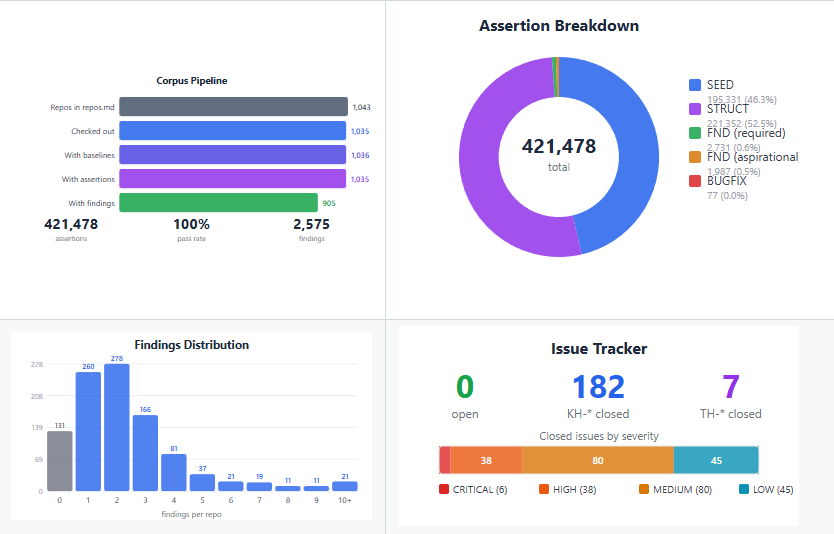
Uses real-world open-source KiCad projects as a testing corpus.
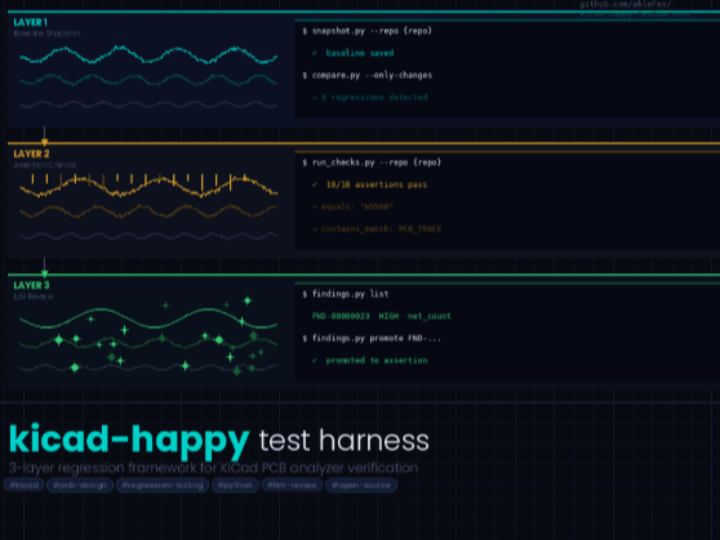
Implements a three-layer validation architecture consisting of:
Baseline Snapshots
Assertions
LLM Reviews
Automatically detects regressions and supports continuous quality improvement.
2. System Architecture
The test harness manages data on a per-repository basis and employs three independent validation layers that together form a continuous feedback loop.
      Open-Source KiCad Projects (Corpus)
                    ↓
         Run kicad-happy Analyzer
                    ↓
    ┌───────────────────────────────┐
    │     3-Layer Validation        │
    │                               │
    │ Layer 1: Baseline Snapshot    │
    │ Layer 2: Assertion Check      │
    │ Layer 3: LLM Review           │
    └───────────────────────────────┘
                    ↓
       Regression Detection
                    ↓
          Fix → Repeat
All reference data is stored under:
reference/{repo}/{project}/
allowing full Git-based version tracking.
3. Three Validation Layers
Layer 1 — Baseline Snapshot
The complete analyzer output is captured as a baseline snapshot and compared against future executions.
Tools
regression/snapshot.py — Generate baselines
regression/compare.py — Compare current output against baseline
This enables fast regression detection while filtering only the repositories that changed.
python3 regression/snapshot.py --repo {repo}
python3 regression/compare.py --repo {repo}
python3 regression/compare.py --all --only-changes
Layer 2 — Assertions
Assertions define outputs that the analyzer must always detect for specific projects.
Assertions are stored as JSON files under:
reference/{repo}/{project}/assertions/
Supported operators include:
exists
equals
range
min_count
contains_match
Since assertions are committed to Git, they provide permanent regression protection.
python3 regression/run_checks.py --repo {repo}
python3 regression/seed.py --repo {repo}
Layer 3 — LLM Review
Original KiCad files and analyzer summaries are bundled into review packets and independently evaluated by Claude.
This layer is particularly effective at identifying quality issues that are difficult to detect using deterministic checks.
Review findings are tracked using identifiers such as:
FND-00000001
and can later be promoted into permanent assertions.
python3 regression/packet.py --strategy random --count 5
python3 regression/findings.py list
python3 regression/findings.py promote FND-00000001
4. The Ratchet Model — Quality Only Moves Forward
The three validation layers do not operate independently; they form a feedback loop.
When an LLM review discovers a defect:
LLM Finding
      ↓
Recorded Finding
      ↓
Promoted to Assertion
      ↓
Automatically Verified in Every Future Run
Once a defect is discovered, it can never silently reappear.
This "Ratchet" model is the core principle of the framework.
5. Technology Stack
Core Components
Python 3 CLI-based tooling
KiCad project analysis
Git-based version control
Analysis Targets
Real-world open-source KiCad projects containing:
.kicad_pcb
.kicad_sch
related design artifacts
Data Storage
reference/{repo}/{project}/
Stores:
Baselines
Assertions
Findings
LLM Integration
Claude API
Independent quality assessment and review
Development Environment
Python 3
KiCad
Git
Connection to W5500
One of the goals of kicad-happy is to automatically identify design issues during the PCB design phase.
Many open-source hardware projects in the corpus contain Ethernet circuitry based on the WIZnet W5500, making them valuable real-world validation targets.
The W5500 is a Hardwired TCP/IP Ethernet controller connected to an MCU through SPI. PCB-level verification commonly involves checking:
Pin assignments
SPI bus connectivity
Decoupling capacitor placement
Power distribution integrity
Ethernet interface design rules
Automated analysis tools such as kicad-happy can help detect these issues early in both schematic and PCB layout stages.
6. Applications
Use Cases
Automated KiCad design verification
Open-source hardware quality assurance
Embedded networking circuit review
AI-assisted PCB analysis pipelines
CI/CD integration for hardware projects
Regression testing for PCB design tools
Value Proposition
The framework validates PCB analysis tools simultaneously through:
Automated baseline comparison
Explicit assertion verification
LLM-based quality review
This multi-layer approach enables continuous improvement of analyzer reliability while minimizing the risk of undetected regressions.
7. Conclusion
kicad-happy-testharness is a testing framework that validates PCB design analysis tools using a corpus of real-world open-source KiCad projects.
Through its three-layer validation architecture:
Baseline Snapshots
Assertions
LLM Reviews
and its Ratchet-based quality model, the framework:
Automatically detects regressions
Converts discovered defects into permanent test cases
Ensures quality improves in a single direction over time
The result is a practical QA platform that can contribute to higher reliability across the open-source KiCad hardware ecosystem.