



EveningStar
Hardware design for the EveningStar ESP32-based Morningstar MeterBus interface.
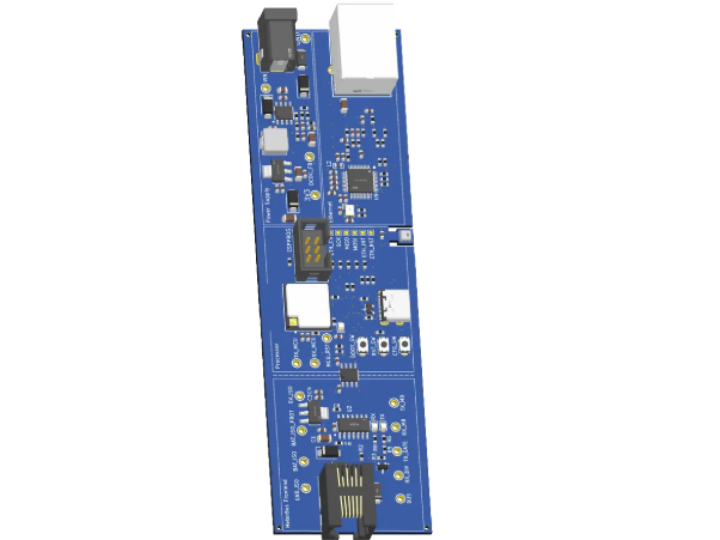
EveningStar: Bringing Morningstar Solar Controllers onto Ethernet with ESP32-C6 and W5500
Introduction

EveningStar is an open-source hardware project designed to connect a Morningstar MeterBus network to a standard Ethernet/IP network.
Morningstar solar charge controllers expose operational and control data through their MeterBus interface. EveningStar connects to this interface and converts it into a network-accessible system, allowing solar equipment to be monitored, automated, or controlled from devices connected through Ethernet.
The hardware is built around an ESP32-C6 and a WIZnet W5500 Ethernet controller.
At a high level, the system can be represented as:
Morningstar Solar Charge Controller
→ MeterBus
→ EveningStar
→ ESP32-C6
→ W5500
→ Ethernet
→ Monitoring / Automation / Control System
Instead of requiring a computer to be physically connected to the solar controller, EveningStar acts as a dedicated gateway between the controller's local field interface and an IP network.
What Is Morningstar MeterBus?
MeterBus is the communication interface used by a number of Morningstar solar charge controllers and related devices.
In EveningStar, the MeterBus side is implemented as a half-duplex, open-drain communication interface.
Because solar and battery installations can be electrically noisy environments, the interface includes additional protection and signal-conditioning circuitry.
The receive path uses a Schmitt-trigger stage, while transient-voltage-suppression devices are included to improve robustness against electrical disturbances.
This makes the board more than a simple serial-to-Ethernet adapter.
It is designed specifically to sit between a solar power system and normal Ethernet or USB-connected equipment.
Galvanic Isolation Between the Two Systems
One of the key design features of EveningStar is its isolation architecture.
The board is divided into two galvanically isolated sections:
MeterBus Side
Connected to the Morningstar device
Powered from the connected MeterBus equipment
Handles the MeterBus electrical interface
Controller / Ethernet Side
ESP32-C6
W5500 Ethernet interface
Independent power supply
USB-C and debugging interface
The isolation boundary prevents a direct electrical connection between the solar system and Ethernet-side equipment.
This is particularly important in systems involving batteries, solar charge controllers, PCs, switches, and external power supplies.
Without isolation, differences in ground potential could create ground loops or allow unwanted fault current to flow through communication cables.
By isolating the MeterBus section from the ESP32 and Ethernet section, EveningStar reduces this risk.
The overall architecture is therefore:
Solar / Battery System
→ MeterBus Interface
→ Galvanic Isolation
→ ESP32-C6
→ W5500
→ Ethernet Network
Why Is the ESP32-C6 Used?
The ESP32-C6 operates as the main application processor.
Its role is to communicate with the MeterBus interface, process the data received from the Morningstar controller, and manage communication with the Ethernet interface.
It therefore sits at the center of the gateway.
Conceptually:
MeterBus Data
→ ESP32-C6
→ Network Processing
→ W5500
→ Ethernet
The ESP32 side can also be powered independently of the MeterBus side.
According to the project, it can be powered from the same battery system connected to the charge controller or from a separate external power source, even when the two supplies operate at different voltages.
USB-C and a dedicated debug header are also included for firmware development and console access.
The Role of W5500
The WIZnet W5500 provides the wired Ethernet interface for the EveningStar gateway.
The Ethernet schematic explicitly defines the interface as using a W5500 together with the Ethernet jack.
The ESP32-C6 communicates with the W5500, while the W5500 provides the connection between the embedded controller and the physical Ethernet network.
This creates the following communication path:
Morningstar Controller
→ MeterBus
→ Isolated Interface
→ ESP32-C6
→ W5500
→ RJ45
→ Ethernet Network
The W5500 is therefore not simply an optional network feature.
It forms the network-facing side of the gateway and allows data originating from a solar charge controller to become accessible through a conventional wired IP infrastructure.
From a Device Interface to a Network Gateway
Without a gateway, the MeterBus interface is primarily a local device connection.
EveningStar changes the accessibility of that interface.
Instead of:
PC / Adapter
→ MeterBus
→ Solar Controller
the system can operate as:
Monitoring System
↔ Ethernet
↔ W5500
↔ ESP32-C6
↔ MeterBus
↔ Solar Controller
This means that the solar controller no longer needs to be directly attached to the same computer that performs monitoring.
The gateway separates the physical location of the solar equipment from the system that consumes its data.
This is useful for remote monitoring and automation architectures in which multiple devices may need to be accessed from a central location.
Reliability at the Field Interface
A notable part of EveningStar is that attention is given not only to Ethernet connectivity but also to the electrical conditions of the field side.
The MeterBus interface includes:
Galvanic isolation
Half-duplex open-drain communication
Schmitt-trigger receive circuitry
Transient-voltage-suppression protection
These features are intended to improve reliability when communication cables are routed through electrically noisy environments.
This is particularly relevant around solar charging and battery equipment, where switching converters, long cables, and multiple power domains may coexist.
The project therefore combines two different design requirements:
Robust Field Interface
+
Standard Ethernet Connectivity
with the ESP32-C6 acting as the bridge between them.
Power Architecture
The two isolated sections also have separate power domains.
The MeterBus interface is powered from the connected Morningstar device.
The ESP32 and Ethernet section is powered independently.
This means the Ethernet side does not need to share the same ground or even the same supply voltage as the solar controller.
That design decision supports the isolation strategy and allows EveningStar to interface with different power-system configurations more safely.
Open Hardware Design and Manufacturing

EveningStar is developed as an open hardware project with practical manufacturing in mind.
The repository provides the complete KiCad design, including separate schematics for the Ethernet, ESP32-C6, MeterBus, power, USB, and flash memory sections.
It also provides a reproducible build workflow with ERC/DRC checks and manufacturing outputs such as Gerber files, BOM data, placement files, STEP models, and PCB renders.
The board can be fabricated and assembled through standard PCBA services such as JLCPCB using a 2-layer FR-4 PCB with top-side SMT assembly and electrical testing.
This makes EveningStar useful not only as an open-source design, but also as a practical reference for reproducing an isolated W5500-based Ethernet gateway.
Note that this repository contains the hardware design only. According to the README, firmware is maintained in a separate eveningstar-firmware repository, which is not yet publicly available at the time of writing — so makers who fabricate the board will need to develop their own firmware for now.
Conclusion
EveningStar is an ESP32-C6-based gateway that connects Morningstar solar equipment to a standard Ethernet/IP network.
Its architecture combines a protected and galvanically isolated MeterBus frontend with an independently powered controller and Ethernet section.
The communication path can be summarized as:
Morningstar Solar Controller
→ MeterBus
→ Galvanic Isolation
→ ESP32-C6
→ W5500
→ Ethernet
→ Monitoring / Automation System
In this project, the W5500 provides the network interface that transforms a locally accessible solar controller into an Ethernet-connected device.
Unlike a simple IoT sensor node, EveningStar applies W5500 to a renewable-energy gateway architecture, connecting an existing equipment bus to standard wired networking while maintaining electrical isolation between the two systems.
This makes the project a useful example of how WIZnet Ethernet technology can be applied to solar monitoring, energy management, remote automation, and industrial gateway systems.
References
EveningStar Hardware
https://github.com/ciaassured/eveningstar-hardware
EveningStar Ethernet Schematic
https://github.com/ciaassured/eveningstar-hardware/blob/main/pcb/ethernet.kicad_sch
EveningStar PCB Documentation
https://github.com/ciaassured/eveningstar-hardware/blob/main/pcb/README.md