



AM_WeatherBox
Astro Makers project to make a weather monitor box for and observatory
Overview
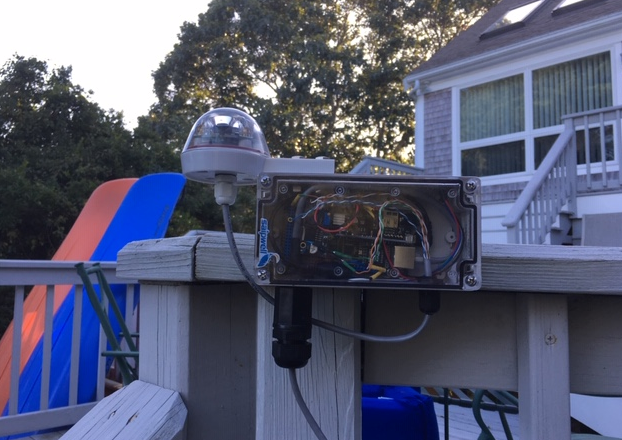
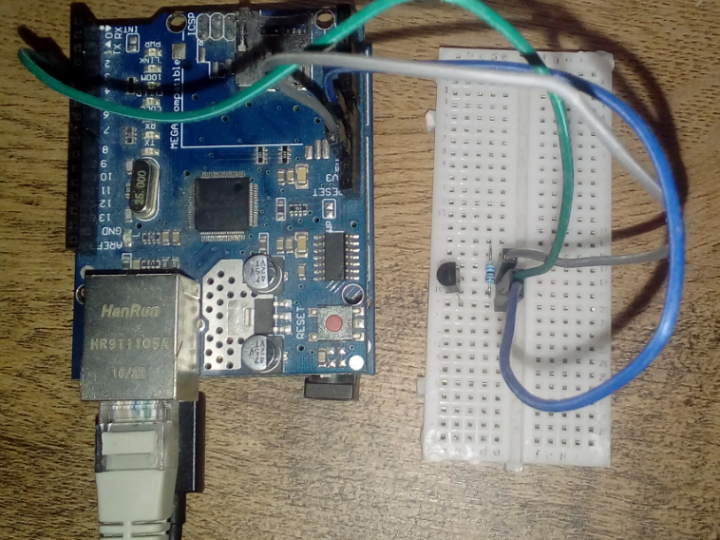
AM_WeatherBoxMega is an Astro Makers project from the AAVSO (American Association of Variable Star Observers). It is a low-cost weather monitoring box designed for observatories and telescope enclosures. The main purpose of this project is to answer one of the most important questions for a remote observatory:
“Is it safe to open the telescope cover or observatory roof right now?”
Astronomical equipment is highly sensitive to rain, moisture, clouds, and sudden weather changes. In particular, remote observatories are often operated without a person on site, so unexpected rain or cloud cover can damage expensive telescopes, cameras, mounts, and other electronic equipment. AM_WeatherBoxMega helps prevent these risks by using a rain sensor and a sky temperature sensor to determine whether observing conditions are safe, then providing the status information through an Ethernet network.
This project is not just a simple Arduino Ethernet example. It is closer to a real Weather Safety System that can be used in an actual observatory environment. It considers sensor data collection, HTTP-based status reporting, PoE power delivery, and possible integration with observatory automation software.
Observatory Weather Safety System?
A weather safety system for an observatory is different from a general weather station.
A typical weather station collects many types of environmental data, such as temperature, humidity, wind speed, and barometric pressure. However, the most important role of an observatory safety system is to quickly determine whether the observatory can be opened safely, or whether the equipment must be protected.
AM_WeatherBoxMega simplifies the sensor configuration for this specific purpose. According to the project README, the device uses two key onboard sensors: a rain detector and a sky/cloud monitor. These are the most important sensors for determining whether it is safe to open a telescope enclosure.
In other words, the project focuses on the following questions:
Is it raining?
Are there clouds in the sky?
Is it safe to open the observatory?
If it is not safe, should the observing equipment be protected?
Because of this structure, AM_WeatherBoxMega is more than a simple weather display device. It can be seen as a safety decision node for remote observatory operation.
Features
Rain Detection
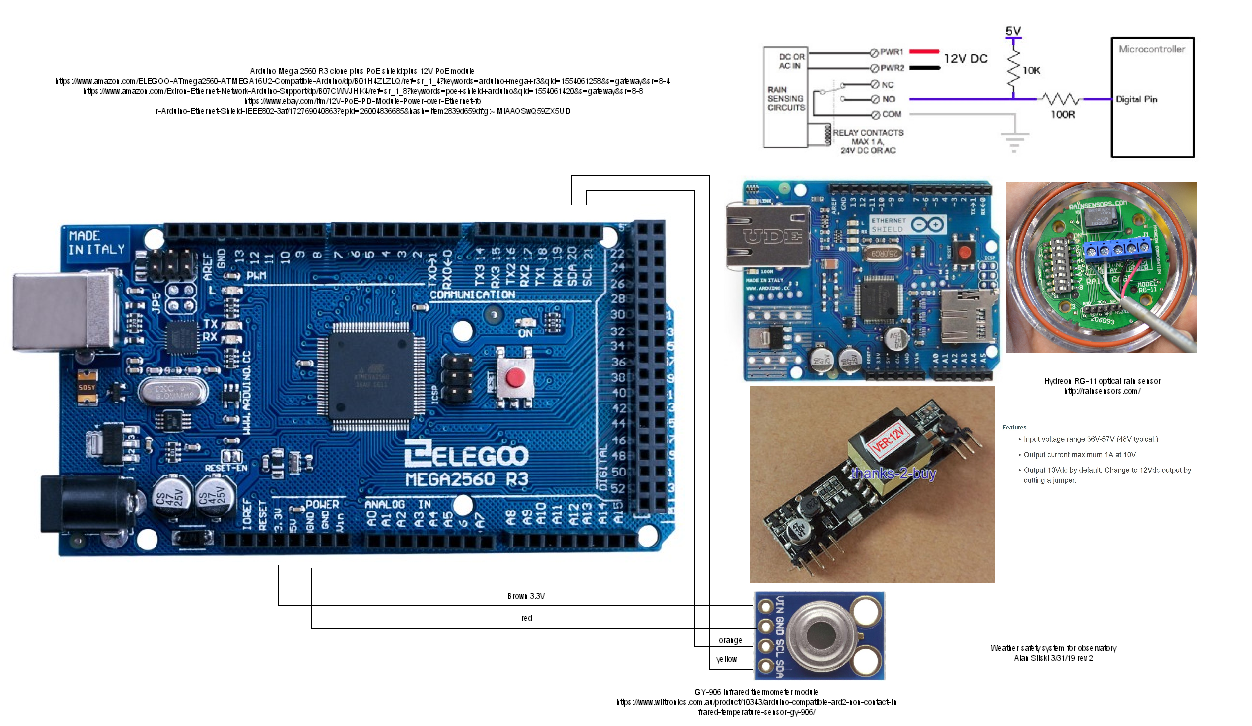
AM_WeatherBoxMega uses a Hydreon RG-11 Rain Gauge to detect rain. The code comments explain that the relay state of the RG-11 is read and provided through the HTTP server.
Rain detection is one of the most critical functions for a remote observatory. If rain begins during an observing session, telescopes, cameras, mounts, and electronic devices can be damaged very quickly. In this project, the relay output from the rain sensor is read by the Arduino Mega and included in the network response.
Sky / Cloud Monitoring
The project uses a Melexis MLX90614 IR Sensor to measure sky temperature. According to the code comments, clouds are measured as warmer than clear sky because they contain water. This temperature difference can be used to estimate whether clouds are present.
A clear night sky appears very cold from an infrared perspective. In contrast, a cloudy sky shows a relatively higher temperature because of moisture and particles in the clouds. By pointing the IR temperature sensor toward the sky, the system can determine whether the sky is clear or cloudy.
This method is especially useful for astronomical observation. Even if it is not raining, heavy cloud cover can make observation impossible. In that case, an automated observatory system may need to stop observing or switch to a standby state.
Ethernet + PoE Based Installation
AM_WeatherBoxMega uses an Ethernet-based network connection. The README explains a design that reduces the number of cables connected to the WeatherBox by using an Ethernet cable with PoE, allowing both data communication and power delivery through a single cable.
In an outdoor or remote observatory environment, installing separate power and communication cables can be inconvenient. With PoE, a single Ethernet cable can provide both network connectivity and power, making installation simpler and maintenance easier.
The project documentation mentions an Arduino Mega, Ethernet Shield, and PoE configuration. It also notes that the RobotDyn Arduino Mega + Ethernet + PoE integrated board can be easier to work with and cost-effective.
HTTP Server and JSON Output
AM_WeatherBoxMega provides the current sensor status through a built-in HTTP server. The code uses the Arduino Ethernet library, EthernetBonjour, the MLX90614 library, and a SimpleHttpServer wrapper.
Users can access the device through a web browser using its IP address or mDNS name. The device returns sensor data in JSON format. The code comments provide the following example output:
{"relay":1, "object":67.30, "ambient":69.03}
In this response, the relay value represents the rain sensor state, while the object and ambient values represent the sky-facing object temperature and ambient temperature measured by the MLX90614 sensor.
mDNS Support
This project uses EthernetBonjour so that the device can be found using the mDNS name rainsensor.local. This allows users to access the WeatherBox on the same network without needing to remember its IP address.
When multiple devices are operating in a remote observatory or local observatory network, mDNS support makes installation and maintenance more convenient.
System Architecture
The overall architecture of AM_WeatherBoxMega can be summarized as follows.
The Rain Sensor detects whether rain is present.
The MLX90614 IR Sensor measures the sky-facing object temperature and ambient temperature.
The Arduino Mega reads the sensor data and prepares the values needed to determine safety status.
The Ethernet Shield / W5500 Ethernet Controller provides wired network connectivity.
PoE allows power and data to be delivered through a single Ethernet cable.
The HTTP Server provides sensor data in JSON format.
An external PC, script, or observatory automation software can read the WeatherBox status and decide whether the observatory should remain open or be closed.
The project README explains that the monitor script is intended to access the WeatherBox, determine whether it is safe to open the observatory, and provide that information to ACP. It also mentions outputting a one-line report file in Boltwood format, which shows that the project was designed with observatory automation software integration in mind.
Market & Application Value
The value of AM_WeatherBoxMega goes beyond that of a simple DIY weather device.
1. Remote Observatory Safety
Remote observatories cannot always have a person on site. Therefore, a system that can automatically detect rain or clouds and help protect observing equipment is essential.
AM_WeatherBoxMega provides the key data needed to determine whether it is safe to open an observatory by using rain detection and sky-temperature-based cloud monitoring. It can be used in remote observatories, private observatories, school observatories, and small research observatories.
2. Low-Cost Open Source Weather Box
According to the README, this device was designed with a target parts cost of around $150. It is also released as an Arduino-based open source project, allowing users to build, modify, and expand it themselves.
Commercial weather safety systems for observatories can be expensive. AM_WeatherBoxMega improves accessibility by using relatively low-cost components and an open source structure.
3. Ethernet-Based Outdoor IoT Node
This project demonstrates how a WIZnet Ethernet controller can be used in an outdoor IoT device.
Many general IoT examples simply publish a temperature value to MQTT or display sensor data on a webpage. In contrast, AM_WeatherBoxMega has a clear real-world purpose: protecting observatory equipment and supporting observatory automation through Ethernet connectivity.
From WIZnet’s perspective, this project delivers several important messages:
WIZnet Ethernet is not only for basic examples, but also suitable for outdoor devices requiring long-term operation.
When used with PoE, it can simplify the installation of monitoring and sensing nodes.
A sensor data collection device can be expanded into an HTTP-based safety decision system.
It can be applied to scientific observation, remote facility management, and outdoor IoT safety systems.
4. Beyond Astronomy
Although AM_WeatherBoxMega was designed for observatories, its structure can also be applied to other fields.
Possible applications include:
Remote weather stations
Mountain facility monitoring
Greenhouse or outdoor agricultural equipment protection
Solar power plant weather monitoring
Outdoor camera or sensor equipment protection
Outdoor research or school experiment equipment protection
The key concept is simple: detect rain and sky conditions, then send the safety status over the network. This structure can be used not only for observatories, but also for many types of outdoor equipment protection systems.
Why This Is Not a Basic Ethernet Example
AM_WeatherBoxMega is different from a basic Arduino Ethernet Web Server example.
Basic examples usually stop at functions such as:
IP address assignment
Running a simple web server
Displaying one sensor value
Ping testing
DHCP verification
However, AM_WeatherBoxMega is a purpose-built device designed to solve a real problem.
This project includes:
Rain detection sensor
Sky-temperature-based cloud detection
Observatory safety decision support
Ethernet-based HTTP JSON output
Single-cable PoE installation
mDNS-based network access
Possible integration with observatory automation software
BOM and documentation
A structure designed for real outdoor installation
Therefore, this project should not be seen as “an Ethernet example that displays sensor values.” It is better understood as a practical Weather Safety System designed to protect observatory equipment.
External Indicators
AM_WeatherBoxMega is published on the GitHub organization of AAVSO, and the repository description clearly states that it is an “Astro Makers project to make a weather monitor box for an observatory.”
The project includes not only Arduino code, but also a Documentation folder, a weather box spreadsheet containing the BOM and drawings, wiring notes, and monitor script-related descriptions. This shows that it is closer to an open source hardware project intended for real construction, rather than a simple code sample.
The code also includes practical components such as the Hydreon RG-11 Rain Gauge, Melexis MLX90614 IR Sensor, Arduino Ethernet Library, EthernetBonjour, and SimpleHttpServer.
Summary
AM_WeatherBoxMega is an Arduino Mega and Ethernet-based weather monitoring box for observatories. It uses a rain sensor and an infrared sky temperature sensor to determine whether it is safe to open an observatory, then provides the current status through an Ethernet HTTP server in JSON format.
The WIZnet Ethernet controller acts as the core communication interface between the sensing device and the observatory network. In particular, when combined with PoE, a single Ethernet cable can provide both data and power, making it suitable for outdoor remote observatory installation.
From WIZnet’s perspective, this project is a meaningful example showing that W5x00 series Ethernet chips can be used beyond simple networking examples. They can support scientific observation equipment protection, remote facility monitoring, and outdoor IoT safety systems.