


DeskPi Super4C Raspberry Pi CM5 Cluster Mini-ITX Board
DeskPi Super4C: Mini-ITX cluster board for 4x RPi CM5. Features 2.5G/1G/W5500 Ethernet, 4x M.2 NVMe slots & ESP32 management. Ideal for servers & dev projects.


Espressif - ESP32-WROOM-32E
x 1

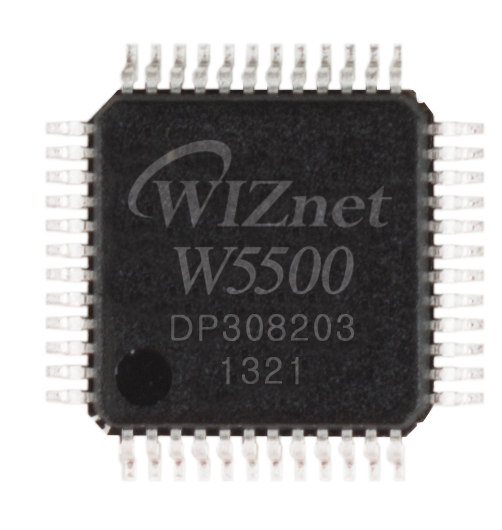
WIZnet - W5500
x 1
1. Introduction
1.1 Background: Limitations of Single Board Computer (SBC) Clustering
Traditional Raspberry Pi-based cluster construction relied on "stacked cases," which entailed physical limitations such as a proliferation of independent power adapters, complex cabling, and inefficient space utilization. In particular, in industrial sites or enterprise environments, the inability to control the power of individual nodes (Power Cycling) meant that physical access was essential in the event of a system downtime, which was a fatal operational capability flaw.
1.2 Solution Overview
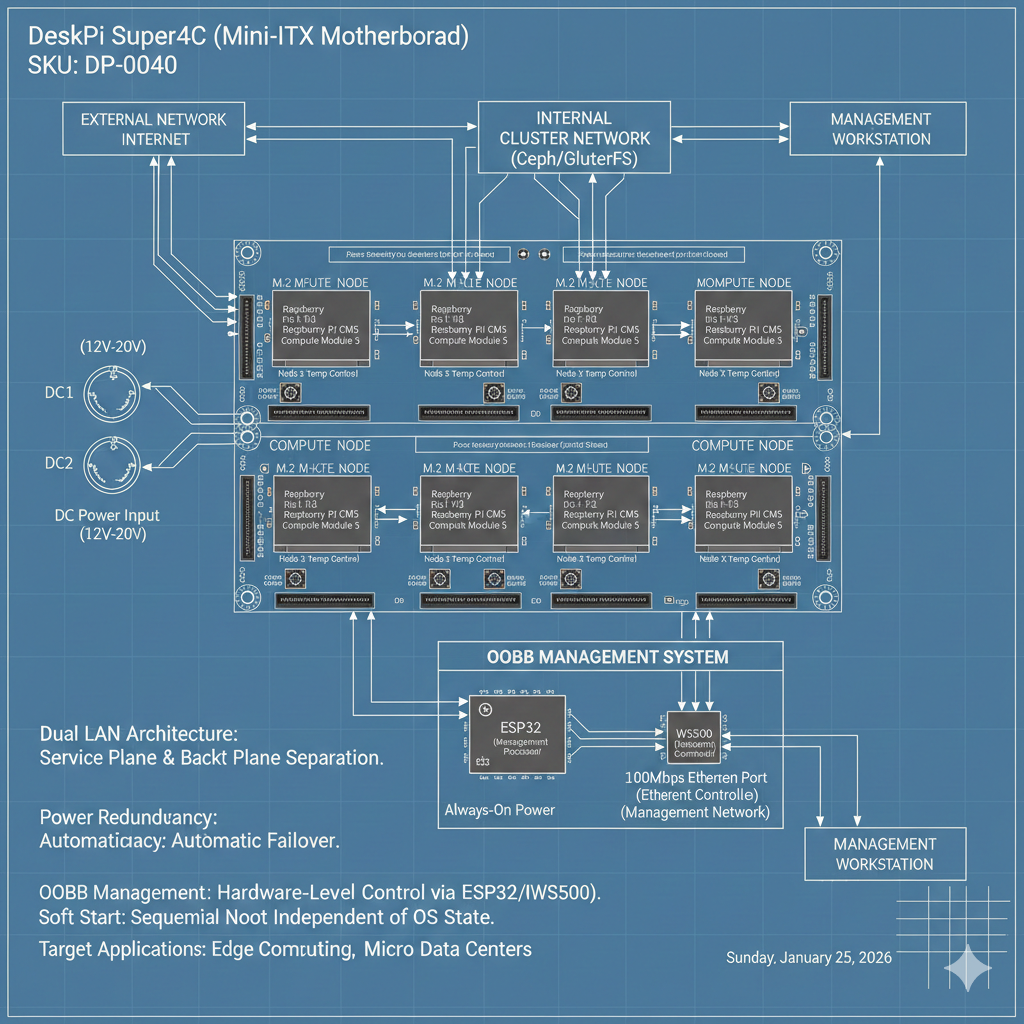
DeskPi Super4C (SKU: DP-0040) is a high-performance cluster board that integrates four Raspberry Pi CM5 (Compute Module 5) units within a standard Mini-ITX form factor. Beyond simple I/O expansion, it aims to provide data center-level operational stability by introducing power redundancy, bandwidth separation (Dual LAN), and OOB (Out-of-Band) management technology.
2. System Architecture and Hardware Specifications
2.1 Compute Node Configuration
This system provides four independent CM5 slots, and each node is allocated physically isolated resources to perform high-performance computing without mutual interference.
Compatibility: Raspberry Pi CM5 dedicated (utilizes PCIe Gen2 x1 interface).
Storage: Provides one M.2 M-Key (NVMe) slot per node, allowing for high-speed SSD installation (SATA not supported).
Cooling Control: Individual temperature management is possible through independent PWM fan headers for each node.
2.2 Network Topology: Dual LAN Architecture
Each CM5 node features two physically separated Ethernet interfaces, allowing for the complete separation of the Service Network (Data Plane) and the Internal Communication Network (Backplane).
1Gbps Ethernet: CM5 native interface. Suitable for external services and internet connectivity.
2.5Gbps Ethernet: Expanded interface utilizing USB 3.0 bandwidth. Used for node-to-node data synchronization (Ceph/GlusterFS) and high-speed internal communication to minimize bottlenecks.
2.3 Power System: Maximizing Availability (Power Redundancy)
Wide Input: Supports DC 12V ~ 20V input, compatible with industrial standard voltages (12V, 19V).
Power Redundancy: Provides two DC input ports (DC1, DC2). In the event of a failure, it automatically switches to the source with the higher voltage to prevent system interruption.
Sequential Boot (Soft Start): When power is applied, the four nodes boot sequentially at 0.5-second intervals to prevent power supply overload caused by Inrush Current.
3. Key Technology Analysis: OOB (Out-of-Band) Management System
The decisive reason why this product can be classified as "Enterprise Server Equipment" rather than a simple development board lies in its unique management architecture combining ESP32 and W5500. The technical justification for equipping a separate low-speed management chipset, despite the existence of Gigabit LAN ports for each node, is as follows.
3.1 Problem Statement: The Fatal Limitation of In-Band Management
In a general environment, the system is managed by accessing via SSH through the 1G/2.5G LAN ports mounted on the CM5. However, this method has a dependency on the OS (Linux Kernel).
Scenario: A situation occurs where the OS does not respond due to a Kernel Panic, network configuration error, or CPU overload.
Result: When the CM5's CPU stops, the 1G/2.5G LAN ports also stop working. Remote access becomes impossible, and a "Management Gap" occurs where the administrator must visit the site to physically unplug the power cord. This is a fatal disaster for remote server operations.
3.2 Technical Solution: Hardware-Level Control Based on ESP32 + W5500
Super4C solves this problem by mounting a separate management processor (ESP32) and an independent network interface (W5500) that are completely separated from the main computing module (CM5).
Independence: The ESP32 and W5500 maintain an "Always-On" state regardless of the status of the CM5. The management system remains alive even if the CM5 is down or powered off.
Hardware Reset Authority (Hard Reset): Administrators can access the web interface of the ESP32 via the W5500 to physically control the PMIC_EN (Power Enable Pin) signal of a specific CM5 node. This implements the same effect remotely as manually pressing the power button in a server room to force a reboot.
Reliability of Wired Connection: By adopting the W5500 Ethernet controller instead of the ESP32's built-in Wi-Fi, it guarantees 99.999% connection stability even in radio-shielded environments (Faraday Cage) inside metal racks or under wireless interference conditions.
4. Conclusion
DeskPi Super4C is a platform that elevates the computing power of the Raspberry Pi CM5 to an industrial level. In particular, the OOB management system through the ESP32 and W5500 combination provides a "Last Resort" to recover the system even in the event of an OS failure, making it an optimized solution for building edge computing and micro data centers where uninterrupted operation is essential.
1. 서론 (Introduction)
1.1 배경: 싱글 보드 컴퓨터(SBC) 클러스터링의 한계
기존의 라즈베리 파이 기반 클러스터 구축은 독립된 전원 어댑터의 난립, 복잡한 배선, 비효율적인 공간 활용이라는 물리적 제약을 수반했습니다. 특히 산업 현장이나 엔터프라이즈 환경에서는 개별 노드의 전원 제어(Power Cycling)가 불가능하여, 시스템 다운 시 관리자가 물리적으로 접근해야만 하는 치명적인 운영상의 한계가 존재했습니다.
1.2 솔루션 개요
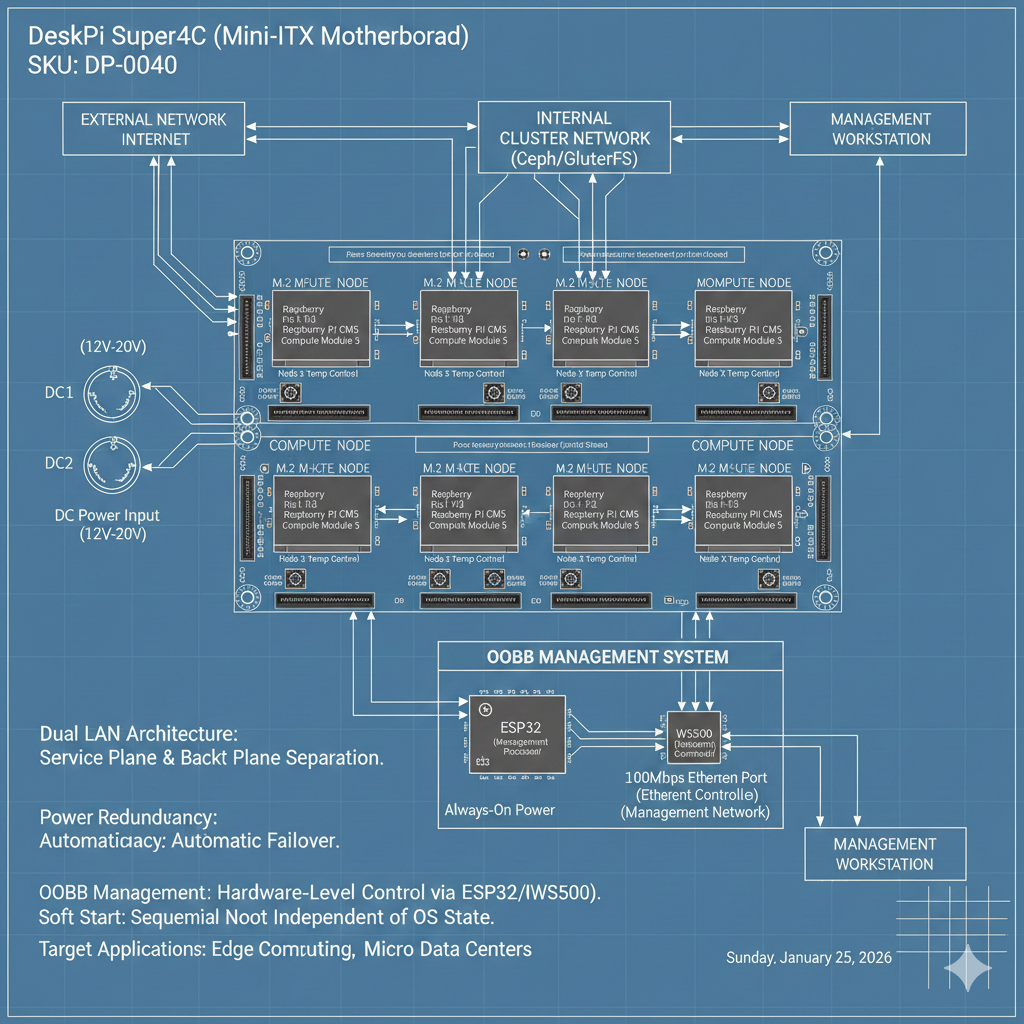
**DeskPi Super4C (SKU: DP-0040)**는 표준 Mini-ITX 폼팩터 내에 4개의 **Raspberry Pi CM5 (Compute Module 5)**를 집적한 고성능 클러스터 보드입니다. 단순한 I/O 확장을 넘어, 전원 이중화(Redundancy), 대역폭 분리(Dual LAN), 그리고 OOB(Out-of-Band) 관리 기술을 도입하여 데이터 센터 수준의 운영 안정성을 제공하는 것을 목표로 합니다.
2. 시스템 아키텍처 및 하드웨어 사양
2.1 컴퓨팅 노드 구성 (Compute Nodes)
본 시스템은 4개의 독립적인 CM5 슬롯을 제공하며, 각 노드는 물리적으로 격리된 자원을 할당받아 상호 간섭 없는 고성능 컴퓨팅을 수행합니다.
호환성: Raspberry Pi CM5 전용 (PCIe Gen2 x1 인터페이스 활용).
스토리지: 노드당 1개의 M.2 M-Key (NVMe) 슬롯을 제공하여 고속 SSD 장착 가능 (SATA 미지원).
쿨링 제어: 각 노드별 독립적인 PWM 팬 헤더를 통해 개별 온도 관리가 가능합니다.
2.2 네트워크 토폴로지: 듀얼 LAN (Dual LAN Architecture)
각 CM5 노드는 물리적으로 분리된 두 개의 이더넷 인터페이스를 갖추어, **서비스 망(Data Plane)**과 **내부 통신 망(Backplane)**의 완전한 분리가 가능합니다.
1Gbps Ethernet: CM5 네이티브 인터페이스. 외부 서비스 및 인터넷 연결용.
2.5Gbps Ethernet: USB 3.0 대역폭을 활용한 확장 인터페이스. 노드 간 데이터 동기화(Ceph/GlusterFS) 및 고속 내부 통신용으로 활용하여 병목 현상을 최소화합니다.
2.3 전원 시스템: 가용성 극대화 (Power Redundancy)
광대역 입력: DC 12V ~ 20V 입력을 지원하여 산업용 표준 전압(12V, 19V)과 호환됩니다.
전원 이중화: 두 개의 DC 입력 포트(DC1, DC2)를 제공하며, 장애 발생 시 전압이 높은 소스로 자동 절체되어 시스템 중단을 방지합니다.
순차 부팅 (Soft Start): 전원 인가 시 4개 노드가 0.5초 간격으로 순차 부팅되어 돌입 전류(Inrush Current)로 인한 파워 서플라이 과부하를 방지합니다.
3. 핵심 기술 분석: OOB 관리 시스템 (Out-of-Band Management)
본 제품이 단순한 개발 보드가 아닌 **'엔터프라이즈 서버 장비'**로 분류될 수 있는 결정적인 이유는 ESP32와 W5500을 결합한 독자적인 관리 아키텍처에 있습니다. 이미 노드마다 기가비트 랜포트가 존재함에도 불구하고, 별도의 저속 관리 칩셋을 탑재한 기술적 타당성은 다음과 같습니다.
3.1 문제 제기: 인-밴드(In-Band) 관리의 치명적 한계
일반적인 환경에서는 CM5에 탑재된 1G/2.5G 랜포트를 통해 SSH로 접속하여 시스템을 관리합니다. 그러나 이 방식은 OS(Linux Kernel)에 대한 의존성을 가집니다.
시나리오: 커널 패닉(Kernel Panic), 네트워크 설정 오류, 혹은 CPU 과부하로 인해 OS가 응답하지 않는 상황 발생.
결과: CM5의 CPU가 멈추면 1G/2.5G 랜포트도 작동을 멈춥니다. 원격 접속이 불가능해지며, 관리자가 현장에 방문하여 전원 코드를 직접 뽑아야 하는 **'관리 공백(Management Gap)'**이 발생합니다. 이는 원격지 서버 운영에 있어 치명적인 재앙입니다.
3.2 기술적 해결책: ESP32 + W5500 기반의 하드웨어 레벨 제어
Super4C는 메인 컴퓨팅 모듈(CM5)과 완전히 분리된 별도의 관리 프로세서(ESP32)와 독립 네트워크 인터페이스(W5500)를 탑재하여 이 문제를 해결했습니다.
독립성 (Independence): ESP32와 W5500은 CM5의 상태와 무관하게 상시 전원(Always-On) 상태를 유지합니다. CM5가 다운되거나 전원이 꺼져 있어도 관리 시스템은 살아있습니다.
하드웨어 리셋 권한 (Hard Reset): 관리자는 W5500을 통해 ESP32의 웹 인터페이스에 접속하여, 특정 CM5 노드의 PMIC_EN (전원 활성화 핀) 신호를 물리적으로 제어할 수 있습니다. 이는 마치 서버실에서 손으로 전원 버튼을 눌러 강제로 재부팅하는 것과 동일한 효과를 원격지에서 구현합니다.
유선 연결의 신뢰성: ESP32의 내장 Wi-Fi 대신 W5500 이더넷 컨트롤러를 채택함으로써, 금속 랙(Metal Rack) 내부의 전파 차폐 환경(Faraday Cage)이나 무선 간섭 상황에서도 99.999%의 접속 안정성을 보장합니다.
4. 결론 (Conclusion)
DeskPi Super4C는 라즈베리 파이 CM5의 컴퓨팅 파워를 산업용 수준으로 끌어올린 플랫폼입니다. 특히 ESP32와 W5500 조합을 통한 OOB 관리 시스템은 OS 장애 시에도 시스템을 복구할 수 있는 **'마지막 비상 통로(Last Resort)'**를 제공함으로써, 무중단 운영이 필수적인 엣지 컴퓨팅 및 마이크로 데이터 센터 구축에 최적화된 솔루션입니다.