



ESP32-S3-VPinball-LED-Software
An high-performance, cost-effective, and native drop-in replacement for the legendary Teensy 3.2 and Teensy 4.1 controllers in Virtual Pinball (vPin) cabi
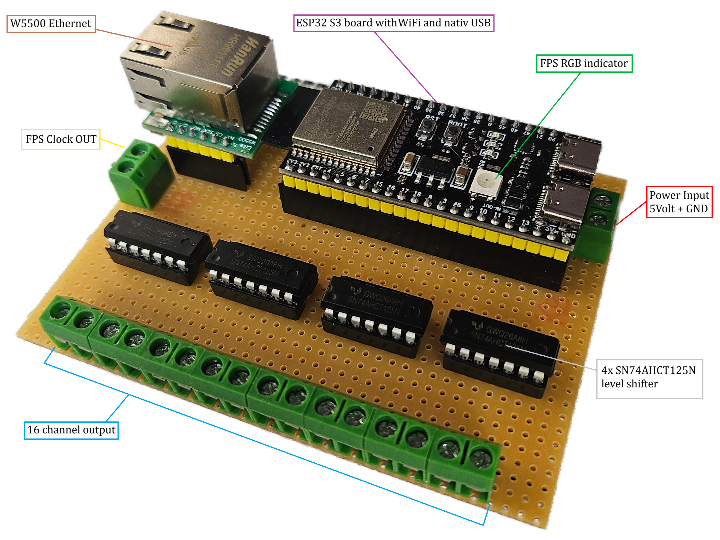
ESP32-S3 Ultimate VPin LED Controller — When a Pinball Cabinet Demands Deterministic 129 FPS, W5500 Ethernet Wins
#W5500 #UDP #Ethernet #ESP32-S3 #VirtualPinball #AddressableLED #WS2812 #ParallelDMA #RealTime #DropInReplacement
📚 Context: Open-source hobbyist / enthusiast hardware framework (MIT-licensed) for the Virtual Pinball (VPin) community. Implementation verified: working hardware prototype, real-world benchmark tables across three transport layers, on-board FPS status LED, and a frame-sync output pin for oscilloscope measurement.
01 — What is this project?
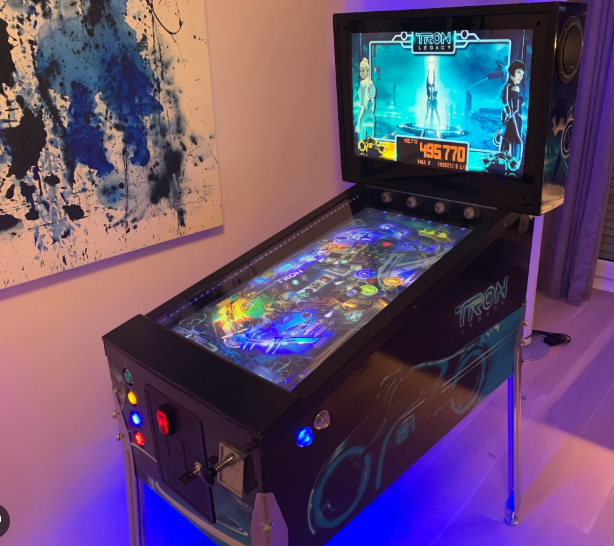
📚 Background — What is Virtual Pinball, and why does it need lighting?
A real pinball machine is the classic arcade cabinet: a steel ball rolls across a slanted playfield, flippers knock it around, and bumpers, lights, and sounds erupt as you score. But real machines are expensive, heavy, and locked to a single table.
Virtual Pinball (VPin) recreates that on a PC — software like Visual Pinball simulates the ball physics, scoring, and artwork entirely on screen, so one machine can run thousands of tables. Enthusiasts often house that PC and its monitors inside a wooden cabinet shaped exactly like a real pinball machine, so it looks like the real thing while everything plays out on a display.
Here's the catch: while the game lights up on screen, the physical cabinet around it stays dark and flat. To recover the "alive" feel of a real machine, builders line the cabinet — playfield edges, speaker rings, backboard, undercab — with addressable LEDs (individually controllable RGB LEDs like WS2812) and sync them to in-game events: a jackpot on screen flashes the whole cabinet gold.
So lighting is not built into VPin; it's an add-on for immersion. This project builds the controller that drives those LEDs — and because a full cabinet has thousands of them, getting the per-frame pixel data from the PC to the controller fast enough is exactly where Ethernet enters the story.
Virtual Pinball cabinets recreate the feel of a real arcade machine on a PC, and a big part of that feel is lighting: hundreds — sometimes thousands — of addressable RGB LEDs flooding the playfield, backglass, speaker rings, and undercab in perfect sync with the game running on the PC. For years the de-facto controller for driving those LEDs has been the Teensy 3.2 / 4.1, paired with the DirectOutput Framework (DOF) on the PC side.
The Teensy approach has two structural problems. First, it is increasingly expensive and supply-constrained. Second — and more importantly — it pushes the entire LED data stream over USB serial, which becomes a hard bottleneck the moment the LED count climbs. Once a cabinet has a few thousand LEDs, USB simply cannot deliver frames fast enough, and the lighting starts to stutter and drop frames exactly when the on-screen action is most intense.
This project is a complete, drop-in replacement for the Teensy controller built around the ESP32-S3. It uses the ESP32-S3's parallel DMA hardware to write up to 16 LED channels absolutely simultaneously in a single hardware clock cycle, eliminating the daisy-chain latency of serial LED updates. But the headline contribution is the transport layer: the framework offers three interchangeable ways to get pixel data from the PC to the controller, and benchmarks each one honestly — and the clear winner for a serious cabinet is Ethernet over a WIZnet W5500.
The final result is a single all-in-one Arduino package that turns a ~$10 ESP32-S3 plus a cheap W5500 module into a controller that out-performs the legendary Teensy by a wide margin.
02 — Why a dedicated network transport (and not just USB)?
The response time of a pinball cabinet is directly bound by how fast pixel data reaches the microcontroller from the PC. This project doesn't just claim that — it measures it. The same 16-channel firmware was tested across all three transports under identical load:
🔷 USB is the bottleneck, not the LEDs
In the real-world asymmetrical cabinet test (2,472 LEDs across 12 channels), native USB delivered only ~28 FPS and fluctuated heavily. The LEDs and the DMA engine can go far faster; the USB CDC serial pipe is what caps the framerate.
🔷 WiFi helps, but inherits the air
Switching the same firmware to WiFi UDP raised it to ~80 FPS, stable, with minimal drops even under interference. A huge improvement over USB — but wireless still carries the inherent risk of jitter and contention in a busy RF environment, which is exactly what you don't want during fast gameplay.
🔷 Ethernet is the premier class
Moving to a wired W5500 Ethernet link pushed the same setup to ~129 FPS, described as rock-solid with no micro-stuttering. That is roughly 4.6× the framerate of USB and a clean ~60% jump over WiFi, with the added benefit of a fully deterministic, interference-free physical link.
The architecture stress tests (symmetrical matrices) tell the same story: at 16×500 = 8,000 LEDs, USB collapses to ~9 FPS while W5500 Ethernet holds ~38 FPS.
The conclusion the project reaches is unambiguous: for an uncompromising high-end cabinet, the network stack is the deciding factor, and a hardware-offloaded wired link is the only one that stays deterministic under heavy load.
03 — System architecture
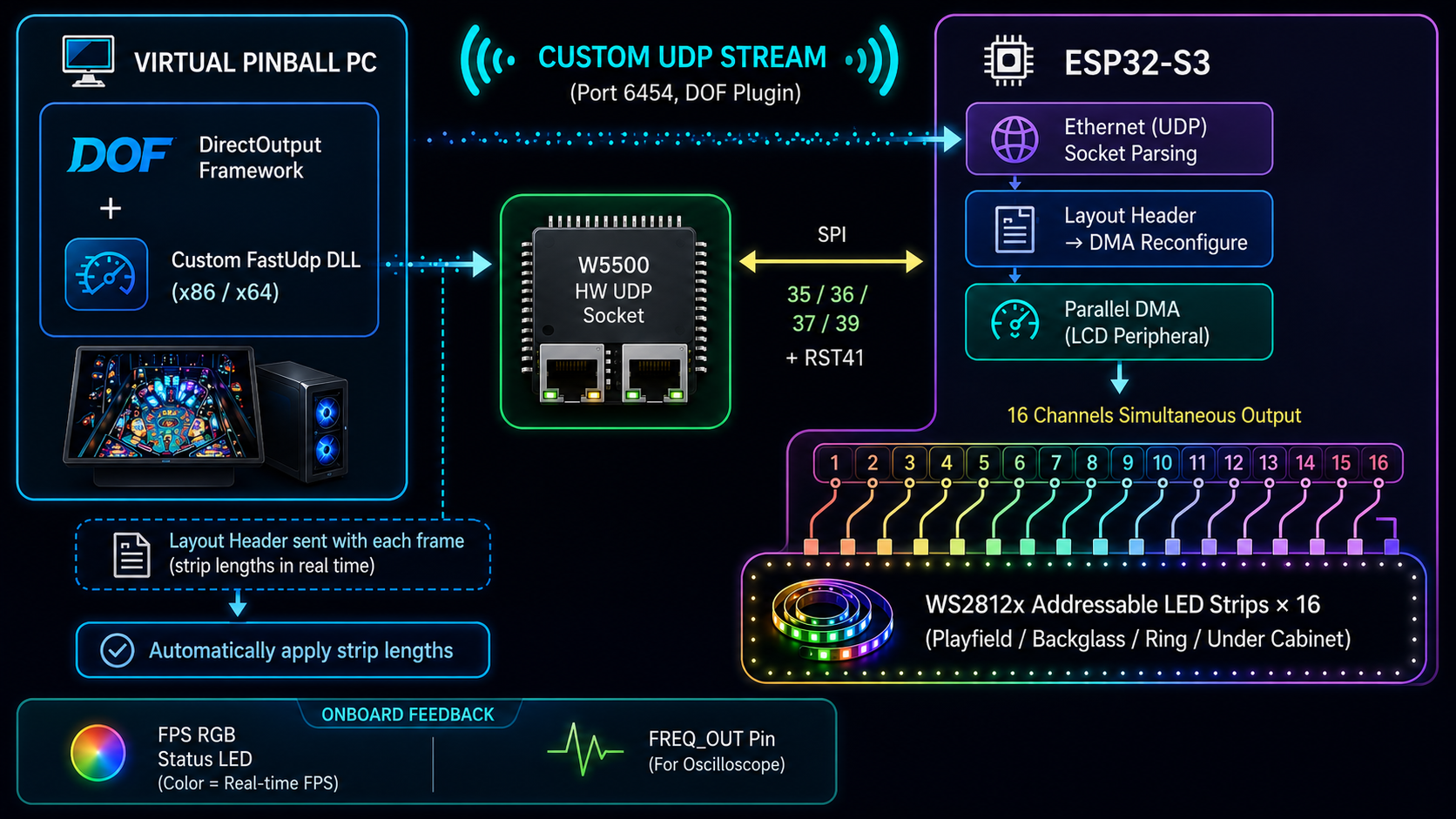
Per-frame UDP packets carry a 3-byte chunk header (frameId, chunkIndex, chunkTotal) so large frames are reassembled reliably, followed by a layout header that the firmware uses to dynamically reallocate DMA memory on the fly whenever the cabinet's LED layout changes — no recompilation, no hardcoded strip lengths.
04 — Why W5500? ⭐
🔷 The technical core
The ESP32-S3 has no native Ethernet MAC+PHY. To get a wired link, the project bolts on a WIZnet W5500 over SPI (MOSI 35 / SCK 36 / MISO 37 / CS 39, with a manual RST cold-start on pin 41 to avoid boot crashes). The W5500 carries its own hardwired TCP/IP stack on-chip, so the ESP32-S3's cores are freed almost entirely from networking work and can spend their cycles where it matters: feeding 16 parallel DMA channels at 100+ FPS.
🔷 The mode used — hardware UDP socket (SnMR::UDP, 0x02)
This is the defining technical choice of the project. The firmware opens a W5500 UDP socket (EthernetUDP udp; udp.begin(6454);) and the main loop is built entirely around udp.parsePacket() / udp.read(). UDP — not TCP — is the correct mode here: a real-time LED stream wants the lowest possible latency and has no use for TCP's retransmission and ordering overhead. A dropped frame in a 129 FPS lighting stream is invisible; a stalled frame from TCP head-of-line blocking is not. The W5500's hardware UDP socket handles the framing and checksumming in silicon, so the ESP32 just reads the payload straight out of the chip. (Port 6454 is the well-known Art-Net/DOF port; the payload itself is a custom DOF chunk format, not Art-Net proper.)
🔷 Advantage over the alternatives
- vs. USB CDC: removes the serial bottleneck entirely (~28 → ~129 FPS in the real-world test).
- vs. ESP32 WiFi UDP: same UDP semantics, but on a deterministic wired medium with no RF jitter (~80 → ~129 FPS, and "rock-solid" instead of "stable with minimal drops").
- vs. a software TCP/IP stack on the ESP32: offloading the stack to the W5500 keeps the application cores free for DMA rendering — the whole reason the high framerates are sustainable.
🔷 Verified evidence ✅
- Published benchmark tables with measured FPS for USB / WiFi / W5500 across multiple LED counts (both stress-test and real-world cabinet configurations).
- A hardware prototype photo in the repo.
- An on-board FPS RGB status LED giving live color-coded framerate feedback (white = 120+ FPS down to red = <20 FPS).
- A dedicated frequency-output pin that toggles on every rendered frame, so the latency and refresh rate can be physically verified with an oscilloscope or multimeter.
05 — Key components
🌐 WIZnet W5500 — Ethernet via hardware UDP socket mode (SnMR::UDP = 0x02)
External SPI Ethernet controller providing the wired, deterministic data path. Drives the real-time pixel stream that lets the cabinet hit ~129 FPS rock-solid. The repo ships a custom-patched Arduino Ethernet library (VPinEthernet) tuned for RAM stability and reduced overhead so it can sustain 100+ FPS UDP streams.
🧠 ESP32-S3
The host MCU. Uses its parallel LCD-peripheral DMA to drive 16 WS2812x channels simultaneously. Strictly requires ESP32 Arduino Core 2.0.17 (the 3.x cores break the DMA timer behavior this framework depends on).
💡 WS2812x addressable LED strips (×16)
Up to 16 parallel channels — playfield, addressable backglass matrix, speaker rings, backboard, undercab. Strip lengths are auto-detected from the DOF layout header, never hardcoded.
🖥️ Custom DOF network plugin (C# DLL, x86 + x64)
A modified DirectOutput FastUdpController on the PC side that emits the UDP layout-headered frame stream. Provided pre-built in the package (pending an upstream pull request).
📦 All-in-one packaging
Bundles custom-modified NeoPixelBus and Ethernet libraries inside the repo so there are no version-mismatch surprises — extract to the Arduino libraries folder and flash.
06 — Application scenarios
01. High-end virtual pinball cabinets
The primary target: a serious VPin build with 2,000–8,000 addressable LEDs that needs jitter-free, high-FPS lighting locked to on-screen gameplay. W5500 Ethernet is the recommended transport for exactly this class of build.
02. Large-scale real-time LED installations
Any installation that streams pixel data from a PC to a microcontroller in real time — stage lighting, kinetic art walls, interactive exhibits — faces the same USB-vs-network bottleneck. The benchmark methodology here transfers directly: hardware-offloaded W5500 UDP for deterministic throughput.
03. Drop-in Teensy modernization
Operators with existing Teensy-based DOF cabinets can swap to a cheaper, faster ESP32-S3 + W5500 stack without changing their DOF workflow — only replacing the controller and the network DLL.
04. A reusable pattern for "ESP32 + external wired networking"
The W5500-over-SPI + hardware UDP socket approach is a clean, reusable recipe for any ESP32 project that needs deterministic wired networking instead of (or alongside) WiFi — industrial telemetry, robotics, machine vision triggers, and beyond.
Conclusion
A ~$10 ESP32-S3 plus a low-cost WIZnet W5500 doesn't just match the legendary Teensy pinball controller — it beats it ~4.6× on framerate, with the W5500's hardware UDP socket turning "stable" lighting into "rock-solid" lighting.
- ✅ Drop-in replacement for Teensy 3.2 / 4.1 in Virtual Pinball cabinets
- ✅ 16 addressable LED channels driven simultaneously via parallel DMA
- ✅ Three benchmarked transports — and W5500 Ethernet is the measured winner (~129 FPS real-world)
- ✅ W5500 hardware UDP socket mode chosen deliberately for lowest real-time latency
- ✅ Networking offloaded to the W5500 so the ESP32 cores stay free for rendering
- ✅ Auto-config: live LED layout read from the DOF stream, DMA reallocated on the fly
- ✅ Verified with real benchmark tables, a hardware prototype, an FPS status LED, and a scope-measurable frame pin
- ✅ Fully open source (MIT), all-in-one package with patched libraries included
This project is a textbook demonstration of why a wired WIZnet controller earns its place: when the requirement is deterministic, high-throughput, low-latency streaming under heavy load, the W5500's hardware UDP socket is the component that makes the numbers real.
Q&A
Q. Why UDP and not TCP for the W5500? A. The data is a continuous real-time LED stream where the newest frame always supersedes the last. TCP's retransmission and in-order delivery would add latency and head-of-line blocking for no benefit; an occasional dropped frame at 129 FPS is imperceptible. The W5500's hardware UDP socket (SnMR::UDP) gives the lowest-latency path and offloads framing/checksums into silicon.
Q. Why an external W5500 instead of the ESP32's WiFi? A. WiFi already hit ~80 FPS in testing, but a wired W5500 link reached ~129 FPS and stayed "rock-solid" with no micro-stuttering. In a busy RF environment, wireless jitter is exactly the failure mode a pinball cabinet can't tolerate during fast gameplay.
Q. Doesn't the ESP32-S3 have its own Ethernet? A. Not a native MAC+PHY usable here, so the project adds the W5500 over SPI. A useful side effect: the W5500 runs the whole TCP/IP stack on-chip, freeing both ESP32 cores to push 16 DMA channels at 100+ FPS.
Q. Is this verified on real hardware? A. Yes — the repo includes a hardware prototype photo, FPS benchmark tables for all three transports, an on-board RGB status LED reporting live framerate, and a dedicated output pin that pulses every frame for oscilloscope-based latency measurement.
[한글 버전] ESP32-S3 Ultimate VPin LED Controller — 핀볼 캐비닛이 흔들림 없는 129 FPS를 요구할 때, 승자는 W5500 이더넷
#W5500 #UDP #Ethernet #ESP32-S3 #버추얼핀볼 #어드레서블LED #WS2812 #병렬DMA #실시간 #드롭인교체
📚 컨텍스트: 버추얼 핀볼(VPin) 커뮤니티를 위한 오픈소스 하드웨어 프레임워크 (MIT 라이선스, 취미/엔수지애스트용). 구현 검증: 동작하는 하드웨어 프로토타입, 세 가지 전송 계층에 대한 실측 벤치마크 표, 온보드 FPS 상태 LED, 오실로스코프 측정용 프레임 동기 출력 핀 보유.
01 — 이 프로젝트는 무엇인가?
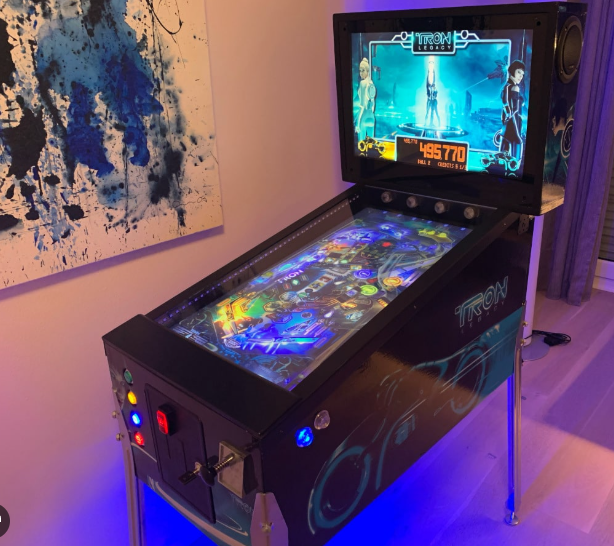
📚 배경 — 버추얼 핀볼이 뭐고, 왜 조명이 필요한가?
실물 핀볼은 오락실의 그 기계다. 비스듬한 플레이필드 위로 쇠구슬이 굴러다니고, 플리퍼로 공을 튕기고, 범퍼를 맞히면 점수와 함께 불빛·소리가 터진다. 다만 실물은 비싸고 무겁고 한 대에 게임이 하나뿐이다.
버추얼 핀볼(VPin) 은 이걸 PC로 재현한 것이다. Visual Pinball 같은 소프트웨어가 공의 물리·점수·아트워크를 전부 화면 안에서 시뮬레이션하므로, 한 대로 수천 종의 테이블을 돌릴 수 있다. 매니아들은 이 PC와 모니터를 진짜 핀볼처럼 생긴 나무 캐비닛에 넣어, 모든 게 화면에서 돌아가지만 겉모습은 실물 기계처럼 보이게 만든다.
문제는 여기 있다. 게임은 화면 안에서 번쩍이지만, 그걸 둘러싼 물리 캐비닛은 깜깜하고 밋밋하다. 실물의 "살아있는" 느낌을 살리려고, 빌더들은 캐비닛 — 플레이필드 테두리, 스피커 링, 백보드, 언더캡 — 에 어드레서블 LED(WS2812처럼 픽셀 단위로 개별 제어되는 RGB LED)를 두르고 게임 속 이벤트에 동기화한다. 화면에서 잭팟이 터지면 캐비닛 전체가 금빛으로 번쩍이는 식이다.
즉 조명은 VPin에 원래 들어있는 게 아니라, 몰입감을 위해 추가하는 요소다. 이 프로젝트는 바로 그 LED를 구동하는 컨트롤러를 만든 것이고 — 풀세팅 캐비닛엔 LED가 수천 개라서, PC에서 컨트롤러로 프레임별 픽셀 데이터를 충분히 빠르게 보내는 지점이 바로 이더넷이 등장하는 자리다.
버추얼 핀볼 캐비닛은 실제 아케이드 머신의 감각을 PC 위에서 재현하는데, 그 감각의 핵심 중 하나가 조명이다. 플레이필드, 백글래스, 스피커 링, 언더캡에 깔린 수백~수천 개의 어드레서블 RGB LED가 PC에서 돌아가는 게임과 완벽하게 동기화되어 번쩍여야 한다. 오랫동안 이 LED를 구동하는 사실상의 표준 컨트롤러는 PC 쪽 DirectOutput Framework(DOF)와 짝을 이룬 Teensy 3.2 / 4.1 보드였다.
Teensy 방식에는 구조적인 문제가 둘 있다. 첫째, 점점 비싸지고 수급도 불안정하다. 둘째이자 더 중요한 문제는, LED 데이터 스트림 전체를 USB 시리얼로 밀어 넣는다는 점이다. LED 개수가 늘어나는 순간 USB가 곧바로 병목이 된다. 캐비닛에 수천 개의 LED가 깔리면 USB는 프레임을 충분히 빠르게 전달하지 못하고, 결국 화면 액션이 가장 격렬할 때 조명이 끊기고 프레임이 떨어진다.
이 프로젝트는 ESP32-S3 기반으로 만든 Teensy 컨트롤러의 완전한 드롭인(drop-in) 교체품이다. ESP32-S3의 병렬 DMA 하드웨어를 사용해 최대 16개 LED 채널을 한 하드웨어 클록 사이클에 동시에 기록함으로써, 시리얼 방식 LED 갱신의 데이지체인 지연을 없앤다. 하지만 진짜 핵심 기여는 전송 계층에 있다. 이 프레임워크는 PC에서 컨트롤러로 픽셀 데이터를 보내는 세 가지 교체 가능한 방식을 제공하고 각각을 정직하게 벤치마크하는데 — 제대로 된 캐비닛을 위한 명백한 승자는 WIZnet W5500 기반 이더넷이다.
최종 결과물은, 약 1만 원짜리 ESP32-S3와 저렴한 W5500 모듈을 전설적인 Teensy를 큰 격차로 능가하는 컨트롤러로 바꿔주는 단일 올인원 Arduino 패키지다.
02 — 왜 (USB가 아니라) 전용 네트워크 전송이어야 하는가?
핀볼 캐비닛의 응답 속도는 PC에서 마이크로컨트롤러로 픽셀 데이터가 얼마나 빨리 도달하느냐에 직접 묶여 있다. 이 프로젝트는 그것을 주장만 하는 게 아니라 측정한다. 동일한 16채널 펌웨어를 같은 부하 조건에서 세 가지 전송 방식 모두로 테스트했다.
🔷 병목은 LED가 아니라 USB다
실제 비대칭 캐비닛 테스트(12채널, 2,472 LED)에서 네이티브 USB는 ~28 FPS밖에 못 냈고, 그마저 심하게 출렁였다. LED와 DMA 엔진은 훨씬 빠르게 갈 수 있다. 프레임을 가두는 건 USB CDC 시리얼 파이프다.
🔷 WiFi는 낫지만 공기의 한계를 물려받는다
같은 펌웨어를 WiFi UDP로 바꾸자 ~80 FPS까지, 안정적으로, 간섭 속에서도 드롭 거의 없이 올라갔다. USB 대비 엄청난 개선이다. 하지만 무선은 혼잡한 RF 환경에서 지터와 충돌의 본질적 위험을 그대로 안고 간다. 빠른 플레이 도중 가장 피하고 싶은 바로 그 상황이다.
🔷 이더넷이 최상위 클래스다
유선 W5500 이더넷 링크로 옮기자 같은 구성이 ~129 FPS까지 치솟았고, "마이크로 스터터링 없이 반석처럼 단단하다"고 기술됐다. 이는 USB 대비 약 4.6배의 프레임레이트이자 WiFi 대비 약 60% 향상이며, 게다가 간섭 없는 완전히 결정론적(deterministic) 물리 링크라는 이점까지 더해진다.
아키텍처 스트레스 테스트(대칭 매트릭스)도 같은 이야기를 한다. 16×500 = 8,000 LED 구간에서 USB는 ~9 FPS로 무너지지만 W5500 이더넷은 ~38 FPS를 지킨다.
프로젝트가 도달하는 결론은 분명하다. 타협 없는 하이엔드 캐비닛에서는 네트워크 스택이 결정적 변수이며, 무거운 부하에서도 결정론을 유지하는 유일한 선택지는 하드웨어 오프로드된 유선 링크다.
03 — 시스템 아키텍처
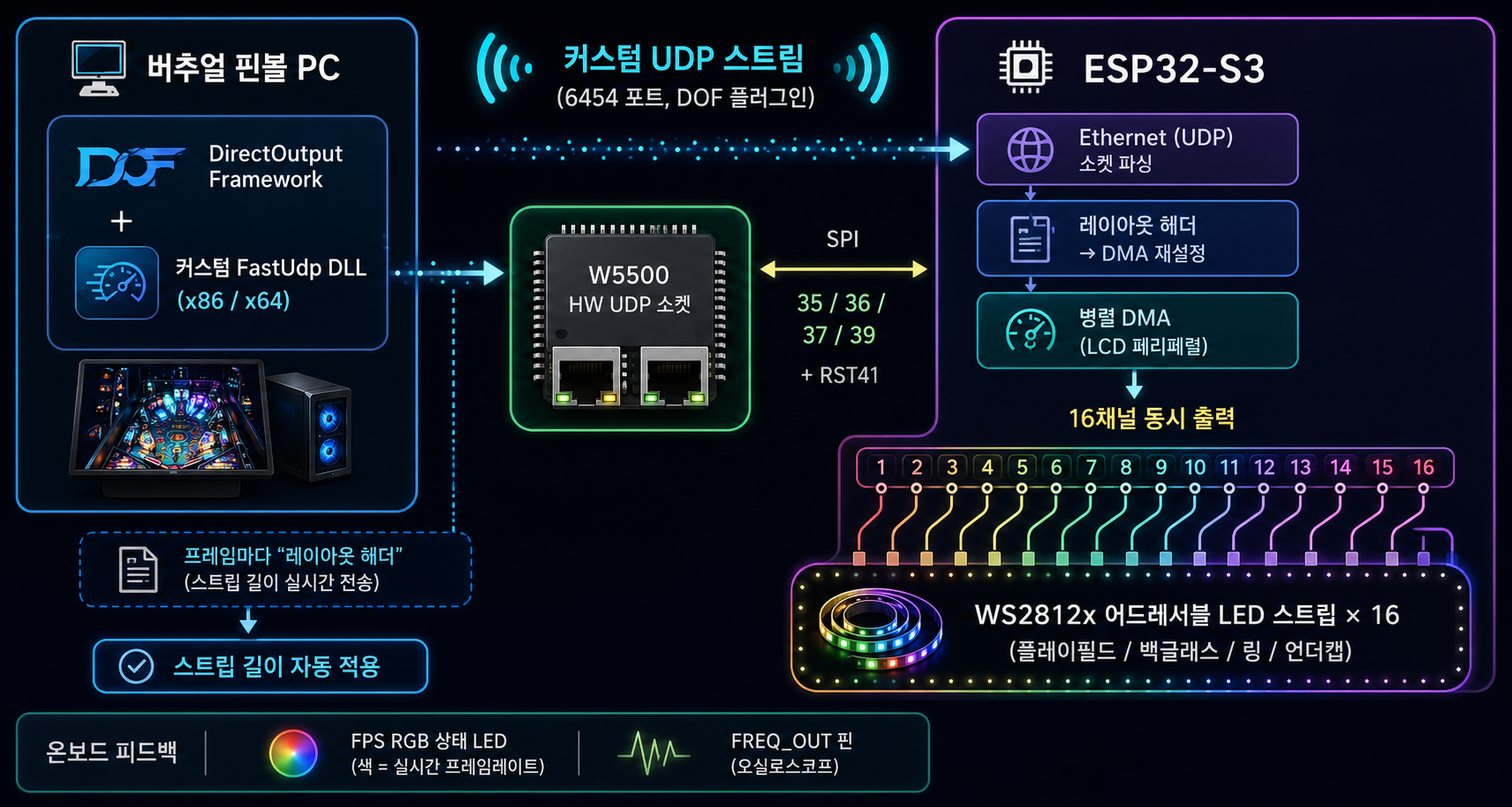
프레임별 UDP 패킷은 3바이트 청크 헤더(frameId, chunkIndex, chunkTotal)를 실어 큰 프레임을 안정적으로 재조립하고, 이어지는 레이아웃 헤더를 통해 캐비닛 LED 배치가 바뀔 때마다 펌웨어가 실시간으로 DMA 메모리를 재할당한다. 재컴파일도, 스트립 길이 하드코딩도 필요 없다.
04 — 왜 W5500인가? ⭐
🔷 기술적 핵심
ESP32-S3에는 쓸 만한 네이티브 이더넷 MAC+PHY가 없다. 유선 링크를 얻기 위해 프로젝트는 WIZnet W5500을 SPI로 붙인다(MOSI 35 / SCK 36 / MISO 37 / CS 39, 부팅 크래시 방지를 위한 RST 핀 41 수동 콜드 스타트). W5500은 자체 하드웨어 TCP/IP 스택을 칩 안에 품고 있어, ESP32-S3의 코어는 네트워킹 작업에서 거의 완전히 해방되어 정작 중요한 일 — 16개 병렬 DMA 채널을 100+ FPS로 먹이는 일 — 에 사이클을 쓸 수 있다.
🔷 사용 모드 — 하드웨어 UDP 소켓 (SnMR::UDP, 0x02)
이것이 이 프로젝트를 규정하는 기술적 선택이다. 펌웨어는 W5500 UDP 소켓을 연다(EthernetUDP udp; udp.begin(6454);). 메인 루프는 전부 udp.parsePacket() / udp.read() 위에 짜여 있다. 여기서는 TCP가 아니라 UDP가 정답이다. 실시간 LED 스트림은 가능한 가장 낮은 지연을 원하고, TCP의 재전송·순서보장 오버헤드는 쓸모가 없다. 129 FPS 조명 스트림에서 떨어진 한 프레임은 보이지 않지만, TCP의 head-of-line 블로킹으로 멈춘 프레임은 보인다. W5500의 하드웨어 UDP 소켓이 프레이밍과 체크섬을 실리콘에서 처리하므로, ESP32는 칩에서 페이로드를 곧장 읽어오기만 하면 된다. (6454 포트는 잘 알려진 Art-Net/DOF 포트이지만, 페이로드 자체는 Art-Net 정식 규격이 아니라 커스텀 DOF 청크 포맷이다.)
🔷 대체 솔루션 대비 우위
- USB CDC 대비: 시리얼 병목을 완전히 제거(실측 ~28 → ~129 FPS).
- ESP32 WiFi UDP 대비: 같은 UDP 의미론을, RF 지터 없는 결정론적 유선 매체 위에서(~80 → ~129 FPS, "안정적이고 드롭 거의 없음" → "반석처럼 단단함").
- ESP32 소프트웨어 TCP/IP 스택 대비: 스택을 W5500으로 오프로드하면 애플리케이션 코어가 DMA 렌더링에 전념할 수 있다 — 이것이 높은 프레임레이트가 유지되는 근본 이유다.
🔷 검증된 증거 ✅
- USB / WiFi / W5500을 여러 LED 개수(스트레스 테스트 + 실제 캐비닛 구성)에서 비교한 실측 FPS 벤치마크 표 공개.
- 리포에 포함된 하드웨어 프로토타입 사진.
- 실시간 프레임레이트를 색으로 피드백하는 온보드 FPS RGB 상태 LED(흰색 = 120+ FPS, 빨강 = <20 FPS).
- 매 렌더 프레임마다 토글되어, 오실로스코프나 멀티미터로 지연·갱신율을 물리적으로 검증할 수 있는 주파수 출력 핀.
05 — 핵심 구성요소
🌐 WIZnet W5500 — 하드웨어 UDP 소켓 모드(SnMR::UDP = 0x02) 의 이더넷
유선의 결정론적 데이터 경로를 제공하는 외장 SPI 이더넷 컨트롤러. 캐비닛이 ~129 FPS를 반석처럼 유지하게 해주는 실시간 픽셀 스트림을 구동한다. 리포에는 100+ FPS UDP 스트림을 견디도록 RAM 안정성과 오버헤드를 손본 커스텀 패치 Arduino Ethernet 라이브러리(VPinEthernet)가 동봉돼 있다.
🧠 ESP32-S3
호스트 MCU. 병렬 LCD 페리페럴 DMA로 16개 WS2812x 채널을 동시 구동한다. ESP32 Arduino Core 2.0.17을 엄격히 요구한다(3.x 코어는 이 프레임워크가 의존하는 DMA 타이머 동작을 깨뜨림).
💡 WS2812x 어드레서블 LED 스트립 (×16)
최대 16개 병렬 채널 — 플레이필드, 어드레서블 백글래스 매트릭스, 스피커 링, 백보드, 언더캡. 스트립 길이는 DOF 레이아웃 헤더에서 자동 감지되며 절대 하드코딩하지 않는다.
🖥️ 커스텀 DOF 네트워크 플러그인 (C# DLL, x86 + x64)
PC 쪽에서 UDP 레이아웃 헤더 프레임 스트림을 내보내는 수정된 DirectOutput FastUdpController. 패키지에 사전 빌드본으로 제공된다(업스트림 PR 대기 중).
📦 올인원 패키징
커스텀 수정된 NeoPixelBus와 Ethernet 라이브러리를 리포 안에 묶어 버전 불일치 사고를 없앴다 — Arduino 라이브러리 폴더에 풀고 플래시하면 끝.
06 — 응용 시나리오
01. 하이엔드 버추얼 핀볼 캐비닛
주 타깃. 화면 플레이에 잠긴, 지터 없는 고 FPS 조명이 필요한 2,000~8,000 어드레서블 LED 규모의 진지한 VPin 빌드. W5500 이더넷은 바로 이 클래스의 빌드에 권장되는 전송 방식이다.
02. 대규모 실시간 LED 설치물
PC에서 마이크로컨트롤러로 픽셀 데이터를 실시간 스트리밍하는 모든 설치물 — 무대 조명, 키네틱 아트 월, 인터랙티브 전시 — 은 동일한 USB-대-네트워크 병목에 부딪힌다. 여기의 벤치마크 방법론이 그대로 이전된다: 결정론적 처리량을 위한 하드웨어 오프로드 W5500 UDP.
03. 드롭인 Teensy 현대화
기존 Teensy 기반 DOF 캐비닛 운영자는 DOF 워크플로를 바꾸지 않고도 더 싸고 빠른 ESP32-S3 + W5500 스택으로 교체할 수 있다 — 컨트롤러와 네트워크 DLL만 바꾸면 된다.
04. "ESP32 + 외장 유선 네트워킹"의 재사용 가능한 패턴
W5500-over-SPI + 하드웨어 UDP 소켓 방식은, WiFi 대신(혹은 WiFi와 함께) 결정론적 유선 네트워킹이 필요한 모든 ESP32 프로젝트를 위한 깔끔하고 재사용 가능한 레시피다 — 산업 텔레메트리, 로보틱스, 머신비전 트리거 등.
결론
약 1만 원짜리 ESP32-S3와 저가 WIZnet W5500은 전설적인 Teensy 핀볼 컨트롤러와 동급에 그치지 않는다 — 프레임레이트에서 약 4.6배로 이긴다. W5500의 하드웨어 UDP 소켓이 "안정적인" 조명을 "반석 같은" 조명으로 바꿔준다.
- ✅ 버추얼 핀볼 캐비닛에서 Teensy 3.2 / 4.1의 드롭인 교체품
- ✅ 병렬 DMA로 16개 어드레서블 LED 채널 동시 구동
- ✅ 벤치마크된 세 가지 전송 방식 — 그리고 W5500 이더넷이 실측 승자(실제 환경 ~129 FPS)
- ✅ 최저 실시간 지연을 위해 의도적으로 선택한 W5500 하드웨어 UDP 소켓 모드
- ✅ 네트워킹을 W5500으로 오프로드해 ESP32 코어를 렌더링에 전념시킴
- ✅ 자동 설정: DOF 스트림에서 LED 배치를 실시간으로 읽어 DMA를 즉석 재할당
- ✅ 실측 벤치마크 표, 하드웨어 프로토타입, FPS 상태 LED, 오실로스코프 측정 가능한 프레임 핀으로 검증
- ✅ 완전 오픈소스(MIT), 패치 라이브러리 포함 올인원 패키지
이 프로젝트는 유선 WIZnet 컨트롤러가 제 값을 하는 이유를 보여주는 교과서적 사례다. 무거운 부하에서 결정론적이고 고처리량이며 저지연인 스트리밍이 요구사항일 때, 그 숫자를 현실로 만들어주는 부품은 바로 W5500의 하드웨어 UDP 소켓이다.
Q&A
Q. W5500에서 왜 TCP가 아니라 UDP인가? A. 데이터는 항상 최신 프레임이 직전 프레임을 대체하는 연속 실시간 LED 스트림이다. TCP의 재전송과 순서보장은 이득 없이 지연과 head-of-line 블로킹만 더한다. 129 FPS에서 가끔 떨어지는 한 프레임은 인지되지 않는다. W5500의 하드웨어 UDP 소켓(SnMR::UDP)이 최저 지연 경로를 주고 프레이밍·체크섬을 실리콘으로 오프로드한다.
Q. 왜 ESP32 WiFi 대신 외장 W5500인가? A. WiFi도 테스트에서 ~80 FPS는 냈지만, 유선 W5500 링크는 ~129 FPS에 도달했고 마이크로 스터터링 없이 "반석처럼" 유지됐다. 혼잡한 RF 환경에서 무선 지터는 핀볼 캐비닛이 빠른 플레이 도중 절대 용납할 수 없는 바로 그 실패 모드다.
Q. ESP32-S3에 자체 이더넷이 있지 않나? A. 여기서 쓸 수 있는 네이티브 MAC+PHY가 없어서 W5500을 SPI로 추가한다. 유용한 부수 효과: W5500이 TCP/IP 스택 전체를 칩에서 돌려, ESP32 두 코어가 16개 DMA 채널을 100+ FPS로 미는 데 전념할 수 있게 된다.
Q. 실제 하드웨어에서 검증됐나? A. 그렇다 — 리포에는 하드웨어 프로토타입 사진, 세 전송 방식 모두에 대한 FPS 벤치마크 표, 실시간 프레임레이트를 알려주는 온보드 RGB 상태 LED, 그리고 매 프레임마다 펄스를 내보내 오실로스코프 기반 지연 측정을 가능케 하는 전용 출력 핀이 들어 있다.