



W5500Ethernet
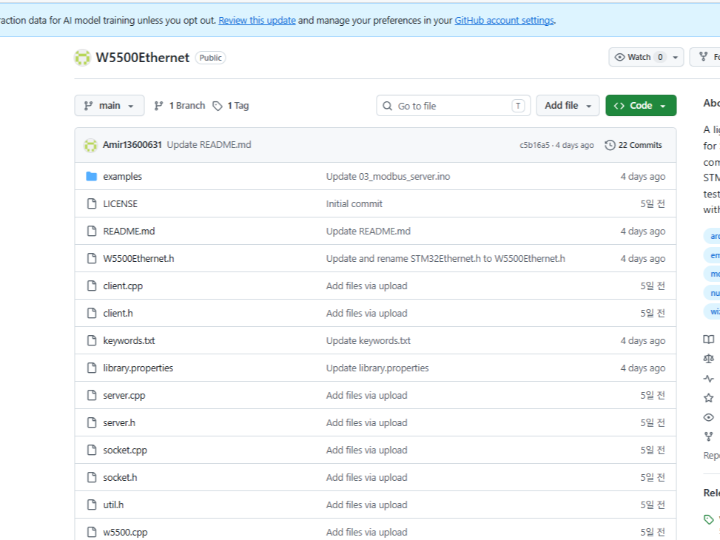
A lightweight W5500 Ethernet library for STM32 microcontrollers, compatible with the official STM32duino Arduino core. Built and tested on STM32F446RE
W5500Ethernet — Production-Grade STM32 Ethernet Library Built for Industrial Modbus TCP
#STM32 #W5500 #WIZ550io #ModbusTCP #STM32duino #ioLibrary #Industrial #BareMetal #ArduinoCore #Embedded
📚 Independent open-source library by an industrial control systems engineer. ioLibrary-compatible API, reimplemented for STM32duino Arduino core. Hardware-verified on STM32F446RE + WIZ550io.
01 — What is this project?
Getting Ethernet to work reliably on STM32 with the Arduino ecosystem has always been a frustrating experience. The official STM32Ethernet library only supports Nucleo-144 boards with built-in MAC + LAN8742A PHY — which excludes every Nucleo-64, every Blue Pill, and every custom STM32 board that uses an external SPI Ethernet module. WIZnet's official ioLibrary exists, but it cannot be used directly in the Arduino environment. Third-party W5500 libraries exist, but each one targets an outdated core, requires manual header editing, or pulls in heavy dependencies.
This project delivers what the ecosystem has been missing: a lightweight, production-tested W5500 Ethernet library purpose-built for STM32 + STM32duino, with Modbus TCP slave and master built in. It compiles and runs out of the box on STM32F446RE Nucleo-64 with a WIZ550io module — no header surgery, no dependency chains, no cryptic SPI framing bugs.
The library was developed as part of a complete bare-metal industrial control firmware project: custom SPI/DMA drivers, ADC DMA scanning with IIR filtering, bxCAN bus driver, and a Modbus TCP gateway. The Ethernet layer was extracted, cleaned up, and released as a focused open-source library so other engineers facing the same STM32 + W5500 wall can get past it in minutes instead of weeks.
02 — Why a new STM32 W5500 library?
🔷 Existing libraries don't actually work on modern STM32duino
The community has multiple W5500 libraries — Ethernet_STM32, Ethernet_STM, EthernetWebServer_STM32, the official Arduino Ethernet library — and not one of them compiles and runs on a Nucleo-64 with the current STM32duino core and a W5500 module without non-trivial modifications. Older cores, manual header edits, outdated SPI handling, missing chip select logic. This library was written from scratch only after exhausting every existing option.
🔷 Correct BSB SPI framing — the silent killer
W5500 uses Block Select Bits (BSB) in its SPI protocol to address registers, sockets, and buffers. Most generic Arduino W5500 implementations get this subtly wrong on STM32, causing the W5500 to silently reject SOCKET OPEN commands even though all register reads and writes appear to succeed. This is one of the most painful bugs in embedded networking. This library implements BSB-aware framing correctly from the register layer up.
🔷 Zero dynamic memory allocation
No new. No malloc. No heap. Every buffer is statically allocated, every state machine is explicit. This is non-negotiable for industrial firmware — the kind that runs unattended on a DIN rail for years and cannot afford a heap fragmentation surprise.
🔷 API-compatible with WIZnet's official ioLibrary — without the integration friction
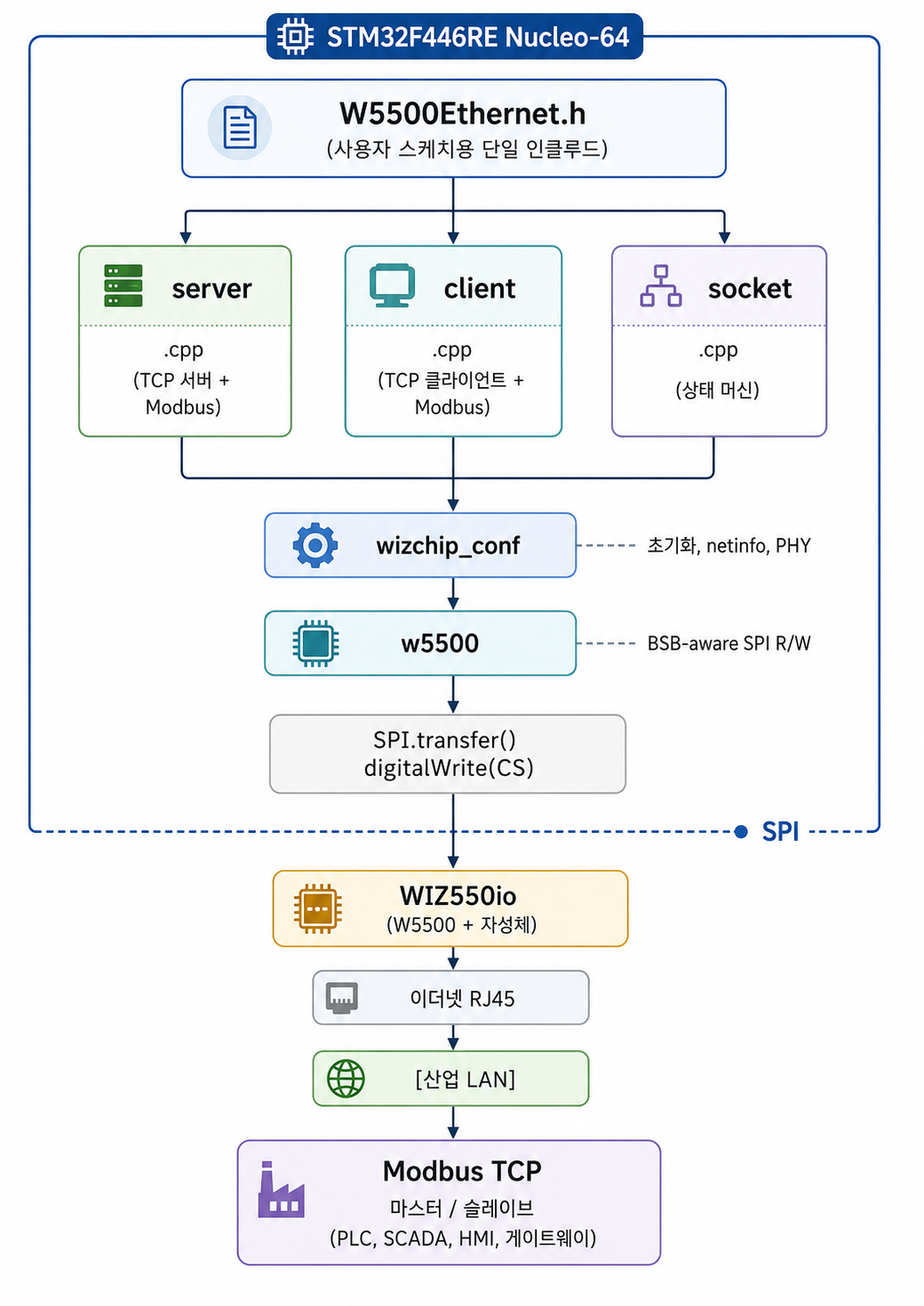
The function names (wizchip_init(), wizchip_setnetinfo(), wiz_NetInfo) and module layout (w5500.cpp, socket.cpp, wizchip_conf.cpp) mirror WIZnet's official open-source ioLibrary. So why not just use ioLibrary?
ioLibrary is a standard C library, designed for STM32CubeIDE / CMake / HAL-based projects where the developer registers their own SPI driver function via callback (reg_wizchip_spi_cbfunc()). It assumes a traditional C-style embedded build environment. The Arduino ecosystem — including STM32duino, the official Arduino core for STM32 boards maintained by STMicroelectronics — is not that environment. Arduino expects .cpp files that include <Arduino.h>, direct use of the SPI.transfer() and digitalWrite() APIs, library-manager-discoverable metadata, and a build system that does not align with ioLibrary's callback-registration model.
This library takes ioLibrary's proven API design and reimplements the SPI/socket layer natively for Arduino. Engineers already familiar with ioLibrary recognize every function name. Arduino users get a library that compiles out of the box. Same API, two ecosystems.
03 — System architecture
04 — Why W5500 (and WIZ550io)?
🔷 STM32 Nucleo-64 has no built-in Ethernet PHY
Nucleo-64 boards (F446RE, F401RE, F411RE, F103) and most STM32 development/custom boards do not have an integrated Ethernet MAC + PHY. The only practical path to wired Ethernet is an external SPI module. W5500 is the cleanest answer — a complete TCP/IP offload engine over a 4-wire SPI interface that maps directly to STM32 GPIO.
🔷 Hardwired TCP/IP stack — deterministic, no LwIP
Unlike software-based Ethernet solutions that require LwIP (memory-hungry, configuration-heavy, deep call stacks), W5500 runs the entire TCP/IP stack in silicon. No LwIP dependency, no ETH_FUNCTIONS macros, no LAN8742A_PHY_ADDRESS symbol errors. Just SPI commands and 8 hardware sockets.
🔷 WIZ550io — single-module integration
WIZ550io combines W5500 + magnetics + RJ45 into a single drop-in module. For a Nucleo-64 + breadboard prototype or a small custom industrial PCB, this collapses the Ethernet hardware to a single component connection. No separate magnetics, no impedance matching, no PHY clock issues.
🔷 Verified hardware behavior
Hardware evidence built into the library development:
- ✅ Correct BSB framing verified across all socket-mode commands
- ✅ SOCKET OPEN succeeds reliably (the failure mode that breaks competing libraries)
- ✅ Static IP, MAC, gateway, subnet configuration round-trip verified
- ✅ PHY link status detection working
- ✅ Modbus TCP slave tested with Modbus Poll
- ✅ Modbus TCP master tested with Modbus Slave simulator
- ✅ Auto-reconnect after physical cable disconnect verified
05 — Key components
🧠 STM32F446RE (Nucleo-64) — Reference Platform
180MHz Cortex-M4 with FPU. Compiled with the official STM32duino Arduino core. Also verified compatible with STM32F446ZE Nucleo-144, STM32F103C8 Blue Pill, and any STM32 with adjustable CS pin. Custom bare-metal core also tested for the same chip.
🌐 WIZnet W5500 / WIZ550io — Ethernet Interface
The W5500 is operated via a custom SPI master implemented in w5500.cpp. The driver speaks correct BSB framing, addresses all 8 hardware sockets independently, and exposes a clean register-level API to the layers above. WIZ550io's integrated magnetics simplify hardware bring-up.
📦 TCP Server (server.cpp)
Single-listener TCP server with automatic re-arm on disconnect. Designed for the industrial use case: one persistent client (a PLC, SCADA terminal, or gateway) connects, talks Modbus, disconnects, and the server immediately re-listens.
📦 TCP Client (client.cpp)
Persistent TCP client with auto-reconnect. Survives cable pulls, switch reboots, and remote-server restarts — reconnects on the next loop tick without intervention.
⚖️ Modbus TCP Slave (FC03 + FC16)
Built into the server. Handles Read Holding Registers and Write Multiple Registers. Returns proper MBAP exception responses for invalid function codes or out-of-range addresses. Tested end-to-end with Modbus Poll simulator.
⚖️ Modbus TCP Master
Built into the client. Polls a remote slave with persistent connection, reconnects on failure. Tested with Modbus Slave simulator polling 5 holding registers every 2 seconds.
🧪 Three Working Examples
01_ethernet_netinfo— link-up smoke test02_modbus_client— Modbus TCP master03_modbus_server— Modbus TCP slave on port 1502
All three verified on real STM32F446RE hardware.
06 — Application scenarios
01. Industrial Modbus TCP Gateway
The native use case. STM32 + W5500 + this library = a deterministic, bare-metal Modbus TCP gateway between an industrial network and field devices. Zero-heap, zero-OS, zero-surprise. The author built exactly this for industrial control deployment. #Modbus #Industrial #SCADA #PLCIntegration
02. STM32 Nucleo-64 Wired IoT Endpoints
Most STM32 IoT tutorials assume Nucleo-144 (built-in MAC) or push you to ESP32. This library opens up the entire Nucleo-64 line — and any custom STM32 board — for wired Ethernet IoT applications without WiFi's reliability and security tradeoffs. #IoT #Nucleo64 #WiredEthernet
03. Bare-Metal Embedded Networking
Engineers writing custom STM32 cores or working below the Arduino abstraction get a clean, heap-free, BSB-correct W5500 driver they can lift into their own projects. No Arduino assumptions baked in below the SPI layer. #BareMetal #EmbeddedSystems #Driver
04. STM32 + W5500 Reference Implementation
Educational and reference use. The library shows correct W5500 SPI framing on STM32, correct timing for SPI clock prescalers, correct CS handling, and a clean separation between hardware layer and protocol layer. A solid teaching example for embedded networking courses. #Education #Reference #OpenSource
Conclusion
Production-grade STM32 + W5500 Ethernet, finally — with Modbus TCP built in and zero heap.
This project closes a real gap in the STM32 + Arduino ecosystem. After years of community libraries that almost work, a control systems engineer wrote, hardware-verified, and open-sourced a focused W5500 driver that actually compiles, actually runs, and actually ships in industrial firmware. The decision tree is simple: if you have an STM32 (any model) and a W5500 module and you want Ethernet without LwIP, this library is the path of least resistance.
The Modbus TCP slave and master are the showcase — but the real value is the underlying W5500 driver, which any embedded engineer can build on for HTTP, MQTT, custom binary protocols, or any other TCP/UDP application.
- ✅ Correct BSB-aware SPI framing — solves the silent SOCKET OPEN failure
- ✅ Zero dynamic memory allocation, zero heap, zero
new/malloc - ✅ API-compatible with WIZnet's official ioLibrary (
wizchip_init,wiz_NetInfo, etc.) - ✅ Single file include (
#include <W5500Ethernet.h>) - ✅ Built-in Modbus TCP slave (FC03, FC16) with MBAP exception handling
- ✅ Built-in Modbus TCP master with persistent connection and auto-reconnect
- ✅ TCP server with single-listener auto re-arm
- ✅ TCP client with auto-reconnect
- ✅ Hardware verified on STM32F446RE Nucleo-64 + WIZ550io
- ✅ Compatible with STM32F446ZE, STM32F103, custom STM32 boards
- ✅ MIT License — usable in commercial products
Q&A
Q. Why not just use the official STM32Ethernet library? The official library only supports STM32 boards with built-in MAC + LAN8742A PHY (Nucleo-144 family). For Nucleo-64, Blue Pill, or any board using an external SPI Ethernet module, that library simply does not apply — it has no W5500 support at all. Open issues on its GitHub repository show recurring LAN8742A_PHY_ADDRESS and PHY_IMR symbol errors even on supported boards. This library exists to fill the SPI Ethernet gap that the official library never addressed.
Q. What is BSB framing and why does it matter? W5500 uses Block Select Bits (BSB) in the second byte of every SPI transaction to address one of eight hardware sockets, common registers, or socket-specific buffers. If the BSB field is constructed incorrectly, register reads and writes appear to work — they return values, they accept writes — but socket-level commands like SOCKET OPEN fail silently. The socket never enters the listening state, no incoming connections are accepted, and there is no error indication. This library implements BSB framing correctly so that pattern can never occur.
Q. Why not just use WIZnet's official ioLibrary directly? ioLibrary is a standard C library built for STM32CubeIDE / CMake / HAL-based projects — it expects the developer to register their own SPI driver as a callback. The Arduino ecosystem has a completely different build model: .cpp files including <Arduino.h>, the SPI and digitalWrite APIs, library-manager metadata, no callback registration. You cannot drop ioLibrary into an Arduino project as-is. STM32 does have Arduino support via STM32duino (the official Arduino core for STM32 boards, maintained by STMicroelectronics), but that doesn't bridge the build-system gap — ioLibrary still needs a substantial integration layer to live there. This library solves that once: same ioLibrary API surface, reimplemented natively for Arduino. ioLibrary users keep their muscle memory, Arduino users get a library that compiles out of the box.
Q. Why no DHCP, DNS, or UDP? This library targets industrial deployment where every endpoint has a static IP, IP addresses are used directly (no DNS), and the protocol is TCP (Modbus TCP). Adding DHCP, DNS, and UDP would expand the code size and dependency surface for features that the target use case does not need. Engineers who need those features can either use the W5500 layer directly (the SPI driver is exposed) or add them on top. This is intentional scoping, not an oversight.
Q. Can I use this with ArduinoModbus or other Arduino TCP libraries? Not directly today — the API uses explicit socket-number functions (EthernetClient_write_array(sock, buf, len)) rather than the standard Arduino EthernetClient / Stream interface. The author notes a thin C++ wrapper providing those interfaces is a planned future addition. For now, if you need ArduinoModbus compatibility, you can wrap the C-style API yourself, or use the Modbus TCP slave/master that ships with this library and skip ArduinoModbus entirely.
Q. What is the SPI clock speed and is it safe? The Quick Start example uses 11.25 MHz SPI, which works reliably on the STM32F446RE + WIZ550io combination. The README warns that SPI wires must be kept under 10 cm — long unshielded wires at 11 MHz cause signal integrity issues that make the W5500 socket state machine silently reject OPEN commands. This is one of the trickiest bugs in W5500 bring-up, and the library documents it explicitly so users avoid it on their own hardware.
[한글 버전]
W5500Ethernet — 산업용 Modbus TCP를 위한 STM32 이더넷 라이브러리
#STM32 #W5500 #WIZ550io #ModbusTCP #STM32duino #ioLibrary #산업용 #베어메탈 #아두이노코어 #임베디드
📚 산업 제어 시스템 엔지니어가 만든 독립 오픈소스 라이브러리. ioLibrary 호환 API를 STM32duino Arduino 코어용으로 재구현. STM32F446RE + WIZ550io로 하드웨어 검증 완료.
01 — 이 프로젝트는 무엇인가?
STM32에서 Arduino 생태계로 이더넷을 안정적으로 동작시키는 일은 항상 답답한 경험이었습니다. 공식 STM32Ethernet 라이브러리는 내장 MAC + LAN8742A PHY를 가진 Nucleo-144 보드만 지원합니다 — 즉 모든 Nucleo-64, 모든 Blue Pill, 외부 SPI 이더넷 모듈을 사용하는 모든 커스텀 STM32 보드는 제외됩니다. 위즈네트에서 제공하는 ioLibrary가 있지만 Arduino 환경에서는 사용이 불가능합니다. 서드파티 W5500 라이브러리는 존재하지만, 각각 구버전 코어를 타겟팅하거나, 헤더 파일을 수동으로 편집해야 하거나, 무거운 의존성을 끌어들입니다.
이 프로젝트는 생태계에 비어 있던 것을 채웁니다: STM32 + STM32duino를 위해 처음부터 설계된 가볍고 프로덕션 검증된 W5500 이더넷 라이브러리, Modbus TCP 슬레이브와 마스터 내장. STM32F446RE Nucleo-64 + WIZ550io 모듈에서 그대로 컴파일되고 동작합니다 — 헤더 수술 없음, 의존성 사슬 없음, 정체불명의 SPI 프레이밍 버그 없음.
이 라이브러리는 완전한 베어메탈 산업 제어 펌웨어 프로젝트의 일부로 개발되었습니다: 커스텀 SPI/DMA 드라이버, IIR 필터링이 있는 ADC DMA 스캐닝, bxCAN 버스 드라이버, Modbus TCP 게이트웨이. 이더넷 계층을 분리해 정리한 뒤 오픈소스로 공개해, 같은 STM32 + W5500 벽에 부딪힌 다른 엔지니어들이 몇 주가 아니라 몇 분 만에 그 벽을 넘을 수 있도록 했습니다.
02 — 왜 새로운 STM32 W5500 라이브러리가 필요한가?
🔷 기존 라이브러리들은 현대 STM32duino에서 실제로 동작하지 않는다
커뮤니티에는 여러 W5500 라이브러리가 있습니다 — Ethernet_STM32, Ethernet_STM, EthernetWebServer_STM32, 공식 Arduino Ethernet — 하지만 그중 어느 것도 현재 STM32duino 코어와 W5500 모듈을 가진 Nucleo-64에서 사소하지 않은 수정 없이 컴파일되고 동작하지 않습니다. 구버전 코어 타겟팅, 수동 헤더 편집, 구식 SPI 처리, 누락된 칩 셀렉트 로직. 이 라이브러리는 모든 기존 옵션을 소진한 뒤에야 처음부터 작성되었습니다.
🔷 정확한 BSB SPI 프레이밍 — 침묵의 살인자
W5500은 SPI 프로토콜에서 레지스터, 소켓, 버퍼를 주소 지정하기 위해 Block Select Bits (BSB)를 사용합니다. 대부분의 일반적인 Arduino W5500 구현은 STM32에서 이 부분을 미묘하게 잘못 처리해, 모든 레지스터 읽기/쓰기는 성공하는 것처럼 보이는데도 W5500이 SOCKET OPEN 명령을 조용히 거부하는 상황을 만듭니다. 임베디드 네트워킹에서 가장 고통스러운 버그 중 하나입니다. 이 라이브러리는 레지스터 계층부터 BSB-aware 프레이밍을 정확히 구현합니다.
🔷 동적 메모리 할당 제로
new 없음. malloc 없음. 힙 없음. 모든 버퍼는 정적 할당, 모든 상태 머신은 명시적. 이는 산업 펌웨어에서 타협 불가능한 요건입니다 — DIN 레일에 무인으로 몇 년씩 동작하며 힙 단편화 같은 깜짝 이벤트를 감당할 수 없는 종류의 펌웨어입니다.
🔷 WIZnet 공식 ioLibrary와 API 호환 — 통합 마찰 없이
함수 이름(wizchip_init(), wizchip_setnetinfo(), wiz_NetInfo)과 모듈 레이아웃(w5500.cpp, socket.cpp, wizchip_conf.cpp)은 WIZnet 공식 오픈소스 ioLibrary와 동일한 구조입니다. 그렇다면 ioLibrary를 직접 사용하지 않은 이유는?
ioLibrary는 표준 C 라이브러리로, STM32CubeIDE / CMake / HAL 기반 프로젝트용으로 설계되었습니다 — 개발자가 자신의 SPI 드라이버 함수를 콜백(reg_wizchip_spi_cbfunc())으로 등록하는 환경입니다. 전통적인 C 스타일 임베디드 빌드 환경을 가정합니다. Arduino 생태계 — STMicroelectronics가 공식적으로 관리하는 STM32 보드용 Arduino 코어인 STM32duino를 포함해 — 는 그 환경이 아닙니다. Arduino는 <Arduino.h>를 인클루드하는 .cpp 파일, SPI.transfer()와 digitalWrite() API의 직접 사용, 라이브러리 매니저가 발견할 수 있는 메타데이터, 그리고 ioLibrary의 콜백 등록 모델과 맞지 않는 빌드 시스템을 기대합니다.
이 라이브러리는 ioLibrary의 검증된 API 설계를 가져와 SPI/소켓 레이어를 Arduino용으로 네이티브하게 재구현합니다. ioLibrary에 익숙한 엔지니어는 모든 함수 이름을 알아봅니다. Arduino 사용자는 즉시 컴파일되는 라이브러리를 얻습니다. 같은 API, 두 생태계.
03 — 시스템 구조
04 — 왜 W5500 (그리고 WIZ550io)인가?
🔷 STM32 Nucleo-64에는 내장 이더넷 PHY가 없다
Nucleo-64 보드(F446RE, F401RE, F411RE, F103)와 대부분의 STM32 개발/커스텀 보드는 통합 이더넷 MAC + PHY를 가지고 있지 않습니다. 유선 이더넷으로 가는 유일한 실용적 경로는 외부 SPI 모듈입니다. W5500이 가장 깔끔한 답입니다 — STM32 GPIO에 그대로 매핑되는 4선 SPI 인터페이스 위에 동작하는 완전한 TCP/IP 오프로드 엔진.
🔷 하드웨어 TCP/IP 스택 — 결정론적, LwIP 불필요
LwIP를 요구하는 소프트웨어 기반 이더넷 솔루션(메모리 소모 큼, 설정 복잡, 깊은 콜 스택)과 달리, W5500은 전체 TCP/IP 스택을 실리콘에서 실행합니다. LwIP 의존성 없음, ETH_FUNCTIONS 매크로 없음, LAN8742A_PHY_ADDRESS 심볼 에러 없음. SPI 명령과 8개의 하드웨어 소켓만 있으면 됩니다.
🔷 WIZ550io — 단일 모듈 통합
WIZ550io는 W5500 + 자성체 + RJ45를 단일 드롭인 모듈로 결합합니다. Nucleo-64 + 브레드보드 프로토타입이나 소형 커스텀 산업 PCB에서, 이는 이더넷 하드웨어를 단일 컴포넌트 연결로 축소합니다. 별도 자성체 없음, 임피던스 매칭 없음, PHY 클럭 이슈 없음.
🔷 검증된 하드웨어 동작
라이브러리 개발 과정에 내장된 하드웨어 증거:
- ✅ 모든 소켓 모드 명령에서 정확한 BSB 프레이밍 검증
- ✅ SOCKET OPEN이 안정적으로 성공 (경쟁 라이브러리들이 깨지는 실패 모드)
- ✅ 정적 IP, MAC, 게이트웨이, 서브넷 설정 라운드트립 검증
- ✅ PHY 링크 상태 감지 동작
- ✅ Modbus Poll로 Modbus TCP 슬레이브 테스트
- ✅ Modbus Slave 시뮬레이터로 Modbus TCP 마스터 테스트
- ✅ 물리적 케이블 분리 후 자동 재연결 검증
05 — 핵심 구성 요소
🧠 STM32F446RE (Nucleo-64) — 레퍼런스 플랫폼
180MHz Cortex-M4 + FPU. 공식 STM32duino Arduino 코어로 컴파일. STM32F446ZE Nucleo-144, STM32F103C8 Blue Pill, CS 핀 조정 가능한 모든 STM32와 호환 검증. 동일 칩에 대한 커스텀 베어메탈 코어도 테스트.
🌐 WIZnet W5500 / WIZ550io — 이더넷 인터페이스
W5500은 w5500.cpp에 구현된 커스텀 SPI 마스터를 통해 동작합니다. 드라이버는 정확한 BSB 프레이밍을 구사하고, 8개의 모든 하드웨어 소켓을 독립적으로 주소 지정하며, 상위 계층에 깔끔한 레지스터 수준 API를 제공합니다. WIZ550io의 통합 자성체가 하드웨어 브링업을 단순화합니다.
📦 TCP 서버 (server.cpp)
연결 해제 시 자동 재무장하는 단일 리스너 TCP 서버. 산업 사용 사례를 위해 설계됨: 하나의 영구 클라이언트(PLC, SCADA 단말, 게이트웨이)가 연결, Modbus 통신, 연결 해제하면 서버가 즉시 다시 리스닝 상태가 됩니다.
📦 TCP 클라이언트 (client.cpp)
자동 재연결 영구 TCP 클라이언트. 케이블 분리, 스위치 재부팅, 원격 서버 재시작에 살아남음 — 다음 루프 틱에 개입 없이 재연결됩니다.
⚖️ Modbus TCP 슬레이브 (FC03 + FC16)
서버에 내장. Read Holding Registers와 Write Multiple Registers 처리. 잘못된 함수 코드나 범위 외 주소에 대해 적절한 MBAP 예외 응답 반환. Modbus Poll 시뮬레이터로 종단 간 테스트.
⚖️ Modbus TCP 마스터
클라이언트에 내장. 영구 연결로 원격 슬레이브를 폴링, 실패 시 재연결. 5개 Holding Registers를 2초마다 폴링하는 Modbus Slave 시뮬레이터로 테스트.
🧪 동작하는 3개 예제
01_ethernet_netinfo— 링크 업 스모크 테스트02_modbus_client— Modbus TCP 마스터03_modbus_server— 포트 1502에서 Modbus TCP 슬레이브
세 예제 모두 실제 STM32F446RE 하드웨어에서 검증.
06 — 응용 시나리오
01. 산업용 Modbus TCP 게이트웨이
원래 사용 사례. STM32 + W5500 + 이 라이브러리 = 산업 네트워크와 필드 디바이스 사이의 결정론적 베어메탈 Modbus TCP 게이트웨이. 제로 힙, 제로 OS, 제로 서프라이즈. 작성자가 산업 제어 배포를 위해 정확히 이것을 만들었습니다. #Modbus #산업용 #SCADA #PLC통합
02. STM32 Nucleo-64 유선 IoT 엔드포인트
대부분의 STM32 IoT 튜토리얼은 Nucleo-144(내장 MAC)를 가정하거나 ESP32로 밀어붙입니다. 이 라이브러리는 전체 Nucleo-64 라인 — 그리고 모든 커스텀 STM32 보드 — 을 WiFi의 안정성·보안 트레이드오프 없이 유선 이더넷 IoT 응용으로 열어줍니다. #IoT #Nucleo64 #유선이더넷
03. 베어메탈 임베디드 네트워킹
커스텀 STM32 코어를 작성하거나 Arduino 추상화 아래에서 작업하는 엔지니어는 자신의 프로젝트로 그대로 가져갈 수 있는 깔끔하고, 힙 없는, BSB-correct W5500 드라이버를 얻습니다. SPI 계층 아래에는 Arduino 가정이 박혀있지 않습니다. #베어메탈 #임베디드시스템 #드라이버
04. STM32 + W5500 레퍼런스 구현
교육 및 레퍼런스 용도. 이 라이브러리는 STM32에서의 정확한 W5500 SPI 프레이밍, SPI 클럭 분주의 정확한 타이밍, 정확한 CS 처리, 하드웨어 계층과 프로토콜 계층의 깔끔한 분리를 보여줍니다. 임베디드 네트워킹 강의의 견고한 교육 예제. #교육 #레퍼런스 #오픈소스
결론
드디어, 프로덕션 수준의 STM32 + W5500 이더넷 — Modbus TCP 내장, 힙 제로.
이 프로젝트는 STM32 + Arduino 생태계의 실제 공백을 메웁니다. 거의 동작하는 커뮤니티 라이브러리들이 수년간 쌓인 끝에, 한 제어 시스템 엔지니어가 작성하고, 하드웨어 검증하고, 오픈소스로 공개한 집중적인 W5500 드라이버가 실제로 컴파일되고, 실제로 동작하고, 실제로 산업 펌웨어로 출하됩니다. 결정 트리는 단순합니다: STM32(어떤 모델이든)와 W5500 모듈이 있고 LwIP 없이 이더넷을 원한다면, 이 라이브러리가 최소 저항 경로입니다.
Modbus TCP 슬레이브와 마스터가 쇼케이스이지만 — 진짜 가치는 그 아래 W5500 드라이버에 있습니다. 어떤 임베디드 엔지니어든 이를 기반으로 HTTP, MQTT, 커스텀 바이너리 프로토콜, 또는 다른 어떤 TCP/UDP 응용도 구축할 수 있습니다.
- ✅ 정확한 BSB-aware SPI 프레이밍 — 조용한 SOCKET OPEN 실패 해결
- ✅ 동적 메모리 할당 제로, 힙 제로,
new/malloc제로 - ✅ WIZnet 공식 ioLibrary와 API 호환 (
wizchip_init,wiz_NetInfo등) - ✅ 단일 파일 인클루드 (
#include <W5500Ethernet.h>) - ✅ Modbus TCP 슬레이브 내장 (FC03, FC16) + MBAP 예외 처리
- ✅ Modbus TCP 마스터 내장 + 영구 연결 + 자동 재연결
- ✅ 단일 리스너 자동 재무장 TCP 서버
- ✅ 자동 재연결 TCP 클라이언트
- ✅ STM32F446RE Nucleo-64 + WIZ550io 하드웨어 검증
- ✅ STM32F446ZE, STM32F103, 커스텀 STM32 보드 호환
- ✅ MIT 라이선스 — 상용 제품에 사용 가능
Q&A
Q. 그냥 공식 STM32Ethernet 라이브러리를 쓰면 안 되나요? 공식 라이브러리는 내장 MAC + LAN8742A PHY를 가진 STM32 보드(Nucleo-144 계열)만 지원합니다. Nucleo-64, Blue Pill, 외부 SPI 이더넷 모듈을 사용하는 모든 보드에는 그 라이브러리가 적용되지 않습니다 — W5500 지원이 전혀 없습니다. GitHub 저장소의 열린 이슈들은 지원되는 보드에서도 LAN8742A_PHY_ADDRESS와 PHY_IMR 심볼 에러가 반복적으로 발생함을 보여줍니다. 이 라이브러리는 공식 라이브러리가 결코 다루지 않은 SPI 이더넷 공백을 채우기 위해 존재합니다.
Q. BSB 프레이밍이 무엇이고 왜 중요한가요? W5500은 모든 SPI 트랜잭션의 두 번째 바이트에 Block Select Bits (BSB)를 사용해 8개의 하드웨어 소켓 중 하나, 공통 레지스터, 또는 소켓별 버퍼를 주소 지정합니다. BSB 필드가 잘못 구성되면 레지스터 읽기/쓰기는 동작하는 것처럼 보입니다 — 값을 반환하고, 쓰기를 받아들입니다 — 하지만 SOCKET OPEN 같은 소켓 수준 명령은 조용히 실패합니다. 소켓이 리스닝 상태에 진입하지 않고, 들어오는 연결이 받아들여지지 않으며, 에러 표시도 없습니다. 이 라이브러리는 BSB 프레이밍을 정확하게 구현해 그 패턴이 절대 발생하지 않게 합니다.
Q. WIZnet 공식 ioLibrary를 직접 사용하지 않은 이유는 무엇인가요? ioLibrary는 표준 C 라이브러리로, STM32CubeIDE / CMake / HAL 기반 프로젝트용으로 만들어졌습니다 — 개발자가 자신의 SPI 드라이버를 콜백으로 등록하는 환경을 기대합니다. Arduino 생태계는 완전히 다른 빌드 모델을 가집니다: <Arduino.h>를 인클루드하는 .cpp 파일, SPI와 digitalWrite API, 라이브러리 매니저 메타데이터, 콜백 등록 없음. ioLibrary는 Arduino 프로젝트에 그대로 떨어뜨릴 수 없습니다. STM32는 STMicroelectronics가 공식적으로 관리하는 STM32duino(STM32 보드용 공식 Arduino 코어)를 통해 Arduino를 지원하지만, 그것이 빌드 시스템 간극을 메꿔주지는 않습니다 — ioLibrary가 그 안에서 동작하려면 여전히 상당한 통합 레이어가 필요합니다. 이 라이브러리는 그 작업을 한 번에 해결합니다: 동일한 ioLibrary API 표면을, Arduino용으로 네이티브하게 재구현. ioLibrary 사용자는 기존 머슬 메모리를 유지하고, Arduino 사용자는 즉시 컴파일되는 라이브러리를 얻습니다.
Q. DHCP, DNS, UDP는 왜 없나요? 이 라이브러리는 모든 엔드포인트가 정적 IP를 가지고, IP 주소를 직접 사용하며(DNS 없음), 프로토콜이 TCP(Modbus TCP)인 산업 배포를 타겟합니다. DHCP, DNS, UDP를 추가하면 타겟 사용 사례에 필요하지 않은 기능을 위해 코드 크기와 의존성 표면이 커집니다. 그 기능이 필요한 엔지니어는 W5500 계층을 직접 사용하거나(SPI 드라이버가 노출되어 있음) 그 위에 추가할 수 있습니다. 이는 의도된 범위 설정이며, 누락이 아닙니다.
Q. ArduinoModbus나 다른 Arduino TCP 라이브러리와 함께 쓸 수 있나요? 오늘 시점에서는 직접적으로는 불가능합니다 — API가 표준 Arduino EthernetClient / Stream 인터페이스 대신 명시적인 소켓 번호 함수(EthernetClient_write_array(sock, buf, len))를 사용합니다. 작성자는 그 인터페이스를 제공하는 얇은 C++ 래퍼가 향후 추가 계획임을 언급합니다. 지금 ArduinoModbus 호환성이 필요하다면, C 스타일 API를 직접 래핑하거나, 이 라이브러리에 포함된 Modbus TCP 슬레이브/마스터를 사용하고 ArduinoModbus를 건너뛰면 됩니다.
Q. SPI 클럭 속도는 얼마이며 안전한가요? Quick Start 예제는 11.25 MHz SPI를 사용하는데, STM32F446RE + WIZ550io 조합에서 안정적으로 동작합니다. README는 SPI 와이어를 10cm 이하로 유지해야 한다고 경고합니다 — 11 MHz의 길고 차폐되지 않은 와이어는 W5500 소켓 상태 머신이 OPEN 명령을 조용히 거부하게 만드는 신호 무결성 문제를 일으킵니다. W5500 브링업에서 가장 까다로운 버그 중 하나이며, 라이브러리는 이를 명시적으로 문서화해 사용자가 자신의 하드웨어에서 이를 피할 수 있게 합니다.