TinyML enabled Low Power Exhaust Fans for Smart Buildings
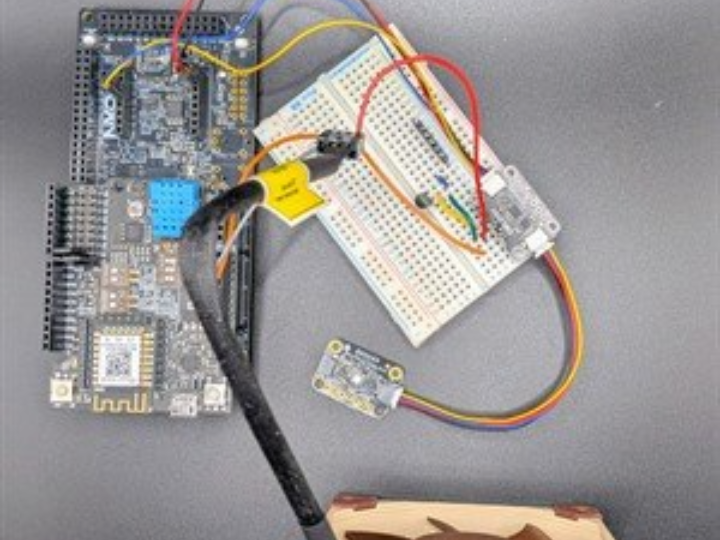
A prototype smart exhaust fan controlled by MCXN236 + WizFi360 + BME688 that adjusts fan operation based on air quality (VOC).
COMPONENTSHardware components
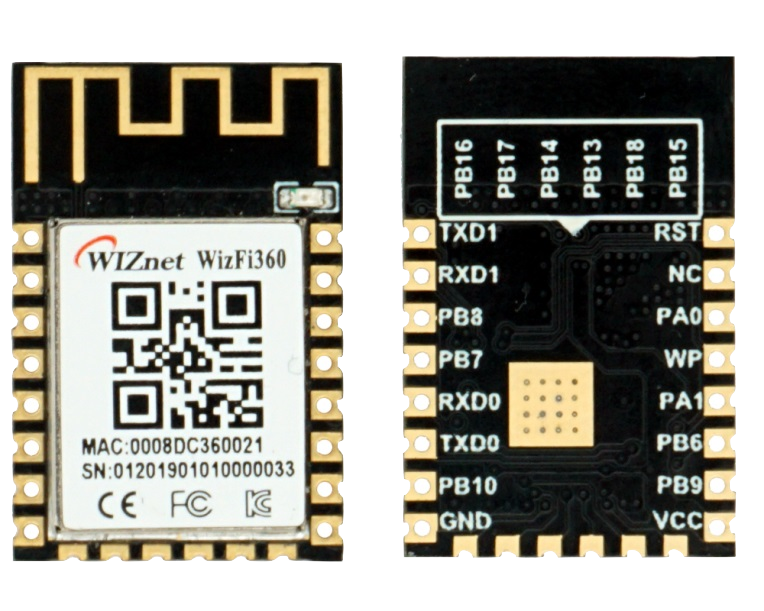
WIZnet - WizFi360
x 1
PROJECT DESCRIPTION
1. How WIZnet Products Are Used
The project uses MCXN236 development board as the main MCU.
For IoT connectivity, a WIZnet WizFi360 shield is used, enabling Wi‑Fi-based data upload and remote commands.
This setup covers sensor data collection, control of actuators (fan), and network communication — showing WIZnet modules can support a full-stack embedded IoT solution.
2. Technical Implementation & Methods
Sensor: BME688 measures VOC and other air‑quality parameters, communicating over I²C to the MCU.
Fan Control: EMC2101 drives a DC fan with adjustable speed via I²C under MCU control.
Connectivity: WizFi360 via UART enables cloud interaction — data upload, remote control commands.
TinyML: The design intends to embed a lightweight ML model on MCU for detecting odors / poor air quality and deciding fan activation. Data collection and training are ongoing, with eventual deployment as a C library on the MCU.
Power Efficiency: Because fan only runs when needed, and speed is dynamically controlled, the system avoids “always-on” waste — key for energy‑efficient smart buildings.
Future enhancements: Use of second core on MCU, RTOS (e.g. FreeRTOS), custom PCB design, scheduler/state‑machine control for robustness and scalability.
3. System Flow (How it Works)
BME688 periodically measures air quality (VOCs, etc.).
Measurement data sent to MCU via I²C.
MCU runs TinyML inference on data. If air quality degraded → generate signal to run fan.
Fan controller EMC2101 receives command from MCU → adjust DC fan speed accordingly.
Meanwhile, WizFi360 handles data upload to cloud and remote commands reception.
Later version may incorporate RTOS, dual‑core scheduling, custom integrated board for production readiness.
4. Next Steps
The proof of concept for this project is now complete. The following are the next steps:
Uploading data and receiving commands via an MQTT server. The WizFI360 driver needs to be modified slightly to accomplish this.
TinyML algorithm training and build to enable odor detection
FreeRTOS adoption to handle all tasks using a scheduler. A state machine would be appropriate as well.
5. Synergy: Why WIZnet + This Project Makes Sense
Using WIZnet MCU + network module + standard sensors/actuators yields a compact, low‑power, edge‑AI–ready system ideal for smart‑building / smart‑space applications.
With TinyML on-device inference, the system avoids latency, privacy, and bandwidth issues — enabling real-time, autonomous operation without cloud dependency.
Because WIZnet-based stack covers hardware, connectivity, and control, moving from prototype to product could be more straightforward, reducing complexity, cost, and power footprint.
7. Potential Derived Applications & Ideas
Smart bathroom ventilation: detect odors / humidity / CO₂ and auto-ventilate when needed.
Indoor air‑quality management + air purification + ventilation combo devices for homes/offices.
Smart office/meeting rooms: integrate occupancy sensors and air‑quality sensing to optimize HVAC & ventilation for energy savings.
Modular IoT air‑quality management platform: sensor + fan control + connectivity + TinyML modules that can be reused across different spaces/buildings.