



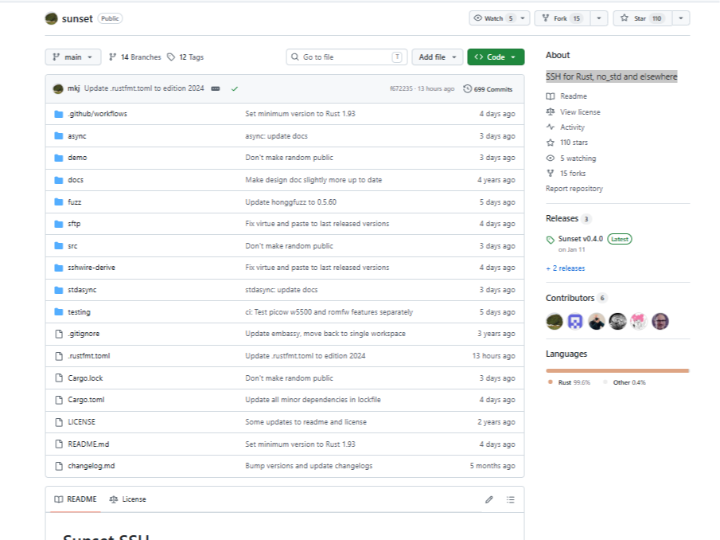
sunset
SSH for Rust, no_std and elsewhere
Sunset SSH — A Full SSH Stack That Fits on a Microcontroller, Wired Over W5500
#SSH #RustEmbedded #no_std #W5500 #MACRAW #Embassy #smoltcp #RP2040 #PostQuantum #WiredEthernet
📚 Context: Open-source systems library by Matt Johnston — the author of Dropbear SSH, the SSH server that runs on millions of routers and embedded devices. Implementation status: Working SSH client and server,
no_std+ no-alloc, with a Raspberry Pi Pico demo that runs over wired Ethernet through a WIZnet W5500 on the W5500-EVB-Pico.
01 — What is this project?
Running SSH on a small embedded device has always meant a painful trade-off. The classic answer is Dropbear — a wonderfully compact SSH daemon — but it assumes a full operating system underneath: a heap allocator, a POSIX-like sockets API, and a multi-megabyte Linux. The moment you drop down to a bare microcontroller with a few hundred kilobytes of RAM and no OS, that option disappears.
Sunset rethinks the problem from the silicon up. It is a clean-room SSH client and server implementation written in Rust that runs with no_std and no heap allocation at all. The core protocol engine doesn't even assume an async runtime — it exposes a synchronous API that you drive yourself, so it can be embedded "pretty much anywhere."
The result is striking: a complete, modern SSH endpoint — password and ed25519 public-key auth, curve25519 key exchange, chacha20-poly1305 and aes256-ctr ciphers, and even post-quantum hybrid key exchange (ML-KEM 768 × x25519) — that fits in roughly 150 kB of flash and ~13 kB of RAM per concurrent session on a Raspberry Pi Pico. The same codebase scales up to a perfectly usable day-to-day desktop SSH client (sunsetc) on Linux.
To prove the embedded story end-to-end, the project ships a Pico demo that can take its network connection one of two ways: over Wi-Fi (the Pico W's cyw43 radio) or over wired Ethernet through a WIZnet W5500 on the W5500-EVB-Pico board. This curation focuses on the wired path — because that is where a $6 microcontroller quietly becomes a hardened, network-attached SSH server with a real RJ45 jack.
02 — Why SSH on bare metal — and why Rust?
🔷 SSH is the universal remote-management protocol
Every serious piece of network infrastructure speaks SSH. Bringing it down to the microcontroller level means a sensor node, a PLC gateway, or an industrial controller can be administered, scripted, and updated using the exact same tooling engineers already trust — no bespoke web UI, no insecure telnet, no cloud dependency.
🔷 no_std, no-alloc, forbid(unsafe)
Sunset is built for environments where a heap is a liability and a single unsafe block is a security review item. The core crate compiles with #![forbid(unsafe)], avoids dynamic allocation entirely, and is designed so release builds don't panic — errors are returned as values. For a security protocol that sits directly on the network, this is exactly the discipline you want.
🔷 The Embassy async ecosystem
The async variant (sunset-async) and the demo are built on Embassy, the async embedded-Rust framework, with smoltcp (via embassy-net) providing the TCP/IP stack. This matters enormously for the WIZnet integration, as Section 04 explains: it lets the SSH code treat Wi-Fi and wired Ethernet as interchangeable link layers behind one uniform async network interface.
🔷 Where WIZnet fits in the Rust embedded networking landscape
In embedded Rust there are broadly two ways to get a device onto a wired network: a software TCP/IP stack (smoltcp) fed by a raw-Ethernet MAC, or a hardware-offload chip that does TCP/IP for you. The W5500 can do either. Sunset deliberately uses the W5500 as a clean SPI-attached Ethernet MAC+PHY and lets smoltcp do TCP/IP — gaining a single, modern, async stack shared with the Wi-Fi path, with no external PHY, no MAC IP block on the MCU, and no Wi-Fi firmware blob to ship.
03 — System architecture
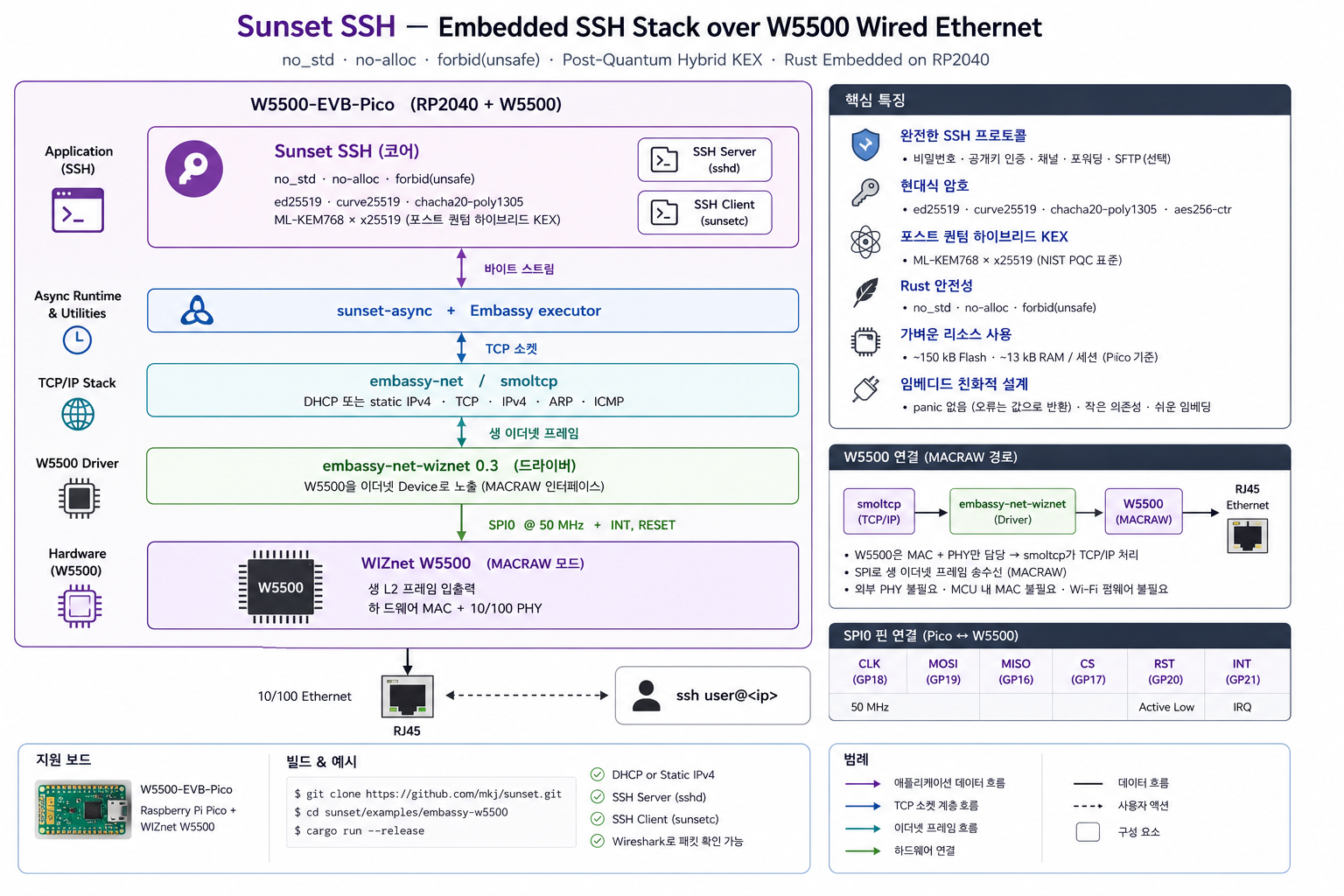
The same embassy-net::Stack is constructed whether the link layer is cyw43 Wi-Fi or the W5500 — only the device driver underneath changes. Everything above the dashed line in the code is identical.
04 — Why WIZnet W5500? ⭐
🔷 The technical core: a wired RJ45 for a chip that has none
The RP2040 has no Ethernet MAC and no PHY. The cleanest way to give it a wired network port is a single SPI peripheral that contains both — and that is precisely the W5500: a MAC + 10/100 PHY behind an SPI bus. Sunset drives it at SPI0, 50 MHz with dedicated reset and interrupt lines, on the WIZnet W5500-EVB-Pico board where the RP2040 and W5500 already share one PCB.
🔷 Mode in use: MACRAW (raw Ethernet), not hardware TOE
This is the defining architectural choice. The W5500 is famous for its hardwired TCP/IP offload (TOE) with eight hardware sockets. Sunset uses none of that. Instead it runs the W5500 in MACRAW mode, where the chip simply hands raw Ethernet frames up to the host, and smoltcp / embassy-net implements the entire TCP/IP stack in software (note the medium-ethernet feature and the embassy-net-wiznet Ethernet-Device driver).
Why give up the hardware offload? Because SSH wants something the fixed-function TOE can't offer:
- One stack, two radios. The Wi-Fi (cyw43) path and the wired (W5500) path expose the identical
embassy-netinterface. The SSH code never learns which one it's on. Swapping wired for wireless is a one-line cargo feature flag —--features w5500vs the defaultcyw43. - Async-native sockets. smoltcp integrates with the Embassy executor, so SSH sessions are
.await-ed cleanly. The W5500's 8 hardwired sockets and fixed TCP behaviour don't map as neatly onto a modern async, multi-session SSH server. - Full control of the TCP/IP edge. A software stack lets the project tune buffering, DHCP, and connection handling to SSH's needs, and keeps the security-relevant networking in audited Rust.
In short: the W5500 is used as the perfect link-layer citizen — it solves the "RP2040 has no Ethernet" problem completely, while the software stack above it keeps the architecture uniform and flexible.
🔷 Advantages over the alternatives
Versus a Wi-Fi-only design: a W5500 wired link needs no ~200 kB firmware blob (the cyw43 path carries one), gives deterministic latency, and is the right call for industrial or fixed installations. Versus a discrete MAC + external PHY (e.g. an MII/RMII PHY hung off a bigger MCU): the W5500 collapses MAC and PHY into one SPI-attached part, so even an RP2040 with zero networking peripherals gets a clean RJ45. Versus an ENC28J60 (the other common SPI Ethernet part): the W5500 is a newer 10/100 device with a better-supported Rust driver (embassy-net-wiznet) and the option to switch to TOE later if a future use case wants it.
🔷 Verified evidence ✅
- The W5500 backend is a first-class, selectable build target in the demo:
cargofeaturew5500pulls inembassy-net-wiznet = "0.3.0", andmain.rscompile_error!s if neither (or both) ofcyw43/w5500is selected — the integration is wired in, not aspirational. - Full hardware bring-up lives in the repo (
demo/picow/src/w5500.rs): SPI configuration, chip reset, interrupt input, MAC assignment, and stack construction with DHCP-or-static IPv4. - The on-device footprint is real and documented: ~150 kB flash, ~13 kB RAM per SSH session on the Pico class of device.
- The board is named explicitly in
Cargo.toml: "for wiznet w5500-evb-pico board."
05 — Key components
🌐 WIZnet W5500 — MACRAW mode, SPI-attached MAC + PHY
The single chip that turns an RP2040 into a wired network node. Driven over SPI0 at 50 MHz with INT/RESET lines, operated as a raw-Ethernet device so the host stack owns TCP/IP. On the W5500-EVB-Pico it sits on the same board as the MCU.
⚙️ embassy-net-wiznet 0.3 — the driver bridge
Presents the W5500 to embassy-net as a standard Ethernet Device. This is the seam that makes the wired path drop-in compatible with the Wi-Fi path.
🌐 embassy-net / smoltcp — software TCP/IP
The pure-Rust TCP/IP stack carrying SSH. Handles DHCP, static IPv4, and the TCP sockets the SSH listener binds to.
🔐 Sunset core — the SSH engine
no_std, no-alloc, forbid(unsafe) SSH client/server: ed25519, curve25519, chacha20-poly1305, aes256-ctr, hmac-sha256, and ML-KEM768×x25519 post-quantum hybrid key exchange.
🦀 Embassy executor + RP2040
The async runtime and the dual-core Cortex-M0+ host that ties flash config, USB console, serial, and the network listener tasks together.
06 — Application scenarios
01. Industrial wired remote management
A controller on a factory floor exposes a real SSH server over a deterministic, EMI-resistant RJ45 link — no Wi-Fi, no cloud — administered with standard ssh/scp tooling.
02. Secure serial-console server
The demo bridges UART pipes to SSH sessions: a W5500-EVB-Pico becomes a tiny networked serial console / jump box for lab equipment, reachable over Ethernet.
03. Future-proofed edge devices
With ML-KEM hybrid key exchange, an embedded node deployed today resists "harvest-now-decrypt-later" attacks — post-quantum SSH on a sub-$10 board with a wired port.
04. Reference design for embedded-Rust networking
The clean cyw43-vs-W5500 swap is a textbook example for any team learning how to put embassy-net over a WIZnet chip, with full SPI bring-up to copy from.
Conclusion
Sunset proves that a complete, modern, post-quantum-ready SSH server fits on a microcontroller — and the WIZnet W5500 is what gives that microcontroller a real wired network port.
- ✅ Full SSH client + server in
no_std, no-alloc Rust,forbid(unsafe) - ✅ ~150 kB flash, ~13 kB RAM per session on Pico-class hardware
- ✅ Post-quantum hybrid key exchange (ML-KEM768 × x25519)
- ✅ Wired Ethernet via WIZnet W5500 on the W5500-EVB-Pico
- ✅ W5500 run in MACRAW mode under smoltcp/embassy-net for a uniform Wi-Fi/wired stack
- ✅ One-flag swap (
--features w5500) between wireless and wired - ✅ Full SPI hardware bring-up included; selectable, compile-checked build target
- ✅ Authored by the creator of Dropbear SSH
Q&A
Q. Does Sunset use the W5500's hardware TCP/IP offload (TOE)? No. It uses the W5500 in MACRAW mode — the chip moves raw Ethernet frames and smoltcp/embassy-net does TCP/IP in software. This is deliberate: it lets the wired path and the Wi-Fi (cyw43) path share one identical async network stack, which suits a multi-session SSH server better than the W5500's fixed eight-socket TOE.
Q. Why a W5500 instead of just using the Pico W's Wi-Fi? Wired Ethernet gives deterministic latency, no RF interference, no ~200 kB Wi-Fi firmware blob, and is the right fit for industrial/fixed installs. The W5500 also adds a real RJ45 to a plain RP2040 that has no Ethernet hardware at all.
Q. Could it switch to the W5500's TOE later? In principle yes — the W5500 supports TCP/UDP socket modes too. But it would lose the uniform smoltcp interface shared with the Wi-Fi path, so for this architecture MACRAW is the better fit.
Q. Is the W5500 path production-ready? The integration is real and compile-checked, with full hardware bring-up in the repo. As with the rest of this fast-moving library, anyone deploying it should pin versions and do their own on-hardware validation.
Sunset SSH — 마이크로컨트롤러에 통째로 들어가는 SSH 스택, W5500으로 유선 연결
#SSH #RustEmbedded #no_std #W5500 #MACRAW #Embassy #smoltcp #RP2040 #PostQuantum #WiredEthernet
📚 컨텍스트: Dropbear SSH(수많은 공유기·임베디드 장비에 들어가는 그 SSH 서버)의 저자 Matt Johnston이 만든 오픈소스 시스템 라이브러리. 구현 상태: 동작하는 SSH 클라이언트 + 서버,
no_std+ no-alloc, W5500-EVB-Pico에서 WIZnet W5500을 통해 유선 이더넷으로 도는 Raspberry Pi Pico 데모 포함.
01 — 이 프로젝트는 무엇인가?
작은 임베디드 장비에서 SSH를 돌리는 일은 늘 괴로운 타협을 동반했다. 고전적인 답은 Dropbear — 훌륭하게 작은 SSH 데몬 — 이지만, 그 밑에 완전한 운영체제가 깔려 있다고 가정한다. 힙 할당기, POSIX 비슷한 소켓 API, 그리고 수 MB짜리 리눅스 말이다. RAM 수백 KB에 OS도 없는 맨 마이크로컨트롤러로 내려오는 순간 그 선택지는 사라진다.
-> 일반적으로 SSH를 사용하기 위한 기본조건 = 완전한 운영체제
Sunset은 이 문제를 실리콘 레벨에서부터 다시 설계한다. Rust로 작성된 클린룸 SSH 클라이언트 겸 서버 구현으로, no_std인 데다 힙 할당을 전혀 하지 않는다. 코어 프로토콜 엔진은 async 런타임조차 가정하지 않는다 — 직접 구동하는 동기 API를 노출해서 "사실상 어디에든" 임베드할 수 있게 했다.
🔷사용된 보안기법
1. 비밀번호 인증
일반적인 ssh user@ip 접속 후 password를 입력하는 방식.
MCU 장비에 접속할 때도 가장 단순한 인증 수단으로 쓸 수 있음.
2. ed25519 공개키 인증
비밀번호 대신 SSH key로 로그인하는 방식.
리눅스에서 ~/.ssh/id_ed25519 같은 키를 쓰는 방식과 동일함.
비밀번호 입력 없이 접속할 수 있어 자동화와 보안 측면에서 더 적합함.
생산 장비나 테스트 장비에 엔지니어 공개키를 등록해두는 식으로 활용 가능함.
3. curve25519 키 교환
SSH 접속 초기에 양쪽이 안전한 세션 키를 만들기 위한 알고리즘.
네트워크 중간에서 누가 패킷을 보더라도 실제 암호화 키를 알아낼 수 없게 하는 과정임.
MCU 입장에서는 SSH 보안 채널을 시작할 때 필요한 핵심 절차임.
4. chacha20-poly1305 / aes256-ctr 암호
SSH 접속 후 실제로 주고받는 데이터를 암호화하는 방식.
명령, 응답, 로그, 상태 정보가 네트워크 위에서 평문으로 노출되지 않게 해줌.
MCU 원격 제어나 진단 정보를 안전하게 주고받는 데 사용됨.
5. ML-KEM768 × x25519 포스트 퀀텀 하이브리드 KEX
기존 x25519 키 교환에 양자컴퓨터 시대를 대비한 ML-KEM768을 함께 사용하는 방식.
현재 널리 쓰이는 키 교환 방식과 포스트 퀀텀 방식을 결합해 장기적인 보안성을 높이는 구조임.
작은 MCU에서 이런 수준의 키 교환을 지원한다는 점이 Sunset SSH의 특징임.
02 — 왜 베어메탈 SSH인가, 그리고 왜 Rust인가?
🔷 SSH는 보편적인 원격 관리 프로토콜이다
제대로 된 네트워크 인프라는 전부 SSH를 말한다. 이걸 마이크로컨트롤러 레벨까지 끌어내리면, 센서 노드·PLC 게이트웨이·산업용 컨트롤러를 엔지니어가 이미 신뢰하는 바로 그 도구로 관리·스크립팅·업데이트할 수 있다. 별도 웹 UI도, 위험한 telnet도, 클라우드 의존도 필요 없다.
🔷 OS는 없지만 OS처럼 — no_std + Embassy async
Pico에는 운영체제가 전혀 없지만(no_std, 힙 없음), OS처럼 동작한다: Embassy의 async executor가 여러 SSH 세션, 네트워크 태스크, W5500/Wi-Fi 드라이버를 협력형 .await 태스크로 스케줄링한다. OS 없이도 OS급 멀티태스킹을 얻고 — WIZnet 통합을 깔끔하게 만드는 통일된 async 네트워크 인터페이스(04 참고)까지 — OS의 무게 없이 가진다.
🔷 네트워크 경계에서의 메모리 안전성
SSH 엔드포인트는 신뢰할 수 없는 바이트를 회선에서 곧바로 파싱한다 — 역사적으로 버퍼 오버플로우 CVE가 가장 많이 나온 지점이다. Rust는 그 버그 부류를 가비지 컬렉터 없이 컴파일 타임에 제거하고, 코어는 #![forbid(unsafe)]로 컴파일된다. 어울리게도 Sunset은 Dropbear(C SSH 데몬)의 저자 Matt Johnston이 만들었다 — 같은 전문성을, C의 메모리 안전 함정을 없앤 언어로 다시 지은 것이다.
🔷 Rust 임베디드 네트워킹 지형에서 WIZnet의 위치
임베디드 Rust에서 장비를 유선 네트워크에 올리는 길은 크게 둘이다. 생 이더넷 MAC이 먹여주는 소프트웨어 TCP/IP 스택(smoltcp), 아니면 TCP/IP를 대신 처리해주는 하드웨어 오프로드 칩. W5500은 둘 다 가능하다. Sunset은 의도적으로 W5500을 깔끔한 SPI 부착 이더넷 MAC+PHY로 쓰고 TCP/IP는 smoltcp에 맡긴다 — Wi-Fi 경로와 공유하는 단일·현대식 async 스택을 얻으면서, 외부 PHY도, MCU 내 MAC IP 블록도, 함께 배포할 Wi-Fi 펌웨어 블롭도 없이.
03 — 시스템 아키텍처
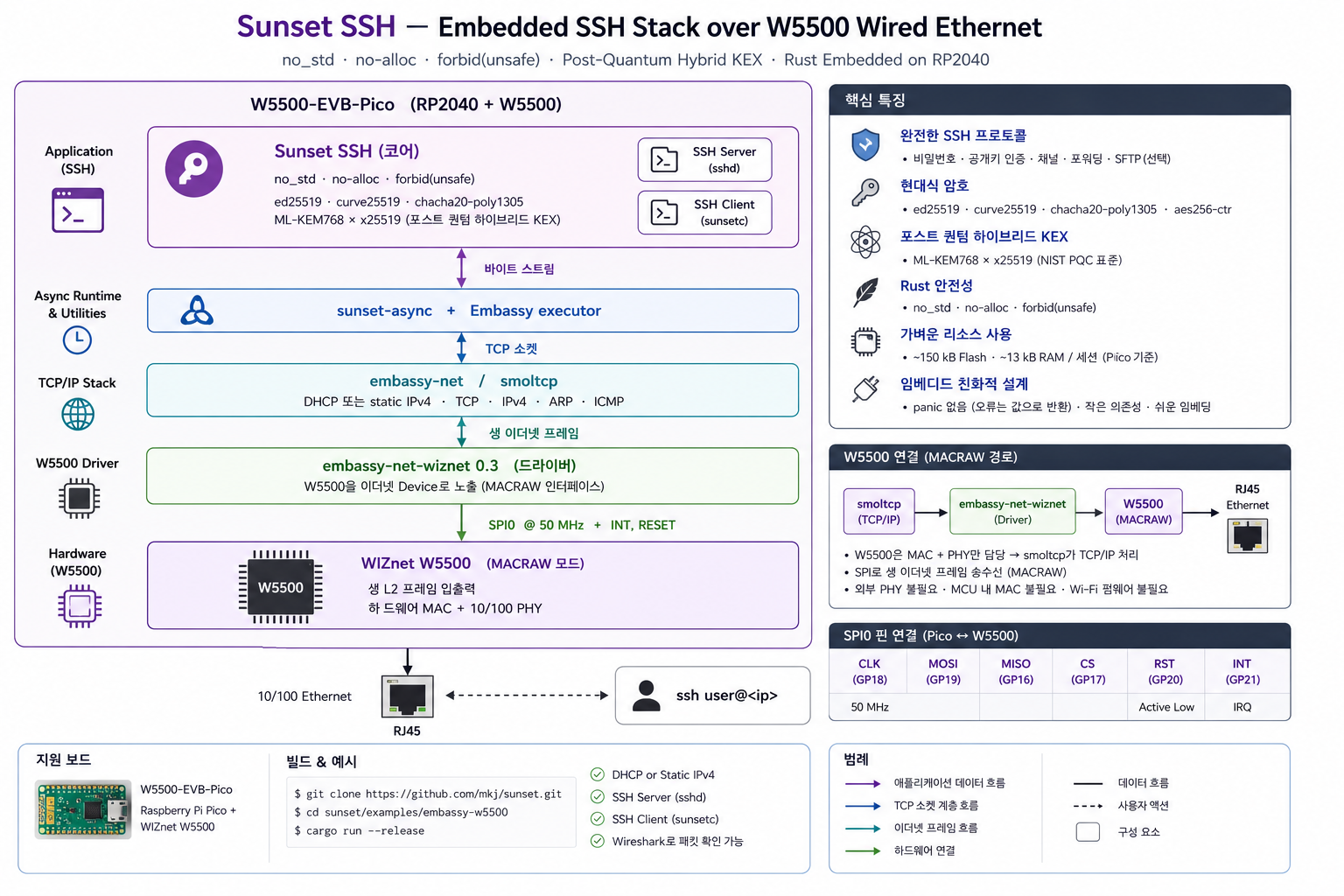
링크 계층이 cyw43 Wi-Fi든 W5500이든 동일한 embassy-net::Stack이 구성된다 — 바뀌는 건 그 아래 디바이스 드라이버뿐이다. 코드에서 점선 위쪽은 전부 동일하다.
04 — 왜 WIZnet W5500인가? ⭐
🔷 기술적 핵심: 이더넷이 없는 칩에 RJ45를 달다
RP2040에는 이더넷 MAC도 PHY도 없다. 여기에 유선 포트를 다는 가장 깔끔한 방법은 둘 다 품고 있는 SPI 주변장치 하나 — 그게 바로 W5500이다. SPI 버스 뒤에 MAC + 10/100 PHY가 들어 있다. Sunset은 이를 SPI0, 50 MHz 로, 전용 reset·interrupt 라인과 함께 구동하며, RP2040과 W5500이 한 PCB에 올라간 WIZnet W5500-EVB-Pico 보드를 쓴다.
🔷 사용 모드: MACRAW(생 이더넷), 하드웨어 TOE 아님
이것이 이 프로젝트를 규정하는 아키텍처 선택이다. W5500은 8개 하드웨어 소켓을 가진 하드와이어드 TCP/IP 오프로드(TOE)로 유명하다. Sunset은 그걸 하나도 쓰지 않는다. 대신 W5500을 MACRAW 모드로 돌려, 칩이 생 이더넷 프레임을 호스트로 그대로 올려보내게 하고, smoltcp / embassy-net 가 TCP/IP 스택 전체를 소프트웨어로 구현한다(medium-ethernet feature와 embassy-net-wiznet의 이더넷 Device 드라이버가 그 근거).
왜 하드웨어 오프로드를 포기할까? SSH가 고정 기능 TOE로는 줄 수 없는 것을 원하기 때문이다.
- 스택 하나, 라디오 둘. Wi-Fi(cyw43) 경로와 유선(W5500) 경로가 동일한
embassy-net인터페이스를 노출한다. SSH 코드는 자기가 어느 쪽에 올라가 있는지 영영 모른다. 유선↔무선 전환은 cargo feature 한 줄 — 기본값cyw43대신--features w5500. - Async 네이티브 소켓. smoltcp는 Embassy executor와 통합되어 SSH 세션을 깔끔하게
.await한다. W5500의 8개 하드와이어드 소켓과 고정된 TCP 동작은 현대식 async·다중 세션 SSH 서버에 그만큼 깔끔히 들어맞지 않는다. - TCP/IP 경계의 완전한 제어. 소프트웨어 스택이면 버퍼링·DHCP·연결 처리를 SSH 요구에 맞게 튜닝할 수 있고, 보안과 직결된 네트워킹을 감사 가능한 Rust 안에 둘 수 있다.
요약하면: W5500은 완벽한 링크 계층 시민으로 쓰인다 — "RP2040엔 이더넷이 없다"는 문제를 완전히 해결하면서, 그 위 소프트웨어 스택이 아키텍처를 통일되고 유연하게 유지한다.
🔷 대체 솔루션 대비 우위
Wi-Fi 전용 설계 대비: W5500 유선 링크는 ~200 kB 펌웨어 블롭이 필요 없고(cyw43 경로는 이를 싣는다), 지연 시간이 결정적이며, 산업·고정 설치에 맞는 선택이다. 별도 MAC + 외부 PHY(예: 더 큰 MCU에 MII/RMII PHY를 붙이는 방식) 대비: W5500은 MAC과 PHY를 SPI 부착 부품 하나로 합쳐서, 네트워킹 주변장치가 전무한 RP2040조차 깔끔한 RJ45를 얻는다. ENC28J60(또 다른 흔한 SPI 이더넷 부품) 대비: W5500은 더 새로운 10/100 장치이고, Rust 드라이버(embassy-net-wiznet) 지원이 더 좋으며, 훗날 필요해지면 TOE로 전환할 선택지까지 남겨둔다.
🔷 검증된 증거 ✅
- W5500 백엔드는 데모의 일급 선택 가능 빌드 타깃이다. cargo feature
w5500이embassy-net-wiznet = "0.3.0"을 끌어오고,main.rs는cyw43/w5500중 어느 것도 (혹은 둘 다) 선택되지 않으면compile_error!를 낸다 — 통합이 구호가 아니라 실제로 배선돼 있다. - 하드웨어 초기화 전체가 레포 안에 있다(
demo/picow/src/w5500.rs): SPI 설정, 칩 리셋, 인터럽트 입력, MAC 할당, DHCP-혹은-static IPv4 스택 구성. - 온디바이스 풋프린트가 실측·문서화돼 있다: Pico급 장비에서 ~150 kB 플래시, SSH 세션당 ~13 kB RAM.
- 보드가
Cargo.toml에 명시돼 있다: "for wiznet w5500-evb-pico board."
05 — 핵심 컴포넌트
🌐 WIZnet W5500 — MACRAW 모드, SPI 부착 MAC + PHY
RP2040을 유선 네트워크 노드로 만들어주는 단일 칩. INT/RESET 라인과 함께 SPI0 50 MHz로 구동되며, 생 이더넷 디바이스로 동작해 TCP/IP는 호스트 스택이 소유한다. W5500-EVB-Pico에서는 MCU와 같은 보드에 올라가 있다.
⚙️ embassy-net-wiznet 0.3 — 드라이버 브리지
W5500을 embassy-net에 표준 이더넷 Device로 노출한다. 유선 경로를 Wi-Fi 경로와 드롭인 호환으로 만드는 이음새다.
🌐 embassy-net / smoltcp — 소프트웨어 TCP/IP
SSH를 실어 나르는 순수 Rust TCP/IP 스택. DHCP, static IPv4, 그리고 SSH 리스너가 bind 하는 TCP 소켓을 처리한다.
🔐 Sunset 코어 — SSH 엔진
no_std, no-alloc, forbid(unsafe) SSH 클라이언트/서버: ed25519, curve25519, chacha20-poly1305, aes256-ctr, hmac-sha256, 그리고 ML-KEM768×x25519 포스트 퀀텀 하이브리드 키 교환.
🦀 Embassy executor + RP2040
플래시 설정·USB 콘솔·시리얼·네트워크 리스너 태스크를 묶는 async 런타임과 듀얼코어 Cortex-M0+ 호스트.
06 — 활용 시나리오
01. 산업용 유선 원격 관리
공장 현장의 컨트롤러가 결정적이고 EMI에 강한 RJ45 링크 위로 진짜 SSH 서버를 노출한다 — Wi-Fi도, 클라우드도 없이, 표준 ssh/scp 도구로 관리.
02. 보안 시리얼 콘솔 서버
데모는 UART 파이프를 SSH 세션에 연결한다. W5500-EVB-Pico가 실험 장비용의 작은 네트워크 시리얼 콘솔 / 점프 박스가 되어 이더넷으로 접근 가능해진다.
03. 미래 대비 엣지 장비
ML-KEM 하이브리드 키 교환 덕에, 오늘 배치한 임베디드 노드가 "지금 수집하고 나중에 복호화" 공격에 견딘다 — 1만 원 이하 유선 포트 보드 위의 포스트 퀀텀 SSH.
04. 임베디드 Rust 네트워킹 레퍼런스 디자인
깔끔한 cyw43↔W5500 교체는 embassy-net을 WIZnet 칩 위에 올리는 법을 배우는 팀에게 교과서적 예시다. 베껴 쓸 수 있는 완전한 SPI 초기화 코드까지 포함.
결론
Sunset은 완전하고 현대적이며 포스트 퀀텀까지 준비된 SSH 서버가 마이크로컨트롤러에 들어간다는 것을 증명한다 — 그리고 그 마이크로컨트롤러에 진짜 유선 네트워크 포트를 주는 것이 WIZnet W5500이다.
- ✅
no_std, no-alloc,forbid(unsafe)Rust로 만든 완전한 SSH 클라이언트 + 서버 - ✅ Pico급 하드웨어에서 ~150 kB 플래시, 세션당 ~13 kB RAM
- ✅ 포스트 퀀텀 하이브리드 키 교환(ML-KEM768 × x25519)
- ✅ W5500-EVB-Pico에서 WIZnet W5500을 통한 유선 이더넷
- ✅ 통일된 Wi-Fi/유선 스택을 위해 W5500을 smoltcp/embassy-net 아래 MACRAW 모드로 운용
- ✅ 무선↔유선 한 줄 전환(
--features w5500) - ✅ 완전한 SPI 하드웨어 초기화 포함; 선택 가능하고 컴파일 단계에서 검증되는 빌드 타깃
- ✅ Dropbear SSH의 저자가 만든 프로젝트
Q&A
Q. Sunset은 W5500의 하드웨어 TCP/IP 오프로드(TOE)를 쓰나요? 아니요. W5500을 MACRAW 모드로 씁니다 — 칩은 생 이더넷 프레임을 옮기고, TCP/IP는 smoltcp/embassy-net가 소프트웨어로 처리합니다. 이는 의도적입니다: 유선 경로와 Wi-Fi(cyw43) 경로가 동일한 async 네트워크 스택을 공유하게 해주는데, 이쪽이 W5500의 고정 8소켓 TOE보다 다중 세션 SSH 서버에 더 잘 맞습니다.
Q. 그냥 Pico W의 Wi-Fi를 쓰면 되지 왜 W5500인가요? 유선 이더넷은 결정적 지연, RF 간섭 없음, ~200 kB Wi-Fi 펌웨어 블롭 불필요를 주고, 산업·고정 설치에 맞습니다. 또 이더넷 하드웨어가 전무한 맨 RP2040에 진짜 RJ45를 달아줍니다.
Q. 나중에 W5500의 TOE로 전환할 수 있나요? 원리상 가능합니다 — W5500은 TCP/UDP 소켓 모드도 지원합니다. 다만 Wi-Fi 경로와 공유하던 통일된 smoltcp 인터페이스를 잃게 되므로, 이 아키텍처에서는 MACRAW가 더 나은 선택입니다.
Q. W5500 경로는 양산 준비가 됐나요? 통합은 실제로 존재하고 컴파일 단계에서 검증되며, 하드웨어 초기화 전체가 레포에 있습니다. 다만 빠르게 발전 중인 라이브러리인 만큼, 배치하는 쪽에서 버전을 고정하고 실제 하드웨어 검증을 직접 수행하는 것이 좋습니다.