



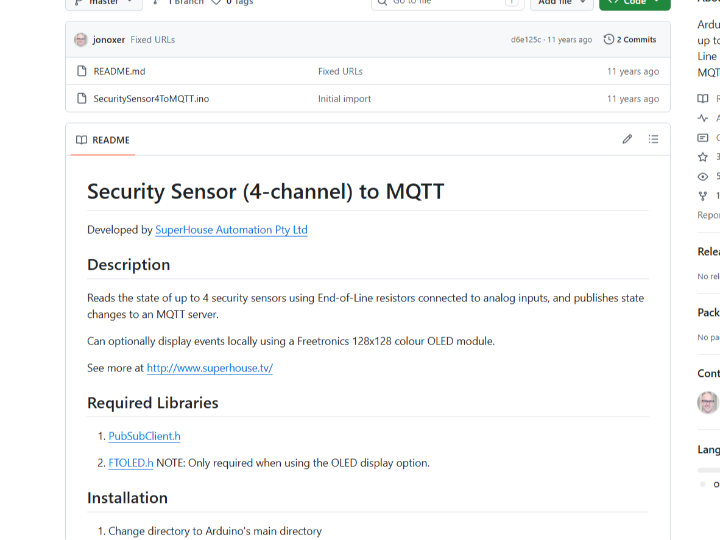
SecuritySensor4ToMQTT
Arduino sketch to read the status of up to 4 security sensors using End Of Line resistors and push events to MQTT
SecuritySensor4ToMQTT — Turning a Wired Alarm Loop into an MQTT Event Stream
#HomeSecurity #MQTT #EOLResistor #AlarmPanel #Arduino #WIZnet #W5100 #TOE #TCP #HomeAutomation
📚 Context: Hobby / home-automation building block, published by SuperHouse Automation Pty Ltd (Jonathan Oxer) in 2015. A compact, single-sketch Arduino firmware. Implementation status: Code-complete and field-oriented — network bring-up, MAC-from-ROM, 6-state sensor supervision, and live MQTT publishing are all present in the sketch. The repository is code-only (no captured logs/screenshots), so behaviour is verified from the source, not from bundled test artifacts.
01 — What is this project?
Traditional wired intrusion alarms are wonderfully reliable but stubbornly closed. A classic panel sits in a cupboard, reads its End-of-Line (EOL) resistor loops, and — if you're lucky — dials a monitoring centre. Getting those same sensor states into a modern smart-home stack (Home Assistant, Node-RED, a phone dashboard) usually means either ripping the panel out or bolting on an expensive proprietary bridge.
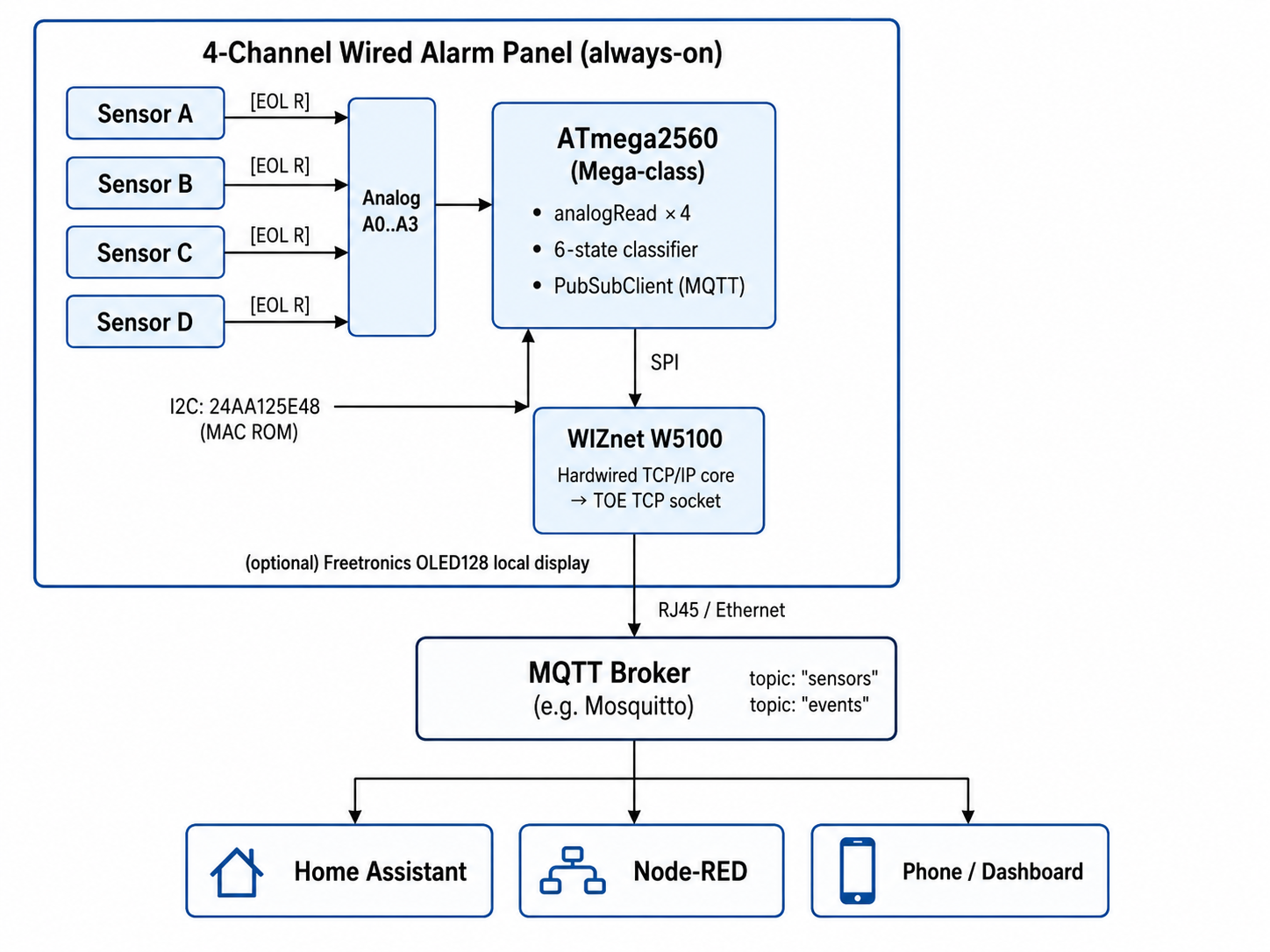
SecuritySensor4ToMQTT takes the opposite approach: it is the panel, but it speaks MQTT natively. The firmware reads up to four security sensors wired with End-of-Line resistors into analog inputs, classifies each loop into one of six electrically-distinct states, and publishes every state change to an MQTT broker as a plain, easy-to-consume message.
Because it uses EOL resistors rather than simple dry contacts, it doesn't just know "open vs closed" — it can tell Normal, Tamper, Alarm, Alarm+Tamper, Shorted, and Cut apart by measuring where the analog reading lands. That is genuine alarm-grade supervision: a snipped wire or a shorted loop is reported as an event, not silently ignored.
The end result is a small, always-on box that turns a professional wired sensor topology into a stream of MQTT events any home-automation platform can subscribe to — with an optional on-device colour OLED for local status.
02 — Why MQTT + EOL supervision?
🔷 EOL resistors = tamper-aware sensing, not just on/off
A dry-contact sensor gives you one bit. An EOL-resistor loop gives you a value. By placing a known resistor at the far end of the loop, the panel can distinguish a healthy "Normal" loop from an "Alarm" (contact opened), a "Tamper" (enclosure interfered with), a "Cut" wire, or a "Shorted" loop. The project encodes this directly as ADC threshold bands (0–162 Short, 163–409 Normal, 410–551 Tamper, 552–641 Alarm, 642–848 Alarm+Tamper, 849–1023 Cut). This is the difference between a hobby reed switch and a supervised security zone.
🔷 MQTT = drop-in integration with the modern smart home
Rather than inventing a protocol, the firmware publishes to standard MQTT topics (sensors for state changes, events on startup). That means it works out-of-the-box with Mosquitto, Home Assistant, Node-RED, or any dashboard that speaks MQTT — no custom server, no polling, just lightweight pub/sub over a persistent TCP connection.
🔷 Always-on, low-overhead, and cheap to duplicate
Each panel carries a panelId, so you can scatter several boxes around a building and let them all report to one broker with unambiguous message prefixes. The design is deliberately minimal — one sketch, a couple of libraries — which keeps it approachable and easy to reproduce.
03 — System architecture
04 — Why WIZnet W5100? ⭐
🔷 The technical core: a hardwired TCP/IP stack next to a small MCU
The panel runs on an ATmega2560-class Arduino board (the sketch uses digital pins up to 53 and an I2C MAC ROM, the hallmark of a Freetronics EtherMega-style board). That MCU has generous flash but only a few kilobytes of SRAM — and it is already busy continuously sampling four analog loops, running a state machine, driving an OLED, and maintaining an MQTT session. Handing the entire TCP/IP job to software would be the wrong trade.
The WIZnet W5100 solves exactly this. It integrates a hardwired TCP/IP core (TCP, UDP, ICMP, IPv4, ARP) plus the 10/100 Ethernet MAC & PHY, exposes 4 independent hardware sockets backed by a 16 KB internal TX/RX buffer, and connects to the MCU over SPI. The three-way handshake, retransmissions, checksums and ACKs all happen inside the W5100 silicon — the ATmega only reads and writes socket payloads.
🔷 Socket mode used: TOE TCP (Sn_MR_TCP)
This project lives entirely in the W5100's TCP Offload Engine (TOE) TCP mode. The MQTT client (PubSubClient) opens a persistent TCP connection to the broker on port 1883 (client.connect(...)) and publishes over it (client.publish("sensors", ...)). No UDP, no MACRAW — just a rock-solid offloaded TCP session, which is exactly what a long-lived MQTT link to an always-on alarm panel wants.
🔷 Advantage over the alternatives
Compared with a MAC+PHY-only chip like the ENC28J60, which forces a software TCP/IP stack (e.g. UIPEthernet) that consumes precious SRAM and CPU, the W5100 gives this panel a reliable network link at near-zero MCU cost. On a device that must never drop its alarm-reporting connection while simultaneously supervising four zones, that offload is the difference between "works on the bench" and "runs for months in a cupboard." It also drops straight into the standard Arduino Ethernet library, so the whole network layer is a handful of lines (Ethernet.begin(mac) and away it goes).
🔷 Verified evidence ✅
- Network bring-up in code:
Ethernet.begin(mac)(DHCP) andEthernet.begin(mac, ip)(static) — both paths present. The source even comments the intent: "setup the Ethernet library to talk to the Wiznet board." - Live MQTT over TCP:
PubSubClient client(server, 1883, callback),client.connect(...),client.publish("sensors", ...)and a startupclient.publish("events", "Starting up"). - Production-style identity: unique MAC pulled from an I2C ROM (Microchip 24AA125E48) with a static fallback.
- Genuine supervision: six ADC threshold bands encode Short / Normal / Tamper / Alarm / Alarm+Tamper / Cut.
05 — Key components
🌐 WIZnet W5100 — TOE TCP socket mode
The networking heart of the panel. Hardwired TCP/IP core with integrated MAC & PHY, 4 hardware sockets, 16 KB buffer, SPI host interface. Here it carries a single persistent TOE TCP connection to the MQTT broker.
🧠 ATmega2560-class Arduino (Freetronics EtherMega-style)
Samples the four analog loops, runs the 6-state classifier, and hosts the MQTT client. Uses pins up to 53 → a Mega-class MCU rather than an Uno.
📟 Microchip 24AA125E48 MAC ROM (I2C)
Provides a globally-unique, burned-in MAC address so multiple panels never collide on the network — read over I2C at boot.
📚 PubSubClient (MQTT)
Lightweight Arduino MQTT client handling the publish/subscribe session to the broker.
🖥️ Freetronics OLED128 (optional, FTOLED)
128×128 colour OLED for on-device status and event display when a headless box isn't desired.
🔌 EOL-resistor sensor loops ×4
End-of-Line resistors turn each sensor into a supervised analog loop, enabling tamper/cut/short discrimination rather than plain open/closed.
06 — Application scenarios
01. Retrofitting a legacy wired alarm into a smart home Reuse existing EOL-resistor sensor wiring, but publish every zone change to MQTT so Home Assistant or Node-RED can automate lights, notifications, or sirens.
02. Multi-zone home / small-office intrusion monitoring Four supervised zones per box, with tamper and wire-cut detection — meaningful security coverage that a phone dashboard can watch in real time.
03. Perimeter supervision that survives sabotage Because the loop is supervised, a cut or shorted wire is itself an event. An intruder disabling a sensor triggers an alarm instead of a silent blind spot.
04. Distributed panels across a building Deploy several units, each with a distinct panelId, all publishing to one broker — a cheap way to cover a whole site while keeping messages unambiguous.
Conclusion
A wired burglar-alarm loop is about as far from "networking gear" as home hardware gets — yet here a WIZnet W5100 quietly carries every alarm event onto the network, turning a closed panel into an open MQTT stream.
- ✅ Four supervised EOL-resistor zones with six discriminated states (Normal / Tamper / Alarm / Alarm+Tamper / Short / Cut)
- ✅ Reliable, always-on network link via WIZnet W5100 in TOE TCP mode — offloaded TCP at near-zero MCU cost
- ✅ Native MQTT pub/sub (
PubSubClient) → drops straight into Home Assistant / Node-RED / any MQTT dashboard - ✅ Production-style unique MAC from I2C ROM with DHCP-or-static flexibility
- ✅ Optional on-device colour OLED status without any extra host
- ✅ Multi-panel scalable via per-box
panelId - ✅ Reach: from FPGA firewalls to end-of-line alarm resistors, WIZnet silicon keeps turning up wherever something has to reliably talk IP — including inside a domestic security panel.
07 — Similar Projects on WIZnet Makers
The WIZnet Makers platform already hosts a small cluster of wired-security and sensor-to-broker projects. Placing SecuritySensor4ToMQTT among them shows a clear spectrum — from bare sensor demos to full supervised-and-published panels.
- Intrusion detection system using W5100 + Arduino — a W5100 + Arduino intrusion-detection build; the closest sibling in silicon and MCU family. (
maker.wiznet.io/WIZnet/projects/intrusion-detection-system-using-w5100-arduino/) - A simple burglar Alarm: motion sensor, noise sensor and ethernet shield — reads motion and noise sensors over an Ethernet shield; multi-sensor alarm, different sensing style. (
maker.wiznet.io/Alan/projects/a-simple-burglar-alarm...) - Proof of Concept Door Alarm — an Ethernet-shield door-alarm example, monitored via the Arduino platform. (
maker.wiznet.io/WIZnet/projects/proof-of-concept-door-alarm/) - Arduino MEGA + Ethernet Shield + PIR — a Mega-class board reading a PIR sensor and surfacing data to phone/desktop. (
maker.wiznet.io/WIZnet/projects/arduino-mega-ethernet-shield-pir/) - Send data from DHT11 sensor using MQTT with Pi Pico and W5500 — the modern MQTT counterpart: a Pico + W5500 pushing sensor data over MQTT. (
maker.wiznet.io/wiz_chandana/projects/send-data-from-dht11-sensor-using-mqtt-with-pi-pico-and-w5500/)
| Project | MCU | WIZnet chip | Sensing approach | Reporting method | Distinctive angle |
|---|---|---|---|---|---|
| SecuritySensor4ToMQTT (this) | ATmega2560 (Mega) | W5100 | 4× EOL-resistor loops, 6 states | MQTT over TOE TCP | Supervised (tamper/cut) and MQTT-published |
| Intrusion detection (W5100 + Arduino) | Arduino | W5100 | Intrusion sensor(s) | Ethernet-connected | Same chip/MCU family; intrusion focus |
| Simple burglar Alarm (Alan) | Arduino | Ethernet shield (WIZnet) | Motion + noise sensors | Ethernet shield | Multi-sensor, non-supervised loops |
| Proof of Concept Door Alarm | Arduino | Ethernet shield (WIZnet) | Door sensor | Monitored via Arduino platform | Minimal PoC demo |
| Arduino MEGA + Ethernet + PIR | ATmega2560 (Mega) | Ethernet shield (WIZnet) | PIR motion | Phone / desktop view | Same board class; single PIR |
| DHT11 → MQTT (Pico + W5500) | RP2040 (Pico) | W5500 | DHT11 environmental | MQTT | Modern chip; telemetry, not security |
Insight: This ecosystem spans two axes — sensing sophistication (dry-contact/PIR demos vs. supervised EOL loops) and reporting maturity (view-on-a-web-page vs. MQTT pub/sub). Most of the security-domain entries sit at the demo end of one axis or the other. SecuritySensor4ToMQTT is distinctive because it lands high on both at once: genuine alarm-grade EOL supervision and clean MQTT integration. The DHT11+Pico+W5500 project shows where the platform's newer hardware takes the same sensor-to-broker pattern — but toward environmental telemetry rather than security. In short, this project is the "grown-up alarm panel" of the cluster.
Q&A
Q. Which WIZnet socket mode does this use, and why not UDP? A. It uses TOE TCP (Sn_MR_TCP). MQTT rides on a persistent TCP connection, and for an always-on alarm reporter you want TCP's guaranteed, ordered delivery and connection awareness — a dropped/re-established session is itself information. UDP would trade that reliability away for latency the application doesn't need.
Q. Does the W5100 do the TCP work, or the ATmega? A. The W5100 does it. Its hardwired TCP/IP core handles the handshake, retransmission, checksums and ACKs in silicon; the ATmega only reads/writes socket payloads over SPI. That offload is precisely why an 8 KB-SRAM MCU can comfortably supervise four zones and hold an MQTT link.
Q. What makes the sensing "supervised" rather than a simple switch? A. The End-of-Line resistors. By measuring the analog value of each loop (not just open/closed), the firmware distinguishes Normal, Tamper, Alarm, Short and Cut — so tampering or a severed wire is reported as an event instead of being silently missed.
Q. Could this be moved to a newer WIZnet part? A. Conceptually yes — the same TOE TCP / MQTT pattern maps cleanly onto W5100S or W5500 (as the Pico + W5500 sibling project demonstrates), which is a natural modernization path for anyone rebuilding this today.
SecuritySensor4ToMQTT — 유선 알람 루프를 MQTT 이벤트 스트림으로
#홈보안 #MQTT #EOL저항 #알람패널 #Arduino #WIZnet #W5100 #TOE #TCP #홈오토메이션
📚 컨텍스트: SuperHouse Automation Pty Ltd(Jonathan Oxer)가 2015년에 공개한 홈 오토메이션용 빌딩 블록. 단일 스케치로 이뤄진 컴팩트한 Arduino 펌웨어. 구현 상태: 코드 완결 + 현장 지향형 — 네트워크 초기화, ROM에서 MAC 읽기, 6-상태 센서 감시, 실시간 MQTT 발행이 모두 스케치 안에 들어 있음. 저장소는 코드 전용(로그/스크린샷 없음)이라, 동작은 번들 테스트 산출물이 아니라 소스 코드로 검증했다.
01 — 이 프로젝트는 무엇인가?
전통적인 유선 침입 알람은 지독하게 신뢰성 높지만, 그만큼 지독하게 폐쇄적이다. 고전적인 패널은 벽장 안에 박혀 End-of-Line(EOL) 저항 루프를 읽고, 운이 좋으면 관제센터로 전화를 건다. 이 센서 상태들을 요즘 스마트홈 스택(Home Assistant, Node-RED, 폰 대시보드)으로 끌어오려면 대개 패널을 통째로 뜯어내거나, 비싼 독점 브리지를 덧붙여야 한다.
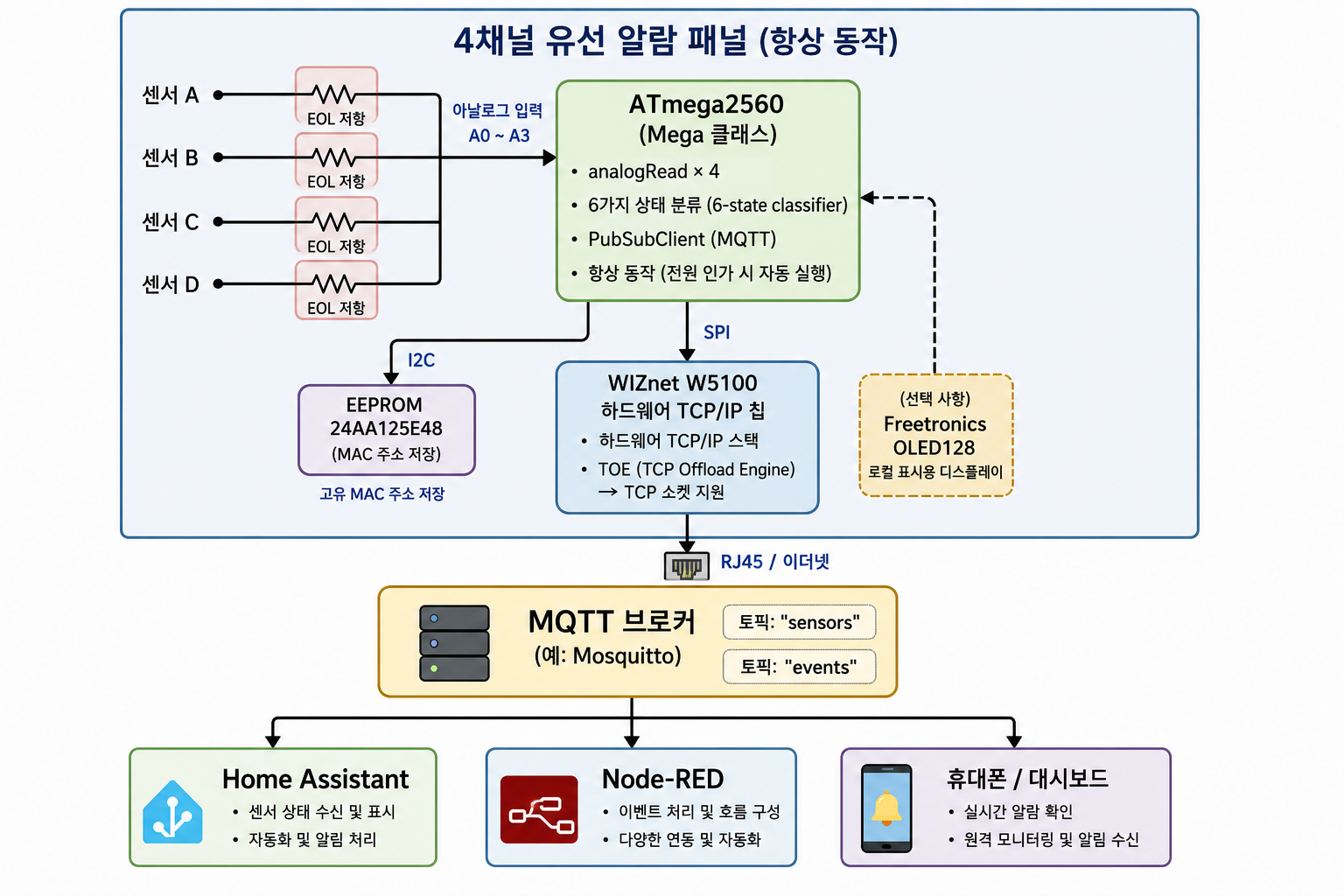
SecuritySensor4ToMQTT는 정반대로 접근한다. 이건 그 자체로 패널이면서, MQTT를 네이티브로 말한다. 펌웨어는 EOL 저항으로 배선된 최대 4개의 보안 센서를 아날로그 입력으로 읽어, 각 루프를 전기적으로 구분되는 6가지 상태 중 하나로 분류하고, 상태가 바뀔 때마다 MQTT 브로커로 소비하기 쉬운 평문 메시지를 발행한다.
단순 드라이 접점이 아니라 EOL 저항을 쓰기 때문에, "열림 vs 닫힘"만 아는 게 아니다. 아날로그 측정값이 어느 구간에 떨어지는지를 보고 **Normal(정상), Tamper(변조), Alarm(경보), Alarm+Tamper, Shorted(단락), Cut(절단)**을 구분한다. 이것이 진짜 알람 등급 감시다 — 잘린 배선이나 단락된 루프가 조용히 무시되지 않고 이벤트로 보고된다.
최종 결과물은 작고 항상 켜져 있는 박스 하나로, 전문가급 유선 센서 토폴로지를 어떤 홈 오토메이션 플랫폼이든 구독할 수 있는 MQTT 이벤트 스트림으로 바꿔준다. 원한다면 기기 자체 컬러 OLED로 로컬 상태 표시도 가능하다.
02 — 왜 MQTT + EOL 감시인가?
🔷 EOL 저항 = 단순 on/off가 아니라 변조 감지가 되는 센싱
드라이 접점 센서는 1비트를 준다. EOL 저항 루프는 값을 준다. 루프 끝에 정해진 저항을 두면, 패널은 건강한 "Normal" 루프와 "Alarm"(접점 열림), "Tamper"(하우징 조작), "Cut"(배선 절단), "Shorted"(단락)을 구분할 수 있다. 이 프로젝트는 이걸 ADC 임계 구간으로 직접 인코딩한다(0–162 Short, 163–409 Normal, 410–551 Tamper, 552–641 Alarm, 642–848 Alarm+Tamper, 849–1023 Cut). 취미용 리드 스위치와 감시되는 보안 존(zone)의 차이가 바로 이것이다.
🔷 MQTT = 요즘 스마트홈에 그대로 꽂히는 통합
프로토콜을 새로 발명하는 대신, 펌웨어는 표준 MQTT 토픽으로 발행한다(상태 변화는 sensors, 부팅 시엔 events). 덕분에 Mosquitto, Home Assistant, Node-RED, 또는 MQTT를 말하는 어떤 대시보드와도 별도 설정 없이 바로 동작한다 — 커스텀 서버도, 폴링도 없이, 지속적 TCP 연결 위에서 가벼운 pub/sub만 오간다.
🔷 항상 켜져 있고, 오버헤드가 낮고, 복제가 싸다
각 패널은 panelId를 갖기 때문에, 여러 박스를 건물 곳곳에 뿌려 하나의 브로커로 명확한 메시지 접두사와 함께 보고하게 할 수 있다. 설계는 의도적으로 최소화돼 있다 — 스케치 하나, 라이브러리 몇 개 — 그래서 접근하기 쉽고 재현하기 쉽다.
03 — 시스템 아키텍처
04 — 왜 WIZnet W5100인가? ⭐
🔷 기술적 핵심: 작은 MCU 옆에 붙은 하드와이어드 TCP/IP 스택
패널은 ATmega2560급 Arduino 보드에서 돌아간다(스케치가 디지털 핀을 53번까지 쓰고 I2C MAC ROM을 사용 — Freetronics EtherMega 계열 보드의 특징). 이 MCU는 플래시는 넉넉하지만 SRAM은 몇 KB뿐이고, 이미 4개 아날로그 루프를 끊임없이 샘플링하고, 상태 머신을 돌리고, OLED를 구동하고, MQTT 세션을 유지하느라 바쁘다. TCP/IP 작업 전체를 소프트웨어에 떠넘기는 건 잘못된 선택이다.
WIZnet W5100이 바로 이 문제를 푼다. 하드와이어드 TCP/IP 코어(TCP, UDP, ICMP, IPv4, ARP)와 10/100 이더넷 MAC & PHY를 통합하고, 16 KB 내부 TX/RX 버퍼로 뒷받침되는 4개 독립 하드웨어 소켓을 제공하며, SPI로 MCU와 연결된다. 3-way 핸드셰이크, 재전송, 체크섬, ACK가 전부 W5100 실리콘 내부에서 처리되고, ATmega는 소켓 페이로드만 읽고 쓴다.
🔷 사용 소켓 모드: TOE TCP (Sn_MR_TCP)
이 프로젝트는 전적으로 W5100의 TCP Offload Engine(TOE) TCP 모드 위에서 산다. MQTT 클라이언트(PubSubClient)가 브로커의 1883 포트로 지속적 TCP 연결을 열고(client.connect(...)), 그 위에서 발행한다(client.publish("sensors", ...)). UDP도, MACRAW도 아니다 — 오프로드된 견고한 TCP 세션 하나뿐이고, 이것이 항상 켜진 알람 패널의 장수(long-lived) MQTT 링크가 정확히 원하는 것이다.
🔷 대체 솔루션 대비 우위
MAC+PHY만 있는 ENC28J60 같은 칩은 소프트웨어 TCP/IP 스택(예: UIPEthernet)을 강제하고, 이는 귀한 SRAM과 CPU를 잡아먹는다. 반면 W5100은 이 패널에 거의 제로에 가까운 MCU 비용으로 신뢰성 있는 네트워크 링크를 준다. 4개 존을 감시하면서 알람 보고 연결을 절대 끊어선 안 되는 기기에서, 이 오프로드는 "실험실에서 됨"과 "벽장에서 몇 달을 돈다"의 차이다. 또한 표준 Arduino Ethernet 라이브러리에 그대로 꽂혀서, 네트워크 계층 전체가 몇 줄로 끝난다(Ethernet.begin(mac) 한 줄로 출발).
🔷 검증된 증거 ✅
- 코드 내 네트워크 초기화:
Ethernet.begin(mac)(DHCP)와Ethernet.begin(mac, ip)(고정) — 두 경로 모두 존재. 소스가 의도까지 주석으로 남김: "setup the Ethernet library to talk to the Wiznet board." - 실시간 MQTT over TCP:
PubSubClient client(server, 1883, callback),client.connect(...),client.publish("sensors", ...), 그리고 부팅 시client.publish("events", "Starting up"). - 양산형 아이덴티티: I2C ROM(Microchip 24AA125E48)에서 읽어온 고유 MAC + 고정 MAC 폴백.
- 진짜 감시: 6개 ADC 임계 구간이 Short / Normal / Tamper / Alarm / Alarm+Tamper / Cut를 인코딩.
05 — 핵심 구성요소
🌐 WIZnet W5100 — TOE TCP 소켓 모드
패널의 네트워킹 심장. 하드와이어드 TCP/IP 코어에 MAC & PHY 통합, 4개 하드웨어 소켓, 16 KB 버퍼, SPI 호스트 인터페이스. 여기선 MQTT 브로커로 가는 지속적 TOE TCP 연결 하나를 담당한다.
🧠 ATmega2560급 Arduino (Freetronics EtherMega 계열)
4개 아날로그 루프를 샘플링하고, 6-상태 분류기를 돌리고, MQTT 클라이언트를 호스팅. 핀을 53번까지 쓰므로 Uno가 아니라 Mega급 MCU.
📟 Microchip 24AA125E48 MAC ROM (I2C)
전 세계적으로 고유한 소성(burned-in) MAC 주소를 제공해 여러 패널이 네트워크에서 충돌하지 않도록 함 — 부팅 시 I2C로 읽는다.
📚 PubSubClient (MQTT)
브로커와의 pub/sub 세션을 처리하는 경량 Arduino MQTT 클라이언트.
🖥️ Freetronics OLED128 (옵션, FTOLED)
헤드리스 박스를 원치 않을 때 기기 자체에서 상태·이벤트를 보여주는 128×128 컬러 OLED.
🔌 EOL 저항 센서 루프 ×4
End-of-Line 저항이 각 센서를 감시되는 아날로그 루프로 바꿔, 단순 열림/닫힘이 아니라 변조/절단/단락 구분을 가능케 한다.
06 — 응용 시나리오
01. 레거시 유선 알람을 스마트홈으로 리트로핏 기존 EOL 저항 센서 배선을 그대로 재사용하되, 모든 존 변화를 MQTT로 발행해 Home Assistant나 Node-RED가 조명·알림·사이렌을 자동화하게 한다.
02. 다중 존 가정 / 소규모 사무실 침입 감시 박스당 4개 감시 존에 변조·배선 절단 감지까지 — 폰 대시보드가 실시간으로 지켜볼 수 있는 의미 있는 보안 커버리지.
03. 사보타주에도 견디는 경계선 감시 루프가 감시되므로, 절단이나 단락 자체가 이벤트다. 침입자가 센서를 무력화하면 조용한 사각지대가 아니라 경보가 울린다.
04. 건물 전역의 분산 패널 각기 다른 panelId를 가진 여러 유닛을 배치해 모두 하나의 브로커로 발행 — 메시지를 명확히 유지하면서 현장 전체를 싸게 커버하는 방법.
Conclusion (결론)
유선 도난 알람 루프는 가정용 하드웨어 중에서도 "네트워킹 장비"와 가장 멀리 떨어진 물건이다 — 그런데 여기서도 WIZnet W5100이 조용히 모든 알람 이벤트를 네트워크로 실어 나르며, 폐쇄된 패널을 열린 MQTT 스트림으로 바꿔놓는다.
- ✅ 6가지 상태(Normal / Tamper / Alarm / Alarm+Tamper / Short / Cut)를 구분하는 감시형 EOL 저항 존 4개
- ✅ TOE TCP 모드의 WIZnet W5100으로 신뢰성 있는 상시 네트워크 링크 — 거의 제로 MCU 비용의 오프로드 TCP
- ✅ 네이티브 MQTT pub/sub(
PubSubClient) → Home Assistant / Node-RED / 어떤 MQTT 대시보드든 그대로 연결 - ✅ I2C ROM에서 읽는 고유 MAC + DHCP/고정 유연성의 양산형 설계
- ✅ 별도 호스트 없이 기기 자체 컬러 OLED 상태 표시(옵션)
- ✅ 박스별
panelId로 다중 패널 확장 가능 - ✅ Reach: FPGA 방화벽부터 End-of-Line 알람 저항까지, WIZnet 실리콘은 뭔가 IP로 안정적으로 통신해야 하는 곳이라면 어디든 — 가정용 보안 패널 안에까지 — 계속 등장한다.
07 — WIZnet Makers 내 유사 프로젝트
WIZnet Makers 플랫폼에는 이미 유선 보안·센서→브로커 계열 프로젝트가 소규모로 모여 있다. SecuritySensor4ToMQTT를 그 사이에 놓으면 명확한 스펙트럼이 보인다 — 맨몸 센서 데모부터 완전한 "감시 + 발행" 패널까지.
- Intrusion detection system using W5100 + Arduino — W5100 + Arduino 침입 탐지 빌드. 실리콘과 MCU 계열이 가장 가까운 형제. (
maker.wiznet.io/WIZnet/projects/intrusion-detection-system-using-w5100-arduino/) - A simple burglar Alarm: motion sensor, noise sensor and ethernet shield — 이더넷 실드 위에서 모션·소음 센서를 읽는 다중 센서 알람. 센싱 방식이 다름. (
maker.wiznet.io/Alan/projects/a-simple-burglar-alarm...) - Proof of Concept Door Alarm — 이더넷 실드 도어 알람 예제. Arduino 플랫폼으로 모니터링. (
maker.wiznet.io/WIZnet/projects/proof-of-concept-door-alarm/) - Arduino MEGA + Ethernet Shield + PIR — Mega급 보드로 PIR 센서를 읽어 폰/데스크톱으로 데이터 노출. (
maker.wiznet.io/WIZnet/projects/arduino-mega-ethernet-shield-pir/) - Send data from DHT11 sensor using MQTT with Pi Pico and W5500 — 현대판 MQTT 대응군: Pico + W5500이 센서 데이터를 MQTT로 푸시. (
maker.wiznet.io/wiz_chandana/projects/send-data-from-dht11-sensor-using-mqtt-with-pi-pico-and-w5500/)
| 프로젝트 | MCU | WIZnet 칩 | 센싱 방식 | 보고 방식 | 차별 포인트 |
|---|---|---|---|---|---|
| SecuritySensor4ToMQTT (본건) | ATmega2560 (Mega) | W5100 | EOL 저항 루프 4개, 6상태 | TOE TCP 위 MQTT | 감시형(변조/절단) 이면서 MQTT 발행 |
| Intrusion detection (W5100 + Arduino) | Arduino | W5100 | 침입 센서 | 이더넷 연결 | 동일 칩/MCU 계열; 침입 초점 |
| Simple burglar Alarm (Alan) | Arduino | 이더넷 실드(WIZnet) | 모션 + 소음 | 이더넷 실드 | 다중 센서, 비감시 루프 |
| Proof of Concept Door Alarm | Arduino | 이더넷 실드(WIZnet) | 도어 센서 | Arduino 플랫폼 모니터링 | 최소 PoC 데모 |
| Arduino MEGA + Ethernet + PIR | ATmega2560 (Mega) | 이더넷 실드(WIZnet) | PIR 모션 | 폰/데스크톱 조회 | 동일 보드급; 단일 PIR |
| DHT11 → MQTT (Pico + W5500) | RP2040 (Pico) | W5500 | DHT11 환경 | MQTT | 현대 칩; 보안 아닌 텔레메트리 |
인사이트: 이 생태계는 두 축으로 펼쳐진다 — 센싱의 정교함(드라이 접점/PIR 데모 vs. 감시형 EOL 루프)과 보고의 성숙도(웹페이지 조회 vs. MQTT pub/sub). 보안 도메인 항목 대부분은 두 축 중 한쪽의 데모 끝단에 머문다. SecuritySensor4ToMQTT가 차별적인 이유는 두 축 모두에서 동시에 높은 곳에 있다는 점이다 — 진짜 알람 등급 EOL 감시 그리고 깔끔한 MQTT 통합. DHT11+Pico+W5500 프로젝트는 같은 "센서→브로커" 패턴이 플랫폼의 신형 하드웨어로 어디까지 가는지 보여주지만, 방향은 보안이 아니라 환경 텔레메트리다. 요컨대 이 프로젝트는 이 묶음의 "다 큰 어른 알람 패널"이다.
Q&A
Q. 어떤 WIZnet 소켓 모드를 쓰며, 왜 UDP가 아닌가? A. TOE TCP(Sn_MR_TCP)를 쓴다. MQTT는 지속적 TCP 연결 위에 올라가며, 항상 켜진 알람 보고기라면 TCP의 보장된 순서 전달과 연결 인지가 필요하다 — 세션이 끊기고 재수립되는 것 자체가 정보다. UDP는 이 애플리케이션이 필요로 하지 않는 지연 이득을 위해 그 신뢰성을 내다 버리는 셈이 된다.
Q. TCP 작업은 W5100이 하나, ATmega가 하나? A. W5100이 한다. 하드와이어드 TCP/IP 코어가 핸드셰이크·재전송·체크섬·ACK를 실리콘에서 처리하고, ATmega는 SPI로 소켓 페이로드만 읽고 쓴다. 이 오프로드 덕분에 8 KB SRAM MCU가 4개 존 감시 와 MQTT 링크 유지를 여유롭게 해낸다.
Q. 무엇이 이 센싱을 단순 스위치가 아니라 "감시형"으로 만드나? A. End-of-Line 저항이다. 각 루프의 아날로그 값을(단순 열림/닫힘이 아니라) 측정함으로써, 펌웨어는 Normal, Tamper, Alarm, Short, Cut을 구분한다 — 변조나 배선 절단이 조용히 누락되지 않고 이벤트로 보고된다.
Q. 더 최신 WIZnet 부품으로 옮길 수 있나? A. 개념적으로 가능하다 — 동일한 TOE TCP / MQTT 패턴이 W5100S나 W5500에 깔끔히 매핑된다(Pico + W5500 형제 프로젝트가 이를 보여준다). 오늘 이걸 다시 만든다면 자연스러운 현대화 경로다.