



NetworkMIDI2
Network MIDI 2.0 C++17 library — binary release (AmeNote Inc.)
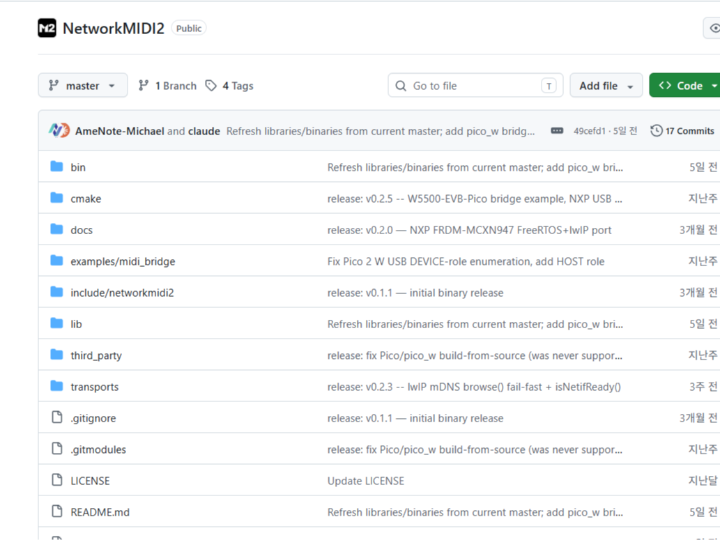
NetworkMIDI2 — W5500 as a First-Class Hardware Target for Network MIDI 2.0
Repository: midi2-dev/NetworkMIDI2
Verified: September 14, 2026
Tags:MIDI 2.0Network MIDI 2.0W5500W5500-EVB-PicoRP2040UDPUMPMACRAWlwIPUSB MIDI
English
01 — Why Does Network MIDI Exist?
MIDI is not audio. It is a control language used by electronic instruments, controllers, computers, lighting systems, and other performance equipment. A MIDI message can describe an action such as “play this note,” “change this parameter,” or “move this control.” The sound is generated somewhere else.
Traditional MIDI connections are usually point-to-point. A five-pin MIDI cable connects one port to another, while USB MIDI normally connects a peripheral to a USB host such as a computer. These methods remain useful, but they become cumbersome when a studio, stage, installation, or test lab contains many devices. More equipment means more cables, more interfaces, and more routing constraints.
Network MIDI moves those control messages onto an IP network. Multiple devices can then communicate through familiar Ethernet or Wi-Fi infrastructure rather than requiring a dedicated physical cable for every logical connection.
Network MIDI 2.0 standardizes this approach for MIDI 2.0. The MIDI Association describes it as a way for devices to discover one another, establish connections, and exchange MIDI 1.0 and MIDI 2.0 messages in Universal MIDI Packet (UMP) format over UDP/IP. It is designed primarily for local-area networks using Ethernet or wireless LAN.
This is the problem that NetworkMIDI2 addresses. It is a C++17 implementation of the Network MIDI 2.0 protocol for desktop and embedded systems. It provides the network session layer needed to carry UMP messages between devices, while platform-specific transport code connects that session layer to POSIX sockets, Winsock, FreeRTOS, or lwIP.
The project therefore serves two related purposes:
It gives software and embedded developers a reusable Network MIDI 2.0 implementation.
It demonstrates complete bridge devices that connect USB MIDI 2.0 equipment to an Ethernet network.
Suggested image 01 — Background concept
A studio or stage with several MIDI controllers and instruments. Contrast multiple direct MIDI/USB cables with one Ethernet network carrying MIDI 2.0 sessions.
02 — What Makes the W5500 Case Important?
W5500 has long been a familiar Ethernet option in embedded music and MIDI projects. What makes this repository more significant than another community experiment is the position that W5500 occupies inside the project.
NetworkMIDI2 is hosted under the midi2-dev GitHub organization. The MIDI Association describes midi2.dev as a developer-resource consortium formed by key contributors and working-group leaders involved in MIDI 2.0. The repository itself is developed and distributed by AmeNote Inc.
Within this repository, W5500 is not merely mentioned in a discussion or left as an optional driver. It appears as a complete, first-class platform target:
The supported-platform table explicitly lists Pico (RP2040) + WIZnet W5500 Ethernet.
A dedicated prebuilt library is supplied under lib/pico/rp2040-w5500/.
The build system has a specific W5500_EVB_PICO board option.
The repository includes the WIZnet ioLibrary driver and an lwIP network-interface port for W5500.
Ready-to-flash UF2 firmware is provided for both USB Device and USB Host bridge roles.
The release notes state that both roles were hardware-validated on a W5500-EVB-Pico.
This supports a precise conclusion: W5500 has become a documented, buildable, precompiled, and hardware-validated reference target in a Network MIDI 2.0 implementation distributed by the midi2-dev developer community.
It does not mean that the MIDI Association has certified W5500, selected it as a mandatory MIDI 2.0 chip, or made it part of the protocol specification. Network MIDI 2.0 is hardware-independent. The importance lies in W5500 being elevated from a commonly used community component to a maintained hardware target in a prominent MIDI 2.0 developer resource.
03 — What Does the Example Actually Build?
The W5500 example turns a W5500-EVB-Pico into a bridge between USB MIDI 2.0 and Ethernet-based Network MIDI 2.0.
The board can be built in either of two roles:
| Firmware role | USB-side behavior | Typical use |
|---|---|---|
| Device | Appears as a USB MIDI 2.0 device to a computer or DAW | Connect a computer to a Network MIDI 2.0 LAN |
| Host | Hosts a directly attached or hub-connected USB MIDI device | Put a USB controller or instrument onto the network without a computer |
The data path is:
A USB MIDI endpoint sends or receives Universal MIDI Packets.
TinyUSB and tusb_ump handle the USB MIDI 2.0 connection.
The bridge application passes UMP data to the NetworkMIDI2 session layer.
NetworkMIDI2 packages the UMP stream according to the Network MIDI 2.0 protocol.
lwIP sends or receives the protocol data as UDP/IP traffic.
The W5500 exchanges raw Ethernet frames with the wired LAN.
The reverse path works in the same way, allowing messages arriving from the network to reach a USB MIDI 2.0 host or device.
Suggested image 02 — System architecture
USB MIDI instrument or DAW ↔ TinyUSB/UMP ↔ RP2040 NetworkMIDI2 bridge ↔ lwIP UDP/IP ↔ W5500 MACRAW Ethernet ↔ LAN ↔ another Network MIDI 2.0 endpoint.
04 — Exactly How Is W5500 Used?
This project contains an important architectural detail that is easy to miss.
Network MIDI 2.0 uses UDP, but this firmware does not open one of W5500’s hardware sockets in UDP mode. Instead, it uses Socket 0 in MACRAW mode. In the W5500, MACRAW mode allows the application to transmit and receive Ethernet frames directly.
The software stack is divided as follows:
| Layer | Implementation in this project |
|---|---|
| Network MIDI 2.0 session and UMP transport | NetworkMIDI2 library |
| UDP/IP, DHCP, ICMP, IGMP, DNS, and mDNS | lwIP on the RP2040 |
| Ethernet-frame input and output | W5500 Socket 0 in MACRAW mode |
| Physical wired network | W5500 10/100 Ethernet interface and RJ45 connector |
The source defines Socket 0 as SOCKET_MACRAW, opens it with Sn_MR_MACRAW, and allocates the W5500’s active TX and RX memory to that socket. The custom lwIP interface then sends complete Ethernet frames through W5500 and reads received frames back into lwIP.
Therefore, the correct use-mode identification is:
W5500 use mode: MACRAW
Application protocol: UDP-based Network MIDI 2.0
IP stack: lwIP running on RP2040
This distinction matters. It shows that W5500 can support a standards-oriented software stack even when an application does not use its hardware TCP/UDP socket engine. In this design, W5500 acts primarily as the wired Ethernet controller beneath lwIP.
05 — Why Choose W5500 for This Bridge?
The repository does not publish a formal component-selection report, so the following interpretation is based on the implementation rather than an explicit statement from the authors.
First, Network MIDI 2.0 is intended for local IP networks, and wired Ethernet offers a direct fit for fixed studio, stage, embedded-product, and test-bench installations. Second, W5500-EVB-Pico combines an RP2040, W5500, RJ45 connector, and USB connector on a compact board. That removes the need to design a custom Ethernet carrier before evaluating the protocol.
Third, the design can reuse established software components. WIZnet’s ioLibrary configures the chip and moves Ethernet frames, while lwIP supplies the UDP/IP services expected by NetworkMIDI2. Finally, the repository provides both the integration source and flashable firmware, lowering the barrier to reproducing the bridge.
The result is not simply “MIDI over a W5500 socket.” It is a layered reference design in which W5500 provides wired Ethernet access to a complete Network MIDI 2.0 stack.
06 — Main Hardware and Software Components
| Component | Role |
|---|---|
| W5500-EVB-Pico | RP2040 development board with integrated W5500 and RJ45 Ethernet |
| RP2040 | Runs the bridge application, lwIP, USB stack, and NetworkMIDI2 integration |
| W5500 | Exchanges Ethernet frames with the LAN through MACRAW Socket 0 |
| NetworkMIDI2 | Implements Network MIDI 2.0 sessions, UMP transport, discovery, keepalive, recovery, and security features |
| lwIP | Implements UDP/IP and network services including DHCP and mDNS |
| WIZnet ioLibrary | Initializes and controls W5500 and transfers frames |
TinyUSB + tusb_ump | Provides USB MIDI 2.0 Device or Host connectivity |
AM_MIDI2.0Lib | Supplies MIDI 2.0 and UMP-related support used by the example |
The W5500-EVB-Pico itself combines a dual-core RP2040 with W5500, 10/100 Ethernet PHY, and RJ45 connector. RP2040 communicates with W5500 over SPI.
07 — NetworkMIDI2 Capabilities
According to the repository documentation, NetworkMIDI2 includes:
Network MIDI 2.0 Host and Client session roles
UDP transport of all UMP message types
Session discovery through the _midi2._udp mDNS service
Keepalive and inactivity handling
Packet-loss recovery using retransmission and forward error correction
Shared-secret challenge-response authentication using SHA-256
Transports for embedded and desktop platforms
The recommended Network MIDI Host port in the example is UDP 5004. The port is configurable and should not be mistaken for a universal requirement of every deployment.
08 — Can the Example Be Reproduced?
Yes, with one licensing limitation.
The repository includes the Pico bridge source, W5500 driver integration, lwIP port, board configuration, CMake build instructions, submodule definitions, and precompiled Device and Host UF2 files. A user can flash the provided binaries directly or clone the repository recursively and build the example with the Pico SDK and the appropriate USB role option.
The release notes explicitly say that both W5500-EVB-Pico roles were hardware-validated. This is stronger evidence than a board name in a compatibility list because the repository also supplies the matching binaries and integration code.
However, the core NetworkMIDI2 implementation is proprietary and distributed as prebuilt static libraries in this repository. Public headers, transports, examples, and binaries are available, but the core source is not. Educational, evaluation, and noncommercial use is offered under the repository’s stated terms; commercial use or access to the core source requires contacting AmeNote.
This means the W5500 bridge is reproducible as a working application, but the entire protocol core cannot be independently audited or rebuilt from the public repository alone.
09 — Where Could This Be Used?
Computer-to-network MIDI gateway
In Device mode, the board appears to a computer or DAW as a USB MIDI 2.0 endpoint and forwards the traffic onto Ethernet. It can give a computer access to a wired Network MIDI 2.0 environment without requiring a built-in Network MIDI interface.
Network adapter for a USB MIDI instrument
In Host mode, the board can host a USB MIDI controller or instrument and bridge it to the LAN. This is useful when the musical device has USB but no Ethernet capability of its own.
Embedded-product prototype
Developers can use the board to explore Network MIDI 2.0 behavior before creating custom hardware. The supplied binary also provides a comparison target while integrating another MCU or Ethernet controller.
Test and interoperability setup
Because the same project supports desktop and embedded transports, the W5500 bridge can participate in a mixed test environment containing computers, embedded devices, and USB MIDI 2.0 equipment.
Suggested image 03 — Application scenarios
Three panels: DAW-to-Ethernet gateway, USB keyboard-to-LAN adapter, and embedded Network MIDI 2.0 interoperability bench.
10 — Why This Is a Strong WIZnet Use Case
The value of this project is not that W5500 has suddenly become part of the MIDI 2.0 specification. It has not.
The stronger and more accurate story is that W5500 now appears as a named, dedicated, prebuilt, and hardware-validated platform in a serious Network MIDI 2.0 developer implementation hosted by the midi2-dev community. The repository shows the full path from a USB MIDI 2.0 endpoint, through UMP and UDP/IP, down to raw Ethernet frames carried by W5500.
For WIZnet, this is a useful reference because it demonstrates relevance in an emerging professional-media protocol without depending on a custom or WIZnet-specific application protocol. W5500 is being used as the network foundation beneath an industry-standard MIDI transport.
Q&A
Was W5500 officially adopted into the MIDI 2.0 specification?
No. Network MIDI 2.0 is hardware-independent, and the specification does not require W5500. The verified claim is that W5500-EVB-Pico is an officially supported target within the NetworkMIDI2 project hosted by midi2-dev.
Is W5500’s hardware UDP socket used?
No. W5500 Socket 0 operates in MACRAW mode. lwIP on RP2040 implements UDP/IP above it.
Is the project only a proof of concept?
It goes beyond a minimal proof of concept. It contains two usable USB bridge roles, precompiled firmware, build integration, discovery and session features, and stated hardware validation. Its proprietary protocol core, however, limits full source-level inspection.
Does the bridge carry audio?
No. It carries MIDI control messages represented as UMP data. Audio follows a separate signal path.
NetworkMIDI2 — W5500, Network MIDI 2.0의 정식 지원 하드웨어가 되다
저장소: midi2-dev/NetworkMIDI2
검증일: 2026년 9월 14일
태그:MIDI 2.0Network MIDI 2.0W5500W5500-EVB-PicoRP2040UDPUMPMACRAWlwIPUSB MIDI
한국어
01 — Network MIDI는 왜 필요한가?
MIDI는 소리가 아닙니다. 전자악기, 컨트롤러, 컴퓨터, 조명 장비와 같은 시스템 사이에서 제어 정보를 전달하는 언어입니다. MIDI 메시지는 “이 음을 연주하라”, “이 값을 변경하라”, “이 컨트롤을 움직여라”와 같은 동작을 표현합니다. 실제 소리는 다른 장치나 소프트웨어가 만듭니다.
전통적인 MIDI 연결은 대부분 장치와 장치를 직접 잇는 방식입니다. 5핀 MIDI 케이블은 한 포트와 다른 포트를 연결하고, USB MIDI 장치는 보통 컴퓨터 같은 USB Host에 연결됩니다. 장비가 적을 때는 단순하지만, 스튜디오나 공연장, 전시 공간, 개발 시험실처럼 여러 장비가 함께 동작해야 하는 환경에서는 문제가 커집니다. 장비 수가 늘수록 케이블, 인터페이스, 분배 장치와 라우팅 제약도 함께 늘어납니다.
Network MIDI는 MIDI 제어 메시지를 IP 네트워크로 옮깁니다. 각 논리적 연결마다 전용 케이블을 추가하는 대신, 여러 장비가 Ethernet 또는 Wi-Fi 네트워크를 공유할 수 있습니다.
Network MIDI 2.0은 이 방식을 MIDI 2.0 환경에 맞게 표준화합니다. MIDI Association의 설명에 따르면 장치들은 IP 네트워크에서 서로를 발견하고 연결한 뒤, MIDI 1.0 및 MIDI 2.0 메시지를 UMP(Universal MIDI Packet) 형식으로 UDP를 통해 교환합니다. 주요 대상은 Ethernet과 무선 LAN을 사용하는 로컬 네트워크입니다.
NetworkMIDI2는 바로 이 표준을 실제 제품과 개발 보드에서 사용할 수 있도록 구현한 C++17 라이브러리입니다. UMP 메시지를 장치 사이에서 전달하는 Network MIDI 2.0 세션 계층을 제공하며, 플랫폼별 Transport가 이를 POSIX Socket, Winsock, FreeRTOS 또는 lwIP에 연결합니다.
따라서 이 프로젝트는 두 가지 역할을 합니다.
소프트웨어 및 임베디드 개발자가 재사용할 수 있는 Network MIDI 2.0 구현을 제공합니다.
USB MIDI 2.0 장비를 Ethernet 네트워크에 연결하는 완성형 Bridge 예제를 제공합니다.
추천 이미지 01 — 배경 개념
여러 MIDI 컨트롤러와 악기가 있는 스튜디오 또는 공연장. 장비마다 직접 연결된 MIDI/USB 케이블과 하나의 Ethernet 네트워크로 MIDI 2.0 세션을 전달하는 방식을 대비해 표현합니다.
02 — 이 프로젝트에서 W5500이 중요한 이유
W5500은 임베디드 음악 및 MIDI 프로젝트에서 익숙하게 사용되어 온 Ethernet 선택지입니다. 그러나 이 저장소가 일반적인 개인 프로젝트보다 중요한 이유는 W5500이 프로젝트 안에서 차지하는 위치에 있습니다.
NetworkMIDI2는 midi2-dev GitHub 조직에 등록되어 있습니다. MIDI Association은 midi2.dev를 MIDI 2.0의 핵심 기여자와 관련 Working Group 리더들이 만든 개발자 리소스 컨소시엄으로 소개합니다. NetworkMIDI2 저장소의 실제 개발과 배포는 AmeNote Inc.가 담당합니다.
이 저장소에서 W5500은 문서 한쪽에 언급된 선택 사양이나 미완성 드라이버가 아닙니다. 다음 요소를 갖춘 독립적인 정식 지원 플랫폼입니다.
지원 플랫폼 표에 Pico(RP2040) + WIZnet W5500 Ethernet이 명시되어 있습니다.
lib/pico/rp2040-w5500/ 경로에 전용 사전 빌드 라이브러리가 제공됩니다.
빌드 시스템에 W5500_EVB_PICO 전용 Board 옵션이 있습니다.
WIZnet ioLibrary Driver와 W5500용 lwIP Network Interface 코드가 포함되어 있습니다.
USB Device 및 USB Host Bridge용 UF2 Firmware가 모두 제공됩니다.
Release Note에는 두 역할 모두 W5500-EVB-Pico에서 실제 하드웨어 검증을 마쳤다고 기록되어 있습니다.
따라서 확인 가능한 결론은 다음과 같습니다. W5500은 midi2-dev 개발자 커뮤니티가 배포하는 Network MIDI 2.0 구현에서 문서화되고, 빌드 가능하며, 사전 컴파일되고, 실제 하드웨어로 검증된 Reference Target이 되었습니다.
다만 MIDI Association이 W5500을 인증했거나, MIDI 2.0의 필수 칩으로 지정했거나, 프로토콜 표준에 포함했다는 의미는 아닙니다. Network MIDI 2.0 표준은 특정 하드웨어에 종속되지 않습니다. 이 사례의 의미는 커뮤니티에서 자주 선택되던 부품이 이제 주목할 만한 MIDI 2.0 개발 리소스 안에서 지속적으로 관리되는 하드웨어 타깃으로 올라섰다는 데 있습니다.
03 — 이 예제로 무엇을 만들 수 있는가?
W5500 예제는 W5500-EVB-Pico를 USB MIDI 2.0과 Ethernet 기반 Network MIDI 2.0 사이의 Bridge로 만듭니다.
Firmware는 두 가지 역할 중 하나로 빌드할 수 있습니다.
| Firmware 역할 | USB 측 동작 | 대표적인 사용 방법 |
|---|---|---|
| Device | 컴퓨터나 DAW에 USB MIDI 2.0 Device로 표시 | 컴퓨터를 Network MIDI 2.0 LAN에 연결 |
| Host | 직접 또는 USB Hub를 통해 연결된 USB MIDI 장치를 제어 | 컴퓨터 없이 USB 컨트롤러나 악기를 네트워크에 연결 |
데이터는 다음 순서로 이동합니다.
USB MIDI Endpoint가 Universal MIDI Packet을 송수신합니다.
TinyUSB와 tusb_ump가 USB MIDI 2.0 연결을 처리합니다.
Bridge Application이 UMP 데이터를 NetworkMIDI2 Session 계층에 전달합니다.
NetworkMIDI2가 UMP Stream을 Network MIDI 2.0 Protocol에 맞게 구성합니다.
lwIP가 이를 UDP/IP Traffic으로 송수신합니다.
W5500이 유선 LAN과 Raw Ethernet Frame을 교환합니다.
반대 방향도 같은 구조로 동작합니다. 네트워크에서 들어온 MIDI 메시지를 USB MIDI 2.0 Host 또는 Device로 전달할 수 있습니다.
추천 이미지 02 — 시스템 구조
USB MIDI 악기 또는 DAW ↔ TinyUSB/UMP ↔ RP2040 NetworkMIDI2 Bridge ↔ lwIP UDP/IP ↔ W5500 MACRAW Ethernet ↔ LAN ↔ 다른 Network MIDI 2.0 Endpoint.
04 — W5500은 코드에서 정확히 어떻게 사용되는가?
이 프로젝트에는 놓치기 쉬운 중요한 기술적 특징이 있습니다.
Network MIDI 2.0은 UDP를 사용하지만, 이 Firmware는 W5500의 Hardware Socket을 UDP Mode로 열지 않습니다. 대신 0번 Socket을 MACRAW Mode로 사용합니다. W5500의 MACRAW Mode에서는 Application이 Ethernet Frame을 직접 송수신할 수 있습니다.
Software Stack은 다음과 같이 나뉩니다.
| 계층 | 이 프로젝트의 구현 |
|---|---|
| Network MIDI 2.0 Session 및 UMP 전송 | NetworkMIDI2 Library |
| UDP/IP, DHCP, ICMP, IGMP, DNS, mDNS | RP2040에서 실행되는 lwIP |
| Ethernet Frame 송수신 | W5500 0번 Socket의 MACRAW Mode |
| 물리적인 유선 네트워크 | W5500 10/100 Ethernet Interface와 RJ45 Connector |
Source Code는 0번 Socket을 SOCKET_MACRAW로 정의하고 Sn_MR_MACRAW 설정으로 연 뒤, 실제로 사용하는 W5500 TX/RX Memory를 해당 Socket에 할당합니다. W5500용 lwIP Interface는 완성된 Ethernet Frame을 W5500으로 보내고, 수신 Frame을 다시 lwIP에 전달합니다.
따라서 정확한 사용 모드는 다음과 같습니다.
W5500 사용 모드: MACRAW
Application Protocol: UDP 기반 Network MIDI 2.0
IP Stack: RP2040에서 실행되는 lwIP
이 구분은 중요합니다. W5500의 Hardware TCP/UDP Socket Engine을 직접 사용하지 않는 Application에서도 W5500이 표준 지향적인 Software Stack을 지원할 수 있다는 것을 보여주기 때문입니다. 이 설계에서 W5500은 lwIP 아래에서 동작하는 유선 Ethernet Controller 역할을 맡습니다.
05 — 왜 이 Bridge에 W5500을 선택했을까?
저장소에는 정식 부품 선정 보고서가 없으므로, 이 절의 설명은 개발자가 직접 밝힌 선정 이유가 아니라 구현 구조에서 확인할 수 있는 해석입니다.
먼저 Network MIDI 2.0은 Local IP Network를 대상으로 합니다. 유선 Ethernet은 고정된 스튜디오, 공연장, 임베디드 제품 및 시험 환경에 자연스럽게 적용할 수 있습니다. 또한 W5500-EVB-Pico는 RP2040, W5500, RJ45 Connector, USB Connector를 하나의 소형 Board에 결합합니다. 개발자는 Protocol을 시험하기 전에 별도의 Ethernet Carrier Board부터 설계할 필요가 없습니다.
검증된 Software Component를 재사용할 수 있다는 점도 중요합니다. WIZnet ioLibrary는 W5500의 초기화와 Frame 전송을 담당하고, lwIP는 NetworkMIDI2가 요구하는 UDP/IP Service를 제공합니다. 여기에 저장소가 Integration Source와 Flash 가능한 Firmware를 함께 제공하므로 Bridge를 재현하기 위한 진입 장벽도 낮아집니다.
결과적으로 이 시스템은 단순한 “W5500 Socket을 이용한 MIDI 전송”이 아닙니다. W5500이 완성된 Network MIDI 2.0 Stack 아래에서 유선 Ethernet 접속 계층을 제공하는 Reference Design입니다.
06 — 주요 Hardware 및 Software 구성 요소
| 구성 요소 | 역할 |
|---|---|
| W5500-EVB-Pico | RP2040, W5500, RJ45 Ethernet이 통합된 개발 Board |
| RP2040 | Bridge Application, lwIP, USB Stack, NetworkMIDI2 Integration 실행 |
| W5500 | MACRAW 0번 Socket을 통해 LAN과 Ethernet Frame 교환 |
| NetworkMIDI2 | Network MIDI 2.0 Session, UMP 전송, Discovery, Keepalive, 복구 및 보안 기능 구현 |
| lwIP | UDP/IP와 DHCP, mDNS 등의 Network Service 구현 |
| WIZnet ioLibrary | W5500 초기화·제어 및 Frame 전송 |
TinyUSB + tusb_ump | USB MIDI 2.0 Device 또는 Host 연결 제공 |
AM_MIDI2.0Lib | 예제에서 사용하는 MIDI 2.0 및 UMP 관련 기능 제공 |
W5500-EVB-Pico에는 Dual-core RP2040과 W5500, 10/100 Ethernet PHY 및 RJ45 Connector가 포함되어 있습니다. RP2040은 SPI를 통해 W5500과 통신합니다.
07 — NetworkMIDI2가 제공하는 기능
저장소 문서에 따르면 NetworkMIDI2는 다음 기능을 제공합니다.
Network MIDI 2.0 Host 및 Client Session 역할
모든 UMP Message Type의 UDP 전송
_midi2._udp mDNS Service를 이용한 Session Discovery
Keepalive 및 Inactivity 처리
Retransmission과 Forward Error Correction을 이용한 Packet Loss 복구
SHA-256 기반 Shared-secret Challenge-response 인증
임베디드 및 Desktop Platform용 Transport
예제의 권장 Network MIDI Host Port는 UDP 5004입니다. Port를 변경할 수 있으므로, 이를 모든 Network MIDI 배포 환경에 적용되는 절대적인 고정값으로 해석해서는 안 됩니다.
08 — 실제로 재현할 수 있는가?
가능합니다. 다만 License에 따른 한계가 하나 있습니다.
저장소에는 Pico Bridge Source, W5500 Driver Integration, lwIP Port, Board 설정, CMake Build 안내, Submodule 정의, Device 및 Host용 사전 컴파일 UF2 파일이 포함되어 있습니다. 제공된 Binary를 바로 Flash하거나, 저장소를 Submodule과 함께 Clone한 뒤 Pico SDK와 원하는 USB 역할 설정으로 예제를 Build할 수 있습니다.
Release Note에는 W5500-EVB-Pico의 두 역할을 모두 실제 Hardware로 검증했다고 명시되어 있습니다. 단순히 호환 목록에 Board 이름만 적어놓은 경우보다 강한 근거입니다. 해당 Board에 맞춘 Binary와 Integration Code가 함께 존재하기 때문입니다.
그러나 NetworkMIDI2의 핵심 구현은 Proprietary이며, 이 저장소에는 사전 빌드된 Static Library 형태로 제공됩니다. Public Header, Transport, Example 및 Binary는 공개되어 있지만 Core Source는 포함되지 않습니다. 저장소가 밝힌 조건에 따르면 교육, 평가 및 비상업적 사용은 무료이고, 상업적 사용이나 Core Source가 필요하면 AmeNote에 문의해야 합니다.
따라서 W5500 Bridge를 동작하는 Application으로 재현하는 것은 가능하지만, 공개 저장소만으로 Protocol Core 전체를 독립적으로 감사하거나 다시 Build할 수는 없습니다.
09 — 어디에 활용할 수 있는가?
컴퓨터와 Network MIDI 환경을 연결하는 Gateway
Device Mode에서는 Board가 컴퓨터 또는 DAW에 USB MIDI 2.0 Endpoint로 표시되고, Traffic을 Ethernet으로 전달합니다. 컴퓨터에 전용 Network MIDI Interface가 없어도 유선 Network MIDI 2.0 환경에 연결할 수 있습니다.
USB MIDI 악기를 위한 Network Adapter
Host Mode에서는 USB MIDI Controller나 악기를 Board에 연결하고 이를 LAN으로 Bridge할 수 있습니다. USB는 있지만 Ethernet 기능이 없는 음악 장비를 컴퓨터 없이 Network에 연결할 때 유용합니다.
임베디드 제품 Prototype
개발자는 Custom Hardware를 제작하기 전에 이 Board로 Network MIDI 2.0 동작을 시험할 수 있습니다. 제공된 Binary는 다른 MCU 또는 Ethernet Controller를 Integration할 때 비교 대상이 될 수도 있습니다.
상호 운용성 시험 환경
동일한 프로젝트가 Desktop과 Embedded Transport를 함께 지원하므로, W5500 Bridge를 컴퓨터, 임베디드 장치, USB MIDI 2.0 장비가 섞인 시험 환경에 포함할 수 있습니다.
추천 이미지 03 — 적용 사례
DAW-to-Ethernet Gateway, USB Keyboard-to-LAN Adapter, Embedded Network MIDI 2.0 상호 운용성 시험대의 세 장면으로 구성합니다.
10 — 이 프로젝트가 좋은 WIZnet 사례인 이유
이 프로젝트의 가치는 W5500이 갑자기 MIDI 2.0 표준의 일부가 되었다는 데 있지 않습니다. 실제로 W5500은 표준의 일부가 아닙니다.
더 강하면서도 정확한 이야기는 다음과 같습니다. W5500은 이제 midi2-dev 커뮤니티에 등록된 본격적인 Network MIDI 2.0 구현에서 이름이 명시된 전용 Platform이며, 사전 빌드 Firmware와 실제 Hardware 검증까지 갖춘 지원 대상이 되었습니다. 이 저장소는 USB MIDI 2.0 Endpoint에서 시작해 UMP와 UDP/IP를 거쳐 W5500이 전달하는 Raw Ethernet Frame에 도달하는 전체 경로를 보여줍니다.
WIZnet 관점에서도 의미 있는 Reference입니다. WIZnet만의 독자 Protocol이나 단순 Demo에 의존하지 않고, 새롭게 확산되는 Professional Media Protocol의 Network 기반으로 W5500이 사용되고 있기 때문입니다.
Q&A
W5500이 MIDI 2.0 표준에 공식 채택된 것인가?
아닙니다. Network MIDI 2.0은 특정 Hardware에 종속되지 않으며 W5500을 요구하지 않습니다. 확인된 사실은 W5500-EVB-Pico가 midi2-dev의 NetworkMIDI2 프로젝트 안에서 정식 지원 Target으로 제공된다는 것입니다.
W5500의 Hardware UDP Socket을 사용하는가?
아닙니다. W5500의 0번 Socket은 MACRAW Mode로 동작합니다. UDP/IP는 RP2040에서 실행되는 lwIP가 처리합니다.
단순한 Proof of Concept인가?
최소 기능만 구현한 개념 증명보다 완성도가 높습니다. 두 가지 USB Bridge 역할, 사전 컴파일 Firmware, Build Integration, Discovery와 Session 기능, 실제 Hardware 검증 기록을 포함합니다. 다만 Protocol Core가 Proprietary이므로 전체 Source를 검토하는 데는 제한이 있습니다.
이 Bridge가 Audio도 전송하는가?
아닙니다. UMP로 표현된 MIDI 제어 메시지를 전송합니다. Audio Signal은 별도의 경로를 사용합니다.