



Lightning Current Measuring Instrument
Protecting Korea's Cable Bridges with W5500
[English Version]
Lightning Current Measuring Instrument — Protecting Korea's Cable Bridges with W5500
#W5500 #ATMEGA1280 #TMS320F28335 #Lightning #InfrastructureMonitoring #RogowskiCoil #MQTT #RemoteMonitoring #Korea
📄 Source: Youngjun Lee, Young Sam Lee. "A Cost-Effective Lightning Current Measuring Instrument with Wide Current Range Detection Using Dual Signal Conditioning Circuits." Sensors 2023, 23, 3349. DOI: 10.3390/s23063349 🏢 Sungjin Techwin Co., Ltd. / Inha University Department of Electrical Engineering
01 — What is this project?
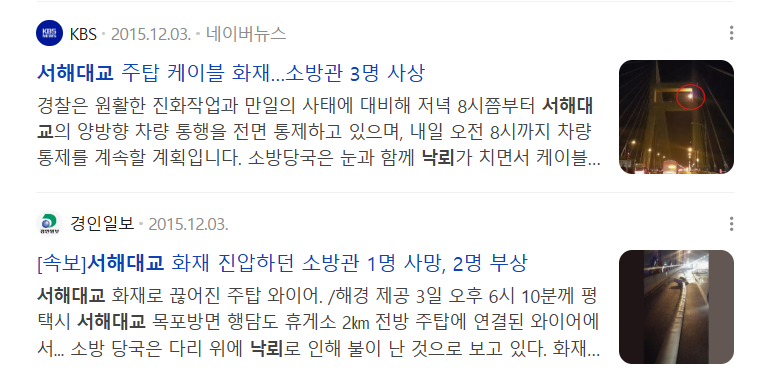
On December 3, 2015, the Seohae Bridge in Korea caught fire. The accident investigation committee concluded the cause was a lightning strike. The Korean Ministry of Land, Infrastructure, and Transport then mandated that all cable bridges be equipped with lightning current measuring instruments (LCMI) to prevent similar accidents.
There was a problem: only two LCMI products existed on the market. One was too expensive (tens of thousands of USD, with a 560×560×750mm enclosure). The other was too limited in detection range. Neither met all the requirements.
This paper proposes a cost-effective LCMI that meets all government requirements — built on dual signal conditioning circuits, a Rogowski coil sensor, and an ATMEGA1280 microcontroller with W5500 Ethernet for remote monitoring.
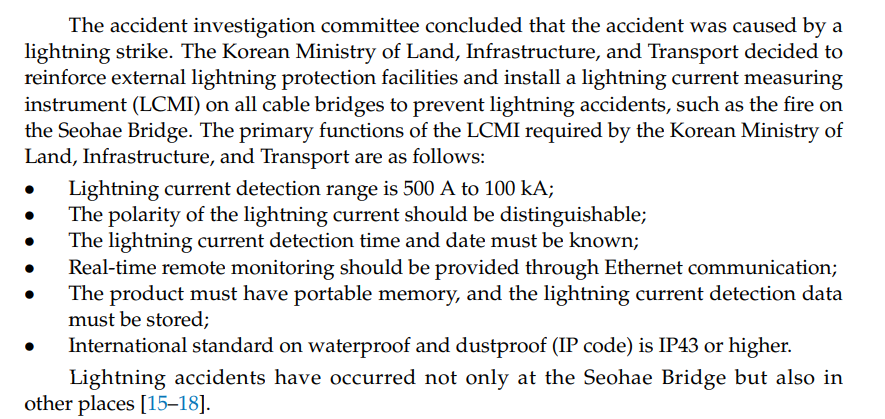
The Korean Ministry of Land, Infrastructure, and Transport are as follows:
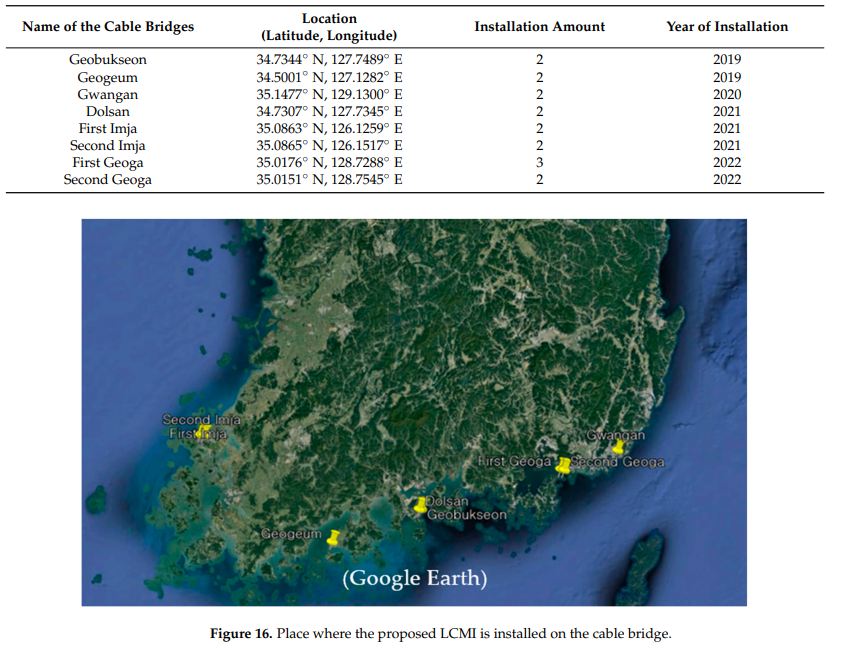
This is not a prototype. It has been installed and operating on 8 cable bridges across Korea since 2019.

02 — Why is lightning current measurement hard?
Lightning current is an extreme electrical phenomenon. The challenge is the enormous range of current magnitudes:
- Induced lightning (nearby strike): as low as 500 A
- Direct lightning (direct strike): up to 100,000 A (100 kA)
That's a 200:1 ratio. A single measurement circuit cannot accurately capture both ends of this range simultaneously — amplifying enough to detect 500 A will cause the circuit to saturate and clip at 100 kA. This is the core technical challenge.
Additionally, lightning is extremely fast. The rise time (T1) of a direct lightning strike is 10 microseconds. To capture this waveform accurately, the ADC sampling time must be in the hundreds of nanoseconds range.
03 — System architecture
[Rogowski coil on down conductor]
  Senses lightning current in the cable bridge
        ↓
[Dual signal conditioning circuits]
  ADC0: 500A – 10kA (high sensitivity)
  ADC1: 10kA – 100kA (low sensitivity)
        ↓
[TMS320F28335 DSP — 380ns sampling]
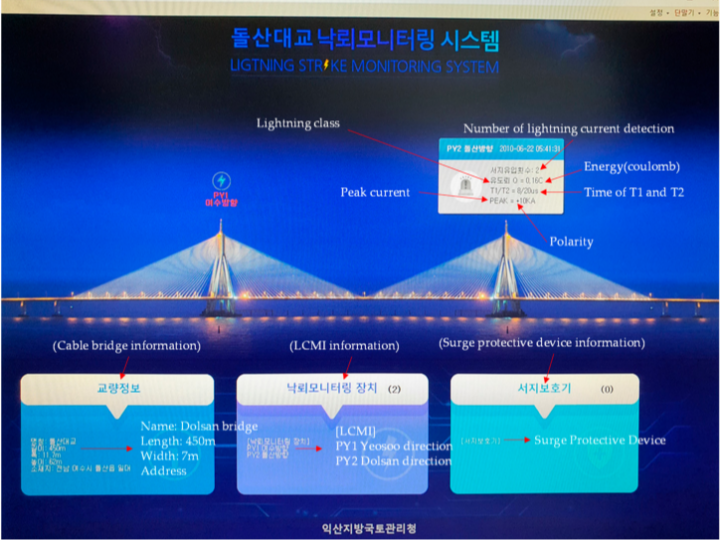
  Extracts: T1, T2, Q, peak current, polarity, lightning class
        ↓  UART
[ATMEGA1280 microcontroller]
  ├─ LCD display (4 screens)
  ├─ SD card (data storage)
  ├─ RS-422 (wired serial output)
  └─ W5500 Ethernet (remote monitoring)
        ↓
[Remote monitoring center]
  Nationwide LCMI dashboard
Two microcontrollers are used with separate roles. The TMS320F28335 DSP is dedicated to high-speed signal processing — its 380ns ADC sampling time is critical for capturing the fast transient of a lightning waveform. The ATMEGA1280 handles system management: storing data to SD card, driving the LCD, and transmitting data via W5500 Ethernet to the remote monitoring center.
04 — The dual signal conditioning circuit — solving the wide-range problem
The key innovation is using two parallel signal conditioning paths with different gain settings:
| Channel | Gain | Detection range | Used when |
|---|---|---|---|
| ADC0 (U1A, gain −1) | High | 500A – 10kA | Peak current < 10kA |
| ADC1 (U1B, gain −0.1) | Low (1/10) | 10kA – 100kA | Peak current > 10kA |
When a lightning strike occurs, both ADCs capture the signal simultaneously. The microcontroller reads ADC1's peak value first — if it exceeds 10kA, it uses ADC1's data; otherwise it uses ADC0's higher-resolution data.
The bias voltage is set at +1.5V (50% of the 3.0V ADC input range) so that both positive and negative polarity lightning can be detected within the same measurement range.
05 — Why W5500?
🔷 Government mandate requires real-time remote monitoring
One of the Korean Ministry of Land's explicit requirements was:
"Real-time remote monitoring should be provided through Ethernet communication."
Cable bridges are physically distributed across Korea. The remote monitoring center needs to receive lightning detection data from all 76 bridges (56 planned for LCMI installation) in real time. Ethernet is the only interface that reliably meets this requirement for permanent outdoor infrastructure installations.
🔷 Installed inside an IP64 enclosure on a coastal bridge
The LCMI enclosure is rated IP64 — dustproof and water jet resistant. It is installed on cable bridges in coastal areas, exposed to salt air, humidity, and strong winds. In this environment, Wi-Fi connectivity would be unreliable. W5500 wired Ethernet is the only viable option for a permanent, maintenance-free installation.
🔷 ATMEGA1280 + W5500 — the proven combination
The ATMEGA1280 handles all peripheral management. W5500 connects via SPI to provide hardware TCP/IP stack capability without burdening the ATMEGA1280. The remote monitoring software receives lightning event data from all installed bridges and displays them on a central dashboard.
06 — Key components
⚡ Rogowski coil (FR-450) — non-contact lightning sensor
An air-core coil that encircles the down conductor without electrical contact. Measures from 1A to 100kA, 10Hz–500kHz. Unlike a current transformer (CT), it does not saturate at high currents — critical for lightning measurement. Price: a few hundred dollars, far cheaper than industrial CT sensors.
🧠 TMS320F28335 (Texas Instruments DSP)
Dedicated signal processing engine. 380ns ADC sampling time with 12-bit resolution. Extracts 6 parameters from each lightning event: T1 (front time), T2 (time to half value), Q (charge in coulombs), peak current, polarity, and lightning class (direct vs. induced).
🖥️ ATMEGA1280 (Microchip)
System controller. Manages LCD display, SD card storage, RTC (real-time clock), RS-422 output, and W5500 Ethernet. Receives analyzed lightning data from the TMS320F28335 via UART and routes it to all output interfaces.
🌐 WIZnet W5500 — Ethernet for remote monitoring
Hardware TCP/IP stack via SPI. Transmits lightning event data to the central monitoring center. Enables real-time nationwide monitoring of lightning strikes on Korea's cable bridge infrastructure. The IP address is configurable via the LCD touch key interface on-site.
💾 SD card + RTC
Every detected lightning event is logged locally to SD card with timestamp from the RTC. Even if network connectivity is lost, no data is lost. The battery-backed RTC (Seiko MS920SE-FL27E) preserves date/time through power outages.
07 — Real deployment: 8 cable bridges in Korea
This instrument is not a laboratory prototype — it is deployed on active infrastructure.
| Bridge | Location | Installed |
|---|---|---|
| Geobukseon | 34.73°N, 127.75°E | 2019 |
| Geogeum | 34.50°N, 127.13°E | 2019 |
| Gwangan | 35.15°N, 129.13°E | 2020 |
| Dolsan | 34.73°N, 127.73°E | 2021 |
| First Imja | 35.09°N, 126.13°E | 2021 |
| Second Imja | 35.09°N, 126.15°E | 2021 |
| First Geoga | 35.02°N, 128.73°E | 2022 |
| Second Geoga | 35.02°N, 128.75°E | 2022 |
The Korean Ministry of Land plans to install LCMIs on 56 of Korea's 76 cable bridges between 2019 and 2030.
08 — Performance vs. existing products
| Proposed LCMI | P Company | I Company | |
|---|---|---|---|
| Size | 140×117×85.5mm | 77.6×185×181.5mm | 560×560×750mm |
| Detection range | ±0.5–100kA | ±5–400kA | ±0.5–100kA |
| Sensor | Rogowski coil | Fiber optic | CT (expensive) |
| Lightning class detection | ✅ | ❌ | ❌ |
| Energy (Q) measurement | ✅ | ❌ | ❌ |
| SD card storage | ✅ | ❌ | ✅ |
| Cost | Few thousand USD | Few thousand USD | Few tens of thousands USD |
The proposed LCMI matches the expensive I Company product in detection range and cost, but adds lightning class detection and energy measurement that neither competitor offers.
Conclusion
A government-mandated instrument protecting Korea's cable bridges — W5500 connects it all to a national monitoring center.
After the Seohae Bridge fire in 2015, the Korean government mandated lightning current measurement on all cable bridges. This paper answers that mandate with a cost-effective instrument that outperforms the expensive market alternatives.
The dual signal conditioning circuit solves the wide-range detection challenge. The TMS320F28335 DSP captures lightning waveforms at 380ns resolution. W5500 Ethernet connects each bridge-mounted unit to a central monitoring center for real-time nationwide surveillance.
It is installed, operating, and protecting infrastructure today.
- ✅ ±500A to ±100kA detection range via dual signal conditioning
- ✅ 380ns ADC sampling — captures fast lightning transients
- ✅ Distinguishes direct vs. induced lightning
- ✅ Measures T1, T2, Q, peak current, polarity
- ✅ W5500 Ethernet for real-time remote monitoring
- ✅ SD card + RTC for local data logging
- ✅ IP64 — waterproof, dustproof for coastal installation
- ✅ Deployed on 8 Korean cable bridges (2019–2022)
- ✅ Peer-reviewed, published in Sensors (MDPI, 2023)
Q&A
Q. What is a Rogowski coil? An air-core coil that encircles a conductor and measures the rate of change of current flowing through it. Unlike a current transformer (CT), it has no iron core and therefore does not saturate at high currents. It is the preferred sensor for lightning current measurement because it can handle the extreme peak currents of direct lightning strikes.
Q. What is the difference between direct and induced lightning? Direct lightning is a strike that directly hits a structure (e.g., a lightning rod or cable bridge cable). It carries very high currents (tens of kA) with a slow rise time (T1 = 10µs, T2 = 350µs). Induced lightning is caused by electromagnetic induction from a nearby strike — lower current but faster waveform (T1 = 8µs, T2 = 20µs). Distinguishing them tells facility managers what to inspect: induced lightning may affect electrical equipment inside the structure, while direct lightning may cause physical damage to the external structure.
Q. Why are two microcontrollers used? The TMS320F28335 DSP is specialized for high-speed signal processing with a 380ns ADC sampling time — critical for capturing fast lightning waveforms. The ATMEGA1280 handles system management tasks (LCD, SD card, Ethernet, RTC) that don't require real-time performance. Separating these roles optimizes both performance and cost.
Q. Why W5500 instead of Wi-Fi for bridge monitoring? Cable bridges are permanent outdoor infrastructure in coastal environments. Wi-Fi connectivity in these conditions would be unreliable due to distance, weather, and interference. W5500 wired Ethernet provides a stable, maintenance-free connection required for a government-mandated monitoring system that must operate 24/7 for years.
Q. What does the remote monitoring center see? The monitoring software receives lightning event data from all installed LCMIs across the country. For each detected lightning strike, it displays the date/time, bridge location, lightning class (direct/induced), polarity, peak current, T1, T2, and charge (Q). This enables systematic lightning risk assessment and accident investigation for Korea's cable bridge network.
[한글 버전]
낙뢰 전류 측정기 — W5500으로 한국 케이블교를 보호하다
#W5500 #ATMEGA1280 #TMS320F28335 #낙뢰 #인프라모니터링 #로고스키코일 #원격모니터링 #한국
📄 출처: 이영준, 이영삼. "A Cost-Effective Lightning Current Measuring Instrument with Wide Current Range Detection Using Dual Signal Conditioning Circuits." Sensors 2023, 23, 3349. DOI: 10.3390/s23063349 🏢 (주)성진테크윈 / 인하대학교 전기공학과
01 — 이 프로젝트는 무엇인가?
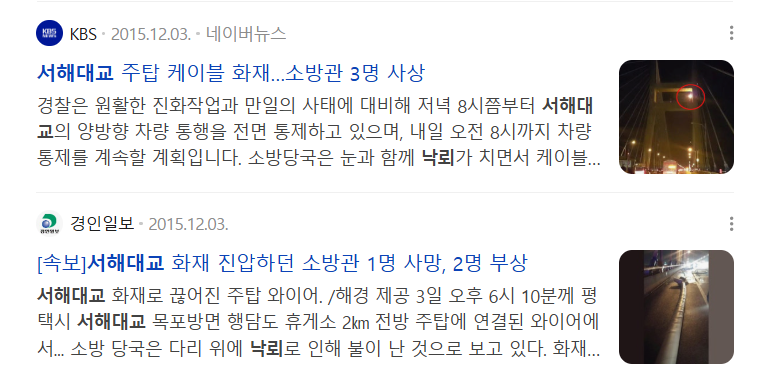
2015년 12월 3일, 서해대교에서 화재가 발생했습니다. 사고조사위원회는 낙뢰가 원인이라고 결론지었습니다. 이후 국토교통부는 유사 사고 예방을 위해 전국 케이블교에 낙뢰 전류 측정기(LCMI) 설치를 의무화했습니다.
문제가 있었습니다. 시장에 LCMI 제품이 두 가지뿐이었습니다. 하나는 너무 비쌌고(수만 달러, 크기도 560×560×750mm), 다른 하나는 측정 범위가 기준에 미달했습니다. 두 제품 모두 요건을 완전히 충족하지 못했습니다.
이 논문은 정부 요건을 모두 충족하는 경제적인 LCMI를 제안합니다 — 이중 신호조건 회로, 로고스키 코일 센서, ATMEGA1280 마이크로컨트롤러, 그리고 W5500 이더넷 원격 모니터링을 기반으로 합니다.
대한민국 국토부의 요구사항
사고 조사위원회는 해당 사고가 낙뢰로 인해 발생했다고 결론지었습니다. 국토교통부는 서해대교 화재와 같은 낙뢰 사고를 예방하기 위해 외부 낙뢰 보호 시설을 강화하고 모든 케이블교에 낙뢰 전류 측정기(LCMI)를 설치하기로 결정했습니다. 국토교통부가 요구한 LCMI의 주요 기능은 다음과 같습니다:
- 낙뢰 전류 감지 범위는 500A에서 100kA
- 낙뢰 전류의 극성을 구분할 수 있어야 함
- 낙뢰 전류 감지 시각과 날짜를 알 수 있어야 함
- 이더넷 통신을 통한 실시간 원격 모니터링 제공
- 이동식 메모리를 갖추어야 하며 낙뢰 전류 감지 데이터를 저장해야 함
- 방수 및 방진 국제 표준(IP 코드)은 IP43 이상
이것은 프로토타입이 아닙니다. 2019년부터 한국 케이블교 8곳에 실제 설치되어 운영 중입니다.
"대한민국에는 총 76개의 케이블교가 있습니다. 국토교통부는 2019년부터 2030년 사이에 56개의 케이블교에 LCMI를 적용할 계획입니다. 제안된 LCMI는 Table 11과 Figure 16에 나타난 바와 같이 8개의 케이블교에 설치되어 운영되고 있습니다."
02 — 낙뢰 전류 측정이 왜 어려운가?
낙뢰는 극단적인 전기 현상입니다. 핵심 난제는 전류 크기의 범위가 엄청나다는 겁니다:
- 유도 낙뢰 (근처 낙뢰): 최소 500 A
- 직격 낙뢰 (직접 타격): 최대 100,000 A (100 kA)
200:1의 비율입니다. 단일 측정 회로로는 이 양쪽 끝을 동시에 정확하게 포착할 수 없습니다 — 500A를 감지할 만큼 증폭하면 100kA에서 회로가 포화 상태가 됩니다. 이것이 핵심 기술 과제입니다.
게다가 낙뢰는 극도로 빠릅니다. 직격 낙뢰의 상승 시간(T1)은 10마이크로초입니다. 이 파형을 정확하게 포착하려면 ADC 샘플링 시간이 수백 나노초 수준이어야 합니다.
03 — 시스템 구조
[다운도체의 로고스키 코일]
  케이블교의 낙뢰 전류 감지
        ↓
[이중 신호조건 회로]
  ADC0: 500A – 10kA (고감도)
  ADC1: 10kA – 100kA (저감도)
        ↓
[TMS320F28335 DSP — 380ns 샘플링]
  추출: T1, T2, Q, 피크 전류, 극성, 낙뢰 유형
        ↓  UART
[ATMEGA1280 마이크로컨트롤러]
  ├─ LCD 표시 (4개 화면)
  ├─ SD 카드 (데이터 저장)
  ├─ RS-422 (유선 시리얼 출력)
  └─ W5500 이더넷 (원격 모니터링)
        ↓
[원격 모니터링 센터]
  전국 LCMI 대시보드
두 개의 마이크로컨트롤러가 역할을 분담합니다. TMS320F28335 DSP는 고속 신호 처리 전용 — 380ns ADC 샘플링으로 낙뢰 파형을 포착합니다. ATMEGA1280은 시스템 관리 전담: SD 카드 저장, LCD 구동, W5500 이더넷으로 원격 모니터링 센터에 데이터 전송.
04 — 이중 신호조건 회로 — 광범위 측정 문제 해결
핵심 혁신은 서로 다른 이득을 가진 두 개의 병렬 신호 처리 경로를 사용하는 것입니다:
| 채널 | 이득 | 감지 범위 | 사용 조건 |
|---|---|---|---|
| ADC0 (U1A, 이득 −1) | 고감도 | 500A – 10kA | 피크 전류 < 10kA |
| ADC1 (U1B, 이득 −0.1) | 저감도 (1/10) | 10kA – 100kA | 피크 전류 > 10kA |
낙뢰가 발생하면 두 ADC가 동시에 신호를 포착합니다. 마이크로컨트롤러는 ADC1의 피크값을 먼저 확인 — 10kA를 초과하면 ADC1 데이터를 사용하고, 미만이면 ADC0의 고해상도 데이터를 사용합니다.
바이어스 전압을 +1.5V(ADC 입력 범위 3.0V의 50%)로 설정해 양극 및 음극 낙뢰를 모두 동일한 측정 범위 안에서 구분할 수 있습니다.
05 — 왜 W5500인가?
🔷 정부 요건에 이더넷 실시간 원격 모니터링이 명시되어 있다
국토교통부가 명시한 요건 중 하나:
"이더넷 통신을 통한 실시간 원격 모니터링이 제공되어야 한다."
케이블교가 전국에 분산되어 있습니다. 원격 모니터링 센터는 설치 예정인 56개 교량 전체에서 낙뢰 감지 데이터를 실시간으로 수신해야 합니다. 영구 야외 인프라 설치 환경에서 이 요건을 안정적으로 충족하는 인터페이스는 이더넷뿐입니다.
🔷 해안가 교량의 IP64 인클로저에 설치된다
LCMI 인클로저는 IP64 등급 — 방진 및 방수. 해안 지역 케이블교에 설치되어 염분 공기, 습기, 강풍에 노출됩니다. 이런 환경에서 Wi-Fi는 신뢰하기 어렵습니다. W5500 유선 이더넷이 유지보수 없는 영구 설치에 유일한 실용적 선택입니다.
🔷 ATMEGA1280 + W5500 — 검증된 조합
ATMEGA1280이 모든 주변장치를 관리합니다. W5500이 SPI로 연결되어 ATMEGA1280에 부담 없이 하드웨어 TCP/IP 스택을 제공합니다. 원격 모니터링 소프트웨어는 설치된 모든 교량에서 낙뢰 이벤트 데이터를 수신해 중앙 대시보드에 표시합니다.
06 — 핵심 구성 요소
⚡ 로고스키 코일 (FR-450) — 비접촉 낙뢰 센서
다운도체를 감싸는 공심 코일로 전기적 접촉 없이 전류를 측정합니다. 1A~100kA, 10Hz~500kHz 지원. 철심이 없어 고전류에서 포화되지 않습니다 — 낙뢰 전류 측정의 핵심 특성. 가격: 수백 달러, 산업용 CT보다 훨씬 저렴합니다.
🧠 TMS320F28335 (Texas Instruments DSP)
전용 신호 처리 엔진. 380ns ADC 샘플링, 12비트 해상도. 각 낙뢰 이벤트에서 6개 파라미터 추출: T1(파두시간), T2(반값시간), Q(전하량 쿨롬), 피크 전류, 극성, 낙뢰 유형(직격/유도).
🖥️ ATMEGA1280 (Microchip)
시스템 컨트롤러. LCD, SD 카드, RTC, RS-422 출력, W5500 이더넷을 관리합니다. TMS320F28335에서 UART로 분석된 낙뢰 데이터를 받아 모든 출력 인터페이스로 라우팅합니다.
🌐 WIZnet W5500 — 원격 모니터링용 이더넷
SPI를 통한 하드웨어 TCP/IP 스택. 낙뢰 이벤트 데이터를 중앙 모니터링 센터로 전송합니다. 한국 케이블교 인프라의 낙뢰 타격을 실시간 전국 감시합니다. IP 주소는 현장 LCD 터치키로 설정합니다.
💾 SD 카드 + RTC
감지된 모든 낙뢰 이벤트가 RTC 타임스탬프와 함께 SD 카드에 로컬 저장됩니다. 네트워크 연결이 끊겨도 데이터는 유실되지 않습니다. 배터리 백업 RTC(Seiko MS920SE-FL27E)가 정전 중에도 날짜/시간을 보존합니다.
07 — 실제 배포: 한국 케이블교 8곳
이 기기는 실험실 프로토타입이 아닙니다 — 실제 운영 중인 인프라에 설치되어 있습니다.
| 교량 | 위치 | 설치연도 |
|---|---|---|
| 거북선교 | 34.73°N, 127.75°E | 2019 |
| 거금교 | 34.50°N, 127.13°E | 2019 |
| 광안대교 | 35.15°N, 129.13°E | 2020 |
| 돌산교 | 34.73°N, 127.73°E | 2021 |
| 제1임자대교 | 35.09°N, 126.13°E | 2021 |
| 제2임자대교 | 35.09°N, 126.15°E | 2021 |
| 제1거가대교 | 35.02°N, 128.73°E | 2022 |
| 제2거가대교 | 35.02°N, 128.75°E | 2022 |
국토교통부는 2019년부터 2030년까지 전국 76개 케이블교 중 56개에 LCMI를 설치할 계획입니다.
08 — 기존 제품과의 성능 비교
| 제안 LCMI | P사 | I사 | |
|---|---|---|---|
| 크기 | 140×117×85.5mm | 77.6×185×181.5mm | 560×560×750mm |
| 감지 범위 | ±0.5–100kA | ±5–400kA | ±0.5–100kA |
| 센서 | 로고스키 코일 | 광섬유 | CT (고가) |
| 낙뢰 유형 감지 | ✅ | ❌ | ❌ |
| 에너지(Q) 측정 | ✅ | ❌ | ❌ |
| SD 카드 저장 | ✅ | ❌ | ✅ |
| 가격 | 수천 달러 | 수천 달러 | 수만 달러 |
제안 LCMI는 고가의 I사 제품과 감지 범위가 동일하면서 비용은 1/10 수준이고, 경쟁사 어느 제품도 제공하지 않는 낙뢰 유형 감지와 에너지 측정까지 추가했습니다.
결론
정부 의무 설치 기기로 한국 케이블교를 지킨다 — W5500이 전국 모니터링 센터와 연결한다.
2015년 서해대교 화재 이후 정부가 케이블교 낙뢰 전류 측정을 의무화했습니다. 이 논문은 고가의 기존 제품을 뛰어넘는 경제적인 기기로 그 요건에 답합니다.
이중 신호조건 회로가 광범위 측정 과제를 해결합니다. TMS320F28335 DSP가 380ns 해상도로 낙뢰 파형을 포착합니다. W5500 이더넷이 각 교량 설치 유닛을 중앙 모니터링 센터에 연결해 실시간 전국 감시를 가능하게 합니다.
지금 이 순간도 설치되어, 운영되고, 인프라를 보호하고 있습니다.
- ✅ 이중 신호조건 회로로 ±500A~±100kA 감지
- ✅ 380ns ADC 샘플링 — 고속 낙뢰 과도현상 포착
- ✅ 직격 vs 유도 낙뢰 구분
- ✅ T1, T2, Q, 피크 전류, 극성 측정
- ✅ W5500 이더넷 실시간 원격 모니터링
- ✅ SD 카드 + RTC 로컬 데이터 로깅
- ✅ IP64 — 해안 설치용 방진·방수
- ✅ 한국 케이블교 8곳 실 배포 (2019–2022)
- ✅ 동료 심사 학술 논문 게재 (Sensors, MDPI, 2023)
Q&A
Q. 로고스키 코일이란 무엇인가요? 도체를 감싸 그 안을 흐르는 전류의 변화율을 측정하는 공심 코일입니다. 철심이 없어 고전류에서 포화되지 않습니다 — 직격 낙뢰의 극한 전류를 측정하는 데 필수적인 특성입니다. 고가의 산업용 CT보다 훨씬 경제적입니다.
Q. 직격 낙뢰와 유도 낙뢰의 차이는 무엇인가요? 직격 낙뢰는 구조물(낙뢰침, 케이블 등)에 직접 타격하는 낙뢰입니다. 수십 kA의 고전류에 느린 파형(T1=10µs, T2=350µs). 유도 낙뢰는 근처 낙뢰의 전자기 유도로 발생 — 낮은 전류지만 빠른 파형(T1=8µs, T2=20µs). 구분이 중요한 이유: 유도 낙뢰는 내부 전기 기기 점검이 필요하고, 직격 낙뢰는 외부 구조물 손상 점검이 필요합니다.
Q. 마이크로컨트롤러를 왜 두 개 쓰나요? TMS320F28335 DSP는 380ns ADC 샘플링으로 고속 신호 처리에 특화된 칩입니다. ATMEGA1280은 LCD, SD 카드, 이더넷, RTC 같은 시스템 관리를 담당합니다. 역할을 분리해 성능과 비용을 최적화했습니다.
Q. 교량 모니터링에 Wi-Fi 대신 W5500을 쓰는 이유는? 케이블교는 해안 환경의 영구 야외 인프라입니다. 거리, 날씨, 간섭으로 Wi-Fi 연결이 불안정할 수 있습니다. W5500 유선 이더넷이 수년간 24/7 운영이 필요한 정부 의무 모니터링 시스템에 안정적이고 유지보수가 없는 연결을 제공합니다.
Q. 원격 모니터링 센터에서 무엇을 볼 수 있나요? 전국에 설치된 모든 LCMI에서 낙뢰 이벤트 데이터를 수신합니다. 감지된 낙뢰마다 날짜/시간, 교량 위치, 낙뢰 유형(직격/유도), 극성, 피크 전류, T1, T2, 전하량(Q)을 표시합니다. 이를 통해 한국 케이블교 네트워크의 낙뢰 위험도 평가와 사고 조사를 체계적으로 수행할 수 있습니다.