


4-Universe Art-Net LED Controller with WIZnet W5500-EVB-Pico
RP2040-based Art-Net node built on WIZnet W5500-EVB-Pico drives 4 × 170 WS2812B pixels at ≈120 FPS, offering 5-24 V input and compact 3-D-printed enclosure.

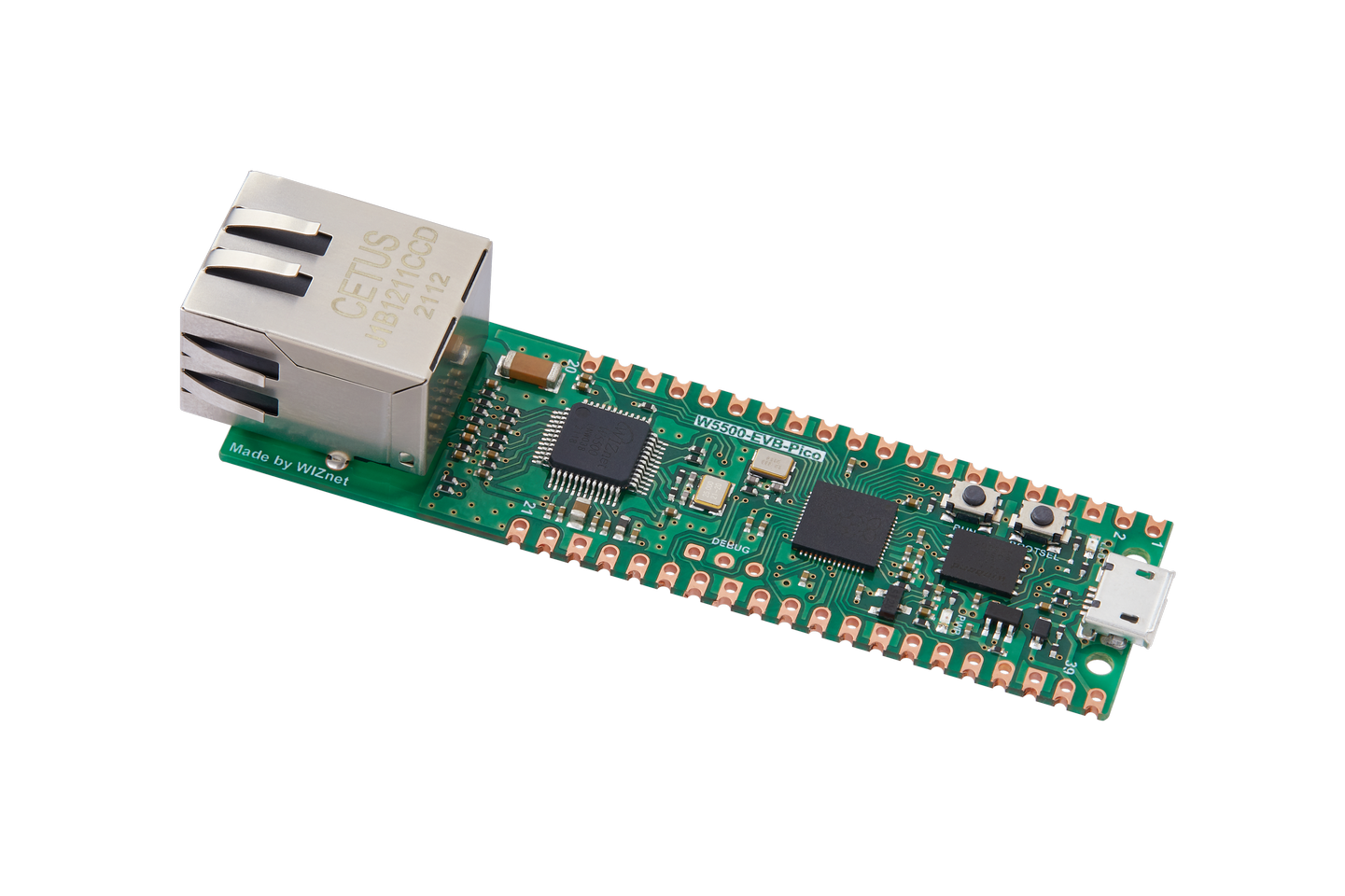
WIZnet - W5500-EVB-Pico
x 1


DFRobot - WS2812B LED Strip
x 1

Arduino - Arduino IDE
x 1
Project Overview
This build turns the WIZnet W5500-EVB-Pico into a rock-solid, four-universe Art-Net node for pixel-dense LED sculptures. Hardware TCP/IP off-load in the W5500 guarantees stable UDP throughput while the RP2040’s PIO + DMA stream 800 kHz LED data, achieving ~120 FPS for 680 pixels. The 5-24 V tolerant buck and IP-rated connectors make it ready for touring installations.
Key Features
Hard-wired Ethernet – W5500 handles MAC/PHY, freeing CPU time for LED timing.
4 independent outputs – each drives up to 170 pixels (one DMX universe) in parallel.
High refresh – ~120 FPS at full load keeps fast visuals crisp.
Wide-input PSU & sealed case – accepts stage power (12 V strips, 24 V rigs) and survives rain with printed gasket.
Hardware Setup
The custom two-layer PCB plugs the EVB-Pico upside-down so the MagJack aligns with a panel bulkhead. A 74AHCT125 shifts the RP2040’s 3 V SPI to 5 V. Four 3-pin terminals expose V+ | DATA | GND; keep each rail under 10 A. Large electrolytics tame inrush from long strips.
Software Implementation
Network Architecture
Each node occupies four consecutive universes; subnet and start-universe are compile-time parameters. Multiple nodes scale linearly (e.g., subnet 0 / uni 0-3, 4-7 …). A gigabit switch or even 100 M run perfectly; crossover direct-link also works for quick demos.
Performance Results
Bench tests with 4 × 1 m strips showed ~120 FPS sustained with <1 ms jitter, zero frame drops over 48 h soak. Current draw steadied at 4.1 A @ 5 V (static white). Network latency PC→Node measured 1.6 ms round-trip (Wireshark).
Lessons Learned
W5500’s large DMA buffers are essential—default 8-socket config overflowed RAM.
RP2040 PIO + DMA keeps CPU under 15 % while slinging 2.2 M B/s to LEDs.
Bulkhead Ethernet plus printed gasket achieved IP-ish splash resistance but PLA proved brittle outdoors; PETG solved it.
Future Improvements
Migrate to W6100 for IPv6 show control.
Add web UI (LittleFS) for live universe mapping.
Chainable “backplane” for power + data daisy-linking multiple nodes.
Challenges & Solutions
| Challenge | Solution |
|---|---|
| 3 V logic unreliable above 3 m cable | 74AHCT125 level-shift to 5 V |
| Enclosure space vs. MagJack height | Cut-out in PCB & inverted EVB-Pico orientation |
| UDP frame loss at >100 FPS | Larger Ethernet buffers + MAX_SOCK_NUM 2 |
DOCUMENTS
Main Application Code – Artnet_node_v1.ino (Instructables attachment)
Circuit Diagram / Gerbers – downloadable PCB set for small & big versions.
3-D Models – STL files for both enclosures (small & big).
Ready to publish! This draft follows WIZnet UCC style and spotlights how the W5500-EVB-Pico simplifies a pro-grade Art-Net pixel driver.