



Smart Solar Charge Controller
Development of Smart Solar Charge Controller on Wiznet W5500 IoT Platform
논문 정보
논문 제목
Wiznet W5500 IoT 플랫폼 기반 스마트 태양광 충전 컨트롤러 개발
저자
Srujan Manohar M.V.N. 외 4명
(인도 Malla Reddy University, IoT 전공)
게재 저널
Journal of IoT in Social, Mobile, Analytics, and Cloud (JISMAC)
Volume 6, Issue 3, 2024년 9월
연구 배경 및 목적
본 논문은 기존의 고정형 태양광 충전 시스템의 낮은 효율 문제를 해결하기 위해,
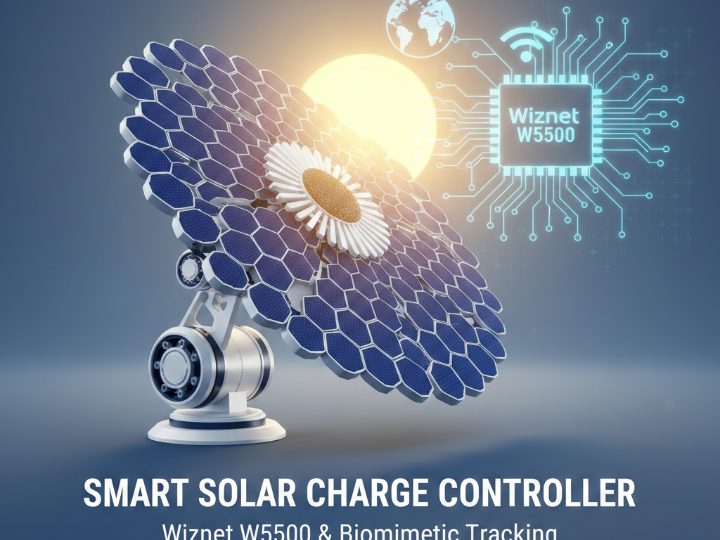
- 태양광 추적(Solar Tracking)
- MPPT(Maximum Power Point Tracking)
- IoT 기반 원격 모니터링
을 결합한 스마트 태양광 충전 컨트롤러 시스템을 설계·구현하는 것을 목표로 합니다.
특히 WIZnet W5500 Ethernet 칩을 활용해 유선 네트워크 기반 IoT 시스템을 구현한 점이 핵심입니다.
- MPPT란?
**MPPT(Maximum Power Point Tracking)**는
👉 태양광 패널에서 가장 많은 전력을 얻을 수 있는 지점을 자동으로 찾아 유지하는 기술입니다.
시스템 핵심 구성 요소
🔧 하드웨어 구성
| 구성 요소 | 역할 |
|---|---|
| LDR 센서 | 태양 위치 감지를 위한 광 센서 |
| 서보 모터 | 태양광 패널 방향 자동 조절 |
| CN3791 MPPT 모듈 | 최대 전력점 추종 기반 배터리 충전 |
| ESP32 / Arduino Nano | 센서 제어 및 로직 처리 |
| WIZnet W5500 | Ethernet 기반 IoT 통신 |
Why WIZnet W5500?
- 원격 모니터링 필수 요소
태양광 충전 시스템의 배터리 상태, 전압·전류 정보를
PC 및 스마트폰에서 실시간으로 확인하기 위해 Ethernet 기반 IoT 통신이 필요함 - 안정적인 유선 Ethernet 통신
야외·무인 환경에서 Wi-Fi 대비 연결 신뢰성이 높아
태양광 에너지 시스템에 적합한 통신 방식 제공 - 하드웨어 TCP/IP 스택 내장
네트워크 처리를 W5500이 직접 수행하여
MCU는 태양광 추적 제어, 센서 처리, MPPT 관리에 집중 가능 - 독립형 웹 모니터링 구현
별도의 게이트웨이나 클라우드 없이
간단한 웹 서버를 통해 실시간 시스템 상태 확인 가능
시스템 동작 원리
태양광 추적 시스템 (Solar Tracking)
- 여러 개의 LDR 센서를 사용해 태양의 위치를 실시간 감지
- 센서 값 차이를 비교하여 서보 모터를 구동
- 태양광 패널이 항상 태양을 정면으로 바라보도록 자동 조절
- 고정형 패널 대비 발전 효율 대폭 향상
MPPT 기반 충전 제어
- CN3791 MPPT 컨트롤러를 사용
- 태양광 패널의 전압·전류를 실시간으로 분석
- **최대 전력점(MPP)**에서 동작하도록 충전 조건 자동 조정
- 날씨 변화나 일조량 변동 상황에서도 안정적인 충전 가능
IoT & 원격 모니터링 (W5500 활용)
- W5500 Ethernet 모듈을 통해 웹 서버 기능 구현
- PC 또는 스마트폰에서 웹 브라우저로 접속 가능
- 다음 정보들을 실시간으로 확인 가능:
- 배터리 충전 상태
- 전압 / 전류
- 시스템 동작 상태
Wi-Fi가 아닌 유선 Ethernet 기반 IoT라는 점이 특징
산업 환경이나 안정성이 중요한 환경에 적합
실험 결과 및 성능
- 태양광 추적 시스템 적용 시
👉 고정형 패널 대비 약 25% 발전 효율 향상 - MPPT 적용으로 배터리 충전 안정성 및 효율 개선
- 실시간 원격 모니터링을 통해 유지보수 편의성 향상
결론
본 연구는 다음을 성공적으로 입증합니다.
- 태양광 추적 + MPPT + IoT 통합 시스템은
에너지 효율과 사용자 편의성을 동시에 향상 - WIZnet W5500 기반 Ethernet IoT는
안정적이고 신뢰성 높은 원격 모니터링 솔루션으로 적합
향후 연구 방향 (논문 제안)
- 머신러닝 기반 태양광 발전량 예측
- 데이터 분석을 통한 에너지 관리 자동화
- 클라우드 연동 및 대규모 태양광 시스템 확장
Article Title
Development of Smart Solar Charge Controller on Wiznet W5500 IoT Platform
Authors:
Srujan Manohar M.V.N., Varun O.A., Lavanya P., Sathwik Y., Madhu M. (Department of Internet of Things, Malla Reddy University, Hyderabad, India)
Published:
September 2024, Volume 6, Issue 3, Pages 199–211
DOI:
https://doi.org/10.36548/jismac.2024.3.001
Abstract & Core Idea
This research discusses the design and implementation of a smart solar charge controller enhanced with IoT capabilities using the Wiznet W5500 Ethernet chip as an IoT platform. The system combines solar tracking, MPPT (Maximum Power Point Tracking), and remote monitoring to maximize solar energy efficiency and allow web-based access to system status.
Key Components & Technologies
- Light Dependent Resistors (LDRs): Track the sun’s position in real time.
- Servos & Mechanical system: Automatically adjust solar panel orientation.
- MPPT Controller (CN3791): Ensures optimal energy capture from panels.
- Wiznet W5500 Module: Provides Ethernet network connectivity for monitoring.
- ESP32 & Arduino Nano: Microcontrollers for control, sensor reading, and IoT tasks.
System Description
- Solar Tracking
Panels constantly adjust to face the sun using LDR sensors and servos, increasing solar capture efficiency compared with static panels.
- MPPT Charge Control
The MPPT controller dynamically modulates panel electrical parameters to operate at the maximum power point, improving energy conversion under variable conditions.
- IoT Integration
Using the Wiznet W5500, the system hosts a web interface accessible from phones or laptops. Users can monitor battery charge status and controller data remotely.
Results
The smart solar system achieved roughly a 25 % increase in energy capture vs. static panels thanks to dynamic tracking.
Real-time web access enabled remote tracking of system parameters.
Conclusion & Future Work
The integration of solar tracking, MPPT optimization, and IoT connectivity resulted in an efficient and user-friendly solar charging solution. Future enhancements could include machine learning for predictive energy management and further automation improvements.
FAQ
Q1. Why did the authors choose W5500 instead of a software TCP/IP stack?
A: The W5500 integrates a hardware TCP/IP stack, which significantly reduces MCU CPU usage and memory consumption. For the system described in the paper, reliability and predictable communication timing were critical, making W5500 a more suitable choice than software-based stacks.
Q2. What role does the W5500 play in this system?
A: The W5500 acts as a dedicated network processor. The MCU sends data to the W5500, and all TCP/IP processing and Ethernet frame handling are performed inside the chip, simplifying firmware design and improving stability.
Q3. Why was Ethernet preferred over Wi-Fi in this research?
A: Wi-Fi communication is susceptible to interference and variable latency. Ethernet, especially with W5500 hardware offloading, provides stable and deterministic communication, which is essential for continuous monitoring and control systems.
Q4. Is a W5500-based design suitable for beginners?
A: Yes. Developers with basic MCU and SPI communication experience can use the W5500 effectively. Since TCP/IP is handled in hardware, developers do not need to implement or tune complex network stacks.
Q5. How does W5500 compare to LwIP-based solutions?
A: LwIP offers flexibility but consumes significant MCU resources. In contrast, the W5500 offloads TCP/IP processing entirely, reducing CPU load and improving real-time performance, which is particularly important in embedded and industrial systems.