



Intelligent Traffic Light Control System using Deep Reinforcement Learning
An AI-powered traffic management system that optimizes multi-intersection signal timing using Deep Q-Network (DQN) and real-time vehicle detection.
<ENG>
Intelligent Traffic Light Control System
AI-Based Multi-Intersection Signal Optimization Using Deep Reinforcement Learning
Project Overview
The Intelligent Traffic Light Control System is an AI-powered traffic management solution that optimizes signal timing across multiple intersections using Deep Reinforcement Learning (DQN) and real-time vehicle detection.
Problem Statement
Traditional fixed-time traffic signals cannot adapt to dynamic traffic conditions, resulting in:
- Long waiting times during peak hours
- Poor coordination between adjacent intersections
- Inefficient green wave progression
Unlike traditional fixed-time traffic lights, this system dynamically adapts to changing traffic conditions and coordinates adjacent intersections to form an efficient Green Wave, reducing congestion and waiting time.
Key Highlights
- Simulation-based training with real-world deployment
- Centralized GUI for multi-intersection control
- Stable Ethernet-based IoT communication using WIZnet W5500

Hardware Components
| Component | Role |
|---|---|
| Raspberry Pi Pico | Local traffic signal controller |
| WIZnet W5500 Lite | Wired Ethernet communication |
| 74HC595 | LED signal expansion |
| Traffic Light LEDs | Physical signal output |
A DQN-based adaptive traffic control system that:
- Learns optimal signal timing policies through simulation
- Adapts to real-time traffic conditions using camera-based vehicle detection
- Coordinates multiple intersections for smooth green wave progression
- Deploys on a real-world GUI with hardware integration

We developed and compared two DQN-based approaches to identify the optimal strategy for traffic signal control:

- Simpler state representation (no travel time focus)
- Single-output action space (combined discrete actions)
- Reward focuses on individual intersection optimization
- No explicit green wave coordination
- Serves as experimental baseline for performance comparison
- Suitable for isolated intersections without coordination needs

| Metric | DQN-GreenWave | DQN-Baseline | Improvement |
|---|---|---|---|
| Average Waiting Time (s) | 21.28 | 14.07 | ✅ -33.9% |
| Average Speed (m/s) | 2.87 | 2.36 | ✅ +17.6% |
| Green Wave Efficiency | 82.5% | 64.3% | ✅ +18.2% |
- ✅ Low Traffic: Both perform well, GreenWave slightly better
- ✅ Medium Traffic: GreenWave shows clear advantage
- ✅ High Traffic: GreenWave significantly outperforms baseline
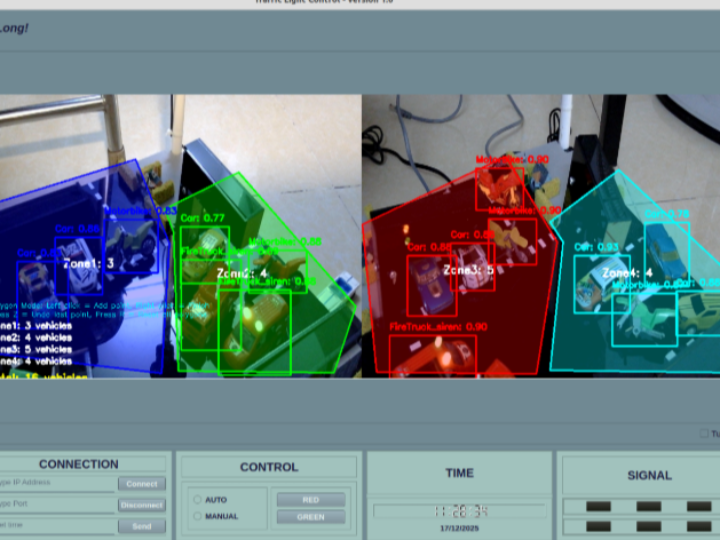
Deployment (GUI Application)
Real-Time Monitoring
Auto Mode (AI-Controlled)
- DQN model makes decisions every cycle
- Updates based on real-time vehicle counts
- Adapts to traffic density changes
Manual Mode
- Override AI decisions
- Set custom cycle length and green times
- Emergency control for special events
<KOR>
Intelligent Traffic Light Control System
Deep Reinforcement Learning 기반 다중 교차로 신호 최적화 시스템
Project Overview
Intelligent Traffic Light Control System은 Deep Reinforcement Learning(DQN) 과 실시간 차량 인식(YOLO) 을 결합하여 다중 교차로 신호를 자동으로 최적화하는 AI 기반 교통 제어 시스템입니다.
문제 제기
기존의 고정 시간 신호등은 역동적인 교통 상황에 적응할 수 없어 다음과 같은 문제가 발생합니다.
- 피크 시간대에는 대기 시간이 길어집니다.
- 인접 교차로 간의 조정 부족
- 비효율적인 녹색 물결 진행
기존 고정 신호 방식의 한계를 극복하고,
실시간 교통 상황에 적응하며 Green Wave(연속 녹색 신호) 를 형성하는 것이 핵심 목표입니다.
핵심 포인트
- 시뮬레이션(SUMO) 기반 학습 → 실제 하드웨어까지 연결
- 중앙 GUI에서 다중 교차로 통합 제어
- Edge AI + Ethernet 기반 안정적 통신
Hardware Components
| Component | Role |
|---|---|
| Raspberry Pi Pico | 각 교차로 신호 제어 MCU |
| WIZnet W5500 Lite | 유선 Ethernet 통신 |
| 74HC595 | 다중 LED 신호 제어 |
| Traffic Light LEDs | 실제 신호 출력 |
DQN 기반 적응형 교통 제어 시스템은 다음과 같은 특징을 갖습니다.
- 시뮬레이션을 통해 최적의 신호 타이밍 정책을 학습합니다.
- 카메라 기반 차량 감지를 사용하여 실시간 교통 상황에 맞춰 작동합니다 .
- 원활한 녹색 신호 진행을 위해 여러 교차로의 좌표 를 조정합니다 .
- 하드웨어 통합을 통해 실제 GUI에 배포됩니다 .
본 연구에서는 교통 신호 제어를 위한 최적의 전략을 파악하기 위해 두 가지 DQN 기반 접근 방식을 개발하고 비교했습니다 .
- 보다 간소화된 상태 표현 (이동 시간에 초점을 맞추지 않음)
- 단일 출력 행동 공간(이산 행동들의 결합)
- 보상은 개별 교차점 최적화 에 중점을 둡니다.
- 녹색 물결에 대한 명시적인 협력은 없었다.
- 성능 비교를 위한 실험 기준선 역할을 합니다.
- 조정이 필요 없는 독립된 교차로에 적합합니다.
| 미터법 | DQN-그린웨이브 | DQN-기준선 | 개선 |
|---|---|---|---|
| 평균 대기 시간(초) | 21.28 | 14.07 | ✅ -33.9% |
| 평균 속도 (m/s) | 2.87 | 2.36 | ✅ +17.6% |
| 그린 웨이브 효율성 | 82.5% | 64.3% | ✅ +18.2% |
- ✅ 교통량이 적을 때 : 두 제품 모두 성능이 우수하며, GreenWave가 약간 더 좋습니다.
- ✅ 중간 규모 교통량 : GreenWave가 확실한 우위를 보입니다
- ✅ 높은 트래픽 : GreenWave는 기준선 대비 훨씬 뛰어난 성능을 보여줍니다.

배포 (GUI 애플리케이션)
실시간 모니터링
교통 제어 모드
자동 모드(AI 제어)
- DQN 모델은 매 주기마다 결정을 내립니다.
- 실시간 차량 대수에 따른 업데이트
- 교통 밀도 변화에 적응합니다
수동 모드
- AI의 결정을 재정의합니다.
- 사용자 지정 사이클 길이 및 녹색 시간 설정
- 특별 행사 비상 통제