



Harvestify
Harvestify HArvestify is an open-source, Arduino-based precision agriculture platform that helps farmers monitor and optimize their crops.
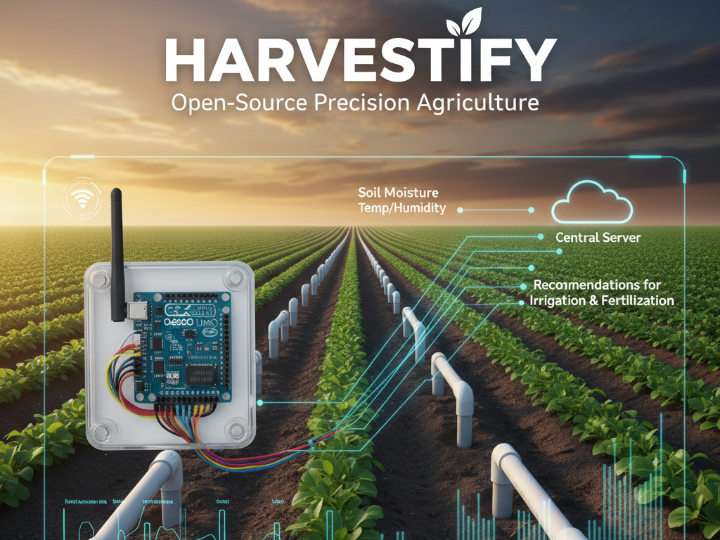
프로젝트 개요 (KR)
Harvestify는 Arduino 기반의 센서 시스템을 활용하여 농업 환경 데이터를 수집·저장·전송하는 정밀 농업(Precision Agriculture) IoT 프로토타입 프로젝트입니다.
토양 및 환경 정보를 데이터로 수집함으로써 농업 환경을 보다 객관적으로 이해하고, 향후 데이터 기반 의사결정으로 확장할 수 있는 기반을 제공합니다.
본 프로젝트는 **완성된 상용 시스템보다는 학습 및 개념 검증(PoC)**을 목적으로 하며,
농업 IoT 시스템의 기본 구조와 데이터 활용 가능성을 보여주는 데 중점을 둡니다.
핵심 기능 (KR)
- 토양 및 환경 센서를 이용한 데이터 수집
- 토양 수분
- 온도 및 습도
- 조도 등
- Ethernet 또는 Wi-Fi를 통한 서버 데이터 전송
- 농업 환경 모니터링을 위한 기초 데이터 확보
시스템 구성 및 현재 구현 범위 (KR)
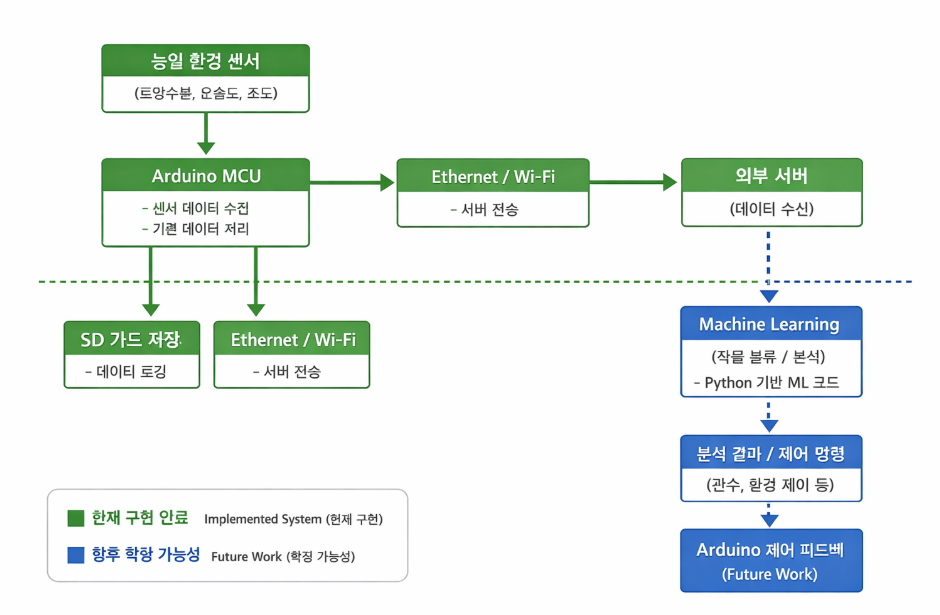
본 프로젝트는 다음과 같은 구조로 구성되어 있습니다.
디바이스 계층
- Arduino 마이크로컨트롤러
- 농업 환경 센서
- SD 카드 저장 장치
- Ethernet 또는 Wi-Fi 통신 모듈
네트워크 계층
- 센서 데이터를 외부 서버로 전송하는 기능까지 구현됨
머신러닝 코드
- 별도의
Machine Learning디렉토리에 Python 기반 분석 코드 포함 - 사전 수집된 데이터셋(CSV)을 이용한 작물 분류 및 조건 분석 실습용 코드
- Arduino 또는 네트워크와 직접 연동되지는 않음
👉 현재 버전에서는 센서 데이터 수집 및 전송까지 구현되어 있으며,
머신러닝 분석 결과를 다시 디바이스로 전달하거나 제어에 활용하는 구조는 구현되어 있지 않습니다.
Future Work – 확장 가능성 (KR)
향후 본 프로젝트는 다음과 같은 방향으로 확장될 수 있습니다.
- IoT 데이터와 머신러닝 분석의 통합
- 서버에서 센서 데이터를 기반으로 실시간 분석 수행
- 분석 결과를 네트워크를 통해 디바이스로 전달하여 관수·환경 제어에 활용
- Ethernet 기반 다중 노드 농업 모니터링 시스템으로 확장
- 장기 데이터 축적을 통한 농업 환경 패턴 분석
Project Overview (EN)
Harvestify is an Arduino-based precision agriculture prototype designed to collect, store, and transmit environmental data from agricultural fields.
By gathering soil and environmental parameters as data, the project aims to provide a foundation for data-driven agricultural insights and future smart farming applications.
Rather than a fully integrated commercial solution, this project focuses on learning and proof-of-concept (PoC), demonstrating the core architecture of an agricultural IoT system and its potential for data utilization.
Key Features (EN)
- Environmental data collection using agricultural sensors
- Soil moisture
- Temperature and humidity
- Light intensity
- Arduino-based data acquisition and processing
- Sensor data logging using an SD card
- Data transmission to a server via Ethernet or Wi-Fi
- Foundational data collection for agricultural monitoring
System Architecture and Current Scope (EN)
The project consists of the following components:
Device Layer
- Arduino microcontroller
- Agricultural environmental sensors
- SD card for data logging
- Ethernet or Wi-Fi communication module
Network Layer
- Sensor data transmission to an external server is implemented
Machine Learning Code
- Python-based ML scripts located in the
Machine Learningdirectory - Uses pre-collected CSV datasets for crop classification and condition analysis
- Not directly connected to the Arduino or network communication
👉 In its current state, the project implements data acquisition and transmission only.
There is no implemented feedback loop that sends machine learning results back to the device for control or automation.
Machine Learning Directory (EN)
The Machine Learning directory contains standalone machine learning experiments for agricultural data analysis.
- Implemented using Python and traditional ML algorithms
- Focused on crop suitability classification based on environmental parameters
- No real-time integration with IoT devices or server-side APIs
This directory serves as a conceptual demonstration of how collected agricultural data could be analyzed, rather than a fully integrated ML service.
Future Work – Potential Extensions (EN)
In future iterations, the project can be extended in the following ways:
- Integration of IoT sensor data with machine learning analysis
- Server-side inference using real-time sensor inputs
- Sending analysis results back to devices for irrigation or environmental control
- Expansion to multi-node agricultural monitoring using Ethernet networking
- Long-term data analysis for seasonal and crop-specific insights
FAQ (WIZnet-Focused)
Q1. Why use WIZnet Ethernet instead of Wi-Fi for smart agriculture?
A. Agricultural environments often suffer from unstable wireless conditions and long distances. Ethernet provides deterministic latency, immunity to RF interference, and higher long-term reliability, making it better suited for continuous sensor data acquisition in farms and greenhouses.
Q2. Why is the W5500 suitable for sensor nodes?
A. The W5500 includes a hardware TCP/IP stack, allowing low-power MCUs to transmit data without running complex software networking stacks. This reduces RAM usage by tens of kilobytes and lowers CPU load, which is critical for always-on agricultural sensor nodes.
Q3. What role would WIZnet play in Harvestify?
A. WIZnet devices would serve as the edge networking layer, transmitting real-time soil and environmental data from field sensors to the Harvestify backend. They do not affect the ML model itself but ensure reliable, continuous data delivery to it.
Q4. Is W55RP20 better than using MCU + W5500 separately?
A. W55RP20 integrates an RP2040 MCU and W5500 Ethernet controller into a single chip. This reduces PCB size, simplifies routing, lowers BOM cost, and improves reliability—key advantages for distributed agricultural sensor deployments.
Q5. Can this architecture scale to large farms?
A. Yes. Ethernet-based sensor nodes can be easily scaled using switches, VLANs, or segmented networks. With W5500’s support for multiple hardware sockets, each node can maintain reliable communication with central servers even in larger agricultural installations.