


Ethernet W5500 mini mikroBUS™ Click
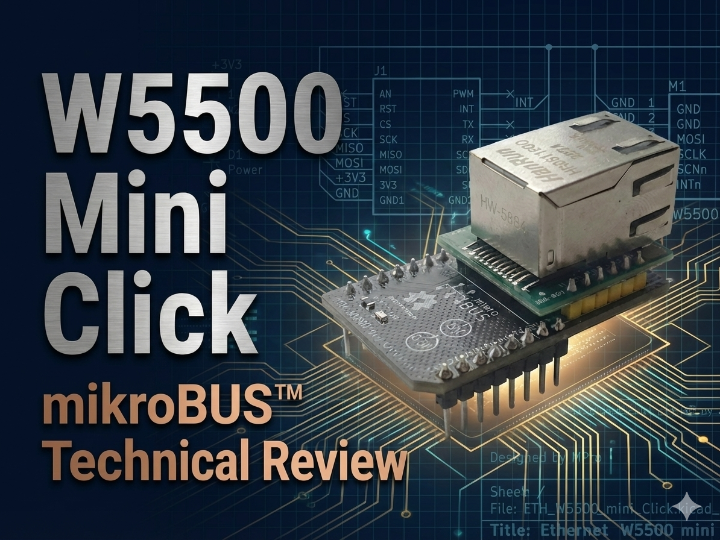
A tech review of MichPro's W5500 Mini Click: Adapting W5500 modules to the mikroBUS™ standard for reliable, interrupt-driven IoT connectivity.
WIZnet - W5500
x 1

* Cover Image in this article were generated by Gemini.
1. Overview
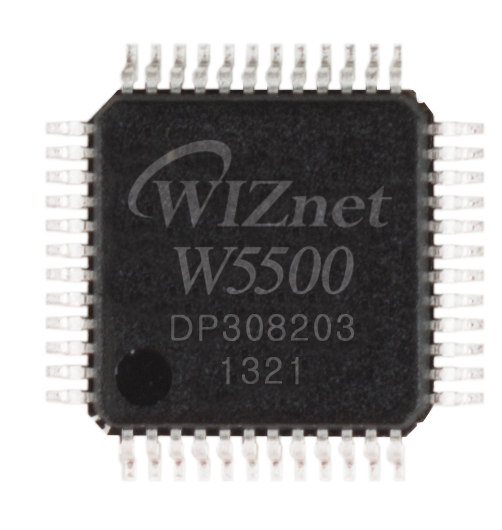
WIZnet's Hardwired TCP/IP Ethernet controller, the W5500, has established itself as the standard chipset for Open Source Hardware (OSHW) projects worldwide, thanks to its stable network offload performance.
In this post, we analyze the 'Ethernet W5500 Mini - mikroBUS™ Click' module, developed by MichPro and distributed via Tindie. This product is not just a simple breakout board; it adopts a unique structure that converts a generic W5500 stamp module into the mikroBUS™ industrial standard interface, maximizing prototyping efficiency.
2. H/W Specifications & Pinout
The core value of this module lies in the combination of a standardized form factor and the W5500 hardware stack.
- Core Chipset: WIZnet W5500 (Hardwired TCP/IP)
- Interface: SPI Mode 0, 3
- Form Factor: mikroBUS™ Standard Socket (28.6mm x 25.4mm)
- Power Input: 3.3V DC via mikroBUS header (5V is N.C)
mikroBUS™ ClickPin Mapping

Based on the schematic analysis, the pin connections are detailed below. Unused pins are physically Not Connected (N.C) to prevent signal interference.
3. Design Analysis
Upon close examination of the schematics and physical board available on GitHub, it is evident that this product employs a practical 'Module-on-Board' design approach.

1. Carrier Board Architecture
Instead of mounting the W5500 chip directly onto the main PCB, this Click Board utilizes a proven commercial 'W5500 Mini Module' (M1, typically a stamp-type module manufactured by makers such as Makerfabs) as a key component. In essence, MichPro's PCB acts as a carrier board that converts this stamp module into the mikroBUS™ standard pinout.
2. Design Efficiency
This design strategy offers significant engineering advantages. By using a module where RF reliability (magnetics/impedance matching) is already secured, it reduces hardware risks and lowers BOM costs through the use of mass-produced components.
4. Technical Deep Dive
Beyond simple connectivity, here are the key points from an engineering perspective:
1. Physical Connection of the INTn (Interrupt) Pin
Some low-cost breakout boards only connect the essential SPI pins and omit the interrupt pin. However, this module correctly routes the W5500's INTn (Pin 6) to the INT pin (Pin 15) of the mikroBUS specification, as confirmed in the schematics.
- Pro Tip: This allows for an interrupt-driven approach, waking the MCU only when data is received, rather than using a polling method where the MCU constantly checks for data. This is a critical factor for S/W optimization in low-power IoT device design.
2. Signal Integrity
Temporary connections using breadboards and jumper wires are susceptible to noise during high-speed SPI communication (W5500 supports up to 80MHz). In contrast, the socket connection ensures the shortest signal path, thereby enhancing communication reliability.
5. mikroBUS™ Ecosystem & Standardization
The mikroBUS™ standard adopted by the MichPro module has become a de facto standard in the embedded development environment, far exceeding a simple connector specification.
1. The Largest Add-on Standard
Proposed by MikroElektronika (Mikroe) in Serbia, this standard currently boasts a lineup of over 1,600 'Click Boards™'. Almost every peripheral imaginable—sensors, RF, interfaces, displays—exists in this form factor. This means engineers can instantly add necessary functions like 'LEGO blocks' without additional hardware design.
2. Industry Adoption
The mikroBUS™ socket is not exclusive to Mikroe boards. Recognizing its utility, global semiconductor vendors such as Microchip, NXP, STMicroelectronics, and Infineon have integrated mikroBUS sockets into their official evaluation boards. This serves as proof that it is a reliable standard acknowledged by major industry players.
3. Powerful Software Resources (LibStock & mikroSDK)
- LibStock: A platform where tens of thousands of libraries and example codes written by developers worldwide are shared.
- mikroSDK: Provides a Hardware Abstraction Layer (HAL), allowing code to work across different MCUs without modification.
4. Open Standard & 3rd Party Scalability
Mikroe has opened this standard, allowing anyone to create compatible boards. Indie developers like MichPro can release unique products on marketplaces like Tindie. This ensures users have access to a rich supply chain, ranging from major distributors like Digi-Key and Mouser to niche markets.
6. S/W Compatibility
- Arduino: Fully compatible with the official
Ethernetlibrary. - Python (Circuit/MicroPython): Can be driven immediately using the
networkmodule's WIZNET5K driver without additional porting.
7. Conclusion
The MichPro Ethernet W5500 Mini Click module is a clever combination of 'versatility' and 'standardization'.
By utilizing a commercial stamp module, it secures price competitiveness while achieving 'connectivity convenience' and 'hardware reliability' through the mikroBUS™ interface. The meticulous routing of the interrupt pin, in particular, is a feature that will be highly appreciated by engineers developing real-world field applications.