


Why WLED Developers Choose W5500: Pin Efficiency Over Speed
WLED uses WIZnet W5500 for stable Ethernet. Its SPI interface saves GPIO pins, making it more efficient than RMII.
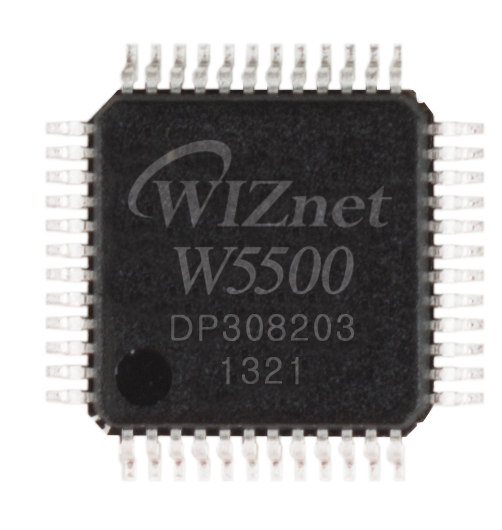
WIZnet - W5500
x 1

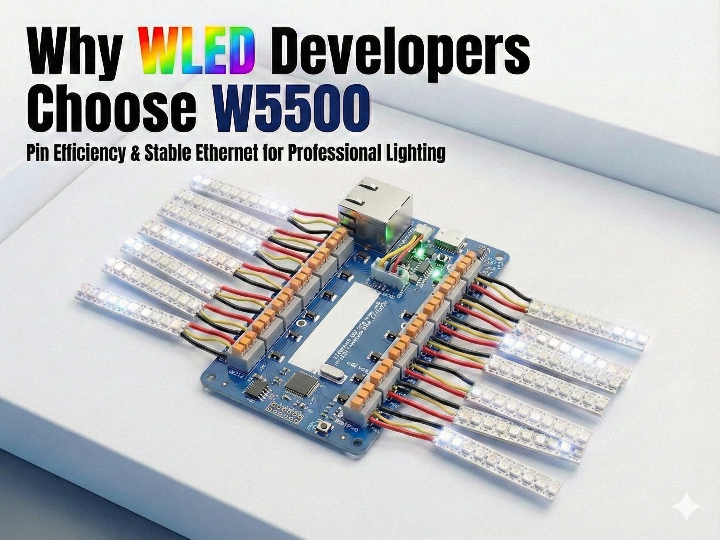
The cover image of this article was generated by Gemini.
3-Line Key Summary
- Market Trend: As the ESP32-based open-source lighting platform (WLED) is utilized in professional and commercial installation areas, the introduction of wired Ethernet is required to overcome the communication instability of Wi-Fi.
- Reason for Selection: Although slower than competitor chipsets (RMII), the W5500 (SPI) was adopted for its advantage in hardware resource efficiency by using fewer GPIO pins.
- Scalability: The scope of application is expanding beyond personal DIY to medium/large-scale media art and commercial facilities requiring high communication reliability.
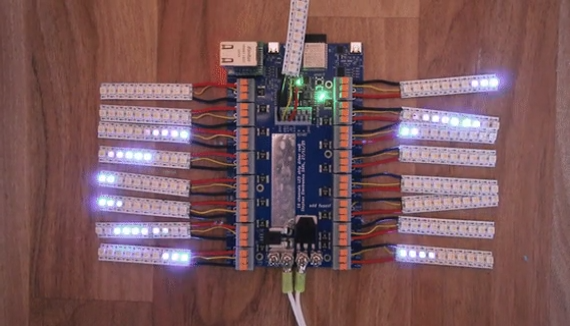
1. Market Pain Point: "Limitations of Wireless Communication in Large-Scale Control"
- WLED (Web Server for LEDs) is an open-source solution for controlling LEDs via smartphones or the web. While it initially supported convenient Wi-Fi connectivity, technical limitations of wireless communication emerged as the quantity of controlled LEDs increased.
- Problem Situation: In environments where multiple LEDs are synchronized in real-time (Art-Net/sACN protocols), 'response latency' and 'packet loss' occur due to Wi-Fi bandwidth limitations.
- Market Demand: Consequently, the introduction of wired Ethernet became a necessary condition in commercial installation environments where stable data transmission is essential.
2. Voice of the Field: Technical Review by Developers (Fact Check)
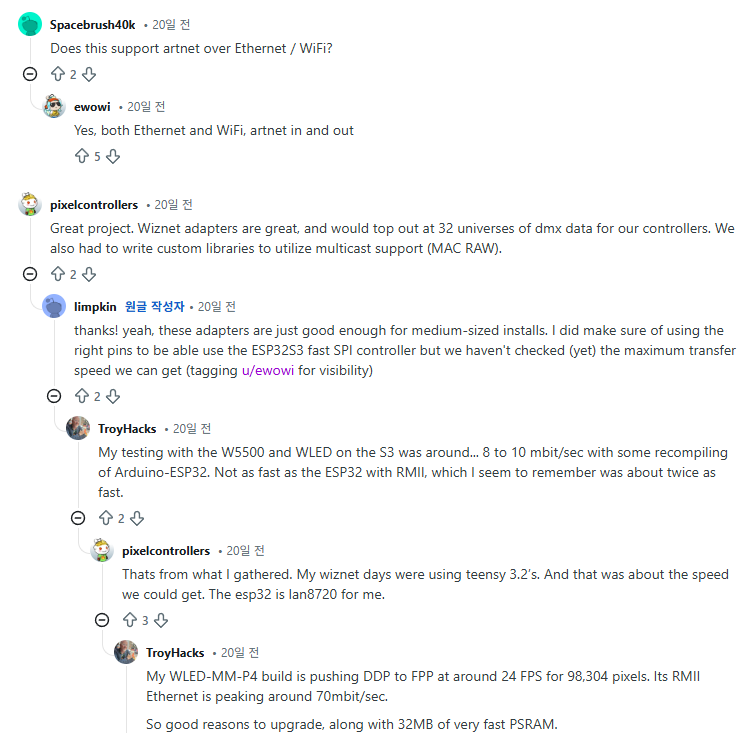
What technical reviews did actual developers undergo for Ethernet introduction? We analyzed technical discussions from the Reddit community.
3. [Comparative Analysis] Differences Between Competitor Chipsets and W5500
The reason engineers use the W5500 despite competitor technologies (RMII PHY, LAN8720) offering faster transmission speeds is due to 'hardware resource efficiency.'
Technical/Economic Feasibility Comparison Table (Features of W5500)
| Comparison Item | WIZnet W5500 (SPI) | Competitor RMII PHY (LAN8720) |
|---|---|---|
| Required GPIO Pins | 4 ~ 5 (Efficient) | 9 ~ 10 (High usage) |
| Circuit Design Difficulty | Easy (Simple) | Difficult (Complex wiring) |
| Suitability | Medium-sized Install | Large-scale Projects |
Insight: Trade-off between 'Speed' and 'Resources (Pin)'
GPIO pins are a finite resource in hardware design.
- WLED driver boards require connections for various peripherals such as microphones, sensors, and remote controls.
- The W5500 minimizes pin usage (Pin-Saving), offering the advantage of adding other functions to the remaining resources.
- In other words, "W5500 can be a valid option for securing functional scalability and efficiency in mass-production board design."
Frequently Asked Questions (FAQ)
Q1. Why is the W5500 used in WLED when it is slower than the competitor chip (LAN8720)?
A. It is due to 'Pin Efficiency.' The W5500 uses the SPI interface, consuming about half the GPIO pins compared to competitor chips. Since LED control requires multiple pins, the W5500 is often chosen for design efficiency.
Q2. In what mode does the W5500 operate in WLED (ESP32)?
A. It operates in MACRAW mode for compatibility with the ESP32's software network stack (LwIP). While it does not use the hardware TCP/IP stack functions, it offers the compatibility advantage of utilizing existing libraries in the ESP32 ecosystem.
Q3. How many LEDs can be controlled with the W5500?
A. According to benchmark results from the technical community, stable control of approximately 32 Universes (about 16,000 LEDs) is reported. This is sufficient capacity to cover general households and medium-sized commercial facilities.