


From Impossible to Reality: W5500-Based 12,288 LED Control System
This project uses W5500 hardware offload to drive 12,288 LEDs at 30 FPS with zero frame drops or latency.
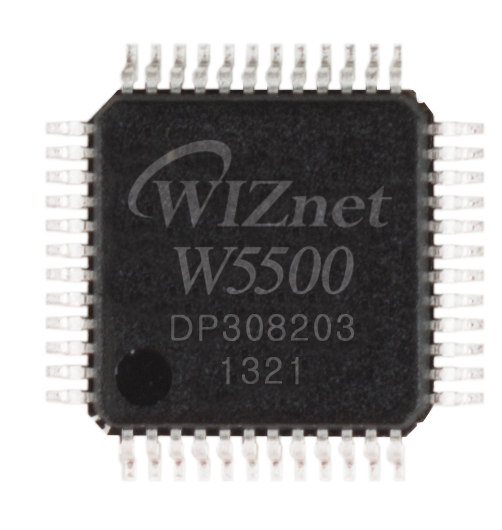
WIZnet - W5500
x 1

The cover image of this article was generated by Gemini.
This report analyzes the "High-Performance ArtNet Controller" project, where an engineer overcame the technical skepticism that "it cannot be done with the RP2350" by adopting the WIZnet W5500 to achieve professional-grade performance.
1. Project Introduction: What Was Built?
This project was conducted by Sri Lankan embedded engineer Kavinda Madhubhashana, with the goal of developing a "High-Performance LED Display Controller" used for large-scale stage lighting or media facades.
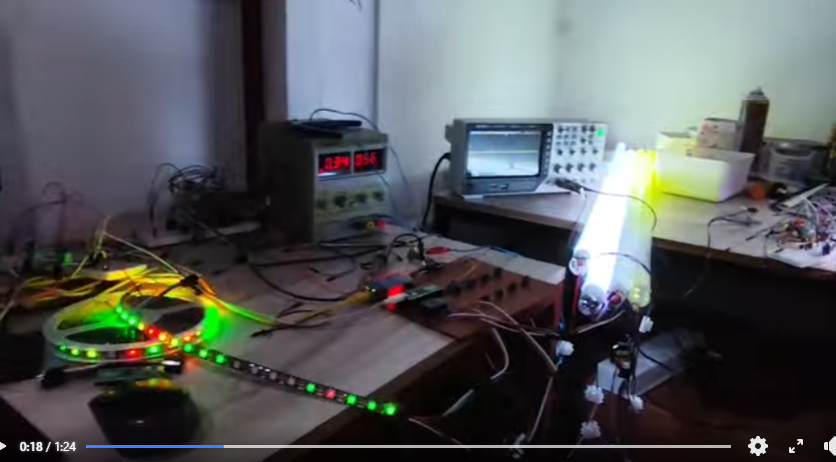
- Project Goal: To receive video signals (ArtNet protocol) sent from a PC or lighting console and control a total of 12,288 LEDs (WS2812) in real-time.
- Requirements: Reliability on par with "Professional Stage Lighting" rather than simple hobbyist projects. (Zero flicker, maintaining 30+ FPS).
- Key Challenge: To process this massive amount of data using only a general-purpose MCU (RP2350) and W5500, without relying on expensive FPGAs or dedicated processors.
2. The Challenge: Technical Limitations and Skepticism
In the early stages of the project, many engineers predicted this attempt would fail. The issues they raised were valid:
- Data Throughput Limits: Controlling over 12,000 LEDs requires processing thousands of network packets per second, a load difficult for a standard MCU's software stack to handle.
- Frame Drops: If CPU resources are diverted to network packet processing, the critical timing for LED signals gets thrown off, resulting in screen stuttering or flickering.
However, the developer tackled these limitations head-on using W5500's Hardware Offload technology.
3. Firmware Architecture: Extreme Optimization Strategy
According to the developer's technical notes, the secret to the system's success lay in a "strict division of labor" combining the characteristics of the W5500 with the dual-core architecture of the RP2350.
① Core 0: Network & Protocol (Feat. W5500)
The first core was dedicated solely to network processing. This is where the true value of the W5500 shines.
- Role of W5500: Since the W5500 handles physical packet reception and TCP/IP processing, the MCU only needs to retrieve verified data via SPI communication.
- Zero-Copy Pipeline: To eliminate unnecessary memory copying, the developer implemented a technique to read data directly from the W5500's 16KB RX buffer and immediately route it to the output buffer.
- Performance: As a result, the system successfully processed 2,160 large packets per second while keeping Core 0 utilization under 80%.
② Core 1: Real-Time Signal Generation
The second core focused exclusively on LED signal generation, a task where "timing" is critical.
- Interference-Free Execution: No matter how busy Core 0 (Network) is, Core 1 is not interrupted by network tasks thanks to the W5500 offloading the work.
- PIO & DMA Utilization: Using PIO (Programmable I/O) to generate precise signals at 6.67ns resolution, and DMA to transfer 48KB of data per frame within 20ms without CPU intervention.
4. The Hardware Reality: Solving Field Noise
In actual stage environments, unlike in the lab, electrical noise was a major hurdle. Ground loops caused by multiple mixed power supplies distorted the signals.
To solve this, the developer applied specialized isolation ICs used in professional lighting consoles (such as grandMA) instead of simple level shifters to ensure signal integrity. This demonstrates that professional-grade perfection was pursued in hardware design as well as firmware.
5. Final Results: Performance Proven by Numbers
This project passed extreme stress tests, numerically proving the stability of the W5500-based system.
- Total Output: 12,288 LEDs (12 Parallel Outputs)
- Throughput: Real-time processing of 72 ArtNet Universes
- Frame Rate: 30+ FPS (Sustained) - Achieved 0% frame drops
- Packet Loss: Zero (0) - Passed stress test of 2,880 packets per second
- Stability: No performance degradation or memory fragmentation during 24-hour continuous operation
6. Conclusion (Insight)
This case provides a clear answer to the question, "What is needed to implement high-performance networking in embedded systems?"
Because the developer had the Hardware TCP/IP processing capability of the W5500, they were able to focus the MCU's resources entirely on LED control, succeeding in a project deemed impossible. This serves as an excellent reference showing that WIZnet solutions act as a key enabler that expands the performance limits of the entire system beyond simple network connectivity.
FAQ: W5500 High-Performance LED Controller
- Q1. Why use the W5500 instead of the MCU's built-in network capabilities?
A. Standard software TCP/IP stacks consume significant CPU resources. In timing-critical applications like LED control, this causes visual artifacts or stuttering. The W5500 offloads TCP/IP processing to hardware, allowing the MCU's CPU to focus entirely on generating precise LED signals without interruption.
- Q2. What is the 'Zero-Copy Pipeline' and why does it matter?
A. Every memory copy introduces latency. This project minimizes latency by reading data directly from the W5500's internal RX buffer and routing it immediately to the output buffer, skipping unnecessary RAM copies. This reduced packet processing time to under 5μs, enabling real-time control of 12,288 LEDs.
- Q3. Were there any frame drops when controlling 12,000 LEDs?
A. None at all. Even under a stress test of 2,880 packets per second, the system maintained 0% packet loss and 0% frame drops. This was achieved because the W5500 reliably handled the data influx while the RP2350's dual cores efficiently distributed the workload.
- Q4. How were real-world noise issues handled?
A. Unlike lab environments, real stages suffer from ground loops caused by multiple power supplies. To solve this, the developer used specialized isolation ICs (similar to those in professional grandMA consoles) instead of simple level shifters, ensuring signal integrity against electrical noise.
- Q5. What are the potential applications for this system?
A. It is suitable for large-scale concert lighting, building media facades, and broadcast studio backgrounds—essentially anywhere high-definition, high-capacity LED control is required. It serves as a cost-effective alternative to expensive professional equipment.
Source: