


FM-ArtNetNode_4U_V2
Raspberry Pi Pico + W5500-Lite four-universe Art-Net-to-DMX512 node, using the W5500 hardware socket for UDP and web config.
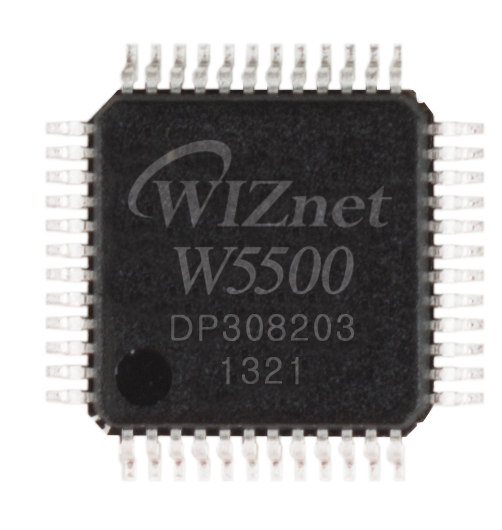
WIZnet - W5500
x 1

How a Raspberry Pi Pico 4-Universe Art-Net-to-DMX512 Node Uses the WIZnet W5500 (W5500-Lite) Hardware Socket for Reliable Stage Lighting Control
Overview
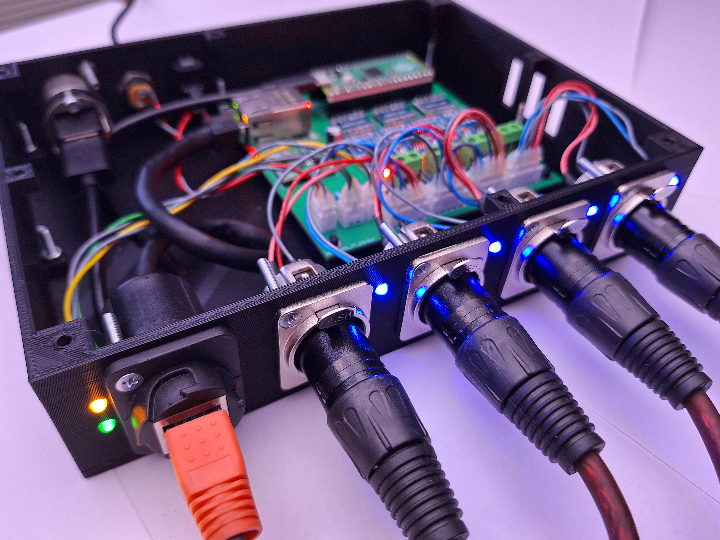
Driving stage lighting from a PC or console needs a node that turns network commands into the DMX512 signal fixtures understand. FM-ArtNetNode_4U_V2 is a custom-built Art-Net → DMX512 node based on the Raspberry Pi Pico (RP2040), made as an author's high-school graduation "masterpiece" project for events, concerts, and clubs.
Its defining trait is scale on a small MCU: it outputs 4 DMX universes (2,048 channels) at once. It receives the lighting-standard protocol Art-Net over wired Ethernet and converts it to four independent DMX512 lines driven through the RP2040's PIO serial engines and MAX485 transceivers. The Ethernet gateway is a WIZnet W5500-Lite module (W5500 + transformer + RJ45), wired to the Pico over SPI, and the design uses the W5500's hardware TCP/IP socket both for Art-Net UDP reception and for a built-in configuration web server.
Key Features
- W5500 hardware socket for Art-Net UDP: Art-Net is a UDP protocol (port 6454) carrying real-time DMX with low latency; an ArtDmx packet is 530 bytes (18-byte header + up to 512 DMX bytes). The W5500 handles the TCP/IP layer in hardware, so the RP2040 receives Art-Net through a hardware socket without a software network stack eating its cycles — leaving the MCU free for four simultaneous DMX outputs.
- 4 universes / 2,048 channels: Rather than a single-universe bridge, this node drives 4 universes at once. The Pico exposes 2 physical UARTs plus 8 PIO-based serial ports, and PIO is used to generate the multiple DMX512 lines in parallel — a natural fit for multi-universe output.
- Dual W5500 protocol use — UDP + TCP web server: Beyond receiving Art-Net over UDP, the same W5500 hosts a configuration web server so IP, MAC, universes, and the ports in use can be set from a browser. It uses the chip for both realtime data (UDP) and management (TCP) — a clean demonstration of the W5500's multi-socket hardware.
- Easy Ethernet via the W5500-Lite module: The W5500-Lite integrates the W5500, magnetics, and RJ45, so Ethernet is added with just an SPI hookup — no magnetics/RJ45 circuit design. The 100×100 mm PCB was kept compact to cut cost and keep the high-speed SPI link to the W5500 clean.
- Robust, event-ready hardware: DMX output via MAX485 (RS-485 differential), a logic-level shifter for 3.3 V↔5 V, DC-DC conversion, reverse-voltage and multi-source protection diodes, activity/status LEDs on packet reception, and last-frame memory so the last state is held. Packaged in a 3D-printed 1U rack case (200×150×45 mm) with connectors for Ethernet, DMX, USB (firmware), and power.
System Architecture
[Lighting SW / console]
   │  Art-Net (UDP 6454), wired Ethernet
   ▼
[W5500-Lite (W5500)]  ── hardware socket ──►  also hosts config web server (TCP)
   │  SPI
   ▼
[Raspberry Pi Pico (RP2040)]
   │  Art-Net parse → 4 DMX buffers
   │  (last-frame memory, status LEDs)
   ▼
[PIO serial ×4] ──► [MAX485 ×4]  (3.3V↔5V level shift)
   │  RS-485 differential
   ▼
[4× DMX512 universes = 2,048 channels]
   │
   ▼
[Stage lighting fixtures]
The W5500's role in the data path: The W5500 (W5500-Lite) is the Ethernet entrance linking lighting software to the node. It receives Art-Net UDP packets through a hardware socket and hands the DMX payload to the RP2040, which fans it out to four universes. The same chip also answers the browser-based setup page, so one Ethernet interface serves both live control and configuration.
Role and Application of the WIZnet Chip
- Chip/module used: WIZnet W5500 (as the W5500-Lite module — W5500 + transformer + RJ45 integrated).
- Connection: Wired to the Raspberry Pi Pico via SPI. As a finished module, it needs no Ethernet physical-layer (magnetics/RJ45) design; the PCB was kept at 100×100 mm partly to keep this high-frequency SPI link short and clean.
- Its role:
- Realtime path (UDP): Wired-Ethernet reception of Art-Net (UDP 6454), which the Pico converts to four DMX512 universes.
- Management path (TCP): Serving a configuration web server for IP, MAC, universe mapping, and ports.
- Why hardware TCP/IP matters here:
- MCU resource savings: With the W5500 doing TCP/IP in hardware, the RP2040's compute and PIO stay dedicated to generating 4 DMX streams — the hard real-time job.
- Stability / determinism: In lighting, dropouts or jitter are instant, visible failures. Wired Ethernet plus a hardware socket gives deterministic, low-latency reception even under a high packet rate.
- What weakens without the W5500: The RP2040 would need a software Ethernet stack plus an external MAC/PHY, stealing cycles from the four DMX outputs and complicating the board. The hardware socket is what makes stable 4-universe Ethernet lighting practical on a low-cost MCU.
Related Existing Contents
Framed as comparisons with other "MCU + W5500 → Art-Net-to-DMX" builds.
STM32 USB + Art-Net-to-DMX interface (midi-and-more.de lineage) An STM32 (Nucleo-L476 / F042) node that receives Art-Net over W5500 and also takes USB (MIDI/ASCII/MiniDMX), using the W5500 hardware UDP socket at register level.
- Similarities: The core — MCU + W5500 hardware socket receiving Art-Net (UDP) → DMX512 — is the same, as is the "add Ethernet to a small MCU with no software stack" idea.
- Differences: The STM32 build weights USB multi-input (MIDI/ASCII/MiniDMX) and single-universe operation. This project instead scales to 4 universes / 2,048 channels via RP2040 PIO, and adds a W5500-hosted web config server — i.e. it leans on the W5500 for both UDP data and TCP management.
stm32_artnet_dmx (max-verem, GitHub) An Art-Net → DMX512 gateway on STM32F411 + W5500 with a hand-written low-level driver, SPI-DMA/TIM-DMA optimization, OLED, and CLI.
- Similarities: STM32/MCU + W5500 hardware socket, Art-Net→DMX512 conversion.
- Differences: max-verem emphasizes DMA-level throughput tuning on a single-universe-class path; this project emphasizes multi-universe output on the Pico, module-based Ethernet (W5500-Lite), and browser configuration, with a strong DIY / educational framing (a graduation project with a full write-up and PCB).
In short, "receive Art-Net with an MCU + W5500 and convert to DMX512" has several cases. What sets FM-ArtNetNode_4U_V2 apart is combining a Raspberry Pi Pico's PIO for 4-universe (2,048-channel) output with a W5500 used across both Art-Net UDP reception and a TCP configuration web server.
Market & Application Value
- Events / concerts / clubs (B2C/prosumer): A 4-universe node that connects standard lighting software and consoles (Art-Net) to fixtures over DMX — enough channel count for real shows in a compact 1U box.
- DIY / maker / education: A documented graduation project (PCB in EasyEDA, 3D-printed case, C/C++ firmware) — a strong teaching resource for RP2040 + W5500 Ethernet, PIO serial, RS-485/DMX, and web-based config.
- Fixed installs: The web server for IP/MAC/universe/port setup makes it convenient to deploy and re-address on site without reflashing.
- Low-cost node for lighting software: A budget Art-Net endpoint for any Art-Net-capable controller needing multiple universes.
- Why it's advantageous in real use: The W5500-Lite module + hardware socket let a low-cost MCU do stable, multi-universe Ethernet lighting, while the module removes Ethernet circuit-design burden and the on-chip TCP sockets enable browser configuration.
WIZnet Strategic Value
- Hardware TCP/IP under real-time load: The project shows the W5500 sustaining Art-Net UDP reception while the MCU generates 4 DMX streams — the core value proposition of offloading networking to hardware.
- Multi-socket, dual-protocol showcase: Using the same W5500 for UDP (Art-Net data) and TCP (web config) demonstrates the chip's multi-socket hardware in one compact product.
- Small-MCU + W5500-module reference: RP2040 + W5500-Lite is a clean, low-cost reference for adding robust Ethernet to popular hobbyist-grade MCUs.
- Module (W5500-Lite) adoption case: Choosing a finished module over a bare chip lowered PCB complexity and RF/magnetics design risk — showing the value of WIZnet modules in DIY / low-volume builds.
- Entertainment-lighting market reach: An Art-Net / DMX512 node broadens WIZnet's footprint in the stage, event, and club lighting market.
- Reference-code value: An RP2040 + W5500 Art-Net node (with web config) is useful reference material for developers pairing the Pico with WIZnet Ethernet.
FAQ
Q. How are Art-Net and DMX512 different? DMX512 is the RS-485 serial signal fixtures receive directly (up to 512 channels per universe). Art-Net carries that DMX data over Ethernet using UDP for low-latency realtime transport. This node receives Art-Net and outputs DMX512 to the fixtures.
Q. Why 4 universes / 2,048 channels? One universe is 512 channels; larger rigs need more. This node outputs 4 universes at once, using the RP2040's PIO serial engines to drive four DMX lines in parallel.
Q. What is the W5500-Lite? Is it different from the W5500? The W5500-Lite is a compact WIZnet module integrating the W5500 chip with a transformer and RJ45. The chip inside is the W5500; you attach the module over SPI with no separate Ethernet-circuit design.
Q. Does the W5500 do more than receive Art-Net? Yes. Besides receiving Art-Net over UDP, the W5500 also hosts a configuration web server (TCP) for setting IP, MAC, universes, and ports from a browser — using the chip's multi-socket hardware for both data and management.
Q. Why does it stay stable at a high packet rate? Because the W5500 handles TCP/IP in hardware. The MCU only parses received DMX and drives the four outputs, so networking overhead doesn't compete with the real-time DMX generation.
Limitations / Notes
- The chip/module used is the W5500 (W5500-Lite module), serving as the Art-Net Ethernet reception gateway and the config web-server host.
- Hardware TCP/IP usage: The design receives Art-Net via the W5500 (UDP) and serves a web server via the W5500 (TCP). Low-level implementation specifics (register-level vs. library) beyond what the project README states are not detailed here.
- What the W5500 does not do: DMX512 signal generation (PIO + MAX485), 3.3 V↔5 V level shifting, last-frame memory, and status LEDs are the MCU/board's roles, not the W5500's. The W5500 handles Ethernet (Art-Net UDP + web config TCP).
- A DIY / student project: FM-ArtNetNode_4U_V2 is a custom-built high-school graduation ("maturità") project with published PDF documentation, firmware, and PCB — not a commercial product. Treat specs and behavior as project-stated.
- Information basis: Summarized from the project's GitHub repository (README in Italian, plus the linked project PDF). Any later changes are unconfirmed.
Source / Reference Links
- Project repository: https://github.com/michifx512/FM-ArtNetNode_4U_V2
- Full project document (PDF): https://github.com/michifx512/FM-ArtNetNode_4U_V2/blob/main/FM-ArtNetNode.pdf
- WIZnet W5500: https://docs.wiznet.io/Product/Chip/Ethernet/W5500
Related Projects
- STM32 USB+Art-Net-to-DMX512 interface (midi-and-more.de)
- stm32_artnet_dmx (max-verem, GitHub)