


esp-eth-drivers PR: W6100 Ethernet Driver Support Coming to ESP-IDF
Community-contributed PR adds WIZnet W6100 Ethernet driver to ESP-IDF, enabling IPv4/IPv6 dual-stack communication over SPI on ESP32.
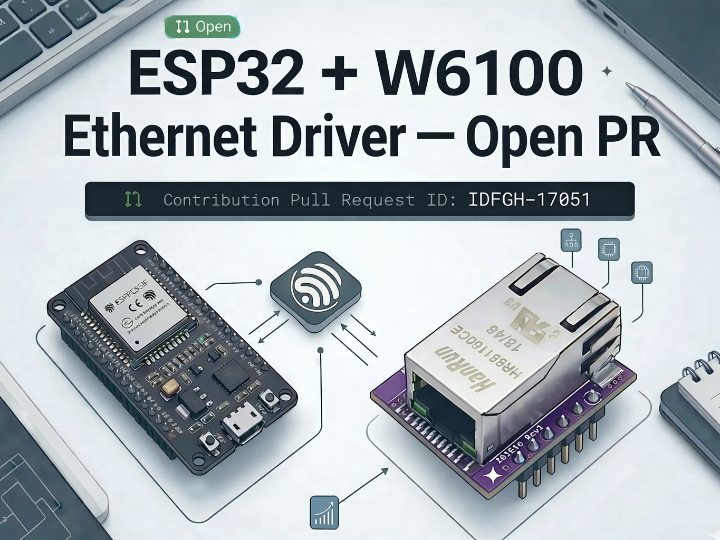

WIZnet - W6100-EVB-Pico
x 1

Open Source Contribution: ESP32 + W6100 Driver PR Under Review at Espressif
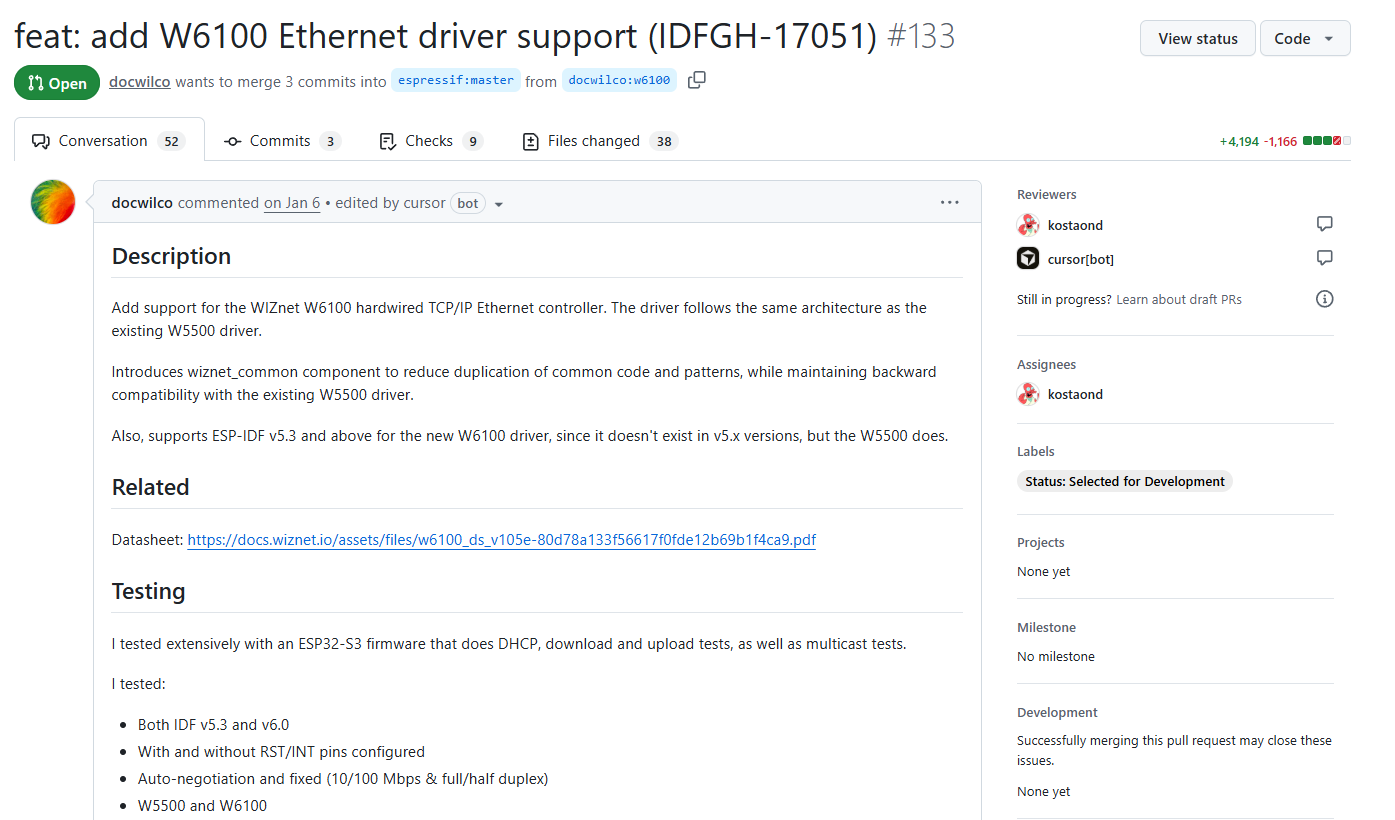
The ESP32 series is widely used for its built-in Wi-Fi and Bluetooth, but in industrial environments or applications requiring wired network connectivity, Ethernet is often essential. Espressif's official SDK, ESP-IDF, first introduced SPI Ethernet support in v4.4, including an official W5500 driver. While the W5500 driver has remained part of ESP-IDF through v5.x, its successor — the W6100, which adds native IPv6 support — has had no official driver available.
In January 2026, developer docwilco submitted a Pull Request to Espressif's external Ethernet driver repository, esp-eth-drivers, adding full W6100 driver support. This is the first publicly available implementation enabling the W6100 to work directly within the ESP-IDF ecosystem.
The Role of the WIZnet W6100
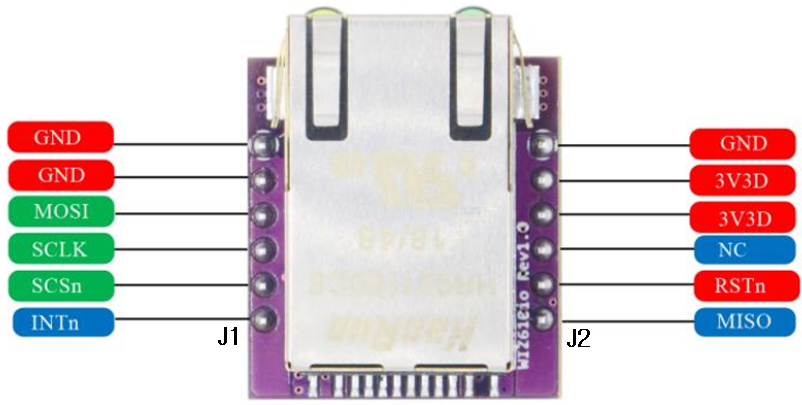
The W6100 is a Hardwired TCP/IP Ethernet controller with the entire TCP/IP stack implemented in hardware. The MCU only needs to access socket registers over SPI to handle TCP, UDP, IPv4, and IPv6 communication — no software TCP/IP stack required. This makes it well-suited for resource-constrained MCU environments where reliable network performance is needed.
Key differences from the W5500:
| Feature | W5500 | W6100 |
|---|---|---|
| IP Version | IPv4 only | IPv4 + IPv6 dual-stack |
| Sockets | 8 | 8 |
| Multicast Filtering | IPv4 block only | IPv4 and IPv6 independent control |
| Max SPI Clock | 80 MHz | 80 MHz |
| Speed | 10/100 Mbps | 10/100 Mbps |
According to the contributor's own testing, the W6100 showed slightly higher throughput than the W5500 under identical conditions.
How It Works
The driver follows ESP-IDF's Ethernet driver architecture, separating the MAC and PHY layers. Here's a breakdown of the key design decisions.
1. wiznet_common — Shared 3-Layer Architecture
Common code shared between W5500 and W6100 has been extracted into a wiznet_common component, covering the SPI transport (wiznet_spi.c), MAC common logic (wiznet_mac_common.c), and PHY common logic (wiznet_phy_common.c). The W6100 driver only needs to implement a wiznet_chip_ops_t structure defining chip-specific behavior; TX/RX handling, the EMAC task, and initialization sequences are all handled by the shared layer. The W5500 driver has been refactored to use the same structure.
esp-eth-drivers/
├── wiznet_common/          ← Shared layer for W5500 / W6100
│   ├── wiznet_spi.c        SPI transport
│   ├── wiznet_mac_common.c MAC TX/RX, EMAC task
│   └── wiznet_phy_common.c PHY link detection, speed/duplex negotiation
├── w5500/                  ← Depends on wiznet_common, chip-specific ops only
└── w6100/                  ← Depends on wiznet_common, chip-specific ops only
2. WIZnet-Specific SPI Frame Format
WIZnet chips use a non-standard SPI frame layout. The driver maps this to ESP-IDF's SPI driver fields as follows:
[ command_bits = 16 ]  [ address_bits = 8 ]  [ data ]
     Address phase         Control phase       R/W data
For register reads of 4 bytes or less, the SPI_TRANS_USE_RXDATA flag is used to prevent 4-byte boundary overwrites.
3. Chip Initialization Sequence
Software reset (clear RST bit in SYCR0)
      ↓
Wait for stabilization (60.3ms per datasheet)
      ↓
Poll W6100_REG_CIDR → verify Chip ID = 0x6100
      ↓
Unlock NETLCKR → clear NETMR (disable IPv4/IPv6 blocking)
      ↓
Call wiznet_setup_default()
(buffer allocation, socket mode, interrupt setup)
      ↓
Set SYCR1 IEN bit → enable global interrupt
4. PHY Register Bit Interpretation — Inverted from W5500
The W6100's PHYSR (PHY Status Register) has inverted speed and duplex bit meanings compared to the W5500:
| Bit | W5500 | W6100 |
|---|---|---|
| speed = 1 | 100 Mbps | 10 Mbps |
| speed = 0 | 10 Mbps | 100 Mbps |
| duplex = 1 | Full | Half |
| duplex = 0 | Half | Full |
The driver abstracts this difference via the speed_when_bit_set/clear fields in phy_wiznet_config_t and an opmode lookup table, so upper layers remain chip-agnostic.
5. Multicast Filtering
The W6100 controls multicast reception via the MMB (IPv4 multicast block) and MMB6 (IPv6 multicast block) bits in the Socket Mode Register (SMR).
add_mac_filter(addr) called
      ↓
Identify by MAC address prefix:
  01:00:5e:xx → IPv4 multicast
  33:33:xx    → IPv6 multicast
      ↓
Increment internal counter (v4_cnt / v6_cnt)
counter 0 → 1: clear MMB / MMB6 bit (allow reception)

rm_mac_filter(addr) called → decrement counter
counter 1 → 0: re-enable MMB / MMB6 bit (block reception)
While W5500 can only block IPv4 multicast, W6100 supports independent control of both IPv4 and IPv6 multicast.
6. ESP-IDF Version-Gated Features
// Multicast filter API only available on ESP-IDF v5.5 and above
#if ESP_IDF_VERSION >= ESP_IDF_VERSION_VAL(5, 5, 0)
    mac->add_mac_filter    = emac_w6100_add_mac_filter;
    mac->rm_mac_filter     = emac_w6100_rm_mac_filter;
    mac->set_all_multicast = emac_w6100_set_all_multicast;
#endif
| ESP-IDF Version | W5500 | W6100 |
|---|---|---|
| v5.3 ~ v5.4 | Built-in driver | Basic Ethernet only |
| v5.5 and above | External component | Full features incl. multicast filter |
| v6.0 and above | External component | Full features |
Potential Applications
Once merged into esp-eth-drivers, the ESP32 + W6100 combination will be easily integrated into any project via the ESP-IDF Component Manager.
Applicable scenarios include:
- Industrial automation and edge gateways: Devices that require stable wired Ethernet rather than Wi-Fi, such as PLC-connected units or data acquisition gateways
- IPv6 transition environments: New systems such as telecom infrastructure or smart home hubs that require native IPv6 support
- Multicast-dependent protocols: Implementing mDNS, CoAP, or IGMP-based services on ESP32, where W6100's IPv6 multicast filtering becomes a practical advantage
- ODM/OEM design: Migrating from W5500-based boards to W6100 is straightforward thanks to the shared
wiznet_commonlayer, minimizing driver migration effort
The contributor has also mentioned plans to develop a W6300 driver once this PR is merged, meaning the wiznet_common architecture is already positioned as the foundation for future WIZnet chip support.
Technical Summary
| Item | Details |
|---|---|
| WIZnet Chip | W6100 (backward compatible with W5500) |
| MCU | ESP32-S3 (applicable across ESP32 family) |
| Interface | SPI |
| Framework | ESP-IDF v5.3 and above (including v6.0) |
| Shared Component | wiznet_common |
| Protocol Support | IPv4, IPv6, TCP, UDP, Multicast |
| Speed | 10/100 Mbps, auto-negotiation / fixed mode |
| Status | Open PR, under Espressif internal review |
| Reference | GitHub PR #133 |
Current Status
This PR is currently under active development, with code feedback being exchanged between the contributor and Espressif's internal reviewers. Developers interested in the ESP32 + W6100 combination are encouraged to follow the PR. If you have thoughts on the implementation or test results, leaving a comment on the PR would be a helpful contribution.
-
GitHub PR: esp-eth-drivers #133


