


esp32-robot-controller
ESP32-S3 + W5500 Hybrid Controller! Features automatic network failover and native ROS2 support for reliable robotics.
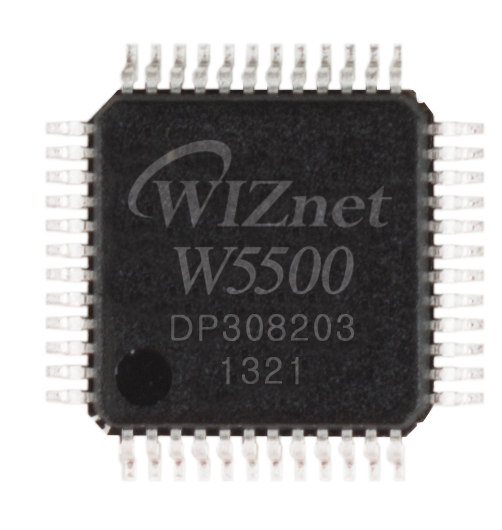
WIZnet - W5500
x 1

Espressif - ESP32
x 1
Hybrid Network Robot Controller via ESP32-S3 & WIZnet W5500
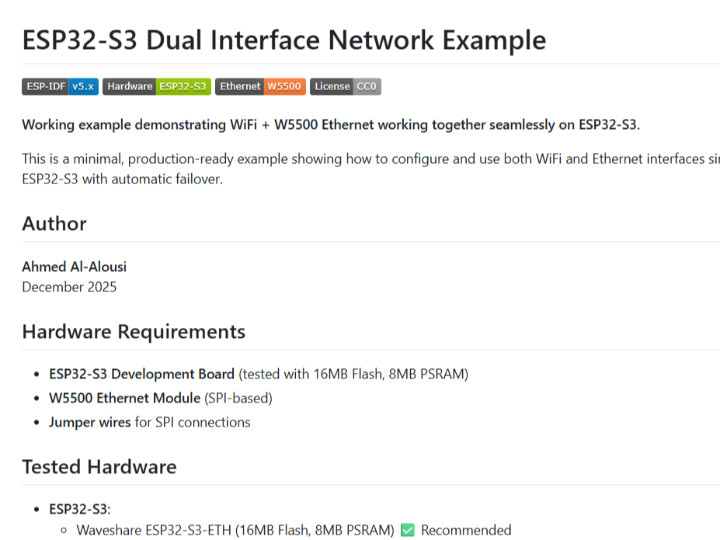
This project pushes the boundaries of communication reliability in robotics by combining the ESP32-S3 with the WIZnet W5500 for a dual-path network architecture.
In robotics, especially within the ROS2 ecosystem, "Communication Latency" and "Connection Drops" are critical failure points. This project solves these hardware limitations by integrating W5500 Wired Ethernet alongside WiFi for maximum redundancy.
1. Technical Core: Why Hybrid (Dual) Networking?
The standout feature of this controller is its ability to handle both WiFi and W5500 (SPI Ethernet) simultaneously.
- Reliable Control Loop: While mobile robots rely on WiFi for movement, the W5500 provides a "Gold Standard" connection for high-bandwidth tasks like camera streaming or precise PID tuning when docked or in interference-heavy environments.
- Failover Mechanism: The system monitors the link status in real-time. If the wired Ethernet is detected, it prioritizes the stable cable connection; if unplugged, it seamlessly fails over to WiFi, ensuring the robot never loses its "heartbeat" control.
- Hardware TCP/IP Offloading: By offloading the networking stack to the W5500’s hardware logic, the ESP32-S3’s CPU is freed up to focus entirely on real-time motor control and sensor fusion, significantly reducing jitter.
2. Hardware Features & Scalability
Based on the Waveshare ESP32-S3-ETH board (which integrates the W5500), this controller is a complete sensor hub:
- Integrated Sensors: Supports MPU-9250 (IMU) for orientation and URM09 (Ultrasonic) for obstacle avoidance.
- Precision Actuation: Features 4-motor PWM+PID control, adaptable for 2WD, 4WD, or tracked robot platforms.
- Vision Streaming: Provides an MJPEG stream (HTTP) compatible with ESP32-CAM, which gains significant stability when transmitted over the W5500’s dedicated bandwidth.
3. Software Value: Native ROS2 Integration
This isn't just a simple firmware; it’s designed to be a first-class citizen in the ROS2 (Robot Operating System) world.
- Standard Topics: It supports
/cmd_vel,/imu,/range, and/camera/image_rawout of the box. - By adhering to these standards, it can communicate directly with high-level controllers (PC or Raspberry Pi) via micro-ROS without complex protocol translations.
💡 FAQ
Q: Why use an external W5500 instead of the ESP32's internal capabilities?
- A: The ESP32-S3 lacks an internal Ethernet MAC. Using the W5500 via SPI provides a dedicated hardware TCP/IP stack. This prevents the "resource tug-of-war" that often happens when a single CPU tries to manage both high-speed WiFi interrupts and precise motor timing.
Q: How does the network failover actually work?
- A: The firmware continuously polls the W5500 link status. If a physical carrier is detected, the routing logic switches to the Ethernet interface. This is crucial for industrial "Smart Factory" environments where wireless interference is unpredictable.
Q: Is there a bottleneck when streaming video and controlling motors at the same time?
- A: The project leverages the ESP32-S3’s dual-core architecture. One core handles the high-frequency PID loops and sensor data, while the other core manages the W5500 communication and MJPEG encoding, minimizing task interference.
Q: Can I use this for industrial prototypes?
- A: Absolutely. The combination of the W5500’s physical reliability and ROS2’s standardized communication makes this an excellent reference for logistics robots, research platforms, or educational kits that require "industrial-grade" connectivity.
🔗 Project Reference
This project is fully open-source. Whether you are building a research bot or an industrial prototype, this architecture serves as a perfect blueprint for reliable networking.
GitHub Repository: https://github.com/ahmedalalousi/esp32-community-projects.git