


KinCony KC868-A16v3: 16-Channel ESP32-S3 I/O Controller with WIZnet W5500 Ethernet
DIN-rail ESP32-S3 controller: 16 digital inputs and 16 MOSFET outputs, WIZnet W5500 wired Ethernet, RS485, and Home Assistant/ESPHome support.
WIZnet - W5500
x 1

Overview
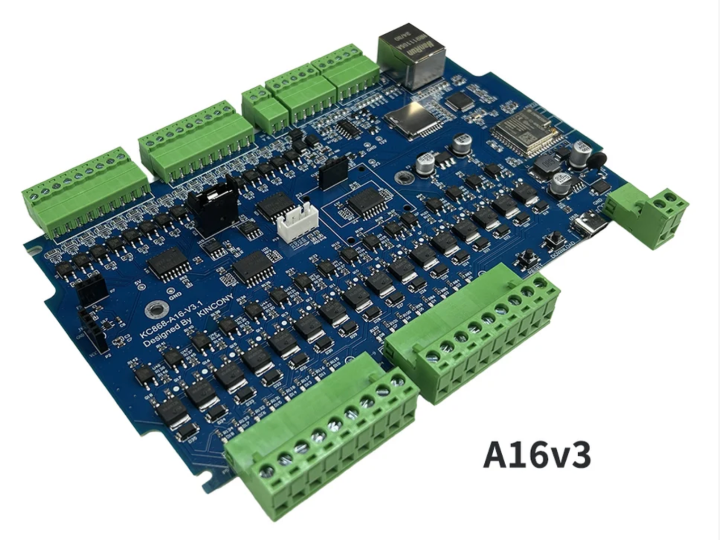
The KinCony KC868-A16v3 is a commercially available, DIN-rail ESP32-S3 automation controller with 16 digital inputs and 16 outputs, using a WIZnet W5500 hardwired TCP/IP Ethernet controller for its wired network path. It targets home and building automation and light industrial control where a reliable, always-on 10/100 Mbps Ethernet link (IPv4/IPv6) is preferred over Wi-Fi. The A16v3 is the 16-channel model in KinCony's KC868-A series, complementing the A2v3 and A8v3 that the maker site already carries.
Who makes it
KinCony (Shenzhen, China) builds a wide range of ESP32-based relay, I/O, and energy-metering controllers for smart-home and industrial use. The KC868-A "v3" line standardized on the ESP32-S3 and the WIZnet W5500 for wired Ethernet, and KinCony documents each board with ESPHome YAML, Arduino demos, an ESPHome device profile, and a support forum.
Key hardware
The board uses an ESP32-S3-WROOM-1U (N16R8) MCU and a WIZnet W5500 over SPI for its RJ45 10/100 Mbps IPv4/IPv6 Ethernet. It provides 16 optocoupler-isolated digital inputs and 16 outputs (driver-IC / MOSFET, up to 10A per channel), four 0-5V analog inputs, and three one-wire GPIOs. Extras include a DS3231 RTC, a microSD slot, an SSD1306 status LCD, RS485, a 433MHz RF sender/receiver, and a Tuya module socket, in a DIN-rail case powered from 12/24V DC.
Role of the WIZnet W5500
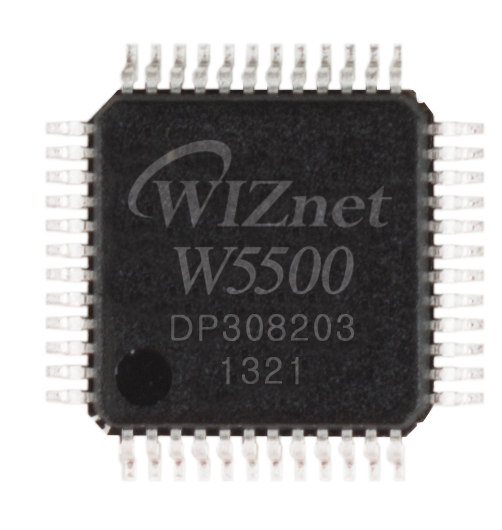
The ESP32-S3 provides Wi-Fi and Bluetooth but no wired Ethernet MAC and PHY, so KinCony adds the W5500 over SPI to supply the RJ45 interface. The W5500 carries WIZnet's hardwired TCP/IP stack plus the 10/100 MAC and PHY in one chip, offloading networking from the ESP32-S3 and giving the controller a stable wired path for Modbus TCP, MQTT, and Home Assistant / ESPHome. Wi-Fi and Bluetooth remain available as fallback or setup channels.
Firmware and integration
The A16v3 runs with ESPHome and Home Assistant (MQTT), Tasmota, or custom Arduino, ESP-IDF, or MicroPython firmware. It has a published ESPHome device profile, which makes it straightforward to bring 16 inputs and 16 outputs into Home Assistant over the wired W5500 link.
Where it fits
The A16v3 is the high-I/O member of KinCony's W5500-based KC868-A automation series. With the A2v3 and A8v3 already curated on the maker site, the A16v3 covers integrators who need more wired digital I/O per DIN-rail unit, for example mixed input-monitoring and output-driving panels rather than relay-only control.
Market and application value
Wired-Ethernet ESP32 I/O controllers are widely used for building automation, industrial monitoring, and equipment sequencing, where Wi-Fi alone is not dependable enough. The W5500 is the common way to add reliable wired Ethernet to these boards. Curating the A16v3 records another concrete, purchasable example of the W5500 in a finished, cased controller, strengthening the maker site's coverage of the KinCony KC868-A family.
Value and limits
The A16v3 is a finished, cased, purchasable product with clear WIZnet content and a strong VAR profile. As with most ESPHome-driven boards, the W5500 usually runs in lwIP / MACRAW mode rather than using WIZnet hardware sockets, so it should not be framed as a hardware-TCP-offload showcase unless a specific Arduino / ioLibrary build is used. Note that a third-party UCC post about the A16v3 already exists as a use-case article rather than a reseller product post, so this VAR entry is distinct, but the live duplicate check on the Original Link should be run before publishing.
FAQ
- Does the A16v3 use a WIZnet chip for Ethernet? Yes. KinCony's specification and the board's ESPHome device profile list a WIZnet W5500 driving the RJ45 100 Mbps IPv4/IPv6 interface over SPI.
- How much I/O does it have? 16 digital inputs and 16 outputs (up to 10A per channel), plus 4 analog inputs and one-wire GPIOs.
- Can it run in Home Assistant? Yes, via ESPHome (published device profile) and MQTT, or Tasmota; custom Arduino / ESP-IDF / MicroPython firmware is also supported.
- Does it need Wi-Fi? No. The wired W5500 Ethernet path is the primary link; Wi-Fi and Bluetooth are fallback or setup options.