


Ethernet 16-Relay Board: An STM32 + W5500 Controller With DIP-Switch IP Deployment
16-channel relay controller from a small French Tindie shop, pairing an STM32F411RE (Cortex-M4) with a WIZnet W5500 that handles all TCP/IP/UDP in hardware.
WIZnet - W5500
x 1

Overview
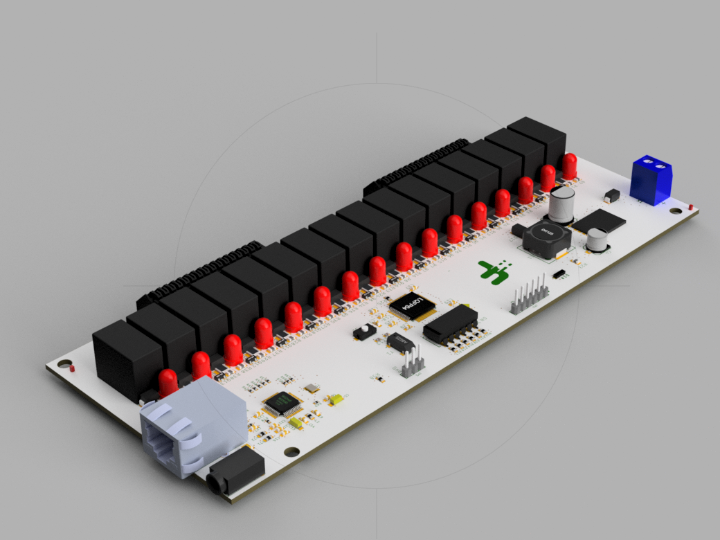
The Ethernet Relay Board is a commercial 16-channel relay controller built and sold by eporutuf, an independent hardware maker based in Auvergne-Rhone-Alpes, France, through the Tindie marketplace. The board pairs an STM32F411RE microcontroller, a 32-bit ARM Cortex-M4 running at up to 100 MHz, with a WIZnet W5500 Ethernet chip, and its whole purpose is wired network control: a computer sends short UDP commands over the LAN and the board switches up to 16 relays, reads back relay status, and optionally reports current and temperature.
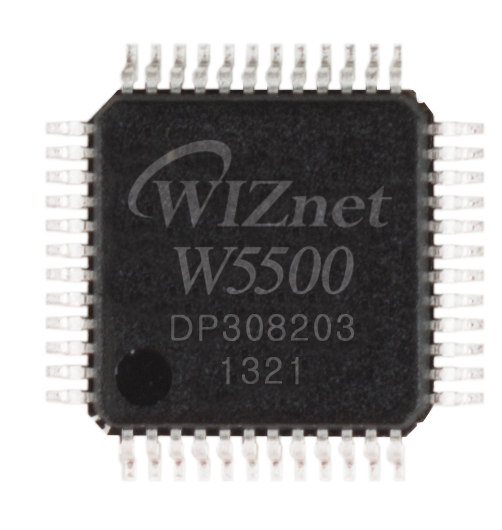
The W5500 is the product's network backbone. It is WIZnet's hardwired TCP/IP Ethernet chip with an integrated 10/100 MAC and PHY, which means the TCP/IP and UDP work runs in silicon on the W5500 rather than in a software stack on the STM32. That keeps the Cortex-M4 free for relay logic and sensor reads, and it is what lets a modest F411-class microcontroller present a robust, always-on network device.
What the product does
Each of the 16 relays provides one normally open contact switched at the supply voltage, rated 3 A per channel, with the whole board accepting a 16 to 30 V DC input over 2x16 fast-connect terminals. An ACS711 sensor measures total current consumption, and a 3.5 mm jack accepts a 1-Wire temperature sensor or other 1-Wire devices on the sensors variant. Control is a simple documented UDP protocol: ASCII-encoded frames such as FF0101 for relay 1 on, FFE000 for all relays off, FF0000 to read back the relay status word, and FFF000 or FFC000 to read temperature and current on the sensors model. The source code is published, so integrators can extend or adapt the protocol.
The deployment detail that stands out is the DIP switch for IP assignment. An installer can set each board's IP address on the hardware itself, without reflashing firmware or attaching a debugger, which matters when several boards go into one site. Combined with the screw-terminal wiring, the 16 to 30 V input range, and the metal-gear simplicity of UDP, the board is aimed at the space between hobby relay modules and full industrial PLCs: home and building projects, benches, labs, and light industrial control, and the maker also positions it as a learning platform for 32-bit embedded development.
Role of the WIZnet W5500
The W5500 gives the board its identity. It provides the RJ45 wired connection at 10/100 Mbit/s and runs the network protocol work on its own hardwired TCP/IP engine with eight independent hardware sockets and 32 KB of buffer memory. In this design the UDP command channel rides directly on the W5500's hardware socket handling, so the STM32 exchanges simple frames with the chip over SPI instead of maintaining a software network stack. For a mains-adjacent controller that people expect to respond every time, that division of labor is the practical argument for a hardwired Ethernet chip: fewer moving parts in firmware, deterministic network behavior, and a wired link that does not share Wi-Fi's failure modes.
Vendor, price, and availability
The board is designed and shipped from France by the Tindie seller eporutuf, whose small catalog also includes a watering electronics system and an electric scooter unlocker. Two variants are offered: the classic 16-relay board at 120 USD and a sensors version, adding the current and temperature readouts, at 160 USD. At the time of writing the listing shows stock on hand for both variants and 29 orders shipped, with worldwide shipping from France via La Poste. Purchase is direct through the Tindie product page, which also links the source code and specifications.
Value and limits
The value is a ready-made, wired, fleet-deployable relay controller with an open protocol and published source, at a price between commodity relay modules and industrial gear. The limits are equally clear. This is a small independent shop rather than an established brand, with a short public track record on Tindie. The controller speaks plain UDP rather than Modbus TCP or MQTT out of the box, so integration with SCADA or Home Assistant environments requires the published protocol or a firmware adaptation. And the product listing is undated, so it should be treated as an available product rather than a new launch.
FAQ
What does this board do? It is a 16-channel relay controller a computer drives over wired Ethernet. Simple UDP commands switch relays, read status, and on the sensors variant read total current and a 1-Wire temperature sensor.
Where is the WIZnet chip in the design? A W5500 provides the RJ45 connection and runs TCP/IP and UDP in hardware, with eight hardware sockets, so the STM32F411RE only exchanges command frames over SPI and never runs a software network stack.
Can I set the IP address without reflashing? Yes. A DIP switch on the board assigns the IP address in hardware, which makes multi-board deployments practical without touching firmware.
Who sells it and for how much? The Tindie seller eporutuf, shipping from France. 120 USD for the classic 16-relay board, 160 USD for the sensors variant with current and temperature measurement.